SMALL-FIELD FLYING
LIGHTWEIGHT COVERING MATERIAL
By Pat Trittle | patscustommodels@gmail.com

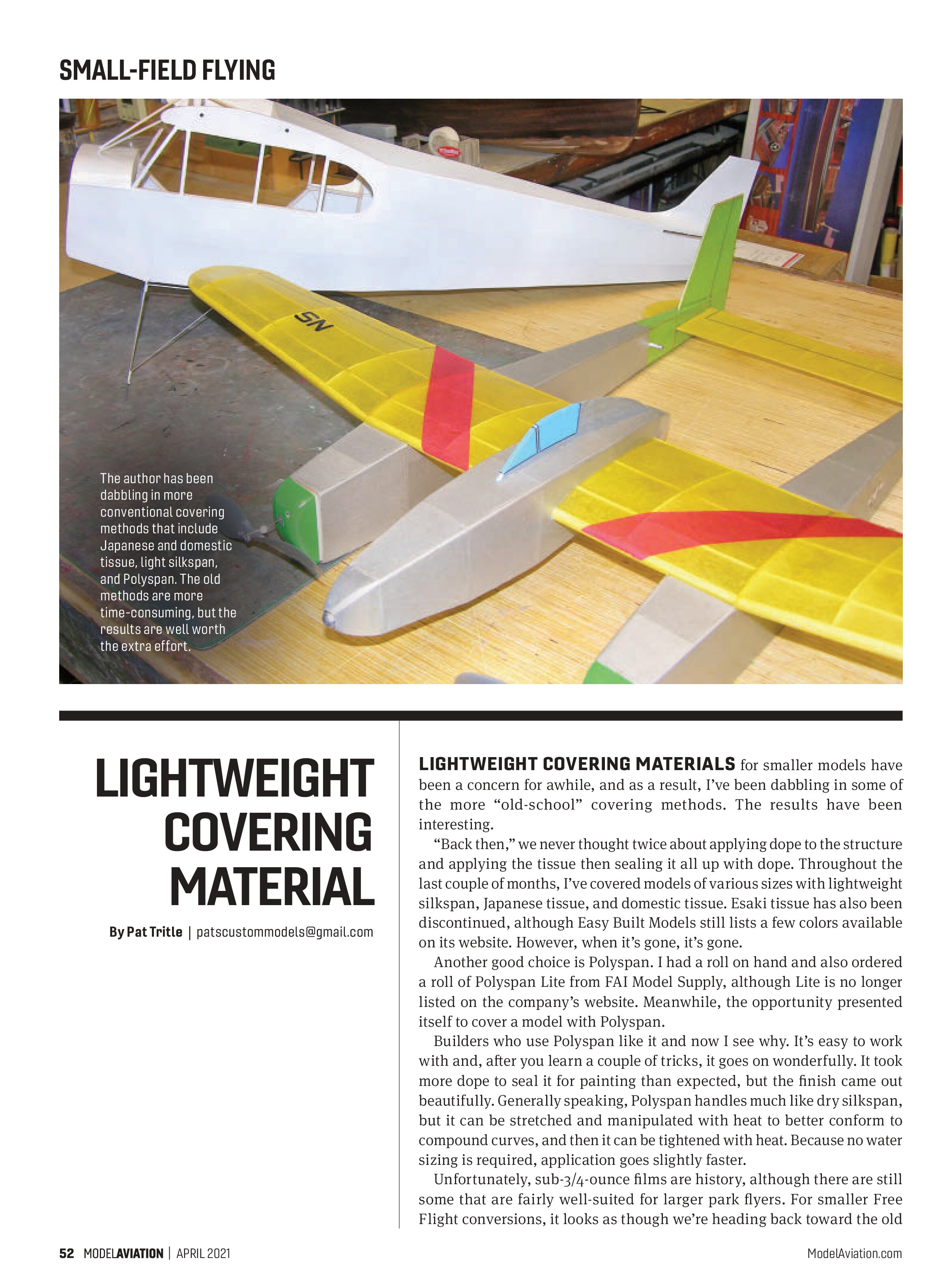
LIGHTWEIGHT COVERING MATERIALS for smaller models have been a concern for awhile, and as a result, I’ve been dabbling in some of the more “old-school” covering methods. The results have been interesting.
“Back then,” we never thought twice about applying dope to the structure and applying the tissue then sealing it all up with dope. Throughout the last couple of months, I’ve covered models of various sizes with lightweight silkspan, Japanese tissue, and domestic tissue. Esaki tissue has also been discontinued, although Easy Built Models still lists a few colors available on its website. However, when it’s gone, it’s gone.
Another good choice is Polyspan. I had a roll on hand and also ordered a roll of Polyspan Lite from FAI Model Supply, although Lite is no longer listed on the company’s website. Meanwhile, the opportunity presented itself to cover a model with Polyspan.
Builders who use Polyspan like it and now I see why. It’s easy to work with and, after you learn a couple of tricks, it goes on wonderfully. It took more dope to seal it for painting than expected, but the finish came out beautifully. Generally speaking, Polyspan handles much like dry silkspan, but it can be stretched and manipulated with heat to better conform to compound curves, and then it can be tightened with heat. Because no water sizing is required, application goes slightly faster.
Unfortunately, sub-3/4-ounce films are history, although there are still some that are fairly well-suited for larger park flyers. For smaller Free Flight conversions, it looks as though we’re heading back toward the old methods that we old-timers cut our teeth on.
Here’s the good news. After covering several models using Polyspan or tissue, I found that it’s still more time-consuming than the iron-on types were, but the results are worth the extra effort. The truth is, it’s been so long since I’ve done much in the way of traditional covering that I forgot just how nice it is working with silkspan, tissue, or Polyspan. I do miss the “quick-and-dirty” iron-on films, but getting back to the old ways has been a great experience.
Workstation
While I’m on the subject of building, a dedicated place to build is a must, and the size of what you’re building will determine the size and type of work area you’ll need.

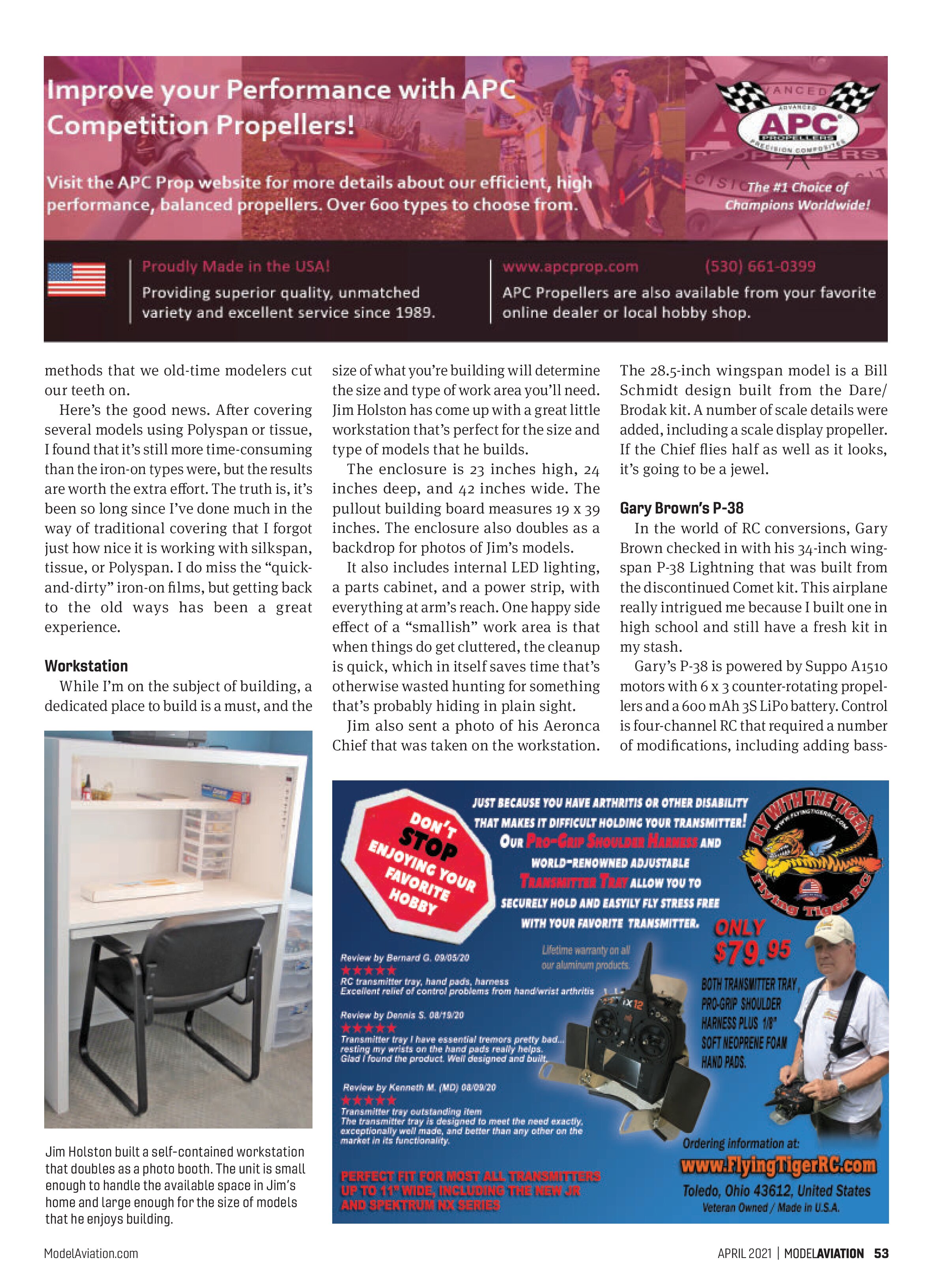
Jim Holston has come up with a great little workstation that’s perfect for the size and type of models that he builds.
The enclosure is 23 inches high, 24 inches deep, and 42 inches wide. The pullout building board measures 19 x 39 inches. The enclosure also doubles as a backdrop for photos of Jim’s models.
It also includes internal LED lighting, a parts cabinet, and a power strip, with everything at arm’s reach. One happy side effect of a “smallish” work area is that when things do get cluttered, the cleanup is quick, which in itself saves time that’s otherwise wasted hunting for something that’s probably hiding in plain sight.
Jim also sent a photo of his Aeronca Chief that was taken on the workstation.
Gary Brown’s P-38
In the world of RC conversions, Gary Brown checked in with his 34-inch wingspan P-38 Lightning that was built from the discontinued Comet kit. This airplane really intrigued me because I built one in high school and still have a fresh kit in my stash.
Gary’s P-38 is powered by Suppo A1510 motors with 6 x 3 counter-rotating propellers and a 600 mAh 3S LiPo battery. Control is four-channel RC that required a number of modifications, including adding bass-
wood wing and stabilizer spars. The model is covered with lightweight film, and the all-up weight tips the scales at 11.3 ounces without the battery. So far, the P-38 has logged more than 80 missions and is a smooth and steady flyer.

Jim built the Schmidt-designed Aeronca Chief in his building workstation then used it to photograph the finished model. That’s what the author calls making good use of limited available space.

Joseph Lemieux built his Gee Bee Model D from a PCM short kit that is available from Manzano Laser Works. Joseph enjoys a spirited flyer.

Gee Bee Model D
Joseph Lemieux also checked in with his 32-inch wingspan Gee Bee Model D. The model was built from the PCM short kit that is available from Manzano Laser Works.
The Gee Bee is covered with cream-colored ParkLite with painted blue trim, hand-cut red striping, and graphics from Callie Graphics. Joseph’s Gee Bee is powered by a Turnigy T-2730-1300 outrunner motor with a 12-amp ESC. Four-channel guidance is by way of Hextronics servos and an Orange receiver. The model will fly on either a 2S or 3S LiPo battery, but Joseph, at the tender age of 71, still prefers the more-spirited performance of the 3S setup.
I’m running out of space again, so I’ll cut it off for now. I’m glad to have had the opportunity to try some alternative covering materials and share the results, as abbreviated as they might be. Sadly, the days of ultralight iron-on films have given way to obscurity, although modelers still have plenty of options. Personally, I’m having a great time moving back toward more traditional ways of modeling and will press on regardless of what comes or goes.
I want to thank all who came onboard this month with some terrific modeling projects. Seeing your innovative ways and what you’ve created always puts a smile on my face. With that, I’ll offer a heartfelt “well done” to each of you.
Until next time, keep the sawdust flying and the good stuff coming.
SOURCES:
Brodak Manufacturing & Distributing Company, Inc.
(724) 966-2726
www.brodak.com
Callie Graphics
info@callie-graphics.com
www.callie-graphics.com
Easy Built Models
(334) 358-5184
www.easybuiltmodels.com
Manzano Laser Works
tomj@manzanolaser.com
www.manzanolaser.com