SKY’S THE LIMIT

PROJECTS GALORE!
By Jennifer Reynolds | jensunshine3@gmail.com
I’VE OFTEN SAID that I’m more of a flier than a builder. I’ve painted rivets on airplanes, screwed in bolts, and dabbled in assembling ARFs, but I’d much rather just get right to it. That’s just me. Nothing against building—I simply prefer to cut to the chase and fly.
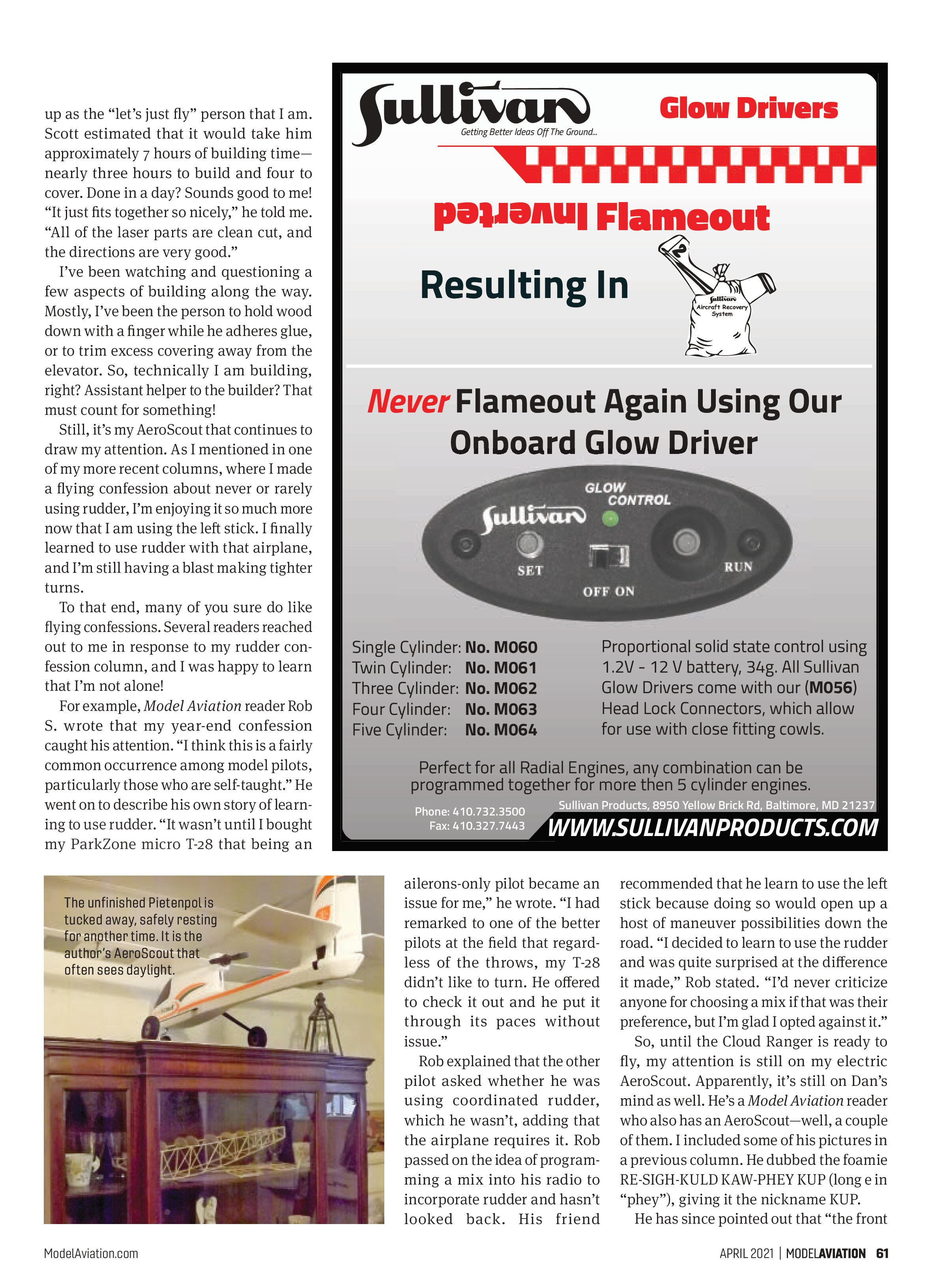
A case in point is my Pietenpol that I wrote about a few columns back. Granted, it was a lofty goal to take on as a first-time build. It was a small airplane that ended with me splitting wood with every tack.
Many of you emailed me with suggestions for handling splitting wood, and some of you even recommended that I start with something slightly less intimidating for a first build. Well, my husband, Scott, even got in on it. Long story short, the Pietenpol still sits on the sidelines, reserved for “someday.” That’s all right. These things happen.
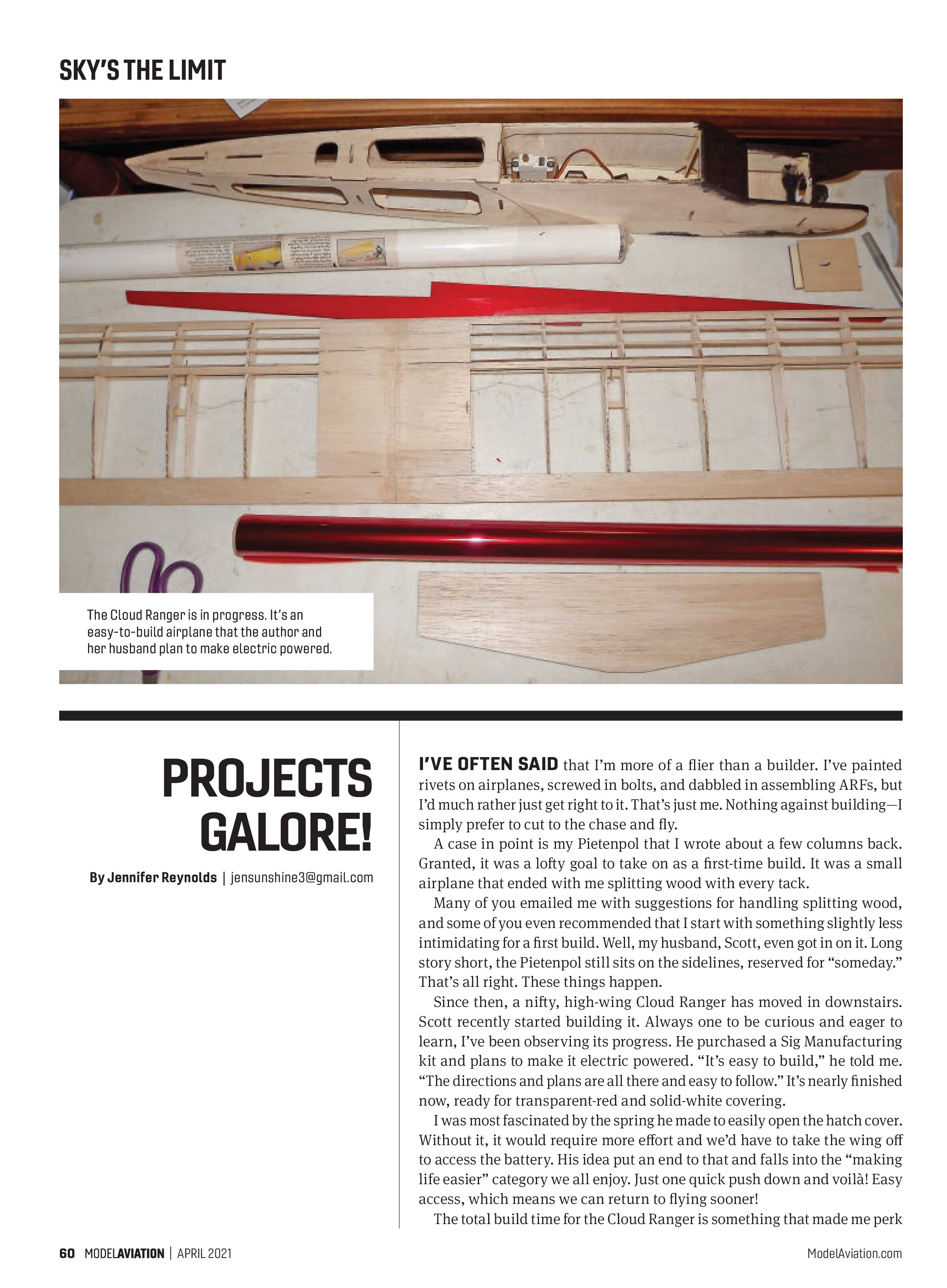
Since then, a nifty, high-wing Cloud Ranger has moved in downstairs. Scott recently started building it. Always one to be curious and eager to learn, I’ve been observing its progress. He purchased a Sig Manufacturing kit and plans to make it electric powered. “It’s easy to build,” he told me. “The directions and plans are all there and easy to follow.” It’s nearly finished now, ready for transparent-red and solid-white covering.
I was most fascinated by the spring he made to easily open the hatch cover. Without it, it would require more effort and we’d have to take the wing off to access the battery. His idea put an end to that and falls into the “making life easier” category we all enjoy. Just one quick push down and voilà! Easy access, which means we can return to flying sooner!
The total build time for the Cloud Ranger is something that made me perk up as the “let’s just fly” person that I am. Scott estimated that it would take him approximately 7 hours of building time—nearly three hours to build and four to cover. Done in a day? Sounds good to me! “It just fits together so nicely,” he told me. “All of the laser parts are clean cut, and the directions are very good.”
I’ve been watching and questioning a few aspects of building along the way. Mostly, I’ve been the person to hold wood down with a finger while he adheres glue, or to trim excess covering away from the elevator. So, technically I am building, right? Assistant helper to the builder? That must count for something!
Still, it’s my AeroScout that continues to draw my attention. As I mentioned in one of my more recent columns, where I made a flying confession about never or rarely using rudder, I’m enjoying it so much more now that I am using the left stick. I finally learned to use rudder with that airplane, and I’m still having a blast making tighter turns.
To that end, many of you sure do like flying confessions. Several readers reached out to me in response to my rudder confession column, and I was happy to learn that I’m not alone!
For example, Model Aviation reader Rob S. wrote that my year-end confession caught his attention. “I think this is a fairly common occurrence among model pilots, particularly those who are self-taught.” He went on to describe his own story of learning to use rudder. “It wasn’t until I bought my ParkZone micro T-28 that being an
ailerons-only pilot became an issue for me,” he wrote. “I had remarked to one of the better pilots at the field that regardless of the throws, my T-28 didn’t like to turn. He offered to check it out and he put it through its paces without issue.”
Rob explained that the other pilot asked whether he was using coordinated rudder, which he wasn’t, adding that the airplane requires it. Rob passed on the idea of programming a mix into his radio to incorporate rudder and hasn’t looked back. His friend recommended that he learn to use the left stick because doing so would open up a host of maneuver possibilities down the road. “I decided to learn to use the rudder and was quite surprised at the difference it made,” Rob stated. “I’d never criticize anyone for choosing a mix if that was their preference, but I’m glad I opted against it.”
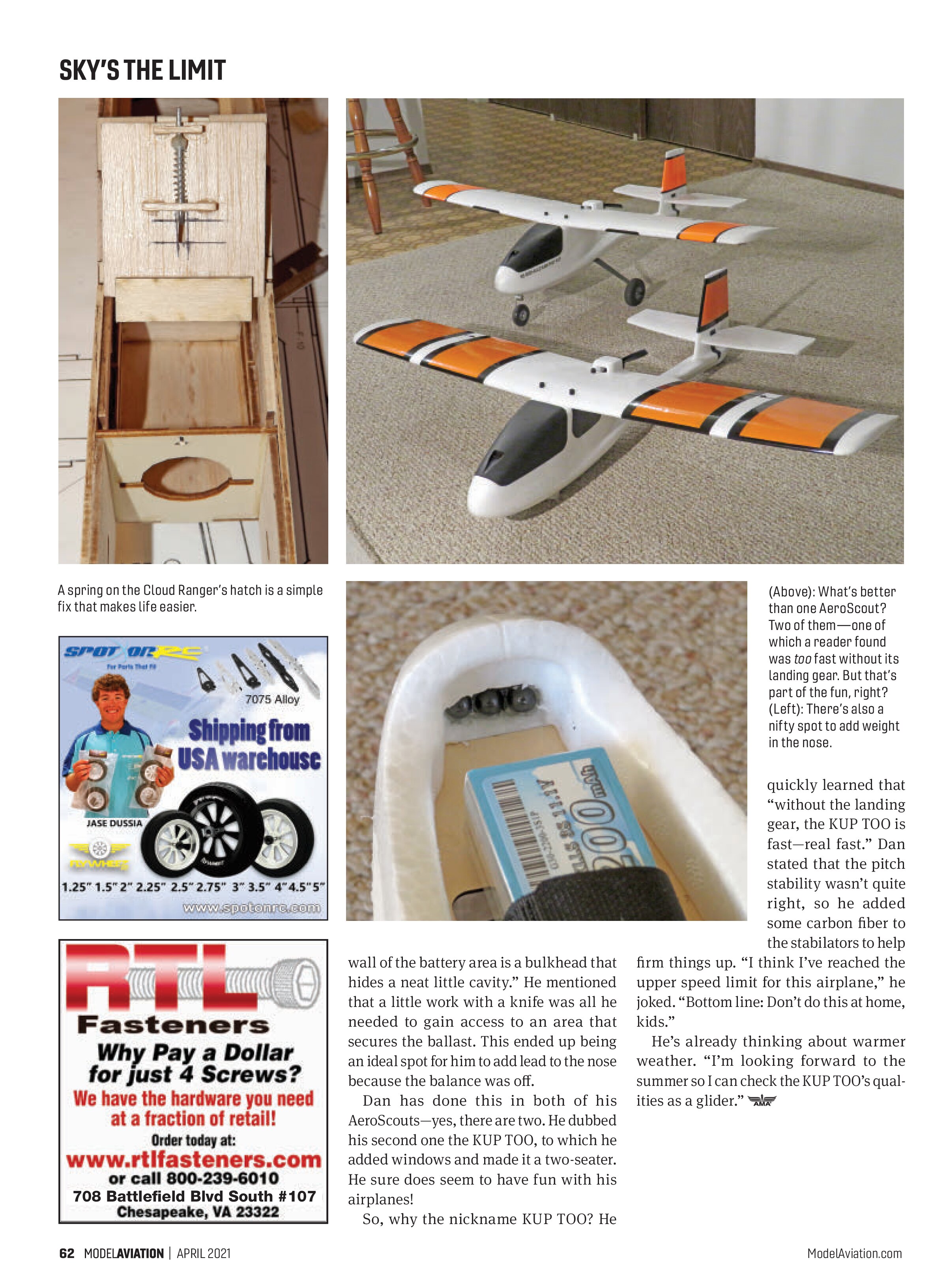
So, until the Cloud Ranger is ready to fly, my attention is still on my electric AeroScout. Apparently, it’s still on Dan’s mind as well. He’s a Model Aviation reader who also has an AeroScout—well, a couple of them. I included some of his pictures in a previous column. He dubbed the foamie RE-SIGH-KULD KAW-PHEY KUP (long e in “phey”), giving it the nickname KUP.
He has since pointed out that “the front


wall of the battery area is a bulkhead that hides a neat little cavity.” He mentioned that a little work with a knife was all he needed to gain access to an area that secures the ballast. This ended up being an ideal spot for him to add lead to the nose because the balance was off.
Dan has done this in both of his AeroScouts—yes, there are two. He dubbed his second one the KUP TOO, to which he added windows and made it a two-seater. He sure does seem to have fun with his airplanes!
So, why the nickname KUP TOO? He quickly learned that “without the landing gear, the KUP TOO is fast—real fast.” Dan stated that the pitch stability wasn’t quite right, so he added some carbon fiber to the stabilators to help firm things up. “I think I’ve reached the upper speed limit for this airplane,” he joked. “Bottom line: Don’t do this at home, kids.”
He’s already thinking about warmer weather. “I’m looking forward to the summer so I can check the KUP TOO’s qualities as a glider.”