RC SLOPE SOARING

SLOPE
SOARING?
WHAT?
WHERE?
By Greg Schutte | gshooty@yahoo.com
WHAT IS SLOPE SOARING? I am asked that question from people when they find out that I fly RC airplanes. Where I am or what I am doing dictates my answer. After our conversation, they usually tell me that they had no idea that Slope Soaring was part of the RC airplane hobby.
Most people associate RC airplanes with the conventional propeller-driven types. When you say glider, they instantly think of a sleek, white, skinny-wing aircraft that has no power and only a short flight time. I usually end up breaking down the different types of airplanes that are in the Slope Soaring category.
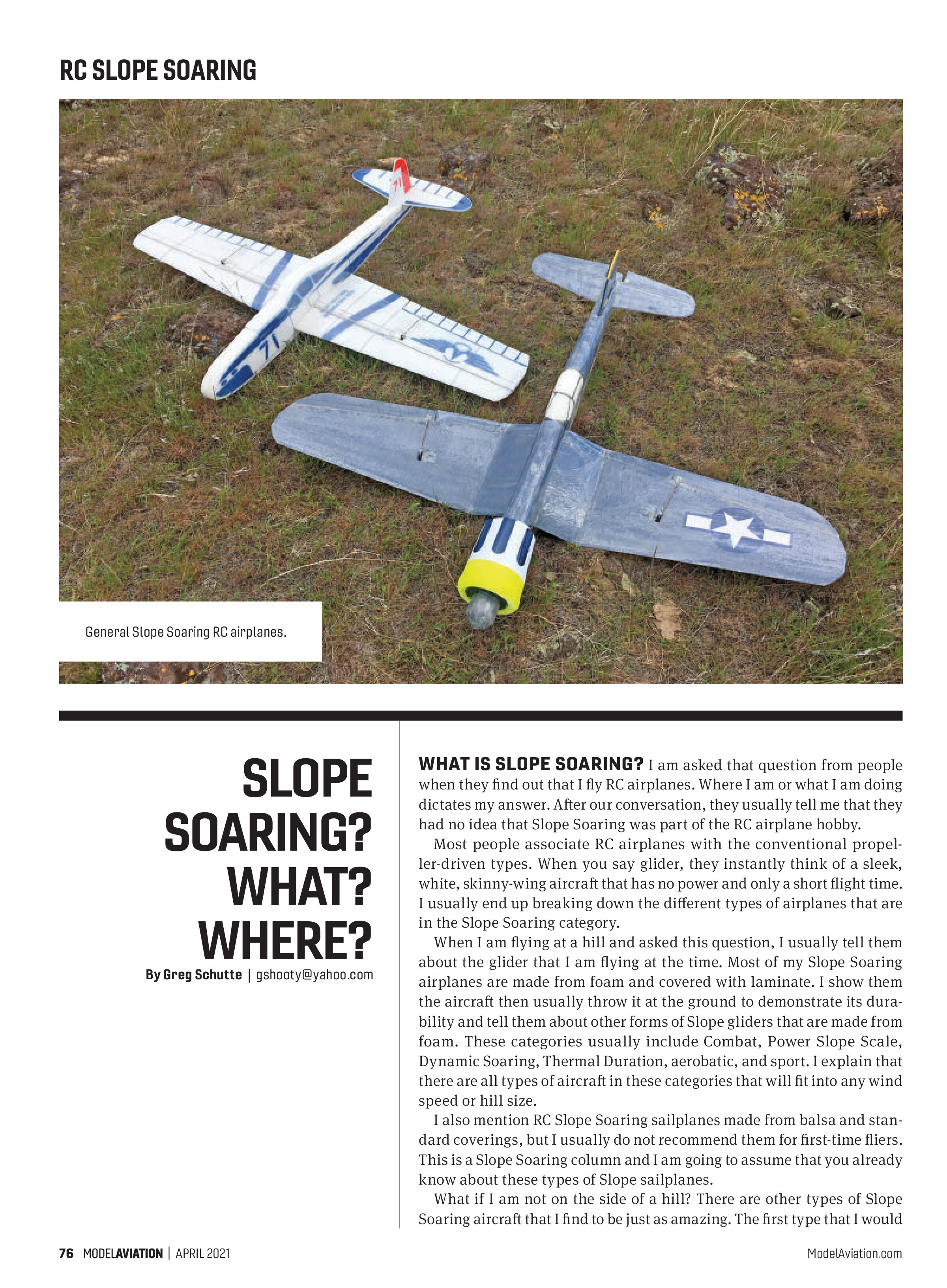
When I am flying at a hill and asked this question, I usually tell them about the glider that I am flying at the time. Most of my Slope Soaring airplanes are made from foam and covered with laminate. I show them the aircraft then usually throw it at the ground to demonstrate its durability and tell them about other forms of Slope gliders that are made from foam. These categories usually include Combat, Power Slope Scale, Dynamic Soaring, Thermal Duration, aerobatic, and sport. I explain that there are all types of aircraft in these categories that will fit into any wind speed or hill size.
I also mention RC Slope Soaring sailplanes made from balsa and standard coverings, but I usually do not recommend them for first-time fliers. This is a Slope Soaring column and I am going to assume that you already know about these types of Slope sailplanes.
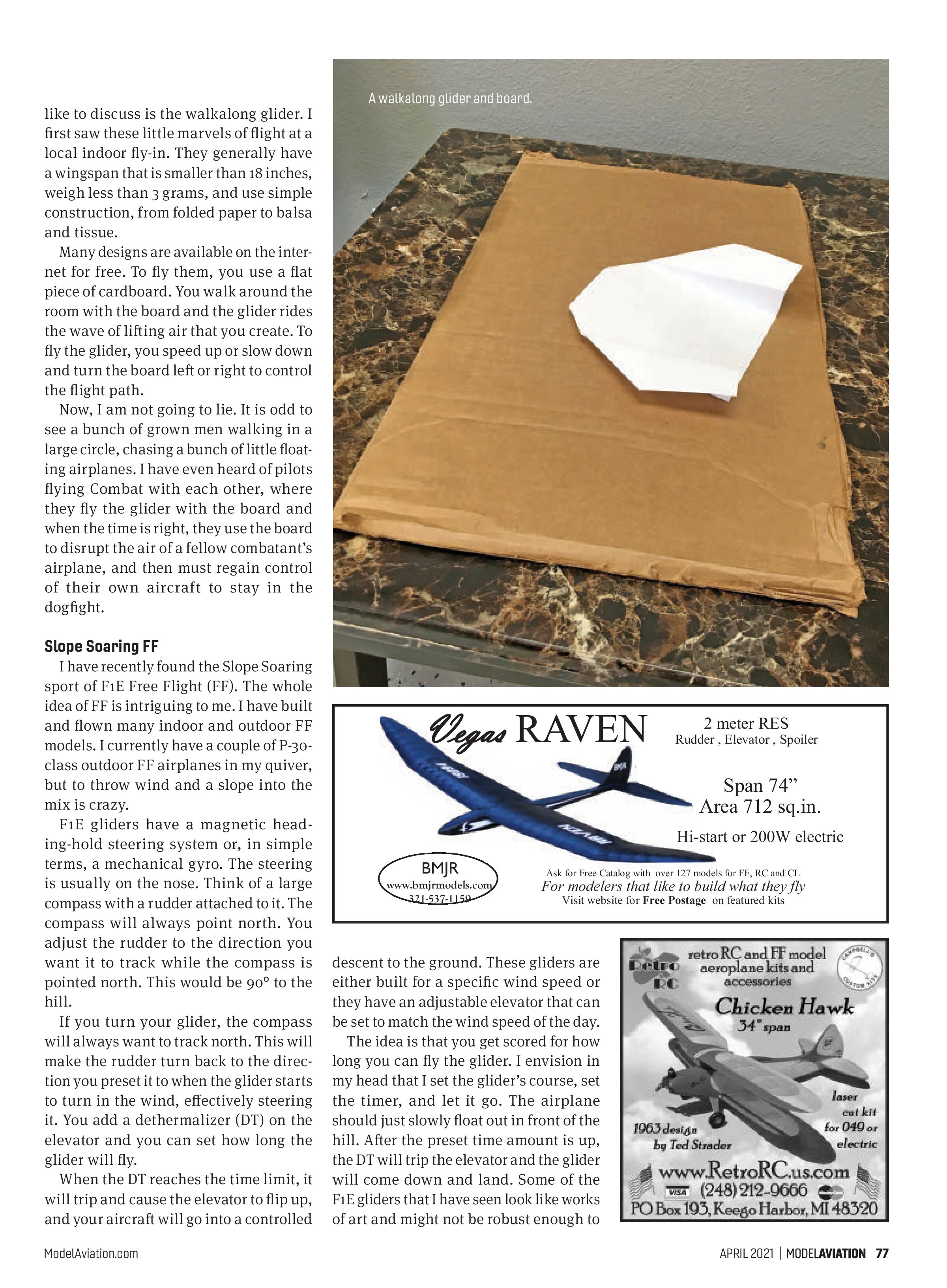
What if I am not on the side of a hill? There are other types of Slope Soaring aircraft that I find to be just as amazing. The first type that I would like to discuss is the walkalong glider. I first saw these little marvels of flight at a local indoor fly-in. They generally have a wingspan that is smaller than 18 inches, weigh less than 3 grams, and use simple construction, from folded paper to balsa and tissue.
Many designs are available on the internet for free. To fly them, you use a flat piece of cardboard. You walk around the room with the board and the glider rides the wave of lifting air that you create. To fly the glider, you speed up or slow down and turn the board left or right to control the flight path.
Now, I am not going to lie. It is odd to see a bunch of grown men walking in a large circle, chasing a bunch of little floating airplanes. I have even heard of pilots flying Combat with each other, where they fly the glider with the board and when the time is right, they use the board to disrupt the air of a fellow combatant’s airplane, and then must regain control of their own aircraft to stay in the dogfight.
Slope Soaring FF
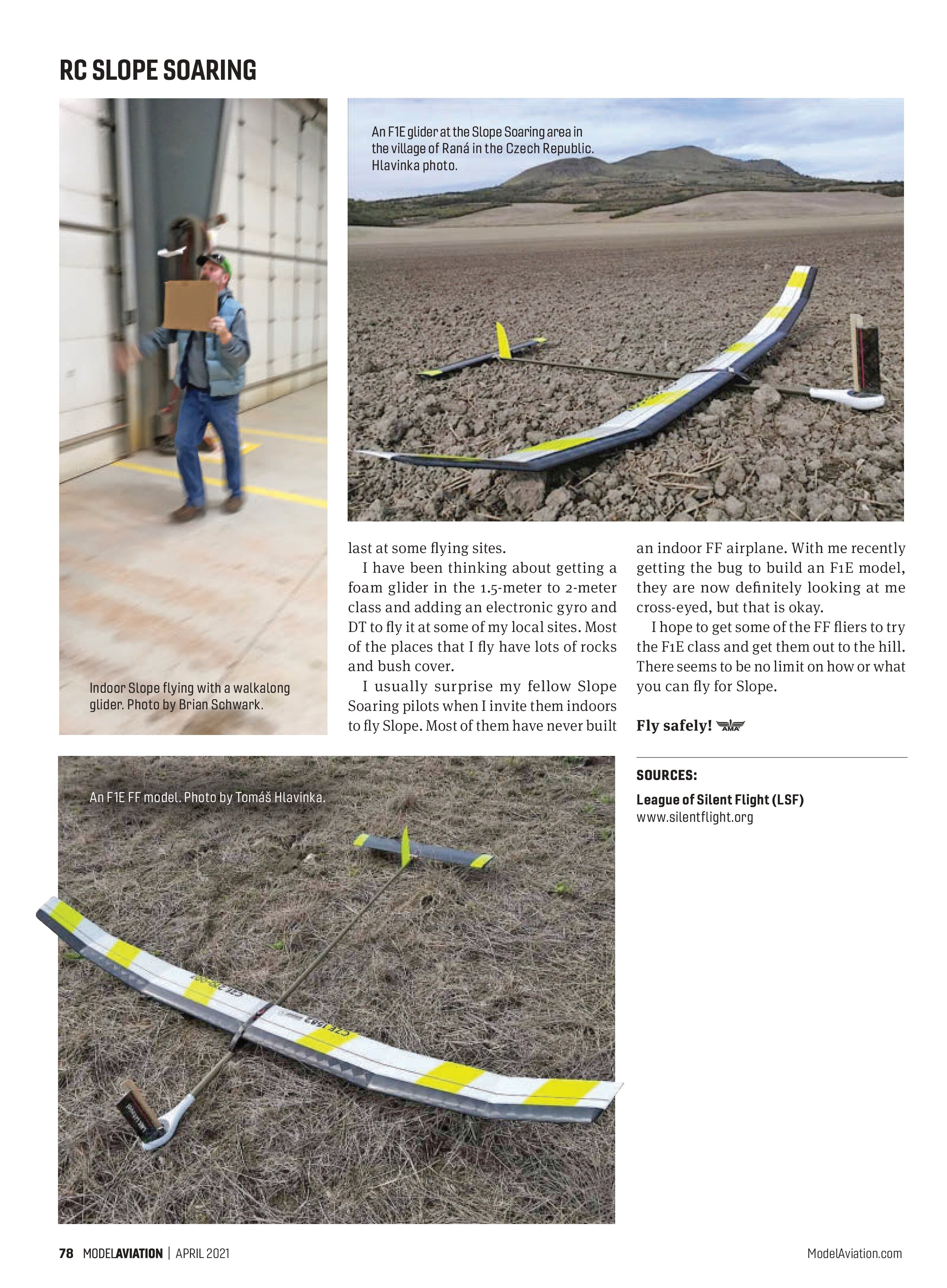
I have recently found the Slope Soaring sport of F1E Free Flight (FF). The whole idea of FF is intriguing to me. I have built and flown many indoor and outdoor FF models. I currently have a couple of P-30-class outdoor FF airplanes in my quiver, but to throw wind and a slope into the mix is crazy.
F1E gliders have a magnetic heading-hold steering system or, in simple terms, a mechanical gyro. The steering is usually on the nose. Think of a large compass with a rudder attached to it. The compass will always point north. You adjust the rudder to the direction you want it to track while the compass is pointed north. This would be 90° to the hill.
If you turn your glider, the compass will always want to track north. This will make the rudder turn back to the direction you preset it to when the glider starts to turn in the wind, effectively steering it. You add a dethermalizer (DT) on the elevator and you can set how long the glider will fly.
When the DT reaches the time limit, it will trip and cause the elevator to flip up, and your aircraft will go into a controlled

descent to the ground. These gliders are either built for a specific wind speed or they have an adjustable elevator that can be set to match the wind speed of the day.
The idea is that you get scored for how long you can fly the glider. I envision in my head that I set the glider’s course, set the timer, and let it go. The airplane should just slowly float out in front of the hill. After the preset time amount is up, the DT will trip the elevator and the glider will come down and land. Some of the F1E gliders that I have seen look like works of art and might not be robust enough to


last at some flying sites.
I have been thinking about getting a foam glider in the 1.5-meter to 2-meter class and adding an electronic gyro and DT to fly it at some of my local sites. Most of the places that I fly have lots of rocks and bush cover.
I usually surprise my fellow Slope Soaring pilots when I invite them indoors to fly Slope. Most of them have never built

an indoor FF airplane. With me recently getting the bug to build an F1E model, they are now definitely looking at me cross-eyed, but that is okay.
I hope to get some of the FF fliers to try the F1E class and get them out to the hill. There seems to be no limit on how or what you can fly for Slope.
Fly safely!
SOURCES:
League of Silent Flight (LSF)
www.silentflight.org