OLD-TIMERS

READING VS. FLYING
By Bob Angel
samrcflier@verizon.net
LIKE MANY OF YOU, I continue to fly less and read more about it. We’re making history every day, but history only becomes interesting after a certain time lapse. That’s one of several good reasons to forget 2020 and look back a little further.
A friend alerted me to an interesting autobiography from the AMA Model Aviation Hall of Fame, which led me to peruse other biographies there as well. I occasionally do a brief biographical sketch to link a name to some of our modeling history. I always consult available AMA biographies and reference them in “Sources” to round out the sketch.
Walter Musciano
There’s no way I could do justice to what Walter Musciano (1922-2019) wrote about his life and modeling. Instead, I’ll treat his 16-page autobiography as though it were a short novel, which I suggest as recommended reading.
Walter was fascinated by model aircraft at an early age, but he was also orphaned at a young age. There were numerous setbacks throughout his life, but in each case, he credited his love of model building with helping him through the tough times. Despite numerous obstacles, he became well educated and had a highly successful career in industry, model designing, and writing.
His straightforward narration describes details of his models and flying adventures, mixed in with personal difficulties that he endured. His story illustrates how adversity can sometimes make a person stronger.
Fred Mulholland (1929-2020)
It so happens that the autobiography of Fred Mulholland appears immediately above that of Walter in the AMA Model Aviation Hall of Fame biography listings. If I listed every Society of Antique Modelers (SAM) member as he or she made that final thermal, there’d be room here for little else. However, because Fred was a well-known SAM flier who recently passed away, I was drawn to his autobiography.
Fred’s presentation is different from Walter’s and reads more like a sketch from an action-packed movie. His long list of accomplishments and honors left little space for detailed descriptions of his personal life. He stayed so busy that I had to sit down and rest after reading it!
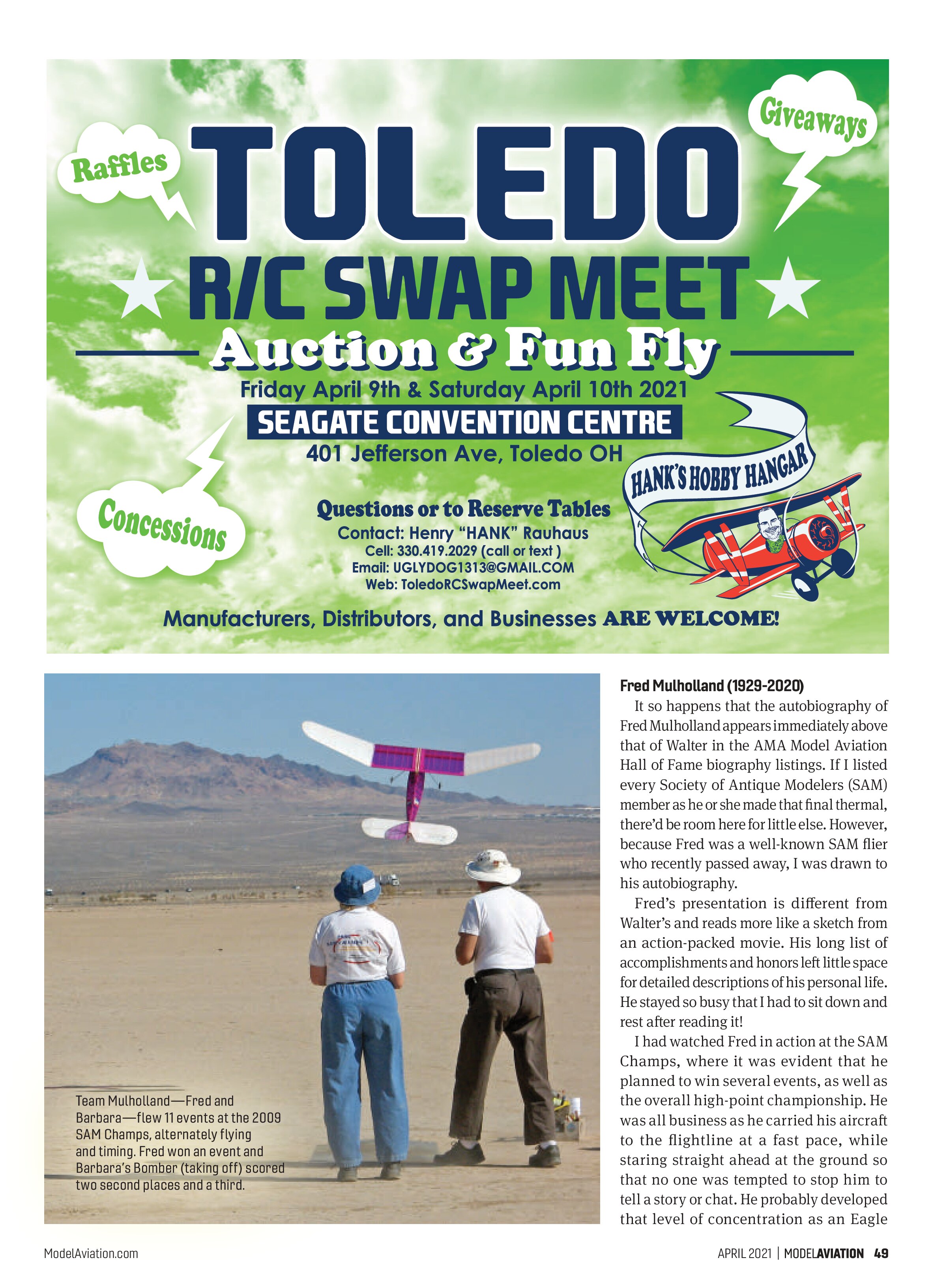
I had watched Fred in action at the SAM Champs, where it was evident that he planned to win several events, as well as the overall high-point championship. He was all business as he carried his aircraft to the flightline at a fast pace, while staring straight ahead at the ground so that no one was tempted to stop him to tell a story or chat. He probably developed

Scout and later as a U.S. Army Green Beret.
When Fred wasn’t pursuing competition, he was equally intent on whatever activity he was engaged in at the moment. One year, he set aside his SAM Champs competition ambitions to crew for his wife, Barbara, who won an overall SAM high-point championship. She was the first woman to accomplish that goal and she continues to be a strong contest competitor.
Some of Fred’s other activities included organizing many model clubs, contest directing, constructing displays for modeling and other museums, running marathons, and developing Florida’s hiking trails.
Gardening was also mentioned, which I presumed was to relax, until I saw that his yard won the first-place landscape award from the Florida Native Plant Society.
Spark Plug Tech Tips
I occasionally need to toss in a technical tip for any newly aspiring Old-Timer fliers. Spark plugs for our antique engines come in two basic thread sizes. The smaller 1/4-inch x 32 threads per inch (TPI) is the most common and found on the newer of our “old” engines, as well as on today’s glow plugs. The 32 TPI is an extra-fine thread pitch that is often mistaken for the common 1/4-inch x 28 TPI thread. Keep that fact in mind or

you might mess up an engine, a plug, or both.
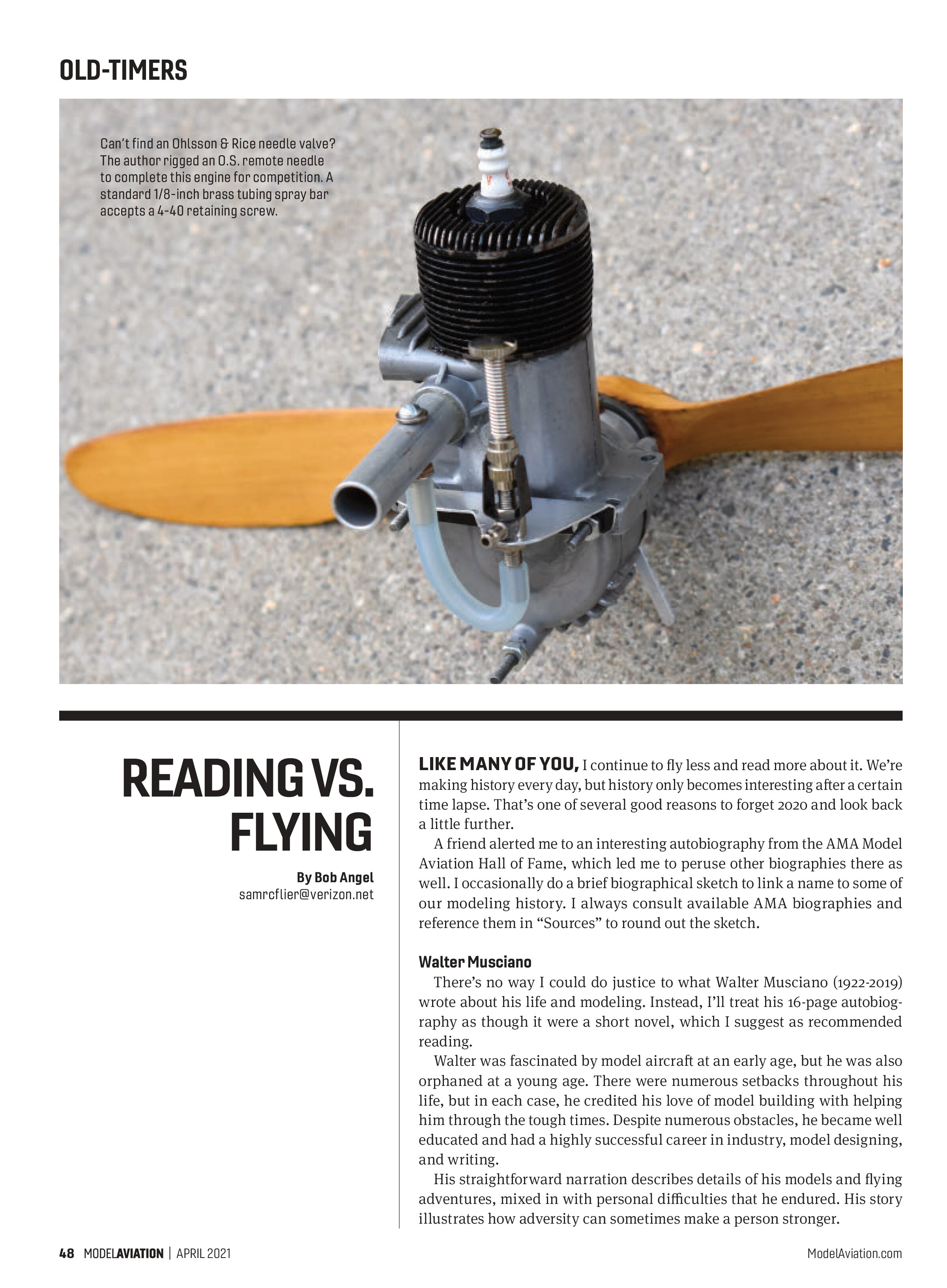
Larger 3/8-inch x 24 TPI plugs are found on many of the older and larger (.60-size) engines, such as Brown Juniors, Ohlsson & Rices, and OKs. The Champion Spark Plug company produced and sold most model plugs in both thread sizes and is the brand you’ll most likely find when you obtain an old engine. Champion even made glow plugs before getting out of the model spark plug business.
Besides Champion, there were many other model spark plug makers, such as Autolite, AC, and Blue Crown, others from overseas, and still others that carried the engine brand itself.
Odds are also fair that when you acquire an old engine, it might come without a plug. That situation intensified a few years back when a few sellers began withholding plugs, creating an illusory shortage. I’m convinced that there are enough original plugs still in collections to supply each old engine, plus spares for running them for years to come. Perhaps the Model Engine Collectors Association (MECA) should require engines that are offered without plugs to be listed as incomplete.
Fortunately, modern spark plugs that are currently manufactured are usually superior to the antique ones. My engines are happy running the RimFire brand, on which the white ceramic is unmarked but is easily identified by its side electrode that is machined as an integral part of the steel body, as opposed to being welded on. NGK ME-8 plugs are also good 1/4-inch spark plugs. Although they are not currently being manufactured, there are many ME-8s still around. Someone also makes Champion reproductions with, I believe, approval from Champion. They simply say “Champion” on the ceramic, with no further identification, unlike the originals.
Many small garden tools and “gassie” model engines are supplied with 10mm metric NGK CM-6 plugs. They are readily available and generally inexpensive, so some have found that they could rethread those to 3/8-inch x 24 TPI size—but it’s not a job for an amateur machinist.
It’s first necessary to reduce the thread diameter to approximately .370 inch. Ideally, you then need a large lathe with a tailstock chuck that will accept the almost 9/16 hex flats of the spark plug and a headstock to accept the (usually) 1-inch flats of a hexagonal die in order to keep the threads straight.
The next problem is that the spark plug has a longer reach into the cylinder, which will require a washer that’s approximately 1/8 inch thick, or a stack of smaller washers to hopefully seal compression without the piston hitting the plug.
There’s little economic benefit to this conversion, but there is still a plus. The converted spark plug has a roomier inside, which reduces compression by a generally insignificant amount, but it will not “carbon up” the ceramic or “wet out” with fuel as easily, which makes it easier to hand start.
Cleaning carbon deposits from model spark plugs lies between difficult and impossible. Fortunately, with today’s higher-voltage ignition systems, the plugs last much longer. Members of my local flying group have noticed that alcohol/synthetic fuel blends produce much less carbon than the old 3:1 mix of white gasoline and 70W oil.
SOURCES:
League of Silent Flight (LSF)
www.silentflight.org
Google Earth
www.google.com/earth
AMA Model Aviation Hall of Fame
www.modelaircraft.org/museum/history-recognition/ama-model-aviation-hall...
The AMA History Project Presents:
Autobiography of Fred W. Mulholland
www.modelaircraft.org/sites/default/files/MulhollandFredW.pdf
The AMA History Project Presents:
Autobiography of Walter (Walt) A. Musciano
www.modelaircraft.org/sites/default/files/MuscianoWalterAWalt.pdf
Model Spark Plugs From Larry Davidson
samchamp@jetbroadband.com