FREE FLIGHT GLIDERS
By Don DeLoach | dde loach@comcast.net


SINCE THE EARLY DAYS of model aviation, simple gliders have been the natural starting point for most beginner Free Flight (FF) fliers. Gliders remain a great place to start today. Thousands of plans exist, dating back nearly a century, and many glider kits are available in the $5 to $50 range, producing nice-flying models and teaching much about flight trimming in the process.
Catapult Gliders
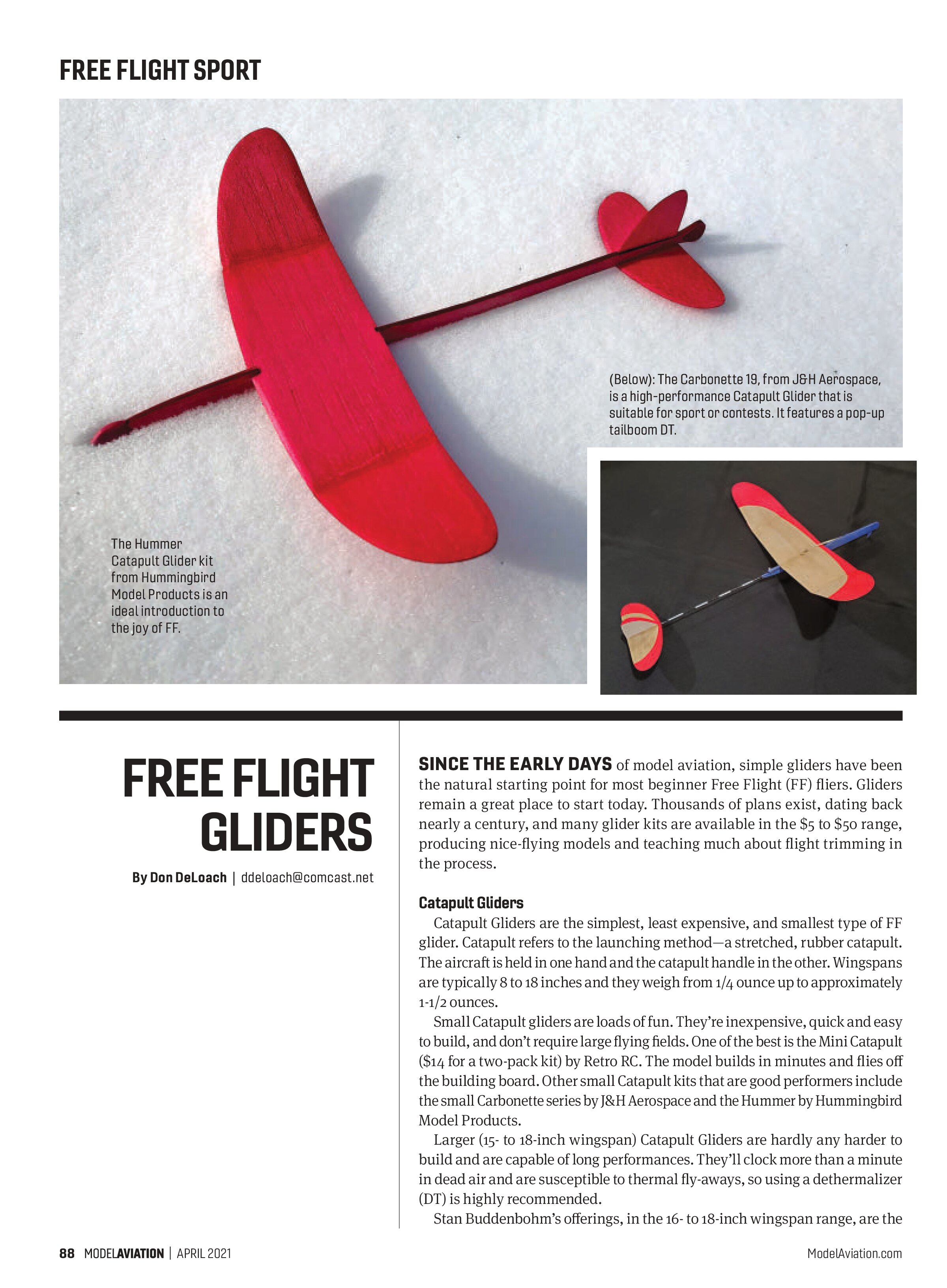
Catapult Gliders are the simplest, least expensive, and smallest type of FF glider. Catapult refers to the launching method—a stretched, rubber catapult. The aircraft is held in one hand and the catapult handle in the other. Wingspans are typically 8 to 18 inches and they weigh from 1/4 ounce up to approximately 1-1/2 ounces.
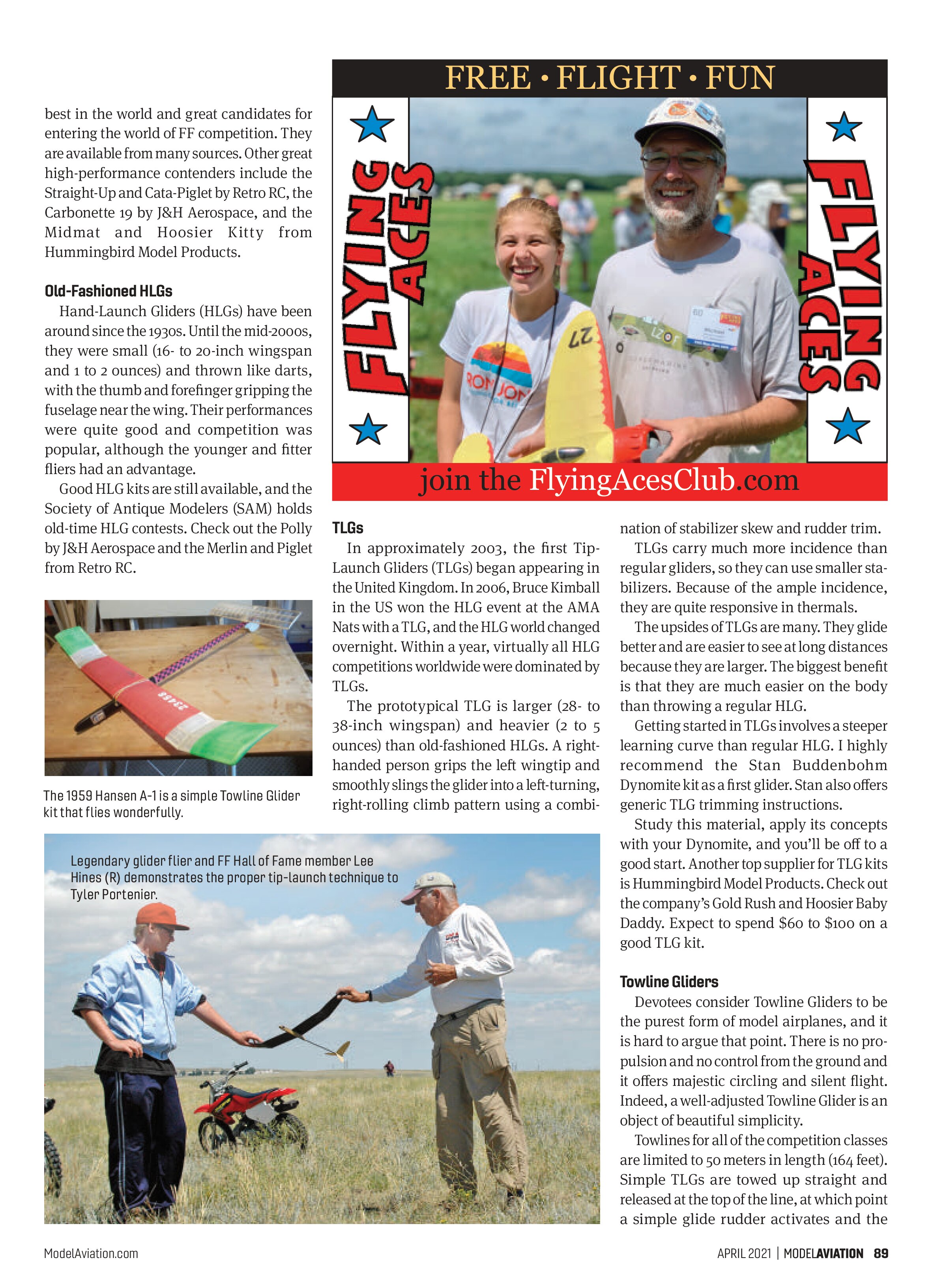
Small Catapult gliders are loads of fun. They’re inexpensive, quick and easy to build, and don’t require large flying fields. One of the best is the Mini Catapult ($14 for a two-pack kit) by Retro RC. The model builds in minutes and flies off the building board. Other small Catapult kits that are good performers include the small Carbonette series by J&H Aerospace and the Hummer by Hummingbird Model Products.
Larger (15- to 18-inch wingspan) Catapult Gliders are hardly any harder to build and are capable of long performances. They’ll clock more than a minute in dead air and are susceptible to thermal fly-aways, so using a dethermalizer (DT) is highly recommended.
Stan Buddenbohm’s offerings, in the 16- to 18-inch wingspan range, are the best in the world and great candidates for entering the world of FF competition. They are available from many sources. Other great high-performance contenders include the Straight-Up and Cata-Piglet by Retro RC, the Carbonette 19 by J&H Aerospace, and the Midmat and Hoosier Kitty from Hummingbird Model Products.
Old-Fashioned HLGs
Hand-Launch Gliders (HLGs) have been around since the 1930s. Until the mid-2000s, they were small (16- to 20-inch wingspan and 1 to 2 ounces) and thrown like darts, with the thumb and forefinger gripping the fuselage near the wing. Their performances were quite good and competition was popular, although the younger and fitter fliers had an advantage.
Good HLG kits are still available, and the Society of Antique Modelers (SAM) holds old-time HLG contests. Check out the Polly by J&H Aerospace and the Merlin and Piglet from Retro RC.

TLGs
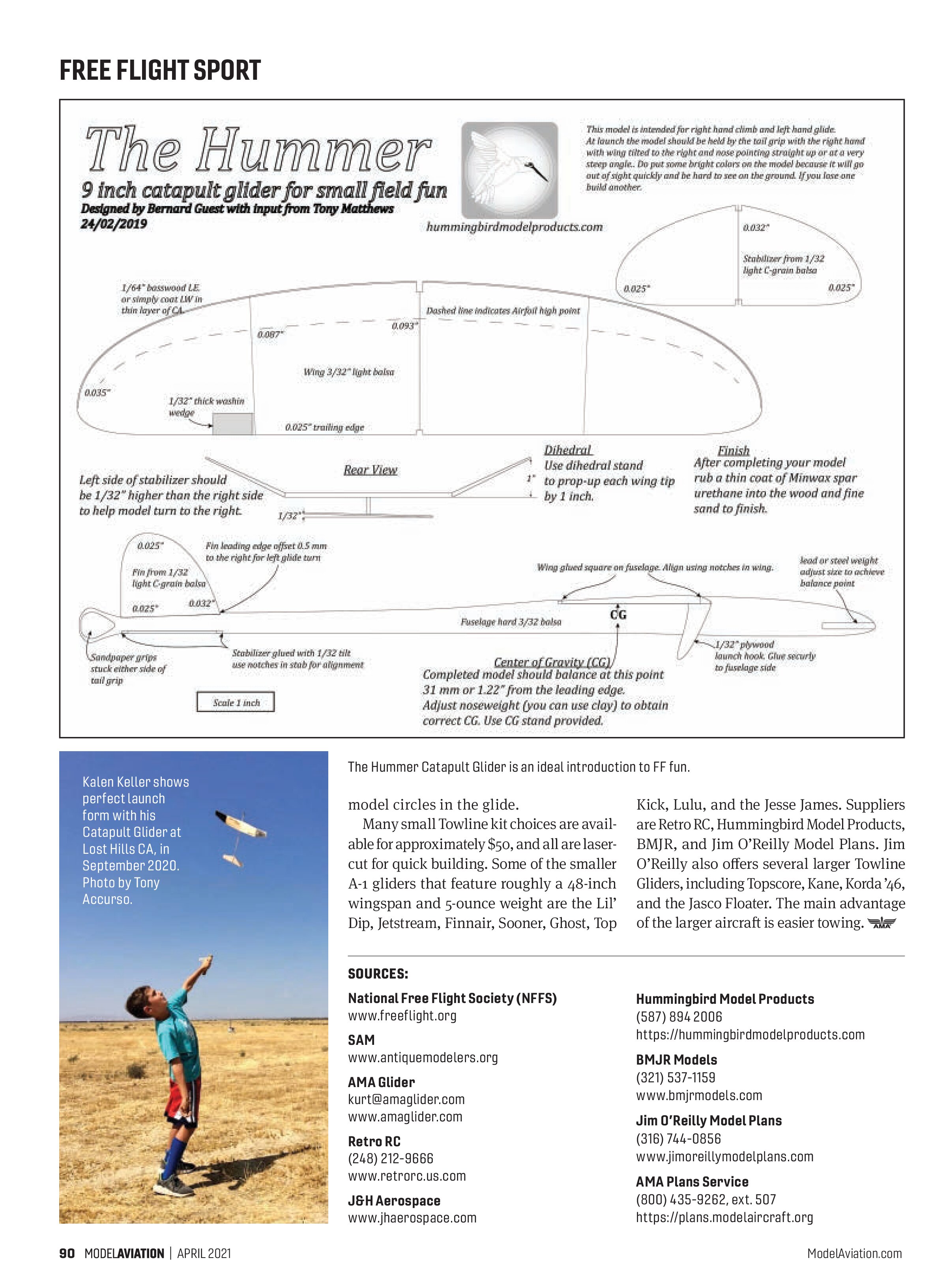
In approximately 2003, the first Tip-Launch Gliders (TLGs) began appearing in the United Kingdom. In 2006, Bruce Kimball in the US won the HLG event at the AMA Nats with a TLG, and the HLG world changed overnight. Within a year, virtually all HLG competitions worldwide were dominated by TLGs.
The prototypical TLG is larger (28- to 38-inch wingspan) and heavier (2 to 5 ounces) than old-fashioned HLGs. A right-handed person grips the left wingtip and smoothly slings the glider into a left-turning, right-rolling climb pattern using a combination of stabilizer skew and rudder trim.
TLGs carry much more incidence than regular gliders, so they can use smaller stabilizers. Because of the ample incidence, they are quite responsive in thermals.
The upsides of TLGs are many. They glide better and are easier to see at long distances because they are larger. The biggest benefit is that they are much easier on the body than throwing a regular HLG.
Getting started in TLGs involves a steeper learning curve than regular HLG. I highly recommend the Stan Buddenbohm Dynomite kit as a first glider. Stan also offers generic TLG trimming instructions.
Study this material, apply its concepts with your Dynomite, and you’ll be off to a good start. Another top supplier for TLG kits is Hummingbird Model Products. Check out the company’s Gold Rush and Hoosier Baby Daddy. Expect to spend $60 to $100 on a good TLG kit.
Towline Gliders
Devotees consider Towline Gliders to be the purest form of model airplanes, and it is hard to argue that point. There is no propulsion and no control from the ground and it offers majestic circling and silent flight. Indeed, a well-adjusted Towline Glider is an object of beautiful simplicity.
Towlines for all of the competition classes are limited to 50 meters in length (164 feet). Simple TLGs are towed up straight and released at the top of the line, at which point a simple glide rudder activates and the


model circles in the glide.
Many small Towline kit choices are available for approximately $50, and all are laser-cut for quick building. Some of the smaller A-1 gliders that feature roughly a 48-inch wingspan and 5-ounce weight are the Lil’ Dip, Jetstream, Finnair, Sooner, Ghost, Top Kick, Lulu, and the Jesse James. Suppliers are Retro RC, Hummingbird Model Products, BMJR, and Jim O’Reilly Model Plans. Jim O’Reilly also offers several larger Towline Gliders, including Topscore, Kane, Korda ’46, and the Jasco Floater. The main advantage of the larger aircraft is easier towing.
SOURCES:
National Free Flight Society (NFFS)
www.freeflight.org
AMA Glider
kurt@amaglider.com
www.amaglider.com
Retro RC
(248) 212-9666
www.retrorc.us.com
J&H Aerospace
www.jhaerospace.com
Hummingbird Model Products
(587) 894 2006
https://hummingbirdmodelproducts.com
BMJR Models
(321) 537-1159
www.bmjrm o dels.com
Jim O’Reilly Model Plans
(316) 744-0856
www.jimoreillymodelplans.com
AMA Plans Service
(800) 435-9262, ext. 507
https://plans.modelaircraft.org