FOCAL POINT
Interested in sharing your handiwork? Visit www.ModelAviation.com for submission guidelines.
FORTE-E MK-II
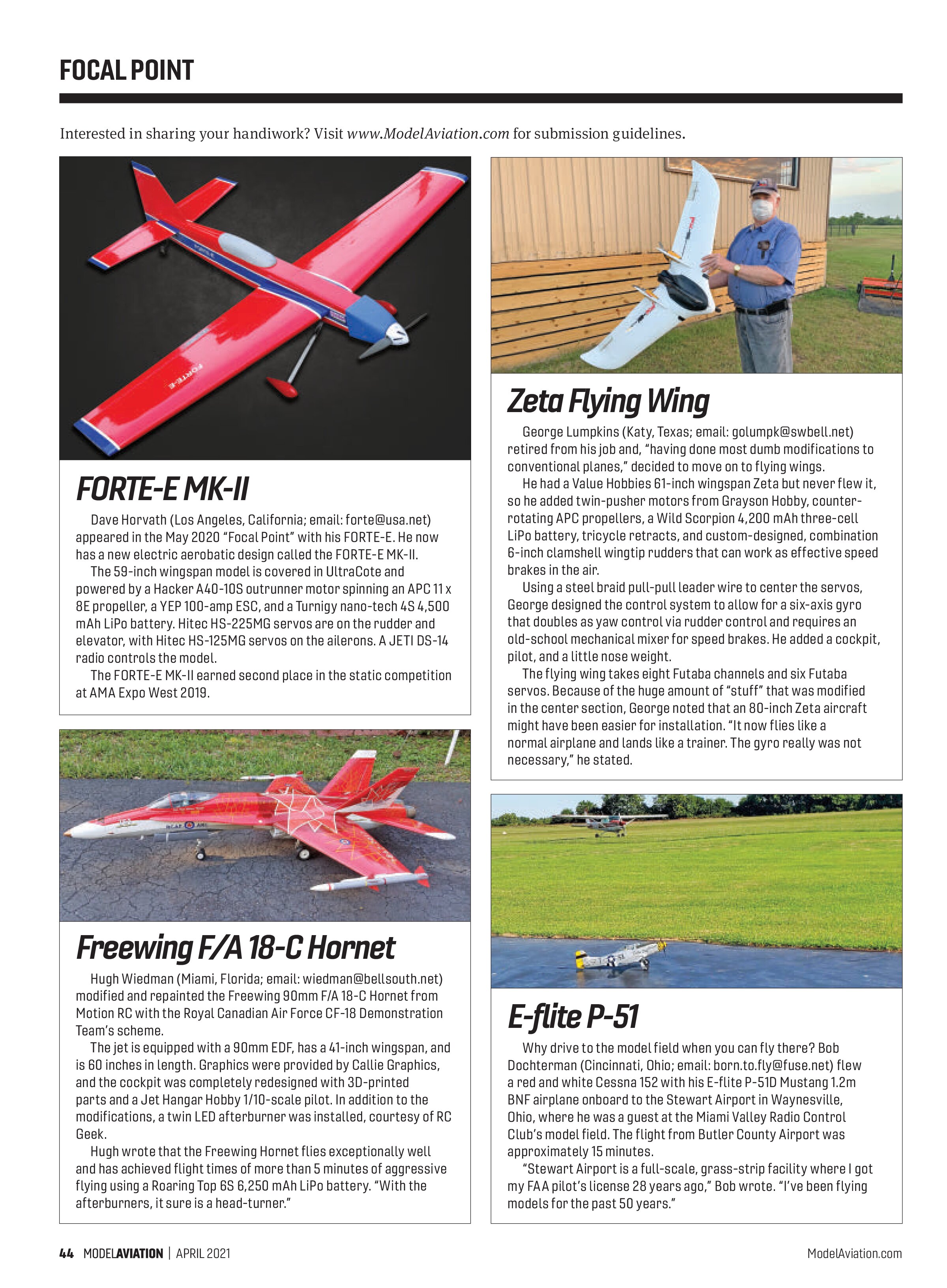
Dave Horvath (Los Angeles, California; email: forte@usa.net) appeared in the May 2020 “Focal Point” with his FORTE-E. He now has a new electric aerobatic design called the FORTE-E MK-II.
The 59-inch wingspan model is covered in UltraCote and powered by a Hacker A40-10S outrunner motor spinning an APC 11 x 8E propeller, a YEP 100-amp ESC, and a Turnigy nano-tech 4S 4,500 mAh LiPo battery. Hitec HS-225MG servos are on the rudder and elevator, with Hitec HS-125MG servos on the ailerons. A JETI DS-14 radio controls the model.
The FORTE-E MK-II earned second place in the static competition at AMA Expo West 2019.

Freewing F/A 18-C Hornet
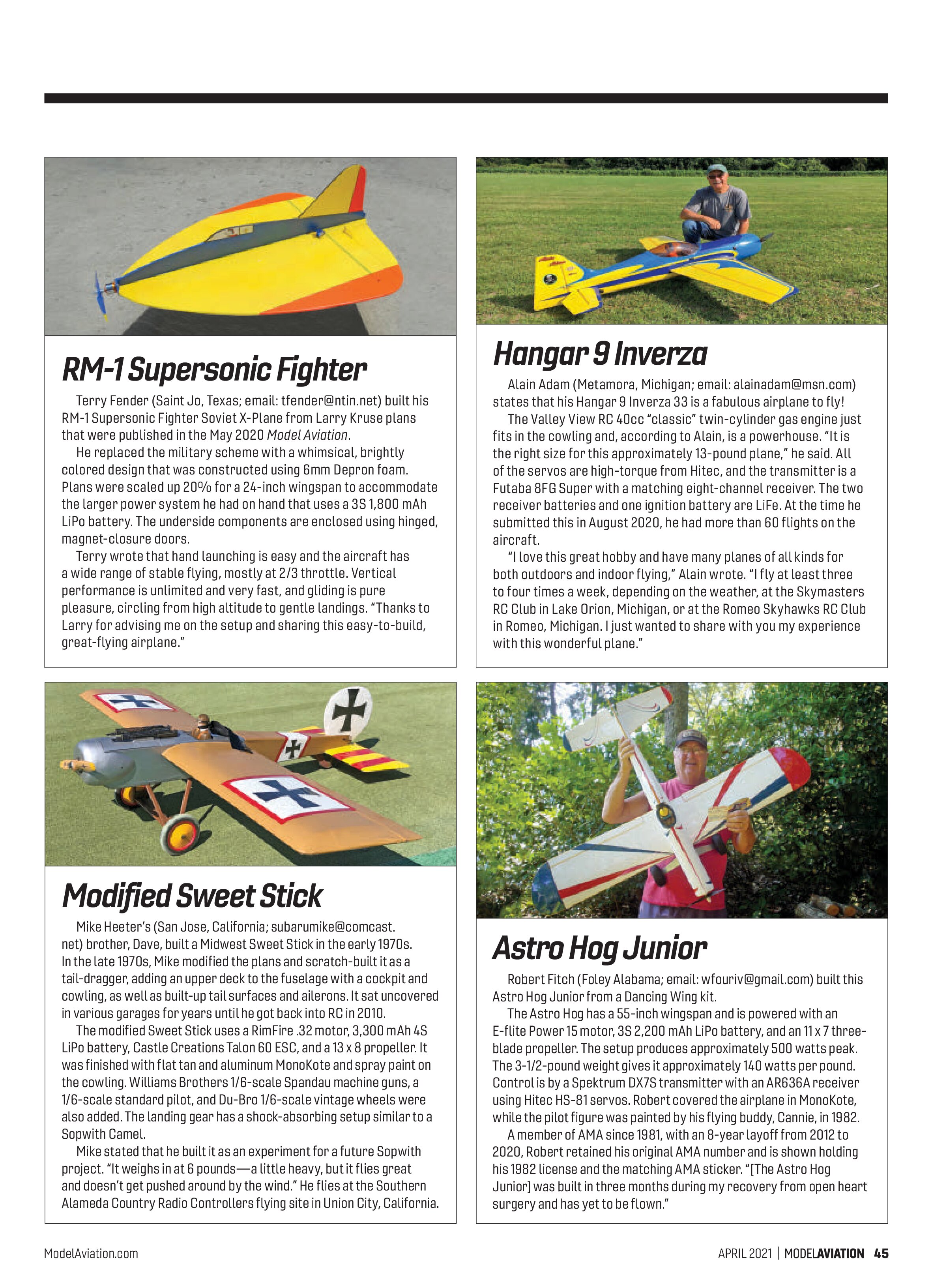
Hugh Wiedman (Miami, Florida; email: wiedman@bellsouth.net) modified and repainted the Freewing 90mm F/A 18-C Hornet from Motion RC with the Royal Canadian Air Force CF-18 Demonstration Team’s scheme.
The jet is equipped with a 90mm EDF, has a 41-inch wingspan, and is 60 inches in length. Graphics were provided by Callie Graphics, and the cockpit was completely redesigned with 3D-printed parts and a Jet Hangar Hobby 1/10-scale pilot. In addition to the modifications, a twin LED afterburner was installed, courtesy of RC Geek.
Hugh wrote that the Freewing Hornet flies exceptionally well and has achieved flight times of more than 5 minutes of aggressive flying using a Roaring Top 6S 6,250 mAh LiPo battery. “With the afterburners, it sure is a head-turner.”

Zeta Flying Wing
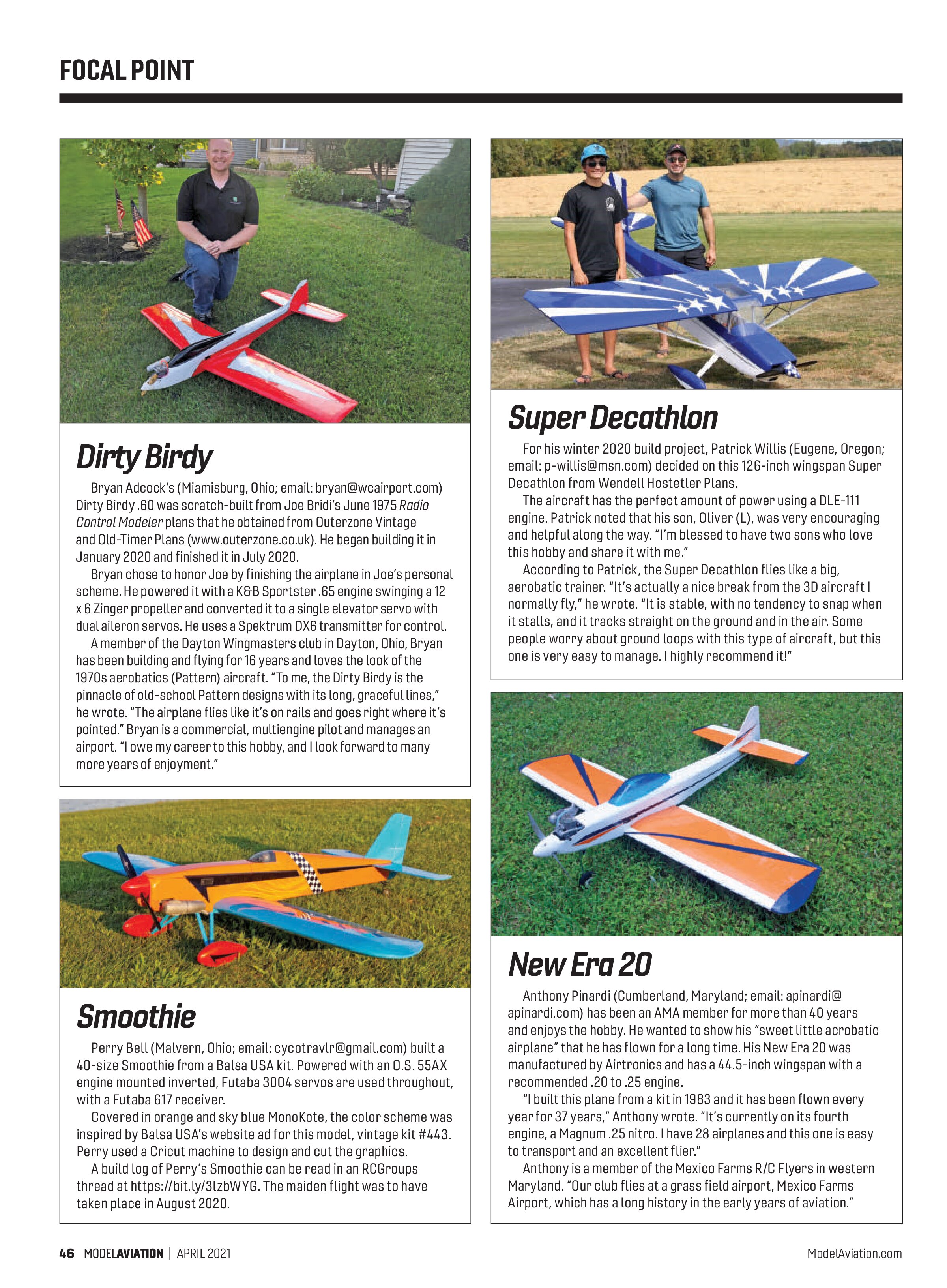
George Lumpkins (Katy, Texas; email: golumpk@swell.net) retired from his job and, “having done most dumb modifications to conventional planes,” decided to move on to flying wings.
He had a Value Hobbies 61-inch wingspan Zeta but never flew it, so he added twin-pusher motors from Grayson Hobby, counter-rotating APC propellers, a Wild Scorpion 4,200 mAh three-cell LiPo battery, tricycle retracts, and custom-designed, combination 6-inch clamshell wingtip rudders that can work as effective speed brakes in the air.
Using a steel braid pull-pull leader wire to center the servos, George designed the control system to allow for a six-axis gyro that doubles as yaw control via rudder control and requires an old-school mechanical mixer for speed brakes. He added a cockpit, pilot, and a little nose weight.
The flying wing takes eight Futaba channels and six Futaba servos. Because of the huge amount of “stuff” that was modified in the center section, George noted that an 80-inch Zeta aircraft might have been easier for installation. “It now flies like a normal airplane and lands like a trainer. The gyro really was not necessary,” he stated.

E-flite P-51
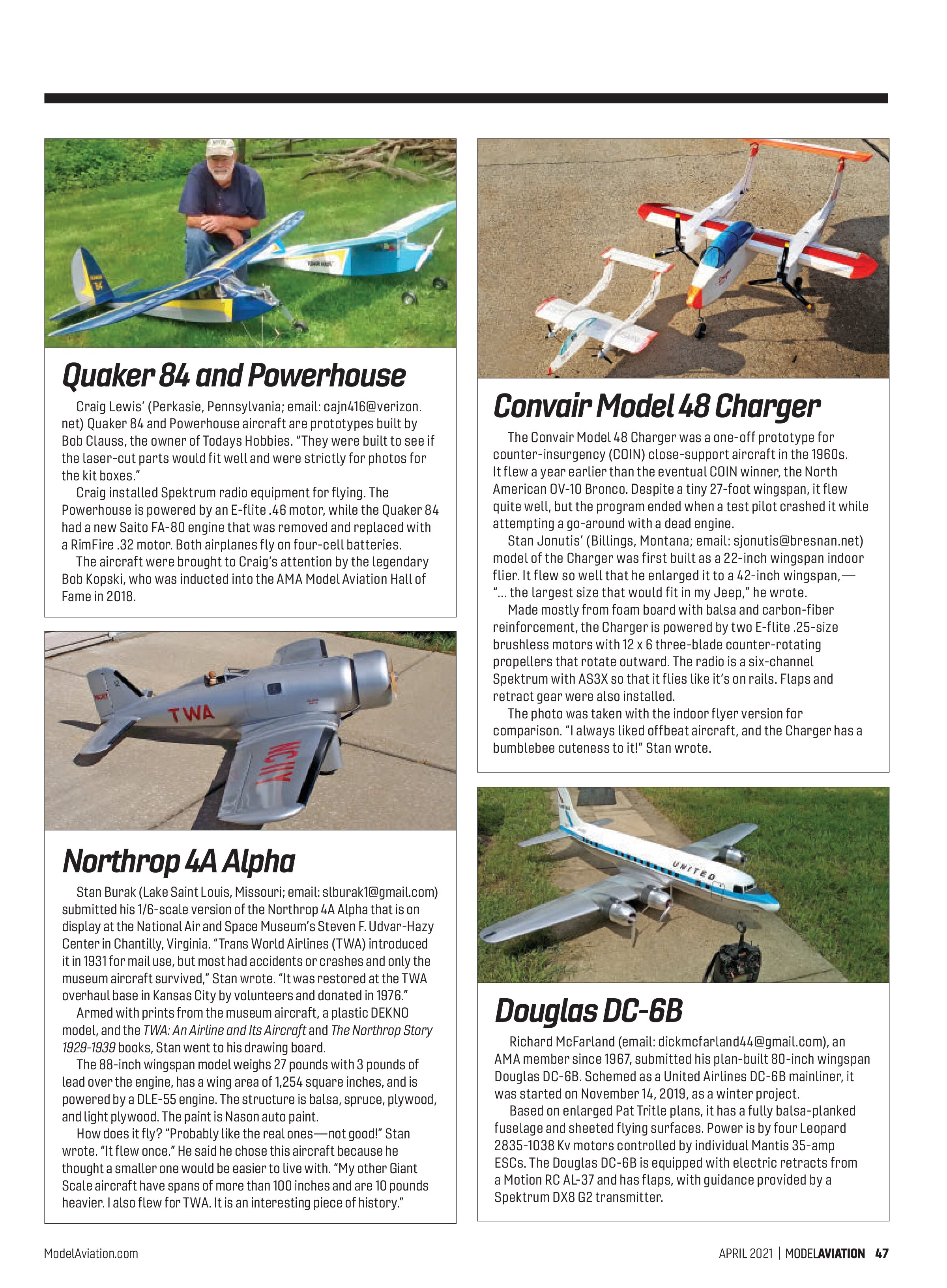
Why drive to the model field when you can fly there? Bob Dochterman (Cincinnati, Ohio; email: born.to.fly@fuse.net) flew a red and white Cessna 152 with his E-flite P-51D Mustang 1.2m BNF airplane onboard to the Stewart Airport in Waynesville, Ohio, where he was a guest at the Miami Valley Radio Control Club’s model field. The flight from Butler County Airport was approximately 15 minutes.
“Stewart Airport is a full-scale, grass-strip facility where I got my FAA pilot’s license 28 years ago,” Bob wrote. “I’ve been flying models for the past 50 years.”

RM-1 Supersonic Fighter
Terry Fender (Saint Jo, Texas; email: tfender@ntin.net) built his RM-1 Supersonic Fighter Soviet X-Plane from Larry Kruse plans that were published in the May 2020 Model Aviation.
He replaced the military scheme with a whimsical, brightly colored design that was constructed using 6mm Depron foam. Plans were scaled up 20% for a 24-inch wingspan to accommodate the larger power system he had on hand that uses a 3S 1,800 mAh LiPo battery. The underside components are enclosed using hinged, magnet-closure doors.
Terry wrote that hand launching is easy and the aircraft has a wide range of stable flying, mostly at 2/3 throttle. Vertical performance is unlimited and very fast, and gliding is pure pleasure, circling from high altitude to gentle landings. “Thanks to Larry for advising me on the setup and sharing this easy-to-build, great-flying airplane.”

Hangar 9 Inverza
Alain Adam (Metamora, Michigan; email: alainadam@msn.com) states that his Hangar 9 Inverza 33 is a fabulous airplane to fly!
The Valley View RC 40cc “classic” twin-cylinder gas engine just fits in the cowling and, according to Alain, is a powerhouse. “It is the right size for this approximately 13-pound plane,” he said. All of the servos are high-torque from Hitec, and the transmitter is a Futaba 8FG Super with a matching eight-channel receiver. The two receiver batteries and one ignition battery are LiFe. At the time he submitted this in August 2020, he had more than 60 flights on the aircraft.
“I love this great hobby and have many planes of all kinds for both outdoors and indoor flying,” Alain wrote. “I fly at least three to four times a week, depending on the weather, at the Skymasters RC Club in Lake Orion, Michigan, or at the Romeo Skyhawks RC Club in Romeo, Michigan. I just wanted to share with you my experience with this wonderful plane.”

Modified Sweet Stick
Mike Heeter’s (San Jose, California; subarumike@comcast.net) brother, Dave, built a Midwest Sweet Stick in the early 1970s. In the late 1970s, Mike modified the plans and scratch-built it as a tail-dragger, adding an upper deck to the fuselage with a cockpit and cowling, as well as built-up tail surfaces and ailerons. It sat uncovered in various garages for years until he got back into RC in 2010.
The modified Sweet Stick uses a RimFire .32 motor, 3,300 mAh 4S LiPo battery, Castle Creations Talon 60 ESC, and a 13 x 8 propeller. It was finished with flat tan and aluminum MonoKote and spray paint on the cowling. Williams Brothers 1/6-scale Spandau machine guns, a 1/6-scale standard pilot, and Du-Bro 1/6-scale vintage wheels were also added. The landing gear has a shock-absorbing setup similar to a Sopwith Camel.
Mike stated that he built it as an experiment for a future Sopwith project. “It weighs in at 6 pounds—a little heavy, but it flies great and doesn’t get pushed around by the wind.” He flies at the Southern Alameda Country Radio Controllers flying site in Union City, California.

Astro Hog Junior
Robert Fitch (Foley Alabama; email: wfouriv@gmail.com) built this Astro Hog Junior from a Dancing Wing kit.
The Astro Hog has a 55-inch wingspan and is powered with an E-flite Power 15 motor, 3S 2,200 mAh LiPo battery, and an 11 x 7 three-blade propeller. The setup produces approximately 500 watts peak. The 3-1/2-pound weight gives it approximately 140 watts per pound. Control is by a Spektrum DX7S transmitter with an AR636A receiver using Hitec HS-81 servos. Robert covered the airplane in MonoKote, while the pilot figure was painted by his flying buddy, Cannie, in 1982.
A member of AMA since 1981, with an 8-year layoff from 2012 to 2020, Robert retained his original AMA number and is shown holding his 1982 license and the matching AMA sticker. “[The Astro Hog Junior] was built in three months during my recovery from open heart surgery and has yet to be flown.”

Dirty Birdy
Bryan Adcock’s (Miamisburg, Ohio; email: bryan@w cairport.com) Dirty Birdy .60 was scratch-built from Joe Bridi’s June 1975 Radio Control Modeler plans that he obtained from Outerzone Vintage and Old-Timer Plans (www.outerzone.co.uk). He began building it in January 2020 and finished it in July 2020.
Bryan chose to honor Joe by finishing the airplane in Joe’s personal scheme. He powered it with a K&B Sportster .65 engine swinging a 12 x 6 Zinger propeller and converted it to a single elevator servo with dual aileron servos. He uses a Spektrum DX6 transmitter for control.
A member of the Dayton Wingmasters club in Dayton, Ohio, Bryan has been building and flying for 16 years and loves the look of the 1970s aerobatics (Pattern) aircraft. “To me, the Dirty Birdy is the pinnacle of old-school Pattern designs with its long, graceful lines,” he wrote. “The airplane flies like it’s on rails and goes right where it’s pointed.” Bryan is a commercial, multiengine pilot and manages an airport. “I owe my career to this hobby, and I look forward to many more years of enjoyment.”

Smoothie
Perry Bell (Malvern, Ohio; email: cycutravlr@gmail.com) built a 40-size Smoothie from a Balsa USA kit. Powered with an O.S. 55AX engine mounted inverted, Futaba 3004 servos are used throughout, with a Futaba 617 receiver.
Covered in orange and sky blue MonoKote, the color scheme was inspired by Balsa USA’s website ad for this model, vintage kit #443. Perry used a Cricut machine to design and cut the graphics.
A build log of Perry’s Smoothie can be read in an RCGroups thread at https://bit.ly/3lzbWYG. The maiden flight was to have taken place in August 2020.

Super Decathlon
For his winter 2020 build project, Patrick Willis (Eugene, Oregon; email: p-willis@msn.com) decided on this 126-inch wingspan Super Decathlon from Wendell Hostetler Plans.
The aircraft has the perfect amount of power using a DLE-111 engine. Patrick noted that his son, Oliver (L), was very encouraging and helpful along the way. “I’m blessed to have two sons who love this hobby and share it with me.”
According to Patrick, the Super Decathlon flies like a big, aerobatic trainer. “It’s actually a nice break from the 3D aircraft I normally fly,” he wrote. “It is stable, with no tendency to snap when it stalls, and it tracks straight on the ground and in the air. Some people worry about ground loops with this type of aircraft, but this one is very easy to manage. I highly recommend it!”

New Era 20
Anthony Pinardi (Cumberland, Maryland; email: apinardi@apinardi.com) has been an AMA member for more than 40 years and enjoys the hobby. He wanted to show his “sweet little acrobatic airplane” that he has flown for a long time. His New Era 20 was manufactured by Airtronics and has a 44.5-inch wingspan with a recommended .20 to .25 engine.
“I built this plane from a kit in 1983 and it has been flown every year for 37 years,” Anthony wrote. “It’s currently on its fourth engine, a Magnum .25 nitro. I have 28 airplanes and this one is easy to transport and an excellent flier.”
Anthony is a member of the Mexico Farms R/C Flyers in western Maryland. “Our club flies at a grass field airport, Mexico Farms Airport, which has a long history in the early years of aviation.”

Quaker 84 and Powerhouse
Craig Lewis’ (Perkasie, Pennsylvania; email: cajn416l@verizon.net) Quaker 84 and Powerhouse aircraft are prototypes built by Bob Clauss, the owner of Todays Hobbies. “They were built to see if the laser-cut parts would fit well and were strictly for photos for the kit boxes.”
Craig installed Spektrum radio equipment for flying. The Powerhouse is powered by an E-flite .46 motor, while the Quaker 84 had a new Saito FA-80 engine that was removed and replaced with a RimFire .32 motor. Both airplanes fly on four-cell batteries.
The aircraft were brought to Craig’s attention by the legendary Bob Kopsky, who was inducted into the AMA Model Aviation Hall of Fame in 2018.

Northrop 4A Alpha
Stan Burak (Lake Saint Louis, Missouri; email: slburak1@gmail.com) submitted his 1/6-scale version of the Northrop 4A Alpha that is on display at the National Air and Space Museum’s Steven F. Udvar-Hazy Center in Chantilly, Virginia. “Trans World Airlines (TWA) introduced it in 1931 for mail use, but most had accidents or crashes and only the museum aircraft survived,” Stan wrote. “It was restored at the TWA overhaul base in Kansas City by volunteers and donated in 1976.”
Armed with prints from the museum aircraft, a plastic DEKNO model, and the TWA: An Airline and Its Aircraft and The Northrop Story 1929-1939 books, Stan went to his drawing board.
The 88-inch wingspan model weighs 27 pounds with 3 pounds of lead over the engine, has a wing area of 1,254 square inches, and is powered by a DLE-55 engine. The structure is balsa, spruce, plywood, and light plywood. The paint is Nason auto paint.
How does it fly? “Probably like the real ones—not good!” Stan wrote. “It flew once.” He said he chose this aircraft because he thought a smaller one would be easier to live with. “My other Giant Scale aircraft have spans of more than 100 inches and are 10 pounds heavier. I also flew for TWA. It is an interesting piece of history.”

Convair Model 48 Charger
The Convair Model 48 Charger was a one-off prototype for counter-insurgency (COIN) close-support aircraft in the 1960s. It flew a year earlier than the eventual COIN winner, the North American OV-10 Bronco. Despite a tiny 27-foot wingspan, it flew quite well, but the program ended when a test pilot crashed it while attempting a go-around with a dead engine.
Stan Jonutis’ (Billings, Montana; email: sjonutis@hresnan.net) model of the Charger was first built as a 22-inch wingspan indoor flier. It flew so well that he enlarged it to a 42-inch wingspan,—“... the largest size that would fit in my Jeep,” he wrote.
Made mostly from foam board with balsa and carbon-fiber reinforcement, the Charger is powered by two E-flite .25-size brushless motors with 12 x 6 three-blade counter-rotating propellers that rotate outward. The radio is a six-channel Spektrum with AS3X so that it flies like it’s on rails. Flaps and retract gear were also installed.
The photo was taken with the indoor flyer version for comparison. “I always liked offbeat aircraft, and the Charger has a bumblebee cuteness to it!” Stan wrote.

Douglas DC-6B
Richard McFarland (email: dickmcfarland44@gmail.com), an AMA member since 1967, submitted his plan-built 80-inch wingspan Douglas DC-6B. Schemed as a United Airlines DC-6B mainliner, it was started on November 14, 2019, as a winter project.
Based on enlarged Pat Tritle plans, it has a fully balsa-planked fuselage and sheeted flying surfaces. Power is by four Leopard 2835-1038 KV motors controlled by individual Mantis 35-amp ESCs. The Douglas DC-6B is equipped with electric retracts from a Motion RC AL-37 and has flaps, with guidance provided by a Spektrum DX8 G2 transmitter.