BUILD A SIMPLE BATTERY DISCHARGER
By Terry Dunn | terrydunn74@gmail.com

THE LIPO BATTERIES that most of us use in our electric-powered models require some pampering to maintain good performance and a long life. One of those special requirements is to make sure that the batteries do not remain fully charged for a long time. There are no absolutes, but “a long time” is generally considered to be more than two or three days.
I think we can all agree that the best way to discharge a battery is to put it in an airplane and go fly. Unfortunately, that’s not always practical. We also require options to safely discharge batteries at home.
In addition to staying charged for too long, LiPo batteries protest if their voltage ever gets too low (less than 3 volts per cell). It is necessary to find a happy medium that keeps them, well, happy. Many battery experts agree that the ideal voltage for storing a LiPo battery is 3.85 volts per cell. For example, that would equate to 11.55 volts for a three-cell LiPo (3.85 volts x 3) and 19.25 volts for a five-cell LiPo (3.85 volts x 5). You get the idea.
Draining Volts
Most modern, hobby-grade LiPo battery chargers have a “storage charge” function that will discharge (or charge) a battery as required to hit 3.85 volts per cell. It’s a handy feature that I recommend using. You paid for that capability, so you might as well take advantage of it!
My only issue with discharging a topped-off LiPo battery on my charger is that it takes a long time. Instead of spinning a propeller or rotor, as on our models, a charger can only dissipate a battery’s energy as heat. That heat has to be carefully and slowly controlled. A battery that provides a 6-minute flight in one of my models could take more than an hour to drain on my charger.
You might be tempted to save time by using a model aircraft to run down a battery in your workshop. I advise against that method for several reasons. First, spinning up a propeller (even a small one) inside a confined space is dangerous. Second, prolonged static running can be hard on your aircraft’s power system. Finally, any significant amount of prop-wash inside your workshop will make a mess of everything that isn’t nailed down!
My solution for dealing with fully charged batteries at home is to use dedicated battery dischargers. These tools allow me to drain a wide range of LiPo batteries to storage voltage more quickly than with my charger. There are commercially made dischargers available (see “Worth a Closer Look” in this issue), as well as the do-it-yourself option that I present here.
Let There Be Light
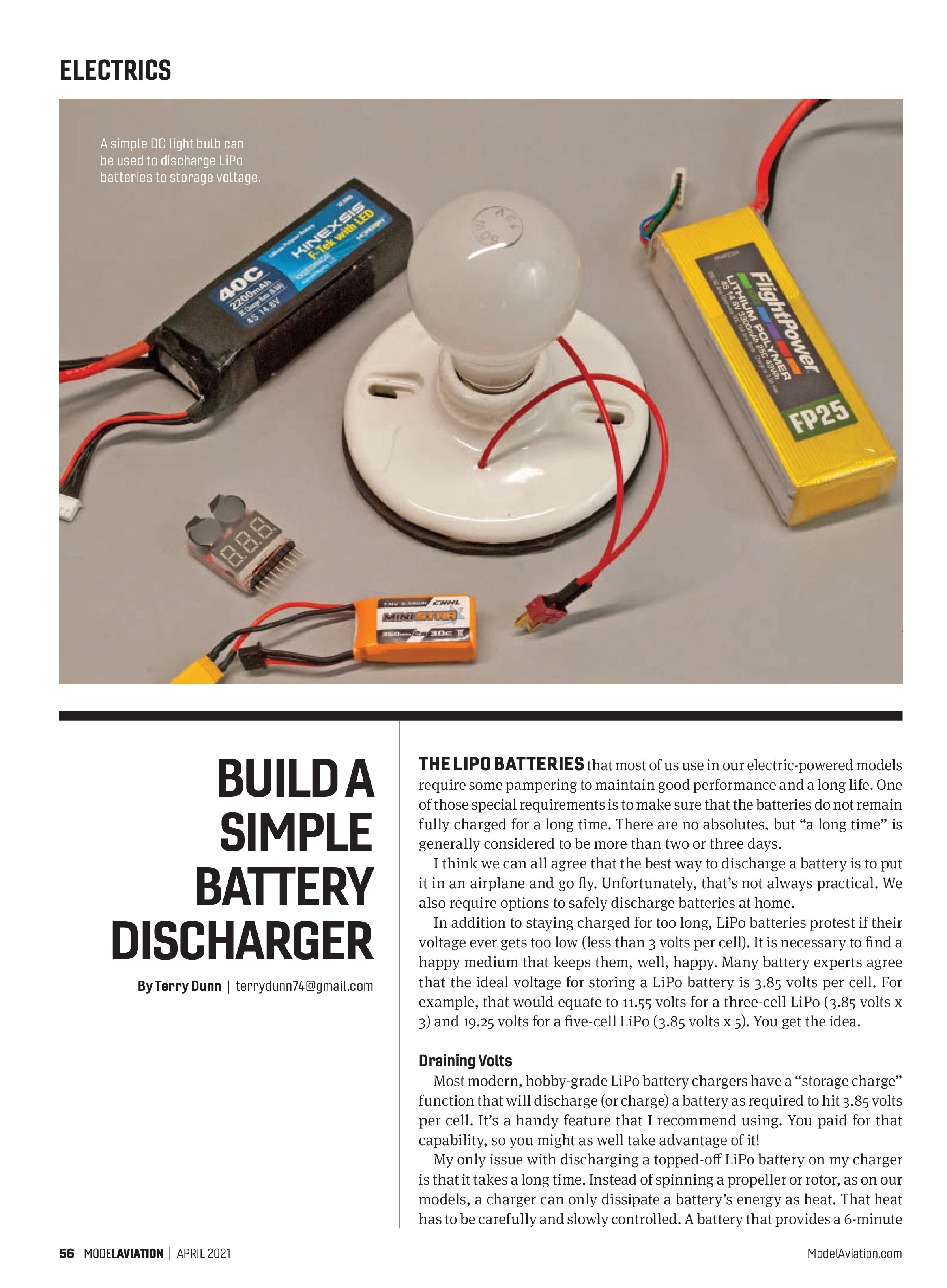
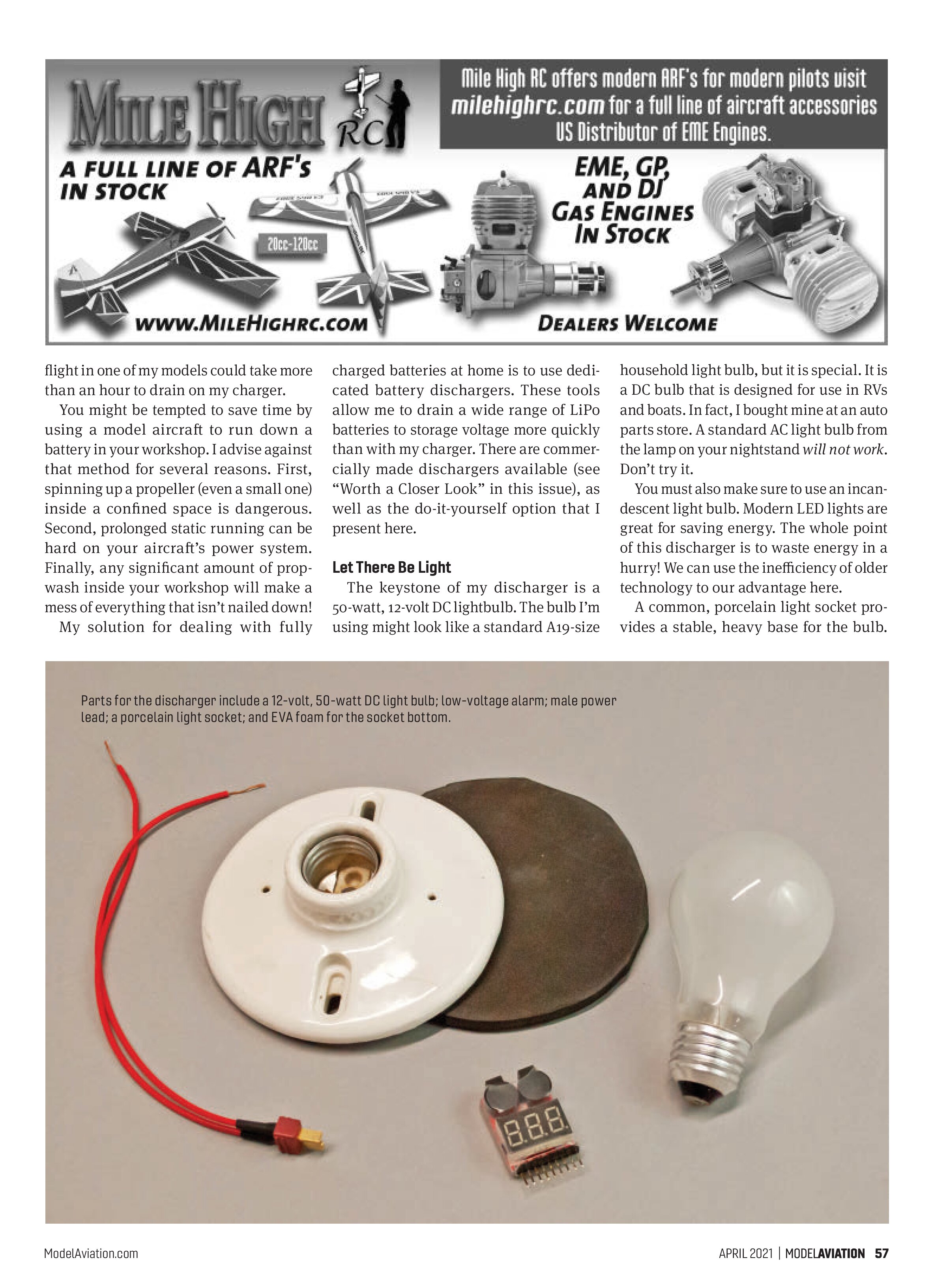
The keystone of my discharger is a 50-watt, 12-volt DC lightbulb. The bulb I’m using might look like a standard A19-size household light bulb, but it is special. It is a DC bulb that is designed for use in RVs and boats. In fact, I bought mine at an auto parts store. A standard AC light bulb from the lamp on your nightstand will not work. Don’t try it.
You must also make sure to use an incandescent light bulb. Modern LED lights are great for saving energy. The whole point of this discharger is to waste energy in a hurry! We can use the inefficiency of older technology to our advantage here.
A common, porcelain light socket provides a stable, heavy base for the bulb.

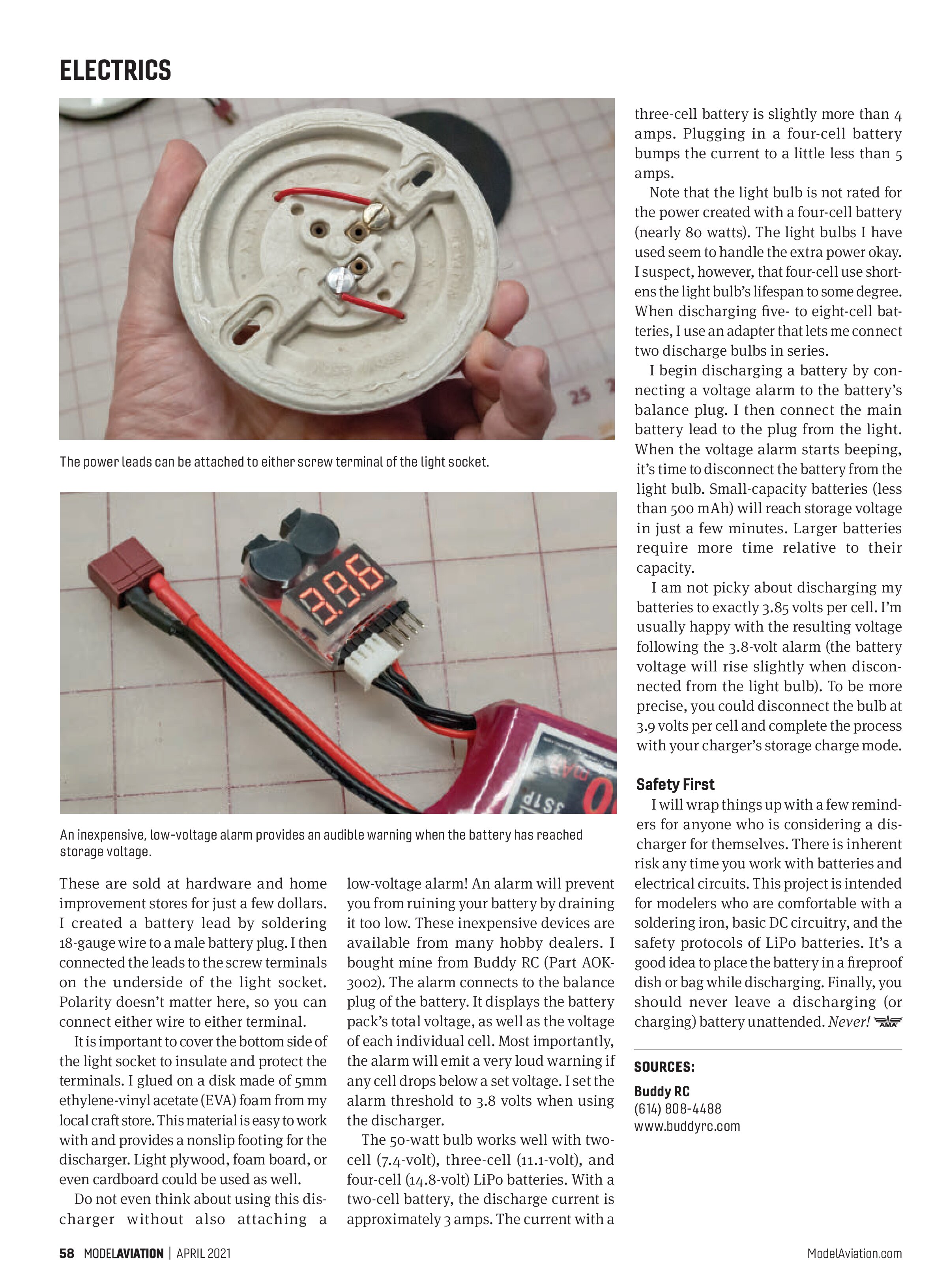
These are sold at hardware and home improvement stores for just a few dollars. I created a battery lead by soldering 18-gauge wire to a male battery plug. I then connected the leads to the screw terminals on the underside of the light socket. Polarity doesn’t matter here, so you can connect either wire to either terminal.
It is important to cover the bottom side of the light socket to insulate and protect the terminals. I glued on a disk made of 5mm ethylene-vinyl acetate (EVA) foam from my local craft store. This material is easy to work with and provides a nonslip footing for the discharger. Light plywood, foam board, or even cardboard could be used as well.
Do not even think about using this discharger without also attaching a low-voltage alarm! An alarm will prevent you from ruining your battery by draining it too low. These inexpensive devices are available from many hobby dealers. I bought mine from Buddy RC (Part AOK-3002). The alarm connects to the balance plug of the battery. It displays the battery pack’s total voltage, as well as the voltage of each individual cell. Most importantly, the alarm will emit a very loud warning if any cell drops below a set voltage. I set the alarm threshold to 3.8 volts when using the discharger.
The 50-watt bulb works well with two-cell (7.4-volt), three-cell (11.1-volt), and four-cell (14.8-volt) LiPo batteries. With a two-cell battery, the discharge current is approximately 3 amps. The current with a three-cell battery is slightly more than 4 amps. Plugging in a four-cell battery bumps the current to a little less than 5 amps.
Note that the light bulb is not rated for the power created with a four-cell battery (nearly 80 watts). The light bulbs I have used seem to handle the extra power okay. I suspect, however, that four-cell use shortens the light bulb’s lifespan to some degree. When discharging five- to eight-cell batteries, I use an adapter that lets me connect two discharge bulbs in series.
I begin discharging a battery by connecting a voltage alarm to the battery’s balance plug. I then connect the main battery lead to the plug from the light. When the voltage alarm starts beeping, it’s time to disconnect the battery from the light bulb. Small-capacity batteries (less than 500 mAh) will reach storage voltage in just a few minutes. Larger batteries require more time relative to their capacity.
I am not picky about discharging my batteries to exactly 3.85 volts per cell. I’m usually happy with the resulting voltage following the 3.8-volt alarm (the battery voltage will rise slightly when disconnected from the light bulb). To be more precise, you could disconnect the bulb at 3.9 volts per cell and complete the process with your charger’s storage charge mode.
Safety First
I will wrap things up with a few reminders for anyone who is considering a discharger for themselves. There is inherent risk any time you work with batteries and electrical circuits. This project is intended for modelers who are comfortable with a soldering iron, basic DC circuitry, and the safety protocols of LiPo batteries. It’s a good idea to place the battery in a fireproof dish or bag while discharging. Finally, you should never leave a discharger (or charging) battery unattended. Never!
SOURCES:
Buddy RC
(614) 808-4488
www.buddyrc.com