THE DEAL WITH DRONES

REMOTE ID IS HERE
By Joshua Bardwell
joshuabardwell@fpvknowitall.com
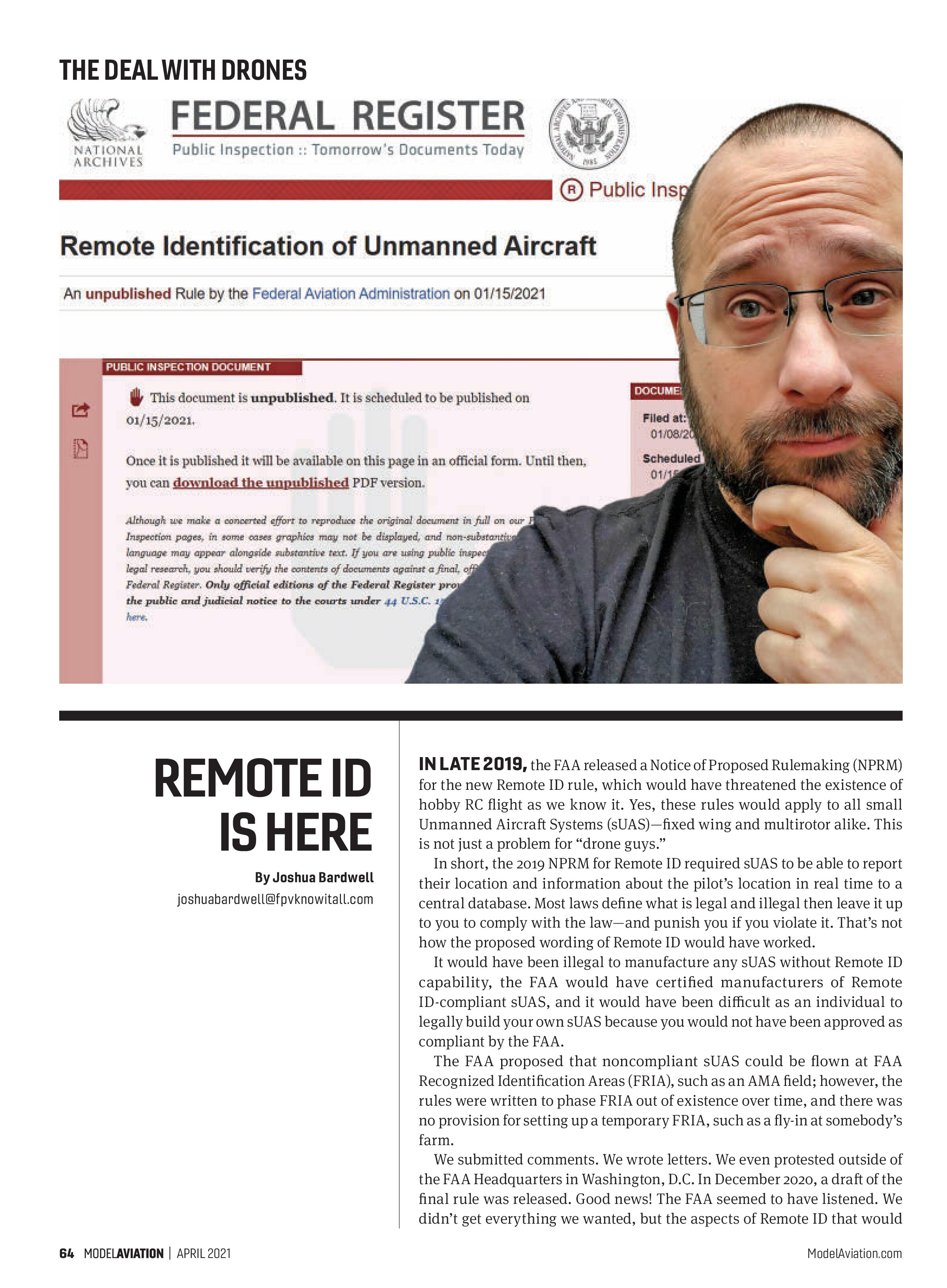
IN LATE 2019, the FAA released a Notice of Proposed Rulemaking (NPRM) for the new Remote ID rule, which would have threatened the existence of hobby RC flight as we know it. Yes, these rules would apply to all small Unmanned Aircraft Systems (sUAS)—fixed wing and multirotor alike. This is not just a problem for “drone guys.”
In short, the 2019 NPRM for Remote ID required sUAS to be able to report their location and information about the pilot’s location in real time to a central database. Most laws define what is legal and illegal then leave it up to you to comply with the law—and punish you if you violate it. That’s not how the proposed wording of Remote ID would have worked.
It would have been illegal to manufacture any sUAS without Remote ID capability, the FAA would have certified manufacturers of Remote ID-compliant sUAS, and it would have been difficult as an individual to legally build your own sUAS because you would not have been approved as compliant by the FAA.
The FAA proposed that noncompliant sUAS could be flown at FAA Recognized Identification Areas (FRIA), such as an AMA field; however, the rules were written to phase FRIA out of existence over time, and there was no provision for setting up a temporary FRIA, such as a fly-in at somebody’s farm.
We submitted comments. We wrote letters. We even protested outside of the FAA Headquarters in Washington, D.C. In December 2020, a draft of the final rule was released. Good news! The FAA seemed to have listened. We didn’t get everything we wanted, but the aspects of Remote ID that would

one in the NPRM, but there is still room for improvement. Two approaches that were rejected by the FAA were “Notify And Fly” and “Protected Operations.” Notify And Fly refers to using a cellphone app to notify a central database where you will be flying in a certain location for a certain time. If you have used the AirMap app to get Low Altitude Authorization and Notification Capability (LAANC) approval to fly in controlled airspace, this is an example of Notify And Fly. The advantage of this approach would be that no hardware is needed on the aircraft.
Protected Operations means that areas near trees, buildings, and other obstacles where no manned aircraft could reasonably fly are exempt from regulation. These two approaches represent opportunities to expand the ability of RC flight enthusiasts to fly safely and conveniently at the same time.

No Remote ID refers to aircraft that are not able to perform the Remote ID function. These aircraft can only be flown at FRIA. A FRIA can be registered by community-based organizations (CBOs) such as the AMA, as well as any accredited educational institution. FRIA are approved for 48 months at a time and can be renewed at the end of that time. New ones can be applied for into the future. The FAA has informally acknowledged that there also needs to be a mechanism for setting up quick and temporary FRIA-like zones, such as for a fly-in or a race, although no specific details for this have been proposed.
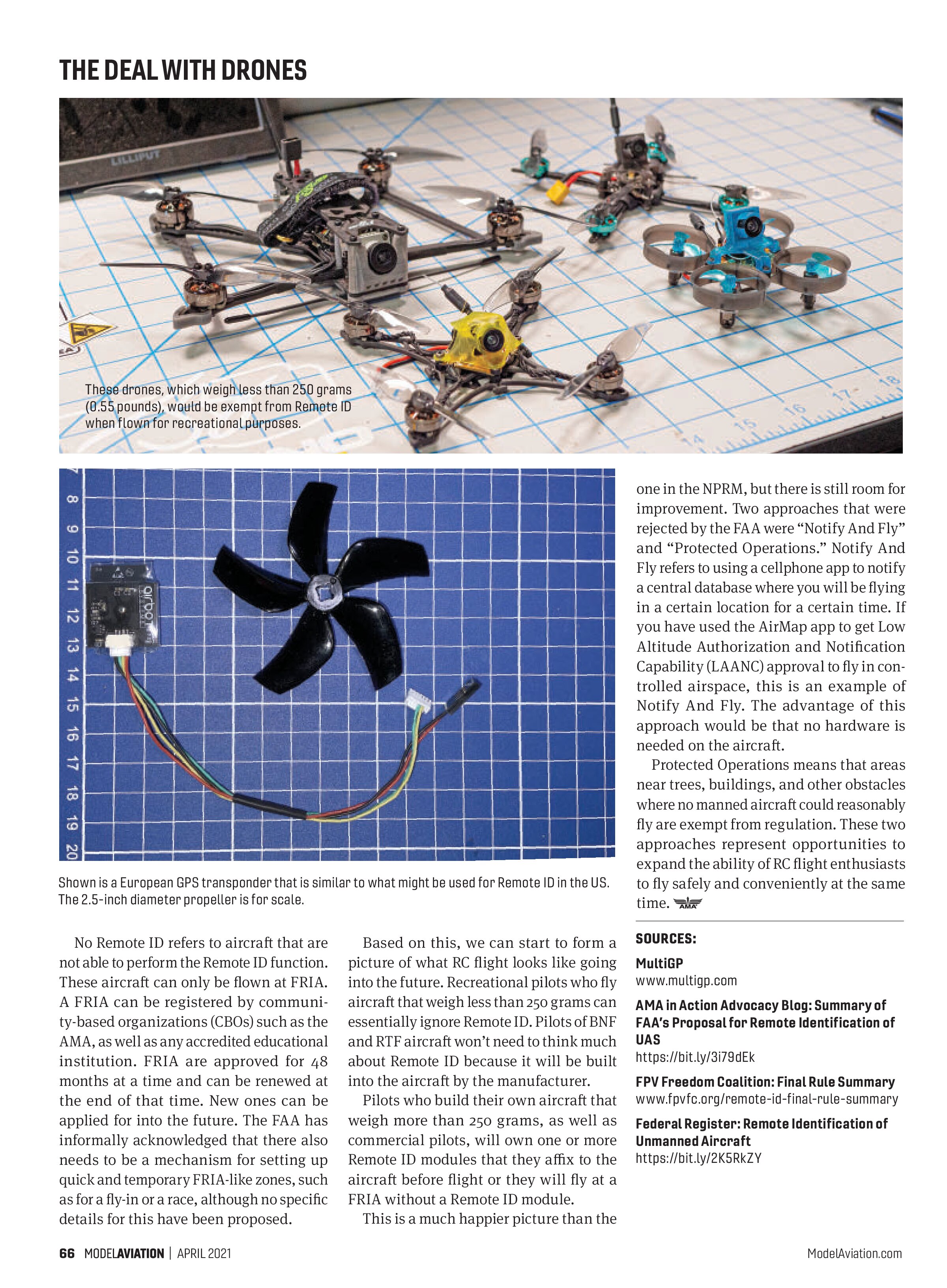
Based on this, we can start to form a picture of what RC flight looks like going into the future. Recreational pilots who fly aircraft that weigh less than 250 grams can essentially ignore Remote ID. Pilots of BNF and RTF aircraft won’t need to think much about Remote ID because it will be built into the aircraft by the manufacturer.
Pilots who build their own aircraft that weigh more than 250 grams, as well as commercial pilots, will own one or more Remote ID modules that they affix to the aircraft before flight or they will fly at a FRIA without a Remote ID module.
This is a much happier picture than the one in the NPRM, but there is still room for improvement.
SOURCES:
MultiGP
www.multigp.com
AMA in Action Advocacy Blog: Summary of FAA’s Proposal for Remote Identification of UAS
https://bit.ly/3i79dEk
FPV Freedom Coalition: Final Rule Summary
www.fpवीfc.org/remote-id-final-rule-summary
Federal Register: Remote Identification of Unmanned Aircraft
https://bit.ly/2K5RkZY