MAGAZINE ARTICLES FROM DECEMBER 1970
By Bob Noll | bobrc@aol.com

IT’S DECEMBER 2020 as I write this, and the Christmas tree at Rockefeller Plaza in New York City was just lit. It came from Norwich, New York, which is less than an hour’s drive from where I live in Endicott. You might have seen the tree when it arrived in Manhattan, looking rather scrawny; however, after 50,000 LED lights were added, it made a magnificent appearance on December 2.
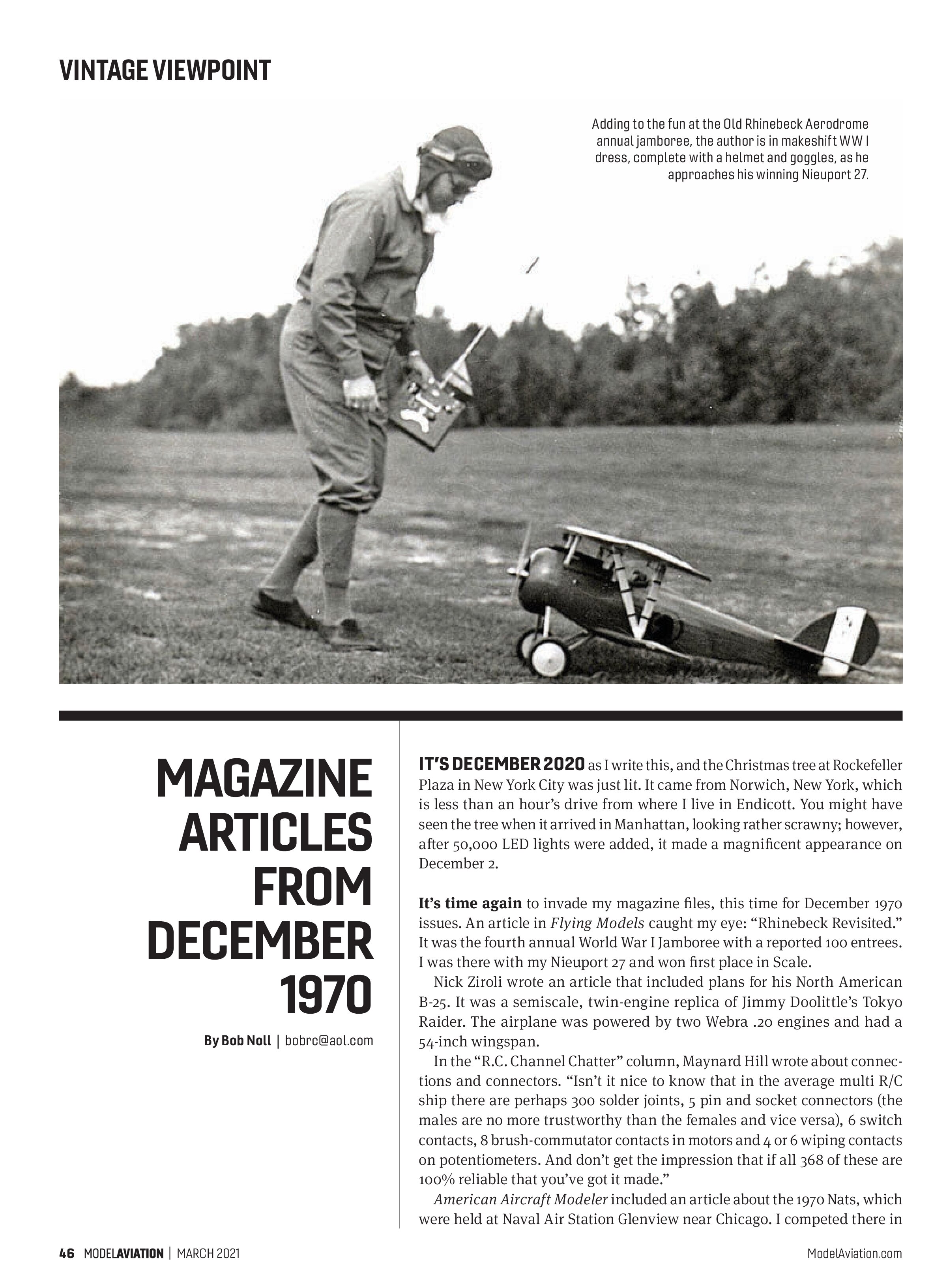
It’s time again to invade my magazine files, this time for December 1970 issues. An article in Flying Models caught my eye: “Rhinebeck Revisited.” It was the fourth annual World War I Jamboree with a reported 100 entrees. I was there with my Nieuport 27 and won first place in Scale.
Nick Ziroli wrote an article that included plans for his North American B-25. It was a semiscale, twin-engine replica of Jimmy Doolittle’s Tokyo Raider. The airplane was powered by two Webra .20 engines and had a 54-inch wingspan.
In the “R.C. Channel Chatter” column, Maynard Hill wrote about connections and connectors. “Isn’t it nice to know that in the average multi R/C ship there are perhaps 300 solder joints, 5 pin and socket connectors (the males are no more trustworthy than the females and vice versa), 6 switch contacts, 8 brush-commutator contacts in motors and 4 or 6 wiping contacts on potentiometers. And don’t get the impression that if all 368 of these are 100% reliable that you’ve got it made.”
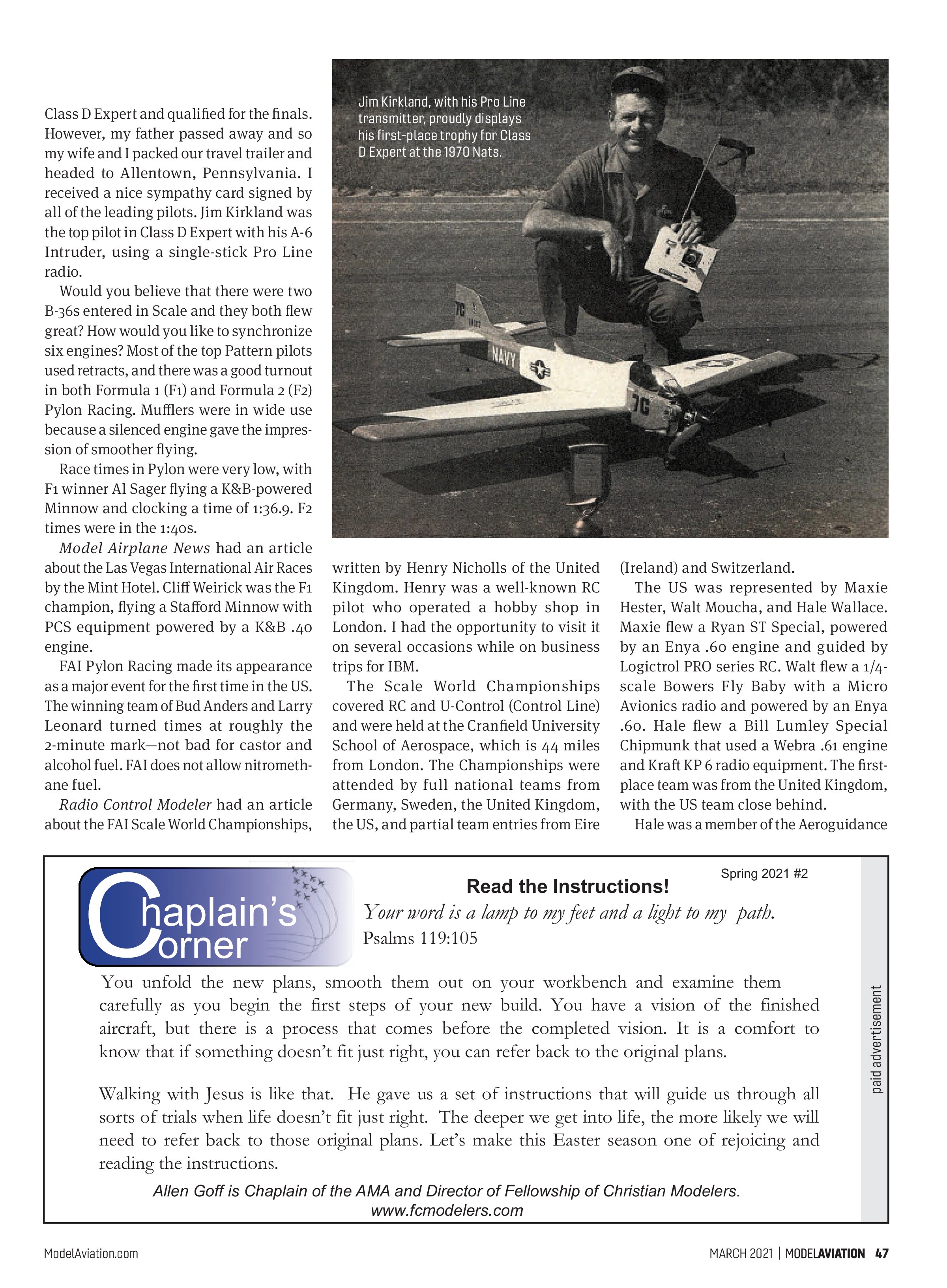
American Aircraft Modeler included an article about the 1970 Nats, which were held at Naval Air Station Glenview near Chicago. I competed there in Class D Expert and qualified for the finals. However, my father passed away and so my wife and I packed our travel trailer and headed to Allentown, Pennsylvania. I received a nice sympathy card signed by all of the leading pilots. Jim Kirkland was the top pilot in Class D Expert with his A-6 Intruder, using a single-stick Pro Line radio.
Would you believe that there were two B-36s entered in Scale and they both flew great? How would you like to synchronize six engines? Most of the top Pattern pilots used retracts, and there was a good turnout in both Formula 1 (F1) and Formula 2 (F2) Pylon Racing. Mufflers were in wide use because a silenced engine gave the impression of smoother flying.
Race times in Pylon were very low, with F1 winner Al Sager flying a K&B-powered Minnow and clocking a time of 1:36.9. F2 times were in the 1:40s.
Model Airplane News had an article about the Las Vegas International Air Races by the Mint Hotel. Cliff Weirick was the F1 champion, flying a Stafford Minnow with PCS equipment powered by a K&B .40 engine.
FAI Pylon Racing made its appearance as a major event for the first time in the US. The winning team of Bud Anders and Larry Leonard turned times at roughly the 2-minute mark—not bad for castor and alcohol fuel. FAI does not allow nitromethane fuel.
Radio Control Modeler had an article about the FAI Scale World Championships,

written by Henry Nicholls of the United Kingdom. Henry was a well-known RC pilot who operated a hobby shop in London. I had the opportunity to visit it on several occasions while on business trips for IBM.
The Scale World Championships covered RC and U-Control (Control Line) and were held at the Cranfield University School of Aerospace, which is 44 miles from London. The Championships were attended by full national teams from Germany, Sweden, the United Kingdom, the US, and partial team entries from Eire (Ireland) and Switzerland.
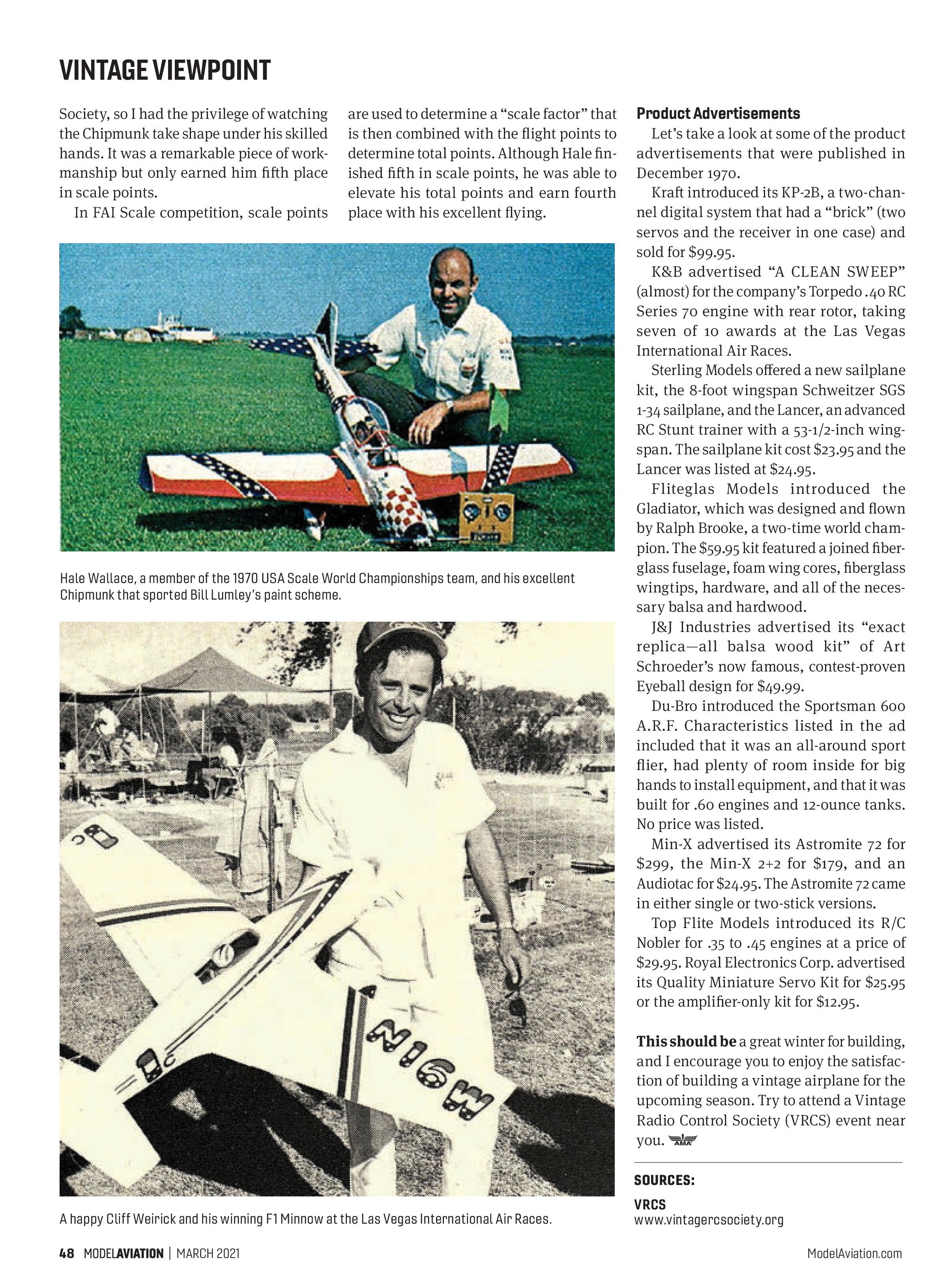
The US was represented by Maxie Hester, Walt Moucha, and Hale Wallace. Maxie flew a Ryan ST Special, powered by an Enya .60 engine and guided by Logictrol PRO series RC. Walt flew a 1/4-scale Bowers Fly Baby with a Micro Avionics radio and powered by an Enya .60. Hale flew a Bill Lumley Special Chipmunk that used a Webra .61 engine and Kraft KP 6 radio equipment. The first-place team was from the United Kingdom, with the US team close behind.
Hale was a member of the Aeroguidance
Society, so I had the privilege of watching the Chipmunk take shape under his skilled hands. It was a remarkable piece of workmanship but only earned him fifth place in scale points.
In FAI Scale competition, scale points are used to determine a “scale factor” that is then combined with the flight points to determine total points. Although Hale finished fifth in scale points, he was able to elevate his total points and earn fourth place with his excellent flying.


This should be a great winter for building, and I encourage you to enjoy the satisfaction of building a vintage airplane for the upcoming season. Try to attend a Vintage Radio Control Society (VRCS) event near you.