SAFETY COMES FIRST

MAKE A STAND FOR SAFETY!
By Dave Gee | safetycolumn@cs.com
IS IT A MODEL STAND, field table, or starter bench? By any name, it is a good tool in our quest for safe flight operations. Whomever designed the first one did us all a favor!
In the old days, models were serviced and started while they sat on the ground. Techniques such as “keeping your mitts away from the propeller” were tried in an effort to prevent hand-to-propeller interface events. There were still occasional problems. Some pilots seemed to be willing to make special efforts to “get nipped.”
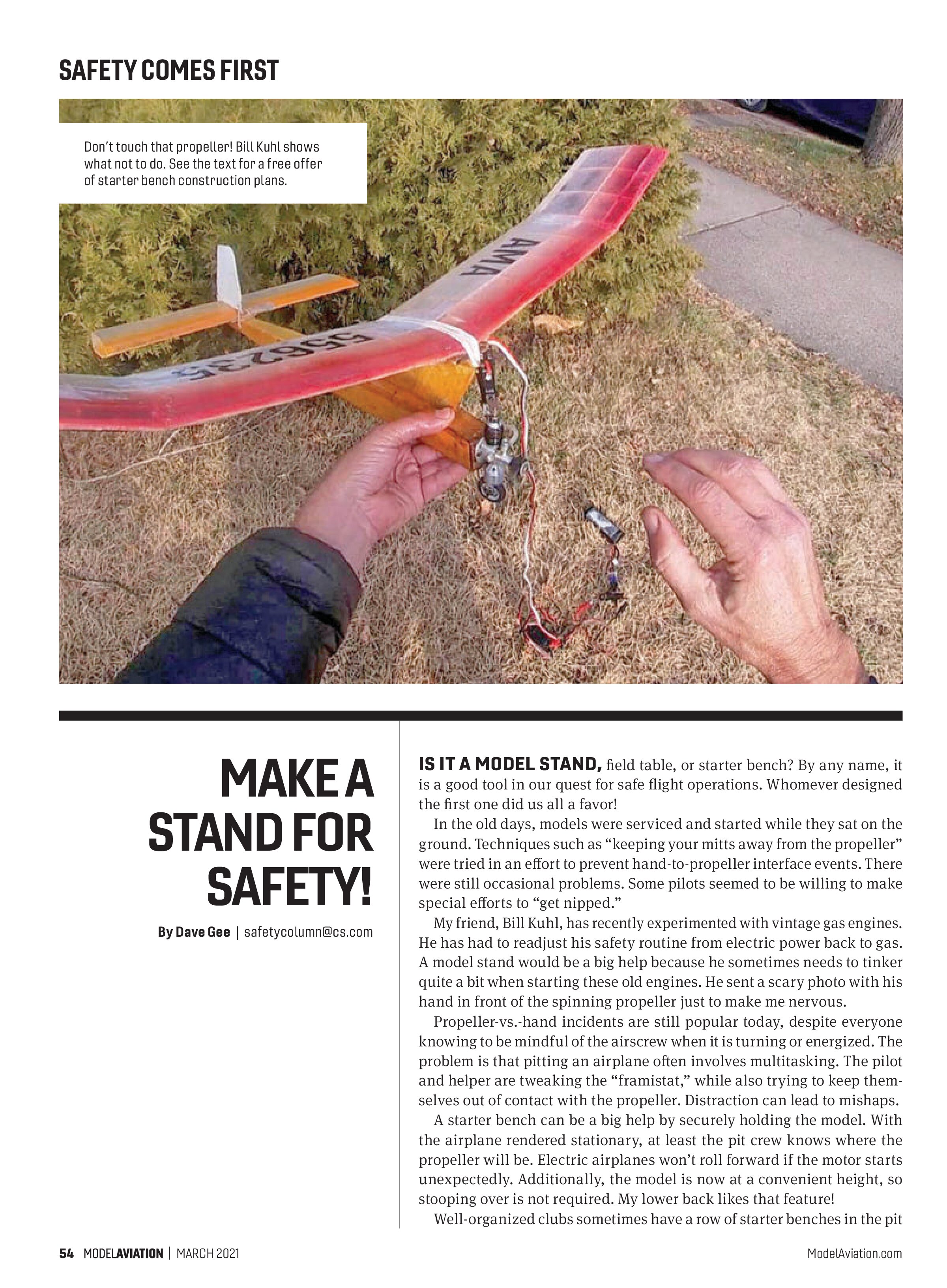
My friend, Bill Kuhl, has recently experimented with vintage gas engines. He has had to readjust his safety routine from electric power back to gas. A model stand would be a big help because he sometimes needs to tinker quite a bit when starting these old engines. He sent a scary photo with his hand in front of the spinning propeller just to make me nervous.
Propeller-vs.-hand incidents are still popular today, despite everyone knowing to be mindful of the airscrew when it is turning or energized. The problem is that pitting an airplane often involves multitasking. The pilot and helper are tweaking the “framistat,” while also trying to keep themselves out of contact with the propeller. Distraction can lead to mishaps.
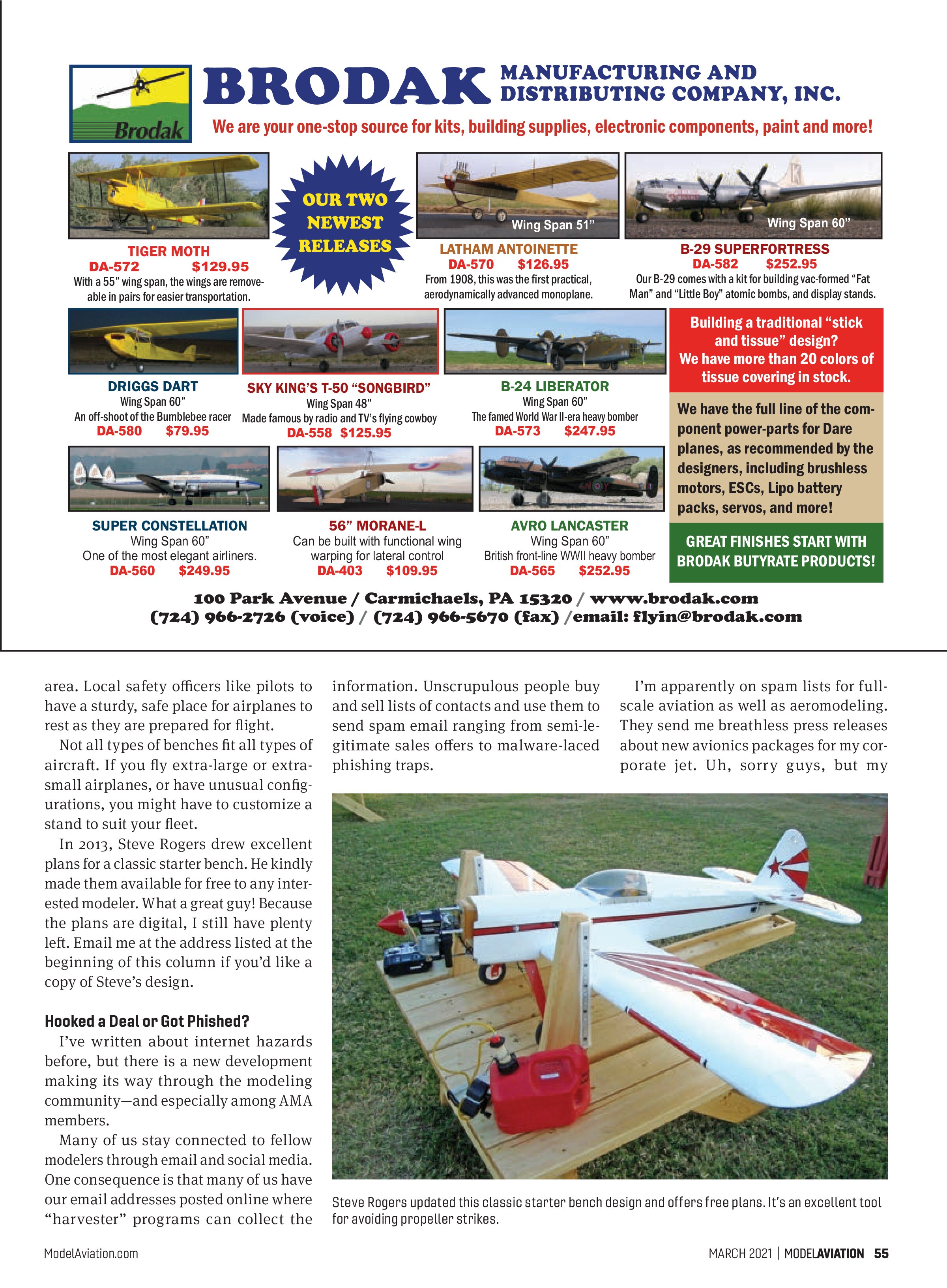
A starter bench can be a big help by securely holding the model. With the airplane rendered stationary, at least the pit crew knows where the propeller will be. Electric airplanes won’t roll forward if the motor starts unexpectedly. Additionally, the model is now at a convenient height, so stooping over is not required. My lower back likes that feature!
Well-organized clubs sometimes have a row of starter benches in the pit area. Local safety officers like pilots to have a sturdy, safe place for airplanes to rest as they are prepared for flight.
Not all types of benches fit all types of aircraft. If you fly extra-large or extra-small airplanes, or have unusual configurations, you might have to customize a stand to suit your fleet.
In 2013, Steve Rogers drew excellent plans for a classic starter bench. He kindly made them available for free to any interested modeler. What a great guy! Because the plans are digital, I still have plenty left. Email me at the address listed at the beginning of this column if you’d like a copy of Steve’s design.
Hooked a Deal or Got Phished?
I’ve written about internet hazards before, but there is a new development making its way through the modeling community—and especially among AMA members.
Many of us stay connected to fellow modelers through email and social media. One consequence is that many of us have our email addresses posted online where “harvester” programs can collect the information. Unscrupulous people buy and sell lists of contacts and use them to send spam email ranging from semi-legitimate sales offers to malware-laced phishing traps.
I’m apparently on spam lists for full-scale aviation as well as aeromodeling. They send me breathless press releases about new avionics packages for my corporate jet. Uh, sorry guys, but my

minivan still has a tape deck.
The dangerous part is that many modelers receive spontaneous email sales offers of RC equipment. Some messages claim to be from dealers selling new merchandise, and others purport to be individuals with used models and radios that are always at a great price. Sometimes the ad offers you a chance to “unsubscribe by clicking here.” Hmm ... spam email with a blind link to click? Nope, not going to fall for that old trick!
In my opinion, unsolicited messages sent to stolen addresses are automatically suspect. Then comes the questions about how the second-hand gear was obtained. Airplanes and helicopters are sometimes stolen and the thief has to find a way to convert the loot into cash. Or maybe it’s a legitimate “estate purchase,” but who knows? I’m not likely to correspond with some unknown entity to find out.
Throughout many decades, I’ve found that mail-order modeling suppliers are some of the best dealers around. It’s a shame when scammers try to take advantage of this culture. Please think twice—or thrice—when confronted with an unsolicited email offer that might seem too good to be true.
Mystery Airplane
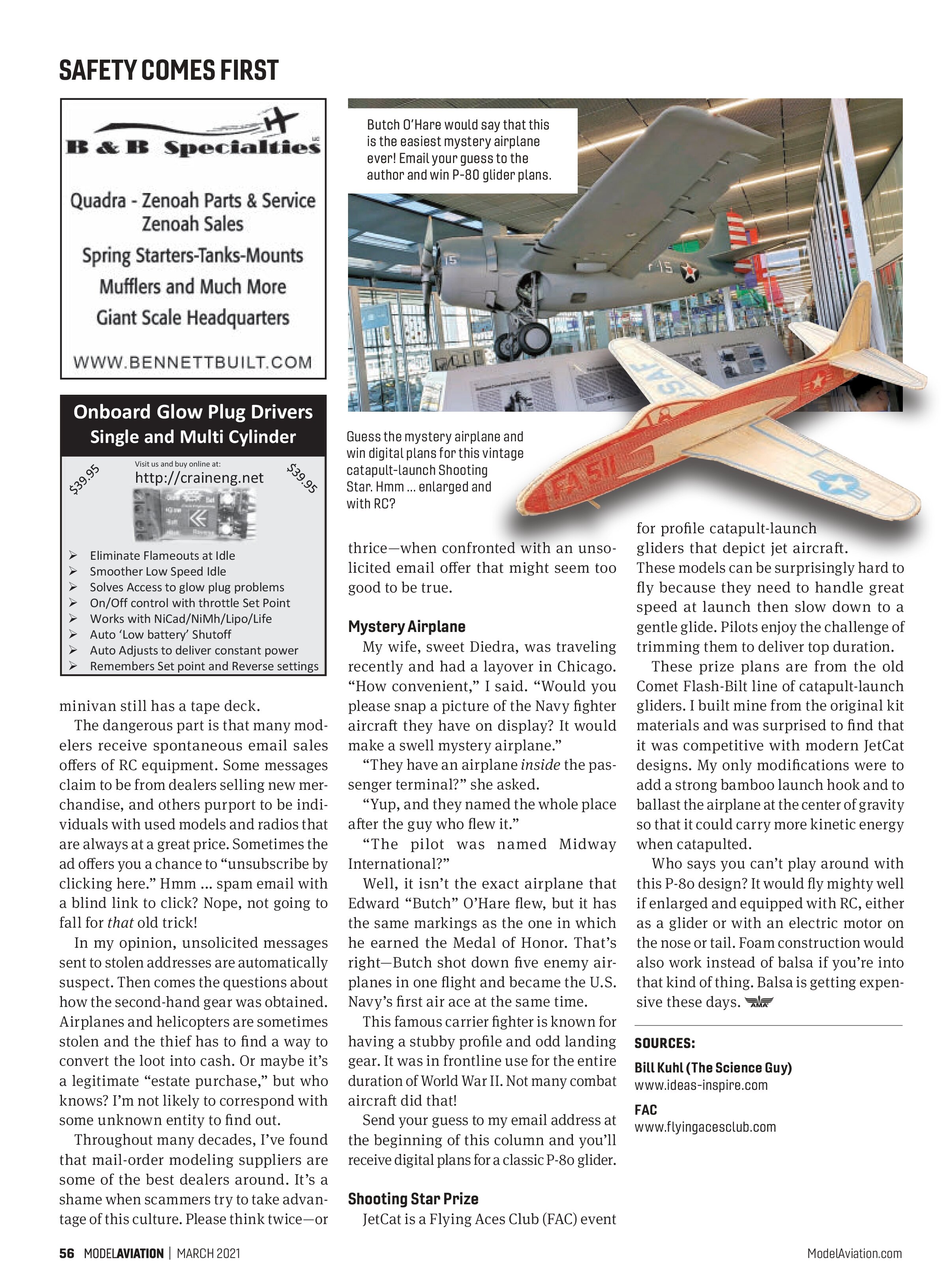
My wife, sweet Diedra, was traveling recently and had a layover in Chicago. “How convenient,” I said. “Would you please snap a picture of the Navy fighter aircraft they have on display? It would make a swell mystery airplane.”
“They have an airplane inside the passenger terminal?” she asked.
“Yup, and they named the whole place after the guy who flew it.”
“The pilot was named Midway International?”
Well, it isn’t the exact airplane that Edward “Butch” O’Hare flew, but it has the same markings as the one in which he earned the Medal of Honor. That’s right—Butch shot down five enemy airplanes in one flight and became the U.S. Navy’s first air ace at the same time.
This famous carrier fighter is known for having a stubby profile and odd landing gear. It was in frontline use for the entire duration of World War II. Not many combat aircraft did that!
Send your guess to my email address at the beginning of this column and you’ll receive digital plans for a classic P-80 glider.
Shooting Star Prize
JetCat is a Flying Aces Club (FAC) event


These prize plans are from the old Comet Flash-Bilt line of catapult-launch gliders. I built mine from the original kit materials and was surprised to find that it was competitive with modern JetCat designs. My only modifications were to add a strong bamboo launch hook and to ballast the airplane at the center of gravity so that it could carry more kinetic energy when catapulted.
Who says you can’t play around with this P-80 design? It would fly mighty well if enlarged and equipped with RC, either as a glider or with an electric motor on the nose or tail. Foam construction would also work instead of balsa if you’re into that kind of thing. Balsa is getting expensive these days.
SOURCES:
Bill Kuhl (The Science Guy)
www.ideas-inspire.com