A GLIMPSE INTO PYLON RACING
By Tim Lampe | tim.lampe@hotmail.com

SOMETIMES I WORRY that my column falls short in providing substance to Pylon Racing’s most accomplished pilots, but then I remember that my audience is composed of model aviation enthusiasts and Pylon Racing pilots of all skill levels, so my main goal is simply to entertain as many readers as possible for the time it takes to read it.
This month’s column might not be a model for recruiting new Pylon Racing pilots. I’ll try to deliver on that another time. This time, I want to give readers another glimpse into Pylon Racing. I didn’t set out to write about myself, but my experiences are common and typical of many pilots and, in the end, might be encouraging.
Just two days before I wrote this, I was moping around the pits during what was shaping up to be a mediocre performance at the Cliff Telford Memorial Tangerine Pylon Race, held December 5-6, 2020, at the Remote Control Association of Central Florida flying site in Apopka, Florida.
During the testing session two days before the event, I had destroyed my newest Quarter 40 (Q-40) aircraft when I allowed it to get slightly off course and drift into the tree line at approximately 200 mph. I am told not to fall in love with my airplanes, but I do anyway. When things such as this happen, you can either quit or pull out another airplane and get back on the horse which, because I’m trying to be a legitimate Pylon Racing pilot, I did.
My average performance for Saturday’s Super Sport Quickie 500 (Q-500) race didn’t exactly cheer me up. I wasn’t walking around with my head down, but whatever our individual expectations, I think we all hope to perform at least up to our skill level. This is when we remind ourselves to enjoy the occasion and reflect on more important things in life, such as friends and family. I know that none of these are a given.
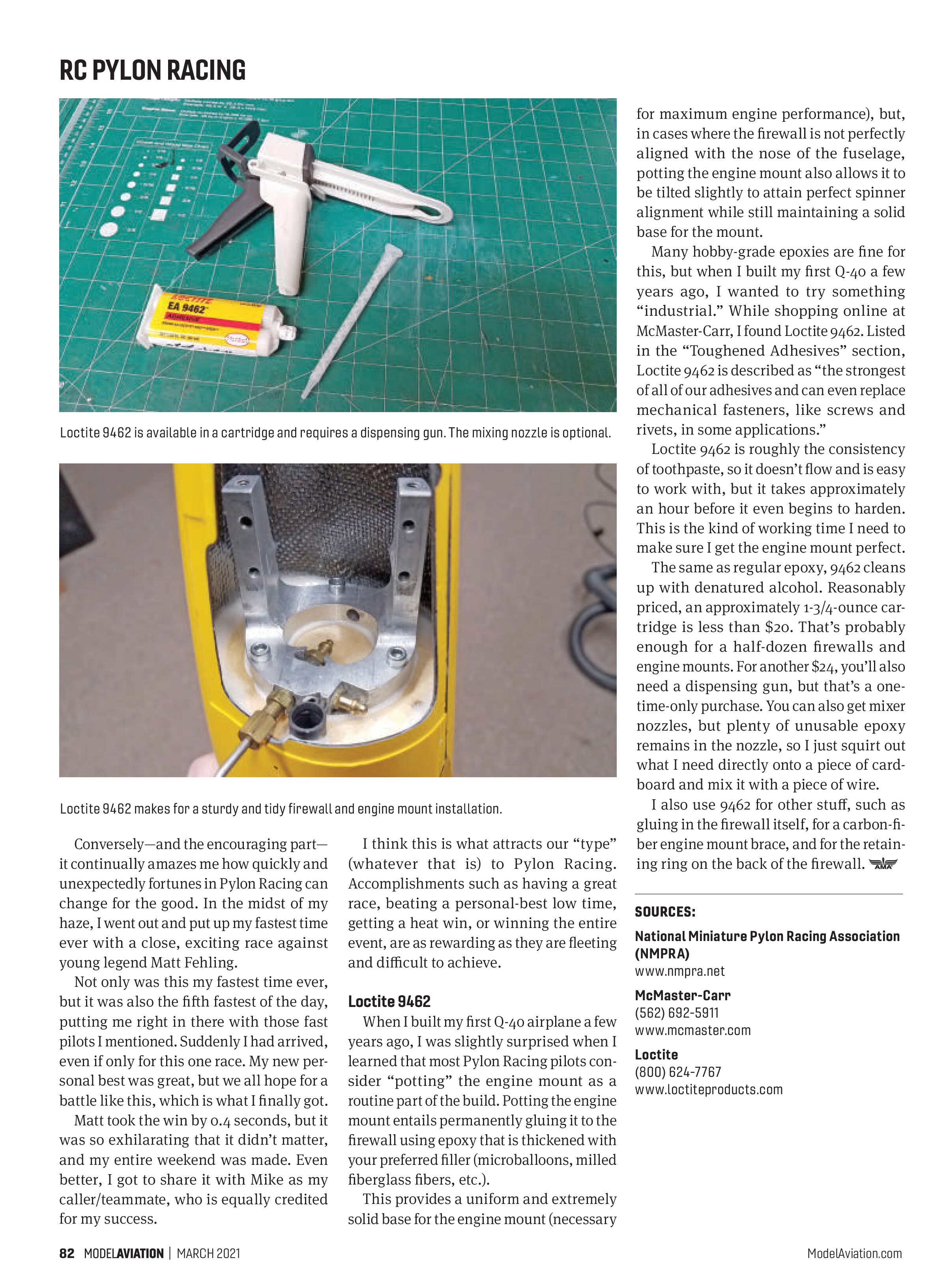
During Sunday’s Q-40 racing, I looked around and realized that I wasn’t the only one having a less-than-spectacular day. The field was loaded with many of the fastest pilots in the country (and a few of the fastest in the world), whom I look up to and respect. But the fastest race times posted for most of these competitors were all with a cut (meaning they never got a clean, 10-lap time). Some of them even had a few races with double cuts, resulting in no points at all from that heat. My teammate, Mike Helsel, who always finishes on the podium (he won Saturday’s Q-500 event), won three of his Q-40 races, but suffered a cut in one round and an engine failure in another.
When I looked around and realized the difficulty that pilots who are much better than I were also experiencing, it didn’t make me feel good, but it reminded me just how hard it is—whether you’re still trying to climb the ladder or have already made it to the top—to perform up to one’s expectations every time.
I’m not sure what my point is, and I suppose I’m rambling, but I’m simply trying to explain that in extremely close, head-to-head competition such as Pylon Racing, the difference between being successful and “being unsuccessful” can be miniscule but punishing. Probably the only competitor who doesn’t wish that he or she would have done better is the one holding the first-place trophy.


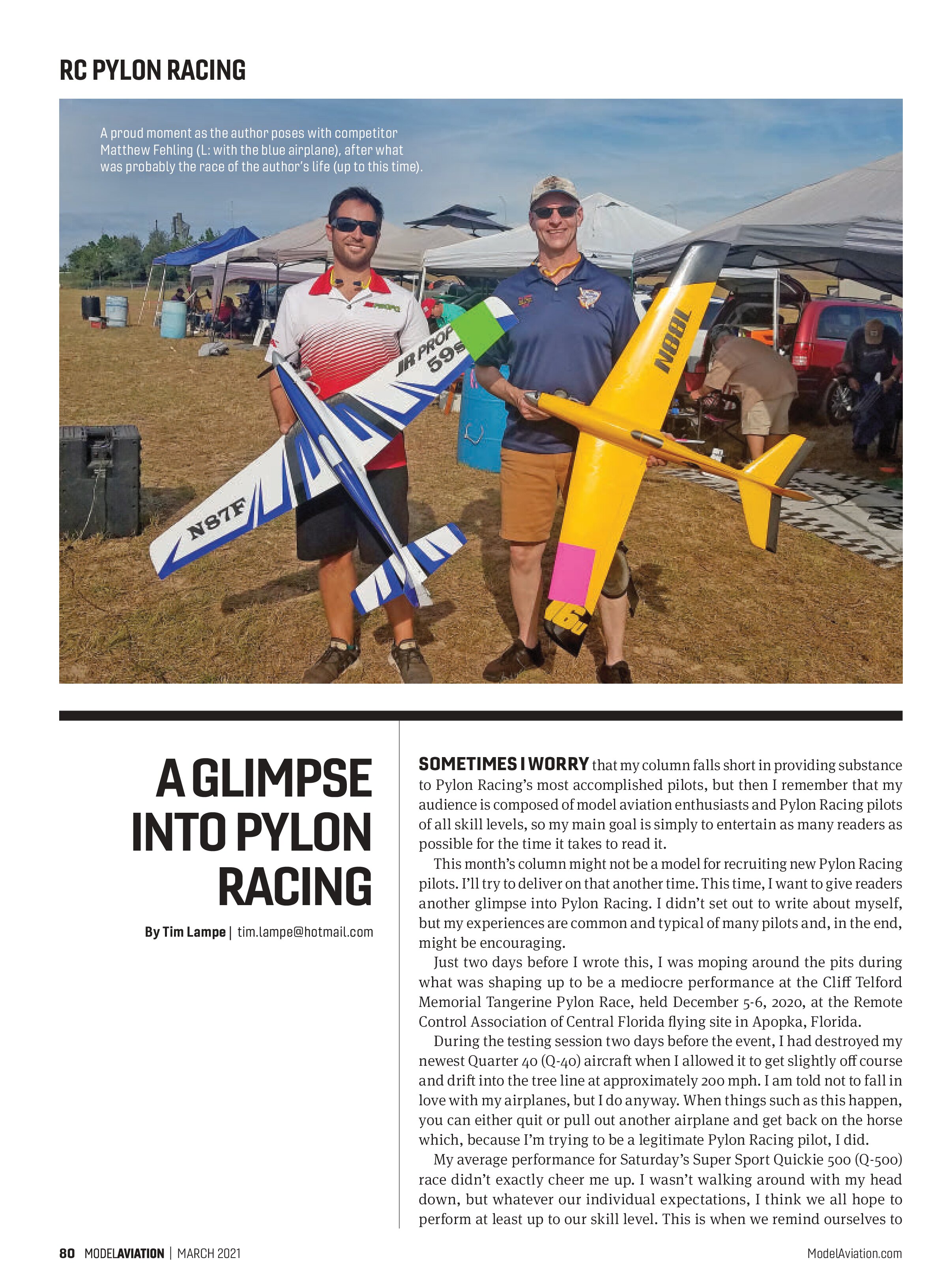
Conversely—and the encouraging part—it continually amazes me how quickly and unexpectedly fortunes in Pylon Racing can change for the good. In the midst of my haze, I went out and put up my fastest time ever with a close, exciting race against young legend Matt Fehling.
Not only was this my fastest time ever, but it was also the fifth fastest of the day, putting me right in there with those fast pilots I mentioned. Suddenly I had arrived, even if only for this one race. My new personal best was great, but we all hope for a battle like this, which is what I finally got.
Matt took the win by 0.4 seconds, but it was so exhilarating that it didn’t matter, and my entire weekend was made. Even better, I got to share it with Mike as my caller/teammate, who is equally credited for my success.
I think this is what attracts our “type” (whatever that is) to Pylon Racing. Accomplishments such as having a great race, beating a personal-best low time, getting a heat win, or winning the entire event, are as rewarding as they are fleeting and difficult to achieve.
Loctite 9462
When I built my first Q-40 airplane a few years ago, I was slightly surprised when I learned that most Pylon Racing pilots consider “potting” the engine mount as a routine part of the build. Potting the engine mount entails permanently gluing it to the firewall using epoxy that is thickened with your preferred filler (microballoons, milled fiberglass fibers, etc.).
This provides a uniform and extremely solid base for the engine mount (necessary for maximum engine performance), but, in cases where the firewall is not perfectly aligned with the nose of the fuselage, potting the engine mount also allows it to be tilted slightly to attain perfect spinner alignment while still maintaining a solid base for the mount.
Many hobby-grade epoxies are fine for this, but when I built my first Q-40 a few years ago, I wanted to try something “industrial.” While shopping online at McMaster-Carr, I found Loctite 9462. Listed in the “Toughened Adhesives” section, Loctite 9462 is described as “the strongest of all of our adhesives and can even replace mechanical fasteners, like screws and rivets, in some applications.”
Loctite 9462 is roughly the consistency of toothpaste, so it doesn’t flow and is easy to work with, but it takes approximately an hour before it even begins to harden. This is the kind of working time I need to make sure I get the engine mount perfect.
The same as regular epoxy, 9462 cleans up with denatured alcohol. Reasonably priced, an approximately 1-3/4-ounce cartridge is less than $20. That’s probably enough for a half-dozen firewalls and engine mounts. For another $24, you’ll also need a dispensing gun, but that’s a one-time-only purchase. You can also get mixer nozzles, but plenty of unusable epoxy remains in the nozzle, so I just squirt out what I need directly onto a piece of cardboard and mix it with a piece of wire.
I also use 9462 for other stuff, such as gluing in the firewall itself, for a carbon-fiber engine mount brace, and for the retaining ring on the back of the firewall.
Sources:
National Miniature Pylon Racing Association (NMPRA)
www.nmpra.net
McMaster-Carr
(562) 692-5911
www.mcmaster.com
Loctite
(800) 624-7767
www.loctiteproducts.com