DESIGNING AND BUILDING THE L4-J GRASSHOPPER, PART TWO
By Joe Malinchak | joemal@echoes.net
PILOTS NEED TO KNOW as much as possible about the aircraft they are flying before they can safely fly them. This normally means studying all of the systems and flight procedures.
When designing a model of my Piper L4-J Grasshopper, I learned even more. Studying the airplane through a modeler’s eyes means looking at it in a different way. Covering, rib spacing, stitching, rivets, panel lines, color/markings, and the outline of the airplane are only a few things to look at closely.
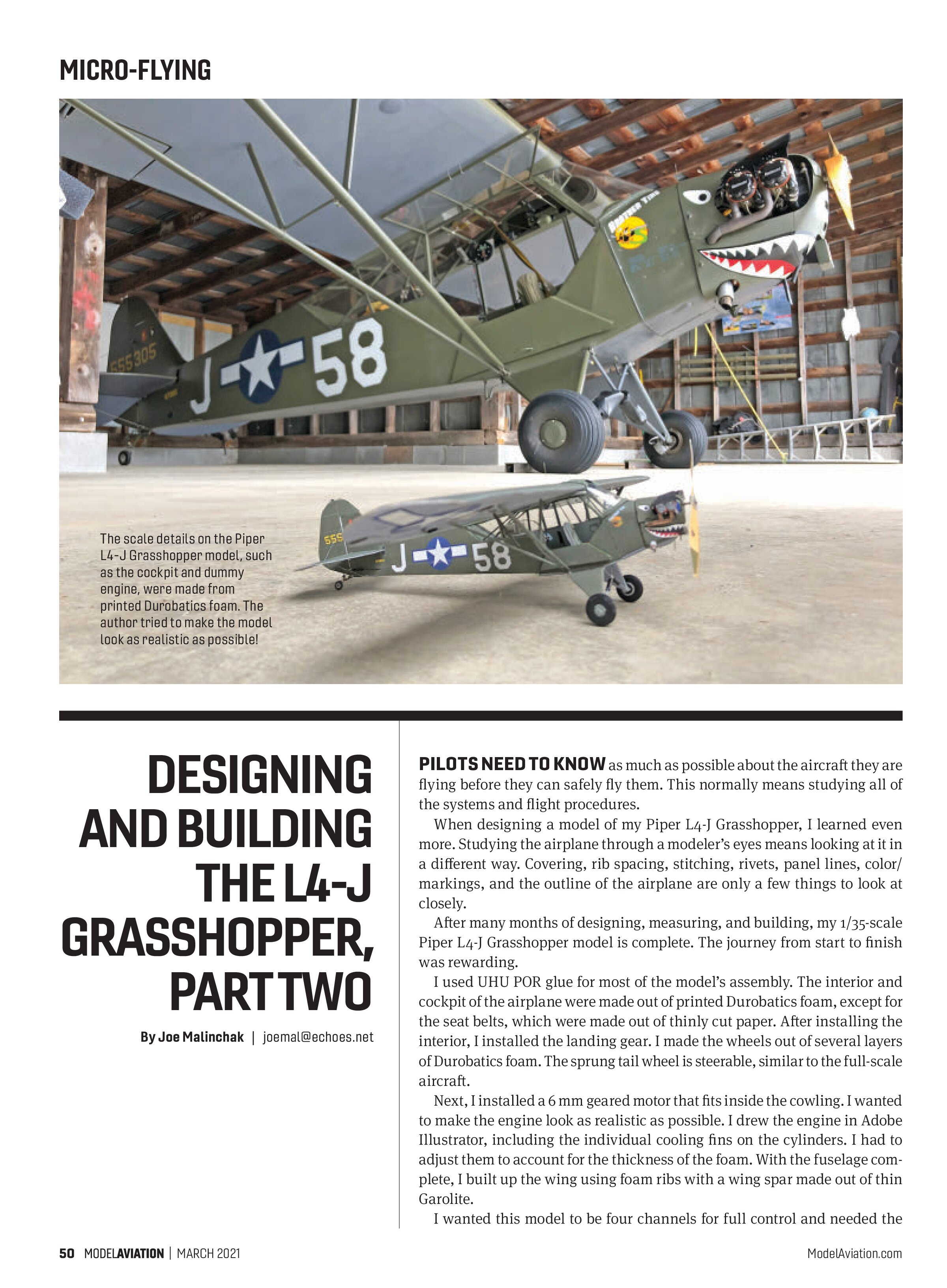
After many months of designing, measuring, and building, my 1/35-scale Piper L4-J Grasshopper model is complete. The journey from start to finish was rewarding.
I used UHU POR glue for most of the model’s assembly. The interior and cockpit of the airplane were made out of printed Durobatics foam, except for the seat belts, which were made out of thinly cut paper. After installing the interior, I installed the landing gear. I made the wheels out of several layers of Durobatics foam. The sprung tail wheel is steerable, similar to the full-scale aircraft.
Next, I installed a 6 mm geared motor that fits inside the cowling. I wanted to make the engine look as realistic as possible. I drew the engine in Adobe Illustrator, including the individual cooling fins on the cylinders. I had to adjust them to account for the thickness of the foam. With the fuselage complete, I built up the wing using foam ribs with a wing spar made out of thin Garolite.
I wanted this model to be four channels for full control and needed the most lightweight, commercially available equipment. I used two Micro Flier Radio 400 mg servos that fit perfectly in each wing half. I routed the pushrod out of the scale location and ran the servo wire down the wing strut to simulate the aileron cable.
I also used two 400 mg servos for rudder and elevator control. To save even more weight, I used the new 185 mg Micro Flier Radio Hip Hop II Grasshopper Receiver in my Grasshopper model! After soldering all of the wires, I neatly tucked the receiver under the foam fuel tank in the nose.
After adding the rest of the scale details, the completed model weighed 12.9 grams ready to fly with a 50 mAh LiPo battery. The first flights went well. The model is not aerobatic, but it flies as I had hoped, in a scalelike manner!
What’s New
Hobby Club is distributing several new laser-cut balsa micro RC kits from Tony Ray’s Aero Model Co. The Etrich Dove (Taube) has an 18-inch wingspan with an average flying weight of 40 grams. The Bleriot XI has a 16.5-inch wingspan and weighs 35 grams.
Readers might recall Gordon Johnson’s wonderful micro Cartoon Scale Fokker Dr.1 triplane that was featured in this column some time ago. Gordon’s Cartoon Scale airplanes are laser-cut, skeletonized-foam covered with lightweight Mylar. Gordon has recently decided to kit his Fokker triplane.
The triplane has a 12-inch wingspan and, when built with an E-flite UMX Vapor receiver brick and gearbox, it weighs a mere 20 grams. It can fly slowly but can also fly fast. It can fly in circles as small as 15 feet in diameter. It is very nice for flying in a


The completed 12-inch wingspan model is shown with a 1/35-scale RC Willys Jeep. It weighs 12.9 grams ready to fly with a 50 mAh LiPo battery.
gym or outdoors in calm conditions.
The kits have covered airframe parts and are ready to assemble. They include all of the wire, carbon-fiber rod, etc. The builder supplies a Vapor or equivalent receiver servo brick and gearbox. Kits are priced at $90 and can be ordered by contacting Gordon at the email provided in “Sources.”

I will review the Cartoon Scale Dr.I kit in a future column, as well as the Tony Ray’s kits from Hobby Club.
Hobby Club is distributing these great, new micro RC laser-cut kits from Tony Ray’s Aero Model Co. The Etrich Taube has an 18-inch wingspan, and the Bleriot has a 16.5-inch wingspan.

Gordon Johnson’s wonderful 12-inch wingspan Dr.I triplane will be offered as a kit with covered airframe parts that are ready to assemble.
SOURCES:
Micro Flier Radio
(941) 377-9808
www.microflierradio.com
Hobby Club
(949) 425-1362
www.hobbyclub.com
Tony Ray’s Aero Model Co.
www.tonyrayaeromodels.co.uk
Gordon Johnson
gordon10402@gmail.com