THE FASTEST E-FLITE AIRPLANE YET!
Horizon Hobby E-flite V1200 1.2m BNF Basic With Smart Technology
By Jon Barnes | barnesjon@gmail.com
Photos by the author

IN AUTUMN 2018, E-flite caught the attention of speed-hungry RC pilots with the release of its speed-focused V900. Reviewed in the March 2019 edition of Model Aviation, this hand-launched, EPO foam-composition model was capable of achieving triple-digit speeds using modestly sized three- and four-cell LiPo batteries. It was proudly promoted as the fastest out-of-the-box model yet produced by E-flite’s engineers!
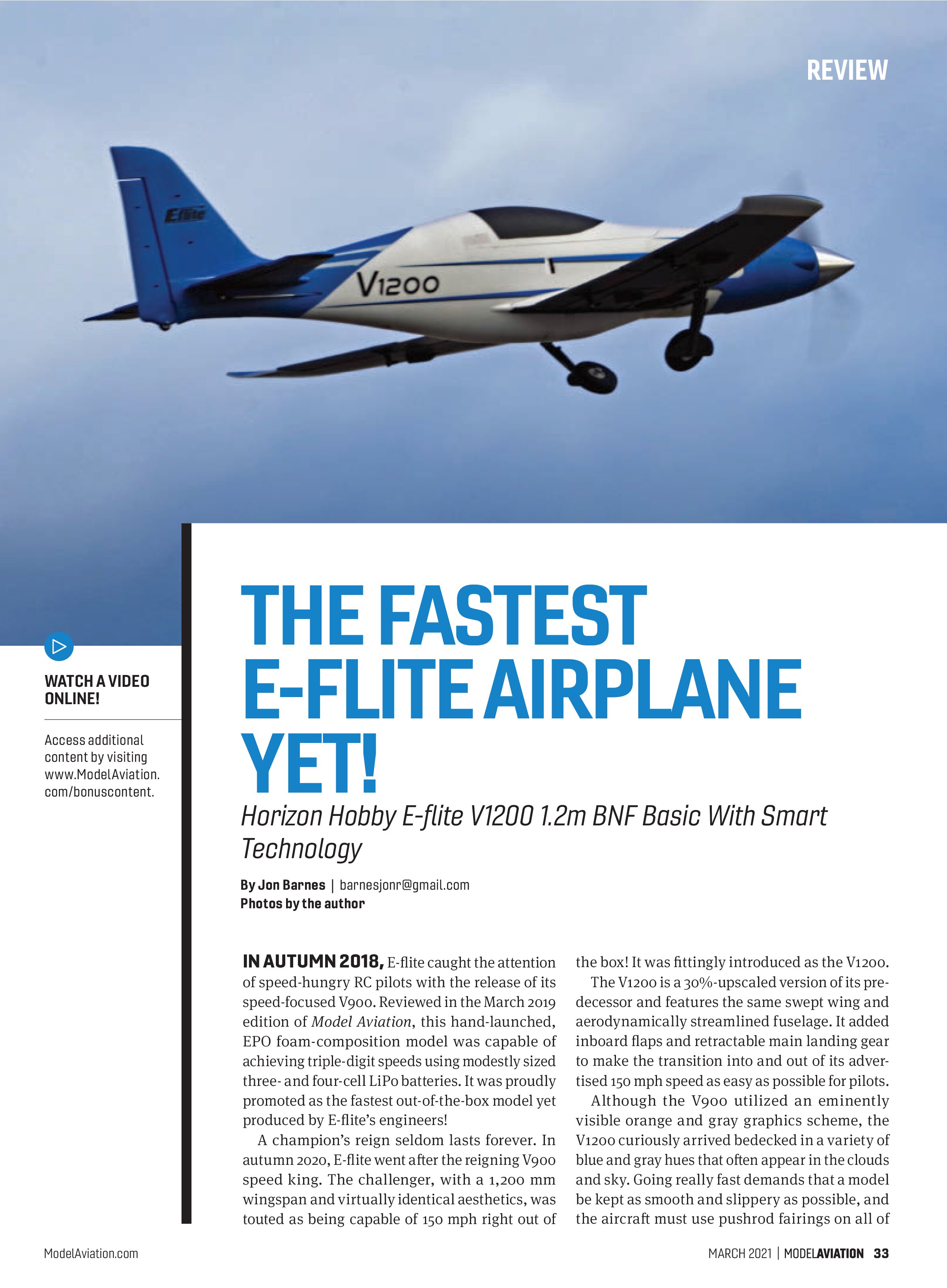
A champion’s reign seldom lasts forever. In autumn 2020, E-flite went after the reigning V900 speed king. The challenger, with a 1,200 mm wingspan and virtually identical aesthetics, was touted as being capable of 150 mph right out of the box! It was fittingly introduced as the V1200.
The V1200 is a 30%-upscaled version of its predecessor and features the same swept wing and aerodynamically streamlined fuselage. It added inboard flaps and retractable main landing gear to make the transition into and out of its advertised 150 mph speed as easy as possible for pilots.
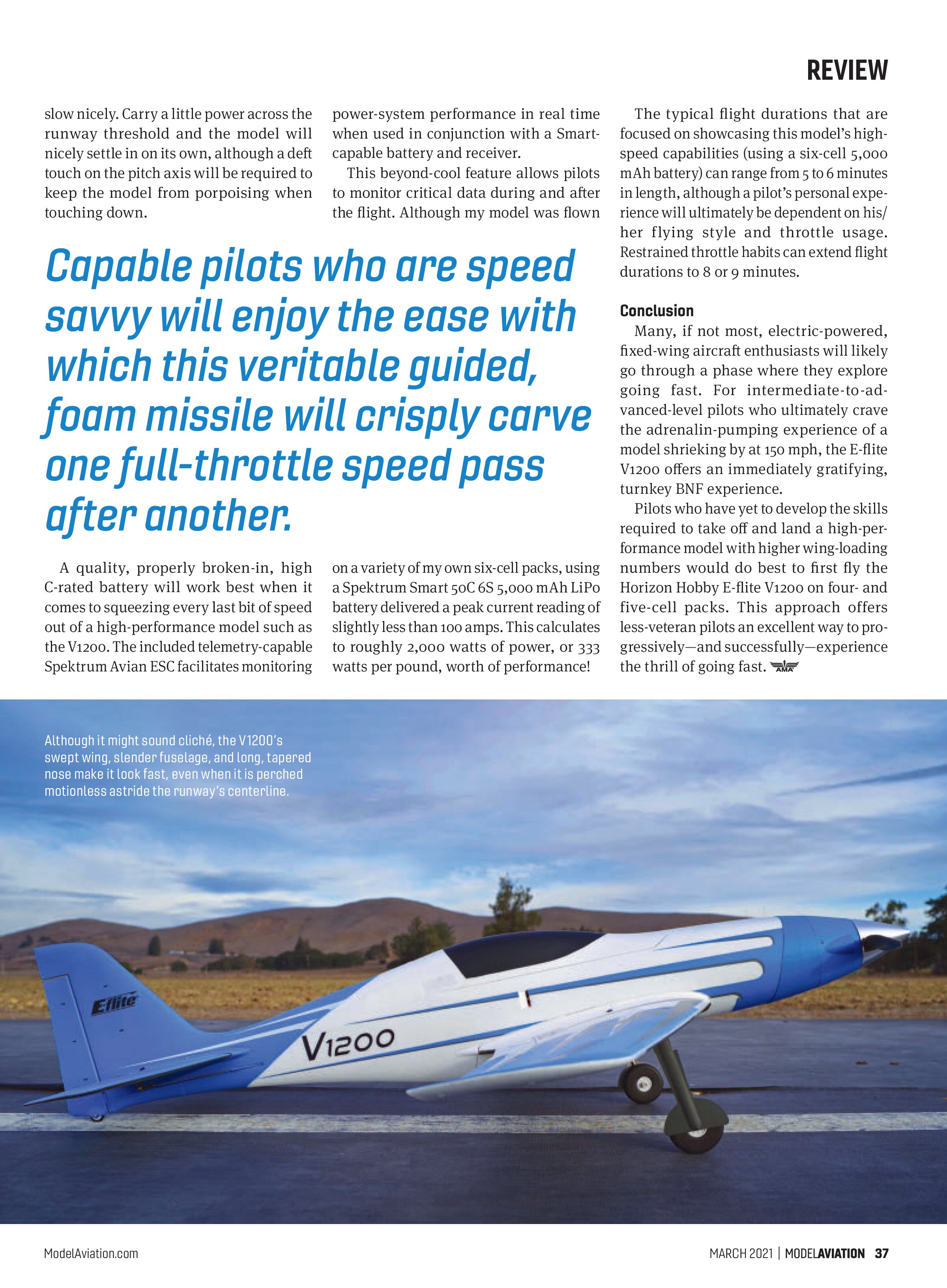
Although the V900 utilized an eminently visible orange and gray graphics scheme, the V1200 curiously arrived bedecked in a variety of blue and gray hues that often appear in the clouds and sky. Going really fast demands that a model be kept as smooth and slippery as possible, and the aircraft must use pushrod fairings on all of
the flap and aileron pushrods.
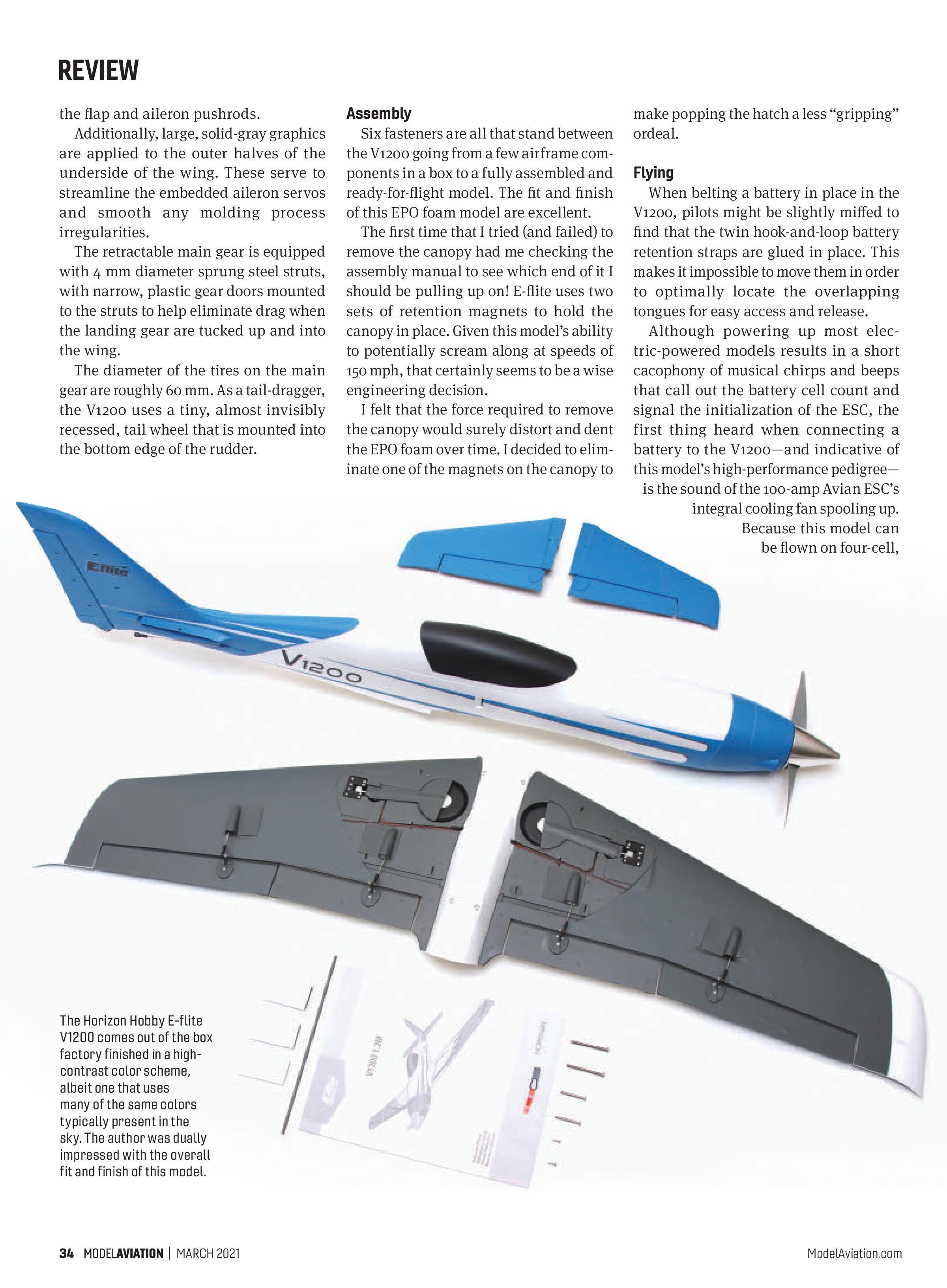
Additionally, large, solid-gray graphics are applied to the outer halves of the underside of the wing. These serve to streamline the embedded aileron servos and smooth any molding process irregularities.
The retractable main gear is equipped with 4 mm diameter sprung steel struts, with narrow, plastic gear doors mounted to the struts to help eliminate drag when the landing gear are tucked up and into the wing.
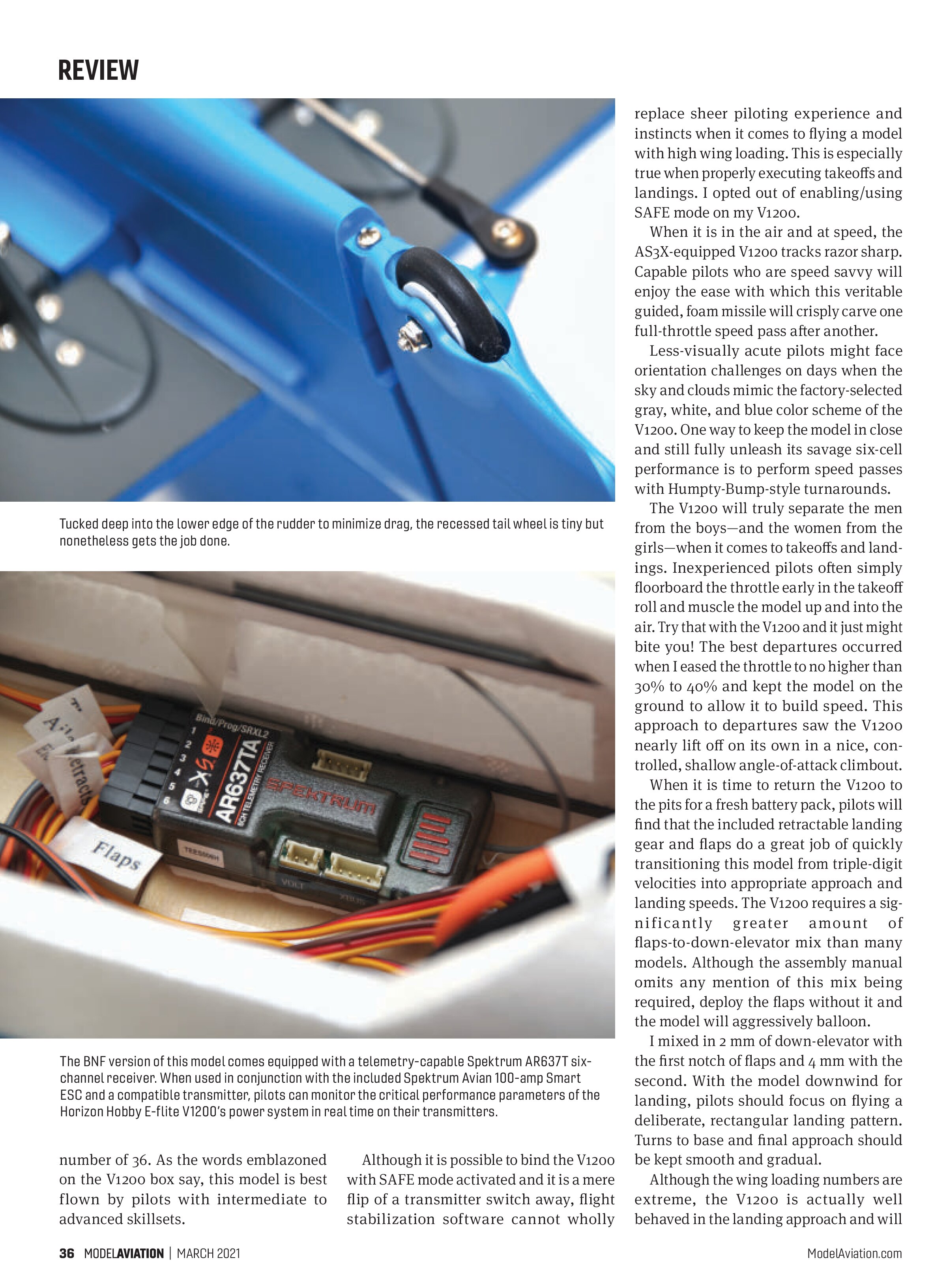
The diameter of the tires on the main gear are roughly 60 mm. As a tail-dragger, the V1200 uses a tiny, almost invisibly recessed, tail wheel that is mounted into the bottom edge of the rudder.
Assembly
Six fasteners are all that stand between the V1200 going from a few airframe components in a box to a fully assembled and ready-for-flight model. The fit and finish of this EPO foam model are excellent.
The first time that I tried (and failed) to remove the canopy had me checking the assembly manual to see which end of it I should be pulling up on! E-flite uses two sets of retention magnets to hold the canopy in place. Given this model’s ability to potentially scream along at speeds of 150 mph, that certainly seems to be a wise engineering decision.
I felt that the force required to remove the canopy would surely distort and dent the EPO foam over time. I decided to eliminate one of the magnets on the canopy to make popping the hatch a less “gripping” ordeal.

Flying
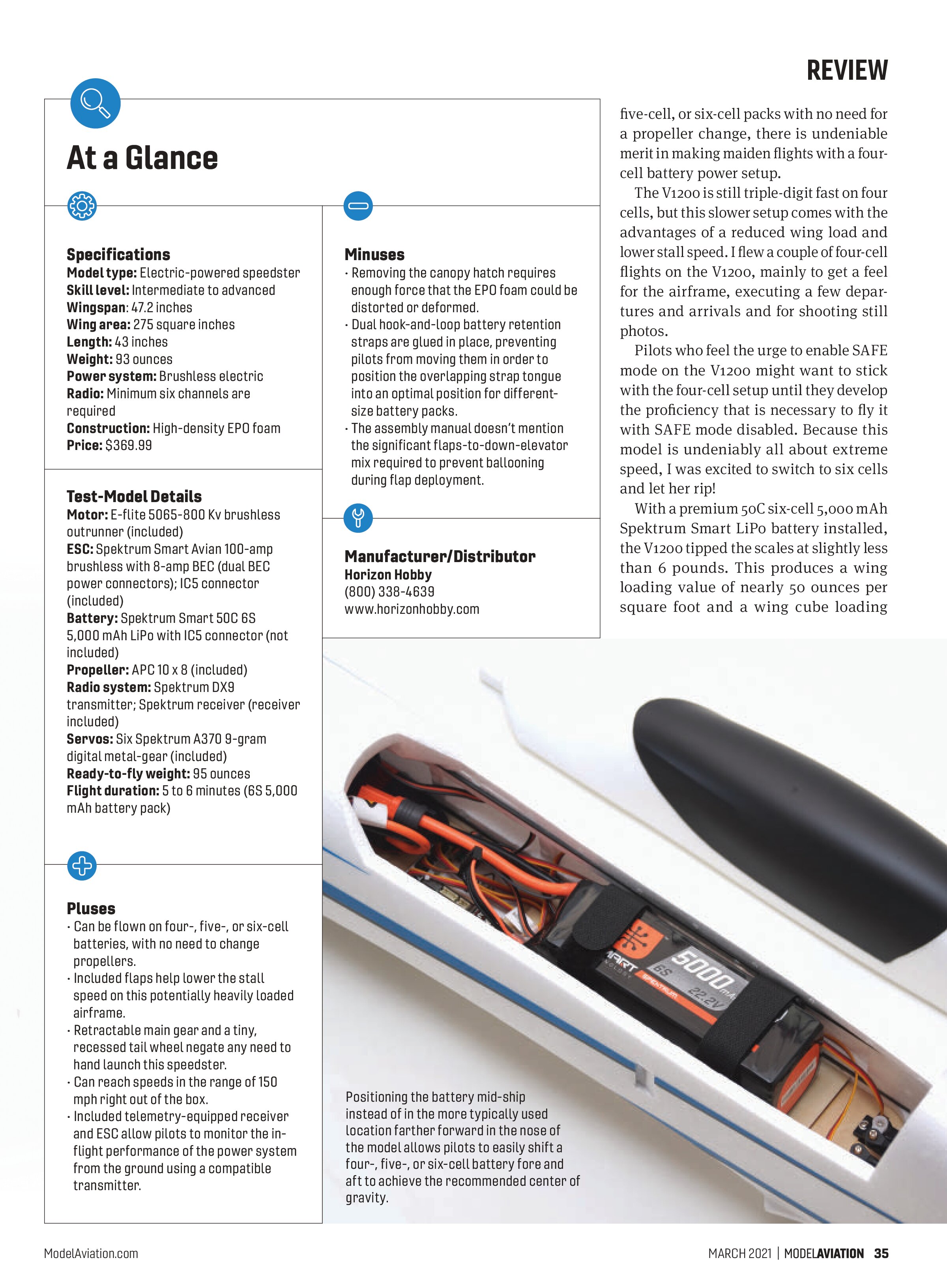
When belting a battery in place in the V1200, pilots might be slightly miffed to find that the twin hook-and-loop battery retention straps are glued in place. This makes it impossible to move them in order to optimally locate the overlapping tongues for easy access and release.
Although powering up most electric-powered models results in a short cacophony of musical chirps and beeps that call out the battery cell count and signal the initialization of the ESC, the first thing heard when connecting a battery to the V1200—and indicative of this model’s high-performance pedigree—is the sound of the 100-amp Avian ESC’s integral cooling fan spooling up.
Because this model can be flown on four-cell, five-cell, or six-cell packs with no need for a propeller change, there is undeniable merit in making maiden flights with a four-cell battery power setup.
The V1200 is still triple-digit fast on four cells, but this slower setup comes with the advantages of a reduced wing load and lower stall speed. I flew a couple of four-cell flights on the V1200, mainly to get a feel for the airframe, executing a few departures and arrivals and for shooting still photos.
Pilots who feel the urge to enable SAFE mode on the V1200 might want to stick with the four-cell setup until they develop the proficiency that is necessary to fly it with SAFE mode disabled. Because this model is undeniably all about extreme speed, I was excited to switch to six cells and let her rip!
With a premium 50C six-cell 5,000 mAh Spektrum Smart LiPo battery installed, the V1200 tipped the scales at slightly less than 6 pounds. This produces a wing loading value of nearly 50 ounces per square foot and a wing cube loading
At a Glance
Specifications
Model type: Electric-powered speedster
Skill level: Intermediate to advanced
Wingspan: 47.2 inches
Wing area: 275 square inches
Length: 43 inches
Weight: 93 ounces
Power system: Brushless electric
Radio: Minimum six channels are required
Construction: High-density EPO foam
Price: $369.99
Test-Model Details
Motor: E-flite 5065-800 Kv brushless outrunner (included)
ESC: Spektrum Smart Avian 100-amp brushless with 8-amp BEC (dual BEC power connectors); IC5 connector (included)
Battery: Spektrum Smart 50C 6S 5,000 mAh LiPo with IC5 connector (not included)
Propeller: APC 10 x 8 (included)
Radio system: Spektrum DX9 transmitter; Spektrum receiver (receiver included)
Servos: Six Spektrum A370 9-gram digital metal-gear (included)
Ready-to-fly weight: 95 ounces
Flight duration: 5 to 6 minutes (6S 5,000 mAh battery pack)
Minuses
- Removing the canopy hatch requires enough force that the EPO foam could be distorted or deformed.
- Dual hook-and-loop battery retention straps are glued in place, preventing pilots from moving them in order to position the overlapping strap tongue into an optimal position for different-size battery packs.
- The assembly manual doesn’t mention the significant flaps-to-down-elevator mix required to prevent ballooning during flap deployment.
Manufacturer/Distributor
Horizon Hobby
(800) 338-4639
www.horizonhobby.com
Pluses
- Can be flown on four-, five-, or six-cell batteries, with no need to change propellers.
- Included flaps help lower the stall speed on this potentially heavily loaded airframe.
- Retractable main gear and a tiny, recessed tail wheel negate any need to hand launch this speedster.
- Can reach speeds in the range of 150 mph right out of the box.
- Included telemetry-equipped receiver and ESC allow pilots to monitor the in-flight performance of the power system from the ground using a compatible transmitter.

number of 36. As the words emblazoned on the V1200 box say, this model is best flown by pilots with intermediate to advanced skillsets.
Although it is possible to bind the V1200 with SAFE mode activated and it is a mere flip of a transmitter switch away, flight stabilization software cannot wholly
replace sheer piloting experience and instincts when it comes to flying a model with high wing loading. This is especially true when properly executing takeoffs and landings. I opted out of enabling/using SAFE mode on my V1200.

When it is in the air and at speed, the AS3X-equipped V1200 tracks razor sharp. Capable pilots who are speed savvy will enjoy the ease with which this veritable guided, foam missile will crisply carve one full-throttle speed pass after another.
Less-visually acute pilots might face orientation challenges on days when the sky and clouds mimic the factory-selected gray, white, and blue color scheme of the V1200. One way to keep the model in close and still fully unleash its savage six-cell performance is to perform speed passes with Humpty-Bump-style turnarounds.
The V1200 will truly separate the men from the boys—and the women from the girls—when it comes to takeoffs and landings. Inexperienced pilots often simply floorboard the throttle early in the takeoff roll and muscle the model up and into the air. Try that with the V1200 and it just might bite you! The best departures occurred when I eased the throttle to no higher than 30% to 40% and kept the model on the ground to allow it to build speed. This approach to departures saw the V1200 nearly lift off on its own in a nice, controlled, shallow angle-of-attack climbout.

When it is time to return the V1200 to the pits for a fresh battery pack, pilots will find that the included retractable landing gear and flaps do a great job of quickly transitioning this model from triple-digit velocities into appropriate approach and landing speeds. The V1200 requires a significantly greater amount of flaps-to-down-elevator mix than many models. Although the assembly manual omits any mention of this mix being required, deploy the flaps without it and the model will aggressively balloon.
I mixed in 2 mm of down-elevator with the first notch of flaps and 4 mm with the second. With the model downwind for landing, pilots should focus on flying a deliberate, rectangular landing pattern. Turns to base and final approach should be kept smooth and gradual.
Although the wing loading numbers are extreme, the V1200 is actually well behaved in the landing approach and will slow nicely. Carry a little power across the runway threshold and the model will nicely settle in on its own, although a deft touch on the pitch axis will be required to keep the model from porpoising when touching down.
power-system performance in real time when used in conjunction with a Smart-capable battery and receiver. This beyond-cool feature allows pilots to monitor critical data during and after the flight. Although my model was flown on a variety of my own six-cell packs, using a Spektrum Smart 50C 6S 5,000 mAh LiPo battery delivered a peak current reading of slightly less than 100 amps. This calculates to roughly 2,000 watts of power, or 333 watts per pound, worth of performance!
Capable pilots who are speed savvy will enjoy the ease with which this veritable guided, foam missile will crisply carve one full-throttle speed pass after another.
The typical flight durations that are focused on showcasing this model’s high-speed capabilities (using a six-cell 5,000 mAh battery) can range from 5 to 6 minutes in length, although a pilot’s personal experience will ultimately be dependent on his/her flying style and throttle usage. Restrained throttle habits can extend flight durations to 8 or 9 minutes.
Conclusion
Many, if not most, electric-powered, fixed-wing aircraft enthusiasts will likely go through a phase where they explore going fast. For intermediate-to-advanced-level pilots who ultimately crave the adrenaline-pumping experience of a model shrieking by at 150 mph, the E-flite V1200 offers an immediately gratifying, turnkey BNF experience.
Pilots who have yet to develop the skills required to take off and land a high-performance model with higher wing-loading numbers would do best to first fly the Horizon Hobby E-flite V1200 on four- and five-cell packs. This approach offers less-veteran pilots an excellent way to progressively—and successfully—experience the thrill of going fast.