GRUMMAN GREATS: THE F6F HELLCAT
By Dennis Norman | dennis@airac emodels.com

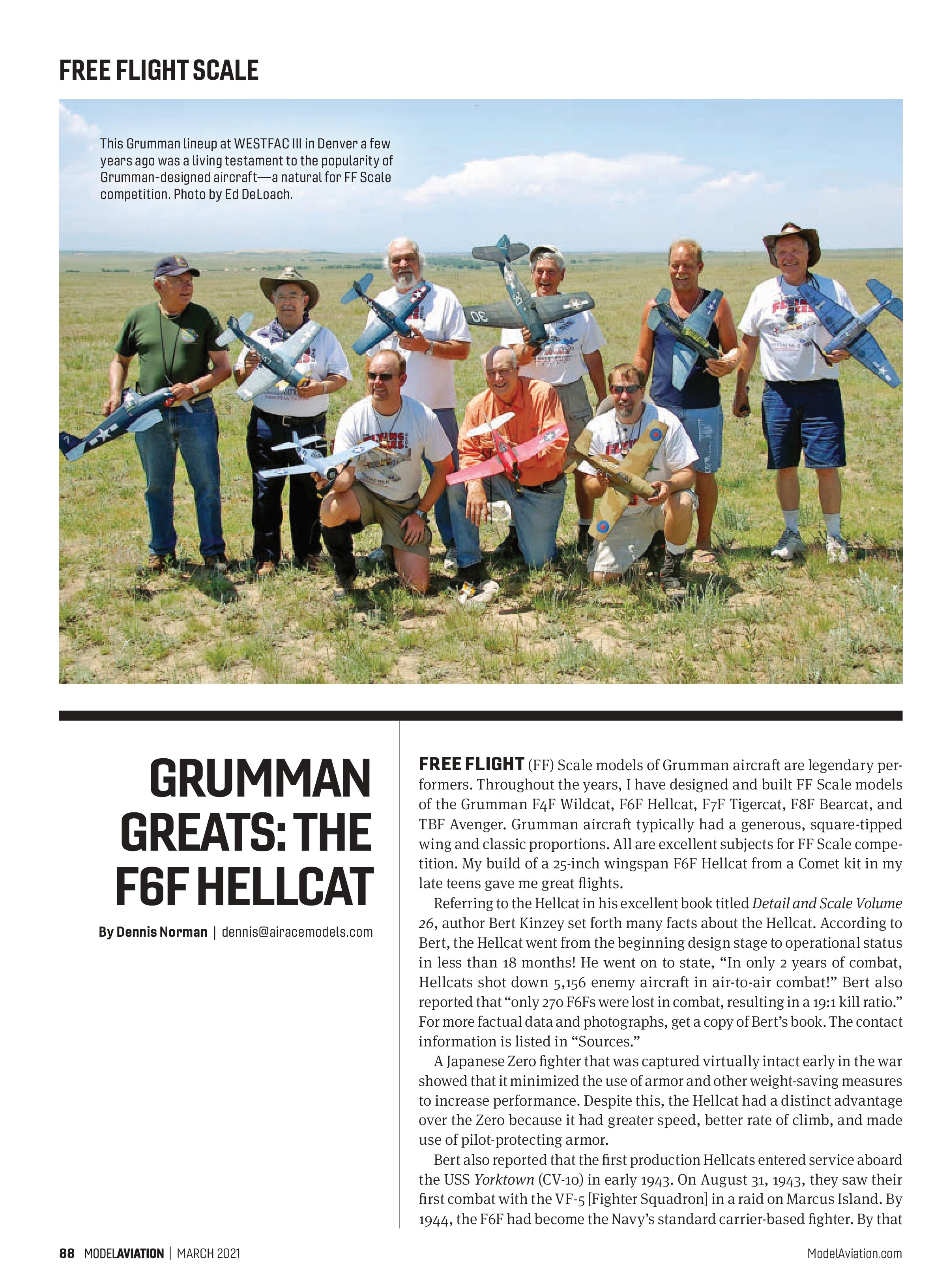
FREE FLIGHT (FF) Scale models of Grumman aircraft are legendary performers. Throughout the years, I have designed and built FF Scale models of the Grumman F4F Wildcat, F6F Hellcat, F7F Tigercat, F8F Bearcat, and TBF Avenger. Grumman aircraft typically had a generous, square-tipped wing and classic proportions. All are excellent subjects for FF Scale competition. My build of a 25-inch wingspan F6F Hellcat from a Comet kit in my late teens gave me great flights.
Referring to the Hellcat in his excellent book titled Detail and Scale Volume 26, author Bert Kinsey set forth many facts about the Hellcat. According to Bert, the Hellcat went from the beginning design stage to operational status in less than 18 months! He went on to state, “In only 2 years of combat, Hellcats shot down 5,156 enemy aircraft in air-to-air combat!” Bert also reported that “only 270 F6Fs were lost in combat, resulting in a 19:1 kill ratio.” For more factual data and photographs, get a copy of Bert’s book. The contact information is listed in “Sources.”
A Japanese Zero fighter that was captured virtually intact early in the war showed that it minimized the use of armor and other weight-saving measures to increase performance. Despite this, the Hellcat had a distinct advantage over the Zero because it had greater speed, better rate of climb, and made use of pilot-protecting armor.
Bert also reported that the first production Hellcats entered service aboard the USS Yorktown (CV-10) in early 1943. On August 31, 1943, they saw their first combat with the VF-5 [Fighter Squadron] in a raid on Marcus Island. By 1944, the F6F had become the Navy’s standard carrier-based fighter. By that time, according to Bert, Grumman “had produced over 4,000 Hellcats” and “a flood of aircraft” that became known as the Navy’s Big Blue Wave, which dominated carrier-based Pacific operations for the rest of the war.
The Hellcat accounted for 75% of the Navy’s aerial victories during World War II. Grumman eventually produced 12,275 Hellcats at its Bethpage Plant #3 on Long Island, New York.
Overall, Hellcats were credited with destroying more enemy aircraft while in service with the U.S. Navy, U.S. Marine Corps, and the Royal Navy Fleet Air Arm than any other Allied naval fighter. The British received 1,268 F6Fs under the Lend-Lease Act.
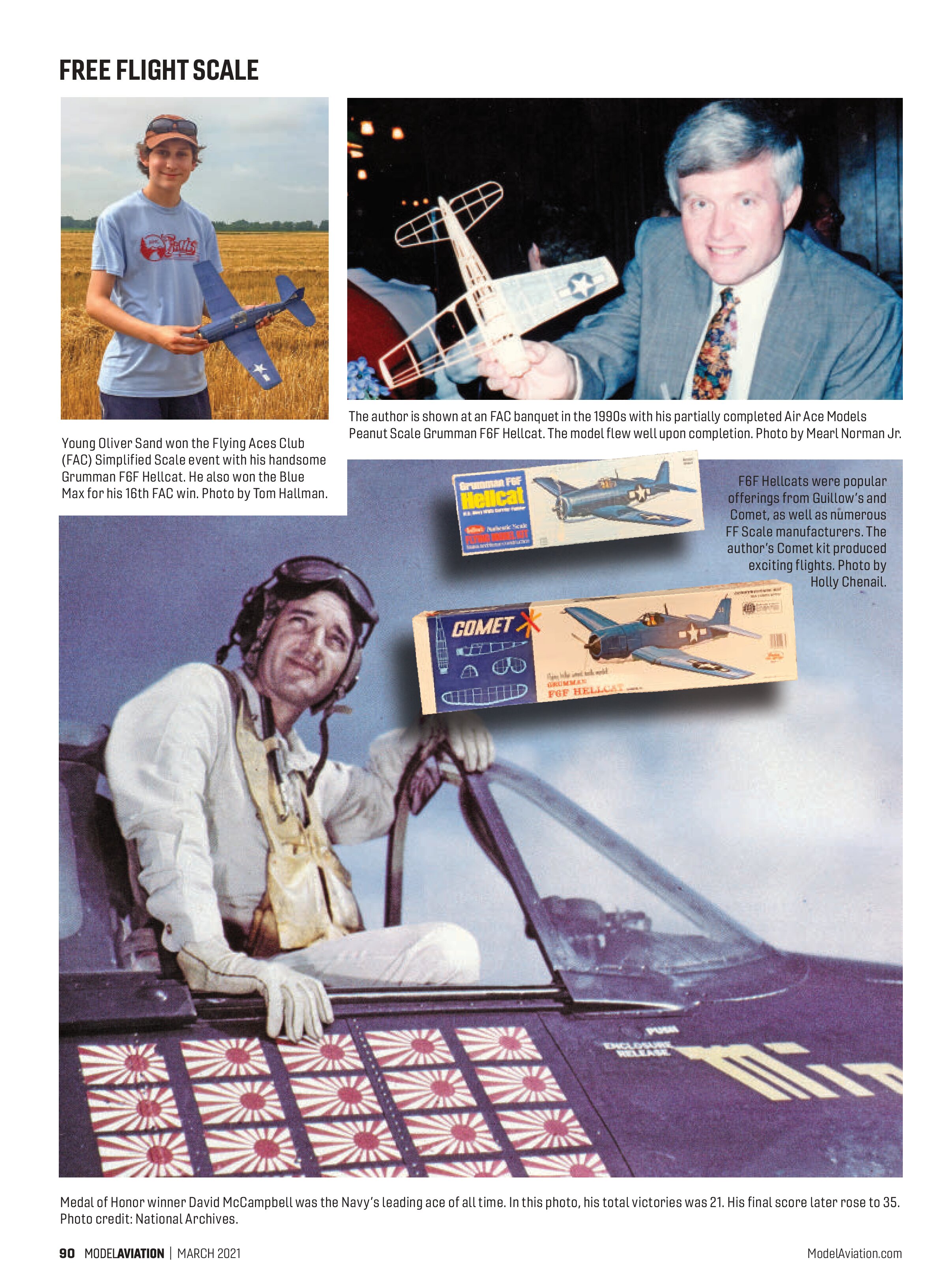
The aircraft was initially called the Grumman Gannet Mk.1. The Royal Navy later adopted the use of American names for all of the US-made aircraft that were supplied to it. The F6F-3, for example, was known as the Hellcat F Mk.1. British Hellcats participated in the Normandy Invasion and wore the characteristic identity stripes of the campaign.
In the portion of this column that is exclusive to Model Aviation Digital, you will find the markings for one of the Hellcats that was used by the British in the Normandy Invasion. Also featured in the digital portion are 16-inch wingspan plans for an F6F from Air Ace Models.
If you wish to make a Hellcat in non-British markings, you will find that seven possibilities are offered, including a post-war scheme of an all-red F6F with a white tail that was used in the atom bomb tests on the Bikini Atoll in July 1946. There is also a list of drawing references, published history, marking details, and three plastic kits of the F6F. Hopefully, this will give you some delightful alternatives in building and refinishing your F6F.