FOCAL POINT
Interested in sharing your handiwork? Visit www.ModelAviation.com for submission guidelines.

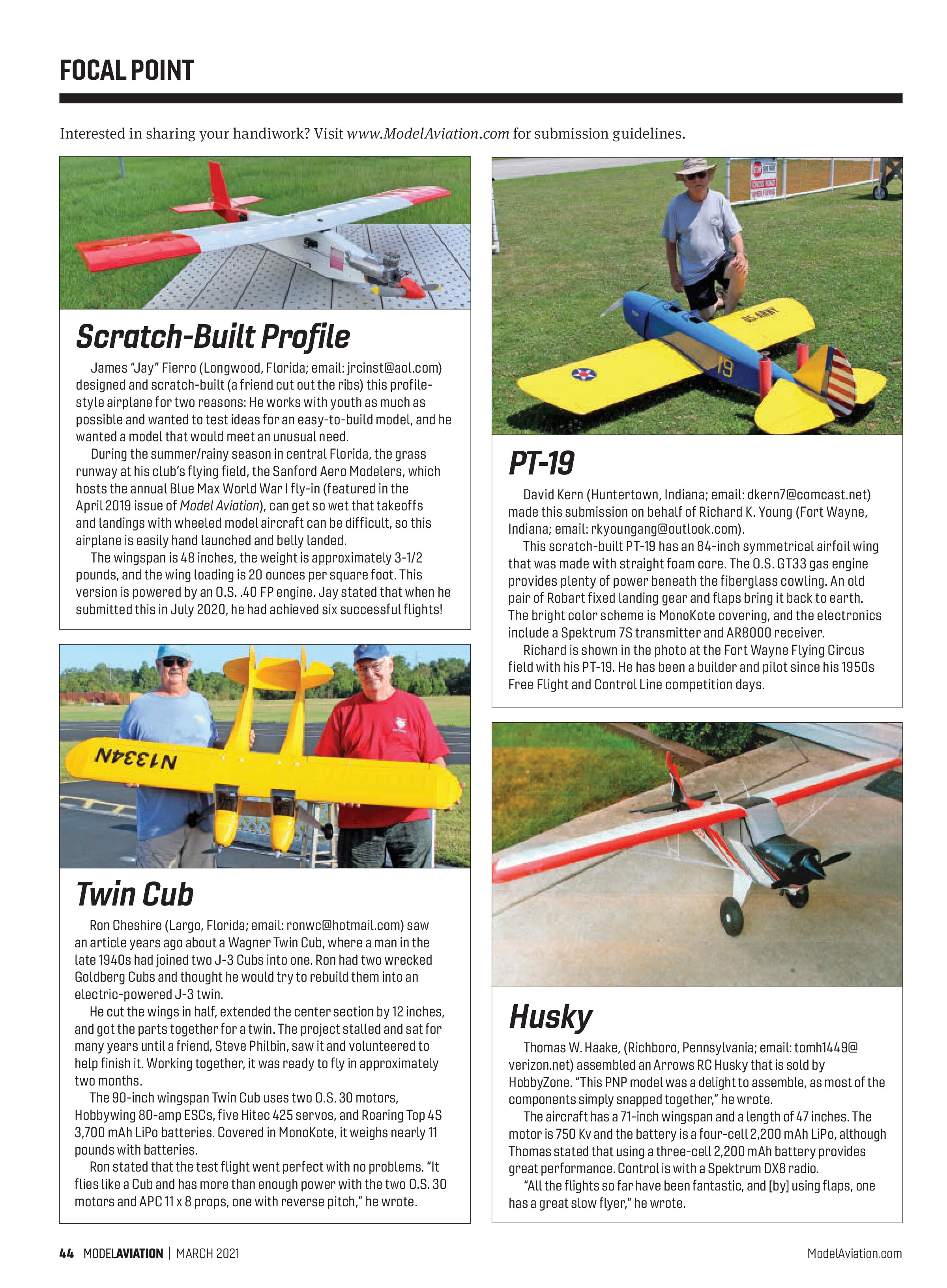
Scratch-Built Profile
James “Jay” Fierro (Longwood, Florida; email: jrcinst@aol.com) designed and scratch-built (a friend cut out the ribs) this profile-style airplane for two reasons: He works with youth as much as possible and wanted to test ideas for an easy-to-build model, and he wanted a model that would meet an unusual need.
During the summer/rainy season in central Florida, the grass runway at his club’s flying field, the Sanford Aero Modelers, which hosts the annual Blue Max World War I fly-in (featured in the April 2019 issue of Model Aviation), can get so wet that takeoffs and landings with wheeled model aircraft can be difficult, so this airplane is easily hand launched and belly landed.
The wingspan is 48 inches, the weight is approximately 3-1/2 pounds, and the wing loading is 20 ounces per square foot. This version is powered by an O.S. .40 FP engine. Jay stated that when he submitted this in July 2020, he had achieved six successful flights!

Twin Cub
Ron Cheshine (Largo, Florida; email: ronwc@hotmail.com) saw an article years ago about a Wagner Twin Cub, where a man in the late 1940s had joined two J-3 Cubs into one. Ron had two wrecked Goldberg Cubs and thought he would try to rebuild them into an electric-powered J-3 twin.
He cut the wings in half, extended the center section by 12 inches, and got the parts together for a twin. The project stalled and sat for many years until a friend, Steve Philbin, saw it and volunteered to help finish it. Working together, it was ready to fly in approximately two months.
The 90-inch wingspan Twin Cub uses two O.S. 30 motors, Hobbywing 80-amp ESCs, five Hitec 425 servos, and Roaring Top 4S 3,700 mAh LiPo batteries. Covered in MonoKote, it weighs nearly 11 pounds with batteries.
Ron stated that the test flight went perfectly with no problems. “It flies like a Cub and has more than enough power with the two O.S. 30 motors and APC 11 x 8 props, one with reverse pitch,” he wrote.

PT-19
David Kern (Huntertown, Indiana; email: dkern7@comcast.net) made this submission on behalf of Richard K. Young (Fort Wayne, Indiana; email: rkyoungang@outlook.com).
This scratch-built PT-19 has an 84-inch symmetrical airfoil wing that was made with straight foam core. The O.S. GT33 gas engine provides plenty of power beneath the fiberglass cowling. An old pair of Robart fixed landing gear and flaps bring it back to earth. The bright color scheme is MonoKote covering, and the electronics include a Spektrum 7S transmitter and AR8000 receiver.
Richard is shown in the photo at the Fort Wayne Flying Circus field with his PT-19. He has been a builder and pilot since the 1950s Free Flight and Control Line competition days.

Husky
Thomas W. Haake, (Richboro, Pennsylvania; email: tomh1449@verizon.net) assembled an Arrows RC Husky that is sold by HobbyZone. “This PNP model was a delight to assemble, as most of the components simply snapped together,” he wrote.
The aircraft has a 71-inch wingspan and a length of 47 inches. The motor is 750 Kv and the battery is a four-cell 2,200 mAh LiPo, although Thomas stated that using a three-cell 2,200 mAh battery provides great performance. Control is with a Spektrum DX8 radio.
“All the flights so far have been fantastic, and [by] using flaps, one has a great slow flyer,” he wrote.

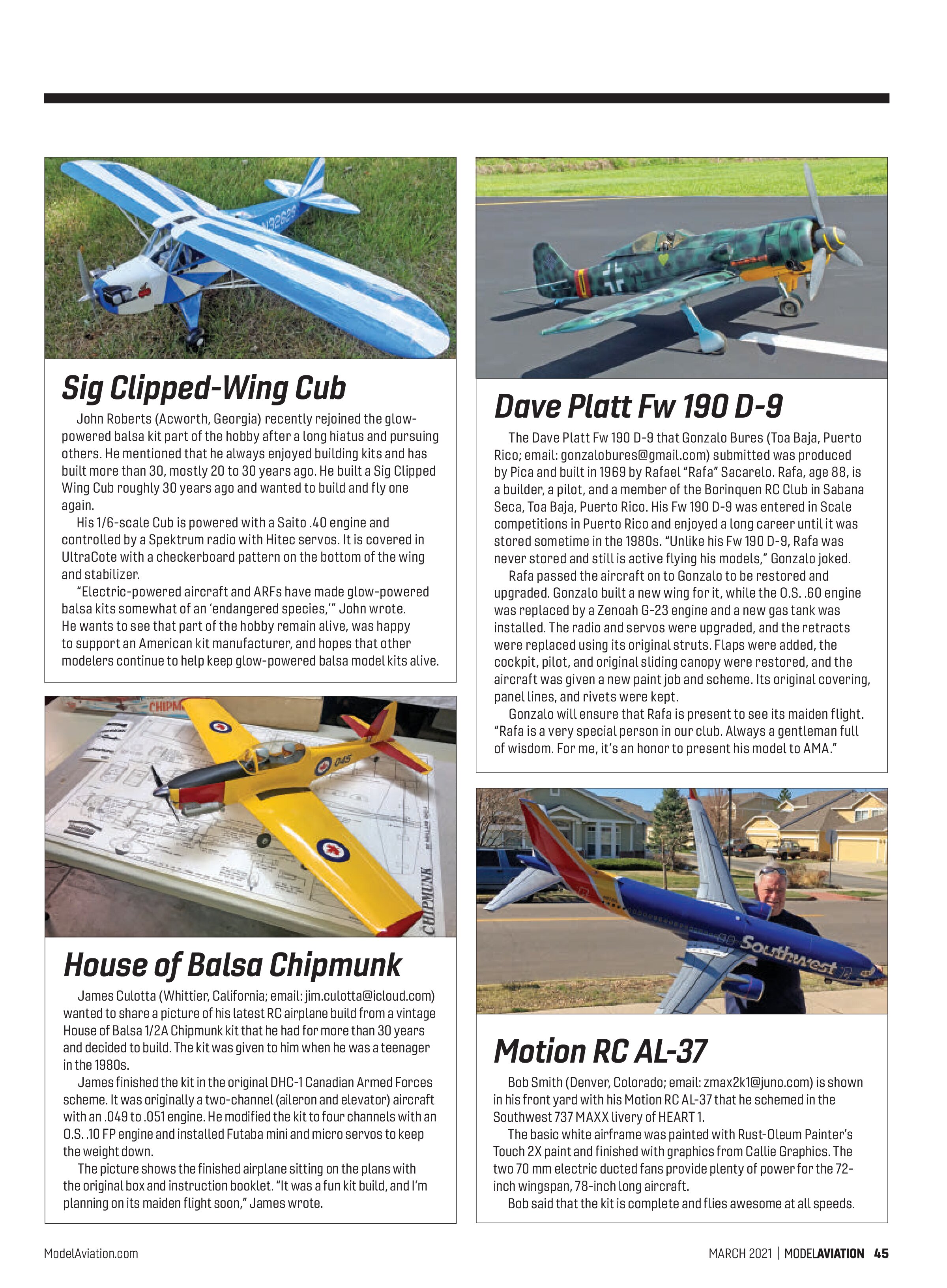
Sig Clipped-Wing Cub
John Roberts (Acworth, Georgia) recently rejoined the glow-powered balsa kit part of the hobby after a long hiatus and pursuing others. He mentioned that he always enjoyed building kits and has built more than 30, mostly 20 to 30 years ago. He built a Sig Clipped Wing Cub roughly 30 years ago and wanted to build and fly one again.
His 1/6-scale Cub is powered with a Saito .40 engine and controlled by a Spektrum radio with Hitec servos. It is covered in UltraCote with a checkerboard pattern on the bottom of the wing and stabilizer.
“Electric-powered aircraft and ARFs have made glow-powered balsa kits somewhat of an ‘endangered species,’” John wrote. He wants to see that part of the hobby remain alive, was happy to support an American kit manufacturer, and hopes that other modelers continue to help keep glow-powered balsa model kits alive.

House of Balsa Chipmunk
James Culotta (Whittier, California; email: jim.culotta@icloud.com) wanted to share a picture of his latest RC airplane build from a vintage House of Balsa 1/2A Chipmunk kit that he had for more than 30 years and decided to build. The kit was given to him when he was a teenager in the 1980s.
James finished the kit in the original DHC-1 Canadian Armed Forces scheme. It was originally a two-channel (aileron and elevator) aircraft with an .049 to .051 engine. He modified the kit to four channels with an O.S. .10 FP engine and installed Futaba mini and micro servos to keep the weight down.
The picture shows the finished airplane sitting on the plans with the original box and instruction booklet. “It was a fun kit build, and I’m planning on its maiden flight soon,” James wrote.

Dave Platt Fw 190 D-9
The Dave Platt Fw 190 D-9 that Gonzalo Bures (Toa Baja, Puerto Rico; email: gonzalobures@gmail.com) submitted was produced by Pica and built in 1969 by Rafael “Rafa” Sacarelo. Rafa, age 88, is a builder, a pilot, and a member of the Borinquen RC Club in Sabana Seca, Toa Baja, Puerto Rico. His Fw 190 D-9 was entered in Scale competitions in Puerto Rico and enjoyed a long career until it was stored sometime in the 1980s. “Unlike his Fw 190 D-9, Rafa was never stored and still is active flying his models,” Gonzalo joked.
Rafa passed the aircraft on to Gonzalo to be restored and upgraded. Gonzalo built a new wing for it, while the O.S. .60 engine was replaced by a Zenoah G-23 engine and a new gas tank was installed. The radio and servos were upgraded, and the retracts were replaced using its original struts. Flaps were added, the cockpit, pilot, and original sliding canopy were restored, and the aircraft was given a new paint job and scheme. Its original covering, panel lines, and rivets were kept.
Gonzalo will ensure that Rafa is present to see its maiden flight. “Rafa is a very special person in our club. Always a gentleman full of wisdom. For me, it’s an honor to present his model to AMA.”

Motion RC AL-37
Bob Smith (Denver, Colorado; email: zmax2k1@juno.com) is shown in his front yard with his Motion RC AL-37 that he schemed in the Southwest 737 MAXX livery of HEART 1.
The basic white airframe was painted with Rust-Oleum Painter’s Touch 2X paint and finished with graphics from Callie Graphics. The two 70 mm electric ducted fans provide plenty of power for the 72-inch wingspan, 78-inch long aircraft.
Bob said that the kit is complete and flies awesome at all speeds.