CONTROL LINE COMBAT

PROPS AND PROPELLERS
By Mark Rudner | mark.s.rudner@gmail.com
THIS MONTH’S COLUMN is about props. First, I would like to give props to all of the frontline workers who have been giving their all throughout the entire COVID-19 pandemic. Your service has been invaluable and is much appreciated.
I wrote this in December, as the tragic year of 2020 was drawing to a close. I sincerely hope that by the time you read this, things look brighter. In a time of such uncertainty, it can be hard to focus, and for those with the luxury to be able to do so, toiling with airplanes might seem out of place. However, one of the things that we have learned from the past year is the importance of physical and mental self-care. Our hobby can play a vital role in this, providing a creative outlet, a chance to relieve stress, and a venue for physical exercise.
Propellers play a crucial role in our sport but are often slapped on an engine almost as an afterthought just before a flight. However, all of the nitro-fueled power in the world means nothing if you don’t give your engine something with which to bite the air. On the flip side, for anyone who is seeking refuge from the chaos of the world outside, propellers can also serve as a medium for creative release and/or for meditative-like, repetitive handiwork.
With the postponement or cancellation of many contests, we have been faced with a lot of downtime without any specific upcoming events for which to prepare. This gap provides a good opportunity for experimentation to try out new setups or even new flying styles.
When it comes to getting the most out of an engine, it is important to minimize vibrations as much as possible. Engine manufacturers (the good ones, at least) pay particular attention to balancing the crankshaft to compensate for the mass of the piston and the connecting rod that

To harness the engine’s power and convert it into forward flight, the engine must be solidly connected to a stable mount on the airplane. Additionally, the propeller that you bolt on the front should be balanced as well as possible; otherwise, you will be wasting valuable energy by shaking your airplane and your lines and, maybe worse, disrespecting the hard work of the engine designer who tried so hard to provide you with a well-balanced machine.
Balancing propellers seems like a mundane task, but there are actually many choices to be made when altering an unbalanced propeller. I’ll note that of the variety of sources for Control Line Combat propellers, in my experience, it is rare to find many propellers that are properly balanced out of the box.
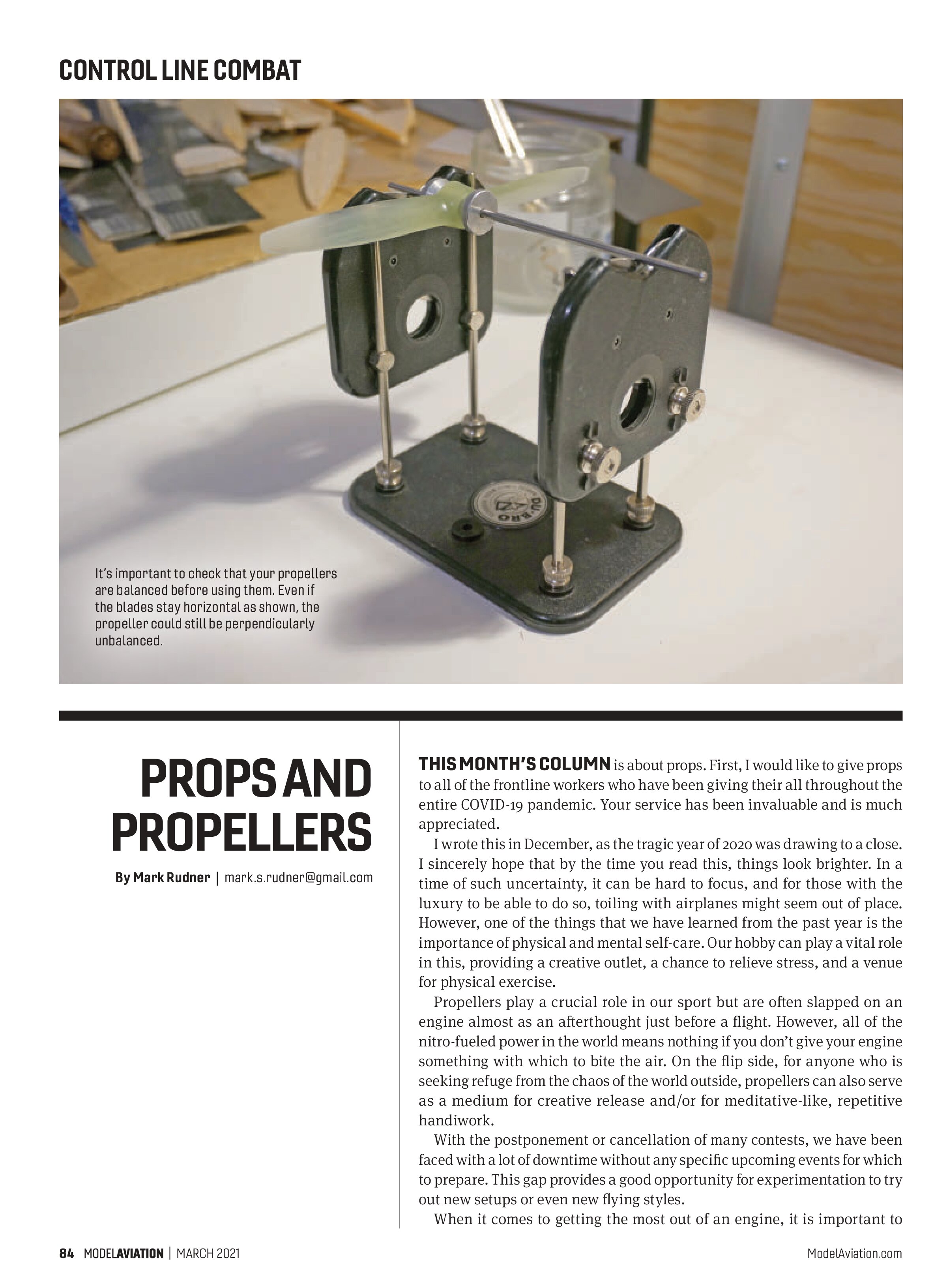
How do you check the balance of your propellers? I use the Du-Bro propeller balancer shown in the photo, but a variety of balancers are available on the market (including magnetic balancers with low friction).
To use the balancer, affix the propeller onto the axle using the two alignment cones, set the axle on the balancer, and then lightly spin the propeller a couple of times, mentally noting its orientation when it naturally comes to rest. When the propeller is balanced, it should come to rest smoothly, without any bias toward any particular angle of rotation. If the propeller swings back and forth like a pendulum before coming to rest, it is definitely not balanced.
If you do find that the propeller tends to always stop with a particular orientation, you need to remove some material from the side that tends to hang downward (because this is the side that the balancer has helped identify as the heavier side of the propeller).
How do you sand your propeller? Will you simply sand some material off of the heavier blade’s tip to shorten it? Do you instead sand the front or the back surface of the blade, while keeping its length fixed? Do you use random motions, or do you deliberately sand in specific areas with intentional patterns?
What tools do you use? Sandpaper (if so, what grit)? Files? In any case, it’s important to always sand gently and to never remove
too much material so that weak spots are created.
All of these choices have consequences and can alter the propeller’s final characteristics, as well as its ability to pull your airplane through the air. If you shorten the blades, you might lose some grip on the air. On the other hand, if the propeller was originally too long, shortening the blades might reduce the load and let the engine reach a more favorable rpm range.
If you sand the back or front surfaces of the blade, you will be changing the airfoil and potentially the pitch of the blade itself. This is not necessarily a bad thing, but it is important to keep it in mind. From this point of view, you might even use your sanding to try to improve the shape of the blade. The next time you’re in your shop, take a close look at the profiles of your propeller blades. You can try out different approaches or modifications and see if you notice any differences in performance.
One point that’s important to recognize is that propellers can be out-of-balance along multiple directions. Just because the propeller stops spinning on the balancer with the two blades perfectly horizontal (parallel to the ground), this does not mean that the propeller is balanced. If each time you spin the propeller on the balancer it eventually stops with the same side of the hub pointing down, this indicates that the center of mass of the propeller is offset from the center of the rotation axis, either because of differences of shapes or the composition of the blades, or because the hub itself is out of balance.
To correct for this, the hub itself can be sanded (if only a little mass needs to be removed). Otherwise, a bit of mass needs to be removed from each of the two blades (near the leading edge of one blade and the trailing edge of the other), biased toward the “heavy” side identified by the balancer.
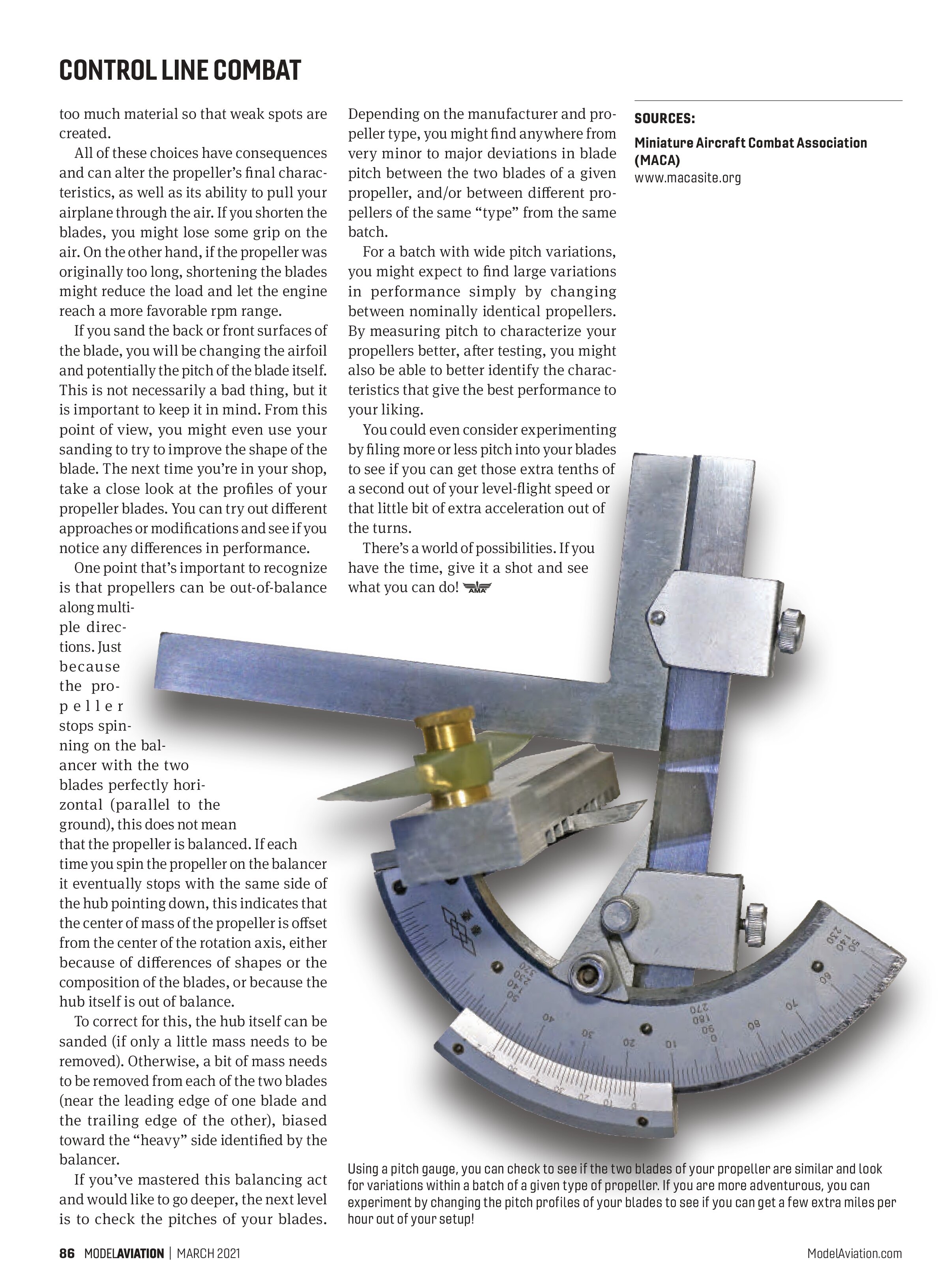
If you’ve mastered this balancing act and would like to go deeper, the next level is to check the pitches of your blades.
Depending on the manufacturer and propeller type, you might find anywhere from very minor to major deviations in blade pitch between the two blades of a given propeller, and/or between different propellers of the same “type” from the same batch.
For a batch with wide pitch variations, you might expect to find large variations in performance simply by changing between nominally identical propellers.
By measuring pitch to characterize your propellers better, after testing, you might also be able to better identify the characteristics that give the best performance to your liking.
You could even consider experimenting by filing more or less pitch into your blades to see if you can get those extra tenths of a second out of your level-flight speed or that little bit of extra acceleration out of the turns.
There’s a world of possibilities. If you have the time, give it a shot and see what you can do!

SOURCES:
Miniature Aircraft Combat Association (MACA)
www.macasite.org