Andy Clancy Designs
The story of the
Lazy Bee
By Jay Smith
jays@modelaircraft.org
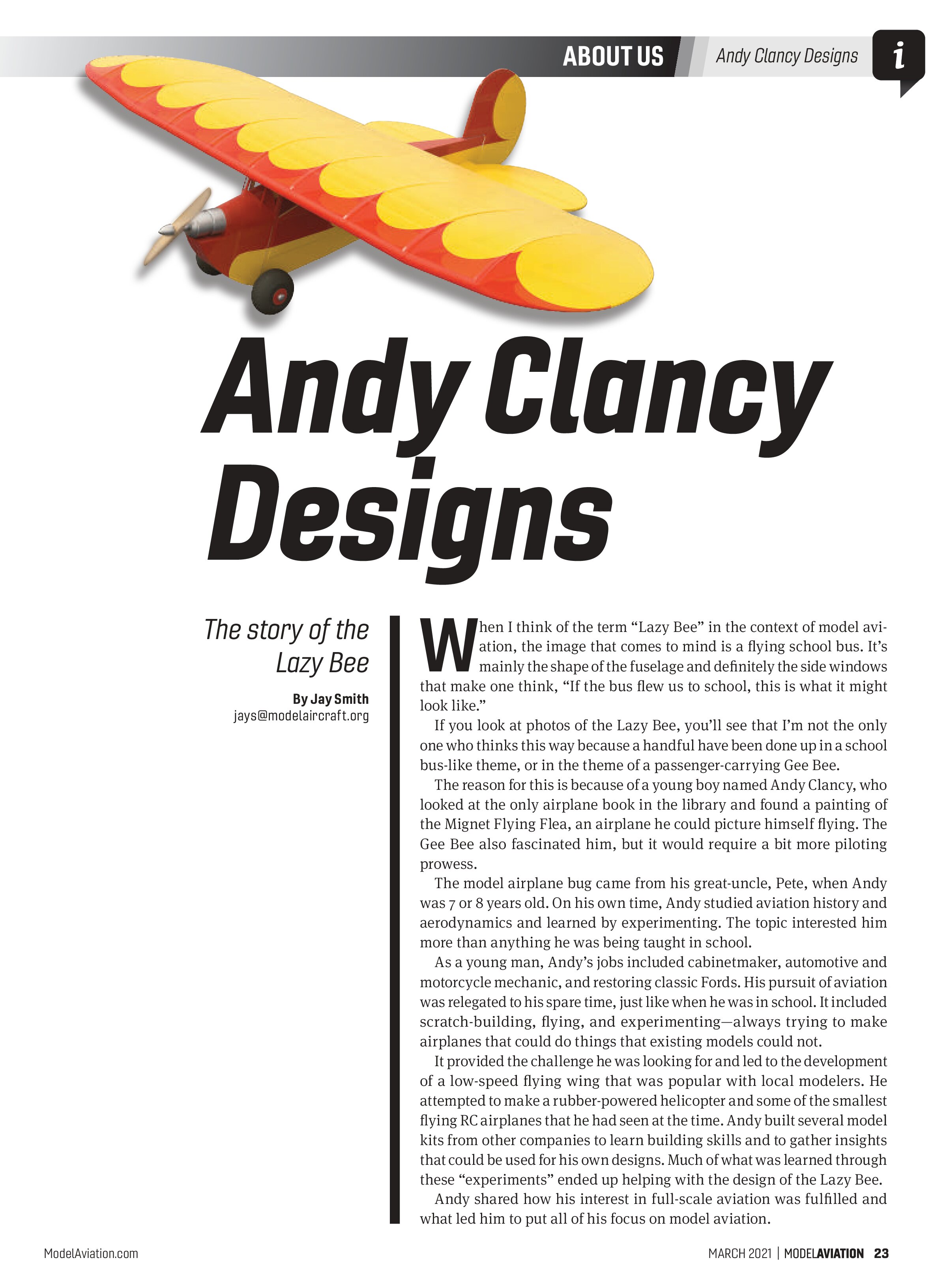
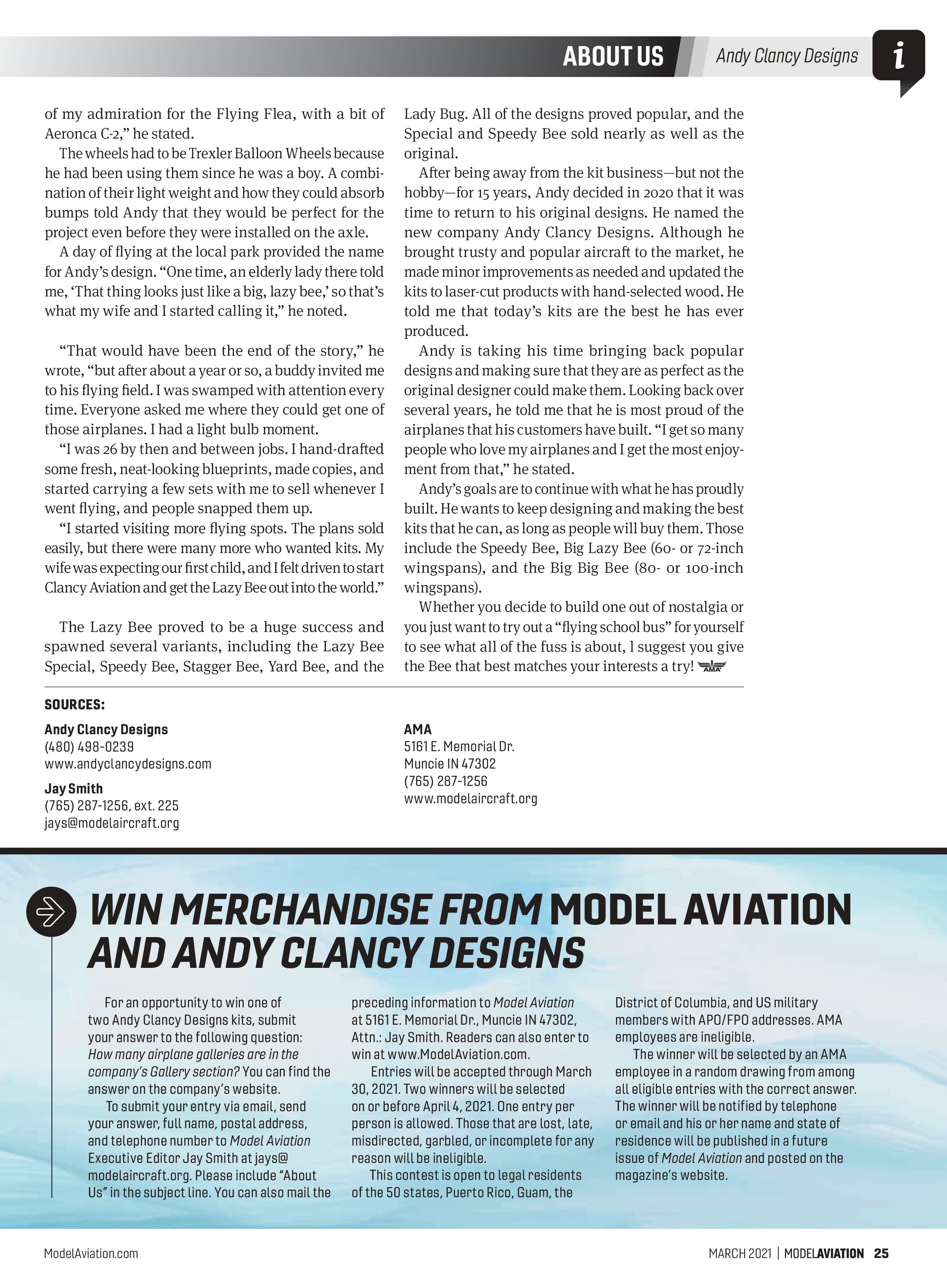
When I think of the term “Lazy Bee” in the context of model aviation, the image that comes to mind is a flying school bus. It’s mainly the shape of the fuselage and definitely the side windows that make one think, “If the bus flew us to school, this is what it might look like.”
If you look at photos of the Lazy Bee, you’ll see that I’m not the only one who thinks this way because a handful have been done up in a school bus-like theme, or in the theme of a passenger-carrying Gee Bee.
The reason for this is because of a young boy named Andy Clancy, who looked at the only airplane book in the library and found a painting of the Mignet Flying Flea, an airplane he could picture himself flying. The Gee Bee also fascinated him, but it would require a bit more piloting prowess.
The model airplane bug came from his great-uncle, Pete, when Andy was 7 or 8 years old. On his own time, Andy studied aviation history and aerodynamics and learned by experimenting. The topic interested him more than anything he was being taught in school.
As a young man, Andy’s jobs included cabinetmaker, automotive and motorcycle mechanic, and restoring classic Fords. His pursuit of aviation was relegated to his spare time, just like when he was in school. It included scratch-building, flying, and experimenting—always trying to make airplanes that could do things that existing models could not.
It provided the challenge he was looking for and led to the development of a low-speed flying wing that was popular with local modelers. He attempted to make a rubber-powered helicopter and some of the smallest flying RC airplanes that he had seen at the time. Andy built several model kits from other companies to learn building skills and to gather insights that could be used for his own designs. Much of what was learned through these “experiments” ended up helping with the design of the Lazy Bee.
Andy shared how his interest in full-scale aviation was fulfilled and what led him to put all of his focus on model aviation.
“I had a dream in mind of starting a full-size kitplane business. When I was around 23, I started building and flying ultralights. Most of these were early, first-generation ultralights. I would buy cheap used or unfinished projects, fix them up, and resell them. This was a way I could learn about and fly many different airplanes without spending much money.
“Many of the airplanes I bought were for sale because they were scary for their pilots to fly. Some had even been crashed. In fixing them up, I experienced a lot of forced landings. This became unacceptable to my wife, Suzy.
“Meanwhile, I was working on another personal engineering challenge. I wanted to fly an RC airplane in my tiny backyard, which was only about 35 x 50 feet with tall obstructions on all four sides. This was back in the early 1990s, when there were no slow fliers—there was no lightweight RC gear yet. Electric was low power and high weight.
“The goals for this airplane were simple, but designing it to meet those goals was more challenging. I knew the airplane would need low wing loading to be able to fly slowly and make tight turns. It had to be rugged enough to survive hard landings and the inevitable crashes I was going to put it through in this tight, closed-in yard.
“My work with tiny airplanes had taught me the trick of using low-aspect-ratio wings to make a strong, lightweight wing. You can have a thick main spar for a short wingspan. Low aspect ratio also translates to a large wing area and volume, which is exactly what you want for slow flying. I chose to make the wing as circular as possible. I know plenty of builders hate laminating, but those rounded, laminated wingtips provide high strength for low weight.
“That thing looks just like a big, lazy bee!”
“Staying lightweight directed so many of my decisions with this wing design. For example, the wing had to be polyhedral, because a wing with dihedral has its joints at or near the center. That weighs more because the dihedral joints have to take the stress of the entire wing and have to be sturdier and heavier than the joints in a polyhedral wing, which only has to take the stress of the wingtips. The joints can be lighter with polyhedral. The wide rib spacing and the lack of sheeting in the center section all save weight.”
The new model achieved its looks as “an expression of my admiration for the Flying Flea, with a bit of Aeronca C-2,” he stated.
The wheels had to be Trexler Balloon Wheels because he had been using them since he was a boy. A combination of their light weight and how they could absorb bumps told Andy that they would be perfect for the project even before they were installed on the axle.
A day of flying at the local park provided the name for Andy’s design. “One time, an elderly lady there told me, ‘That thing looks just like a big, lazy bee,’ so that’s what my wife and I started calling it,” he noted.
“That would have been the end of the story,” he wrote, “but after about a year or so, a buddy invited me to his flying field. I was swamped with attention every time. Everyone asked me where they could get one of those airplanes. I had a light bulb moment.
“I was 26 by then and between jobs. I hand-drafted some fresh, neat-looking blueprints, made copies, and started carrying a few sets with me to sell whenever I went flying, and people snapped them up.
“I started visiting more flying spots. The plans sold easily, but there were many more who wanted kits. My wife was expecting our first child, and I felt driven to start Clancy Aviation and get the Lazy Bee out into the world.”
The Lazy Bee proved to be a huge success and spawned several variants, including the Lazy Bee Special, Speedy Bee, Stagger Bee, Yard Bee, and the Lady Bug. All of the designs proved popular, and the Special and Speedy Bee sold nearly as well as the original.
After being away from the kit business—but not the hobby—for 15 years, Andy decided in 2020 that it was time to return to his original designs. He named the new company Andy Clancy Designs. Although he brought trusty and popular aircraft to the market, he made minor improvements as needed and updated the kits to laser-cut products with hand-selected wood. He told me that today’s kits are the best he has ever produced.
Andy is taking his time bringing back popular designs and making sure that they are as perfect as the original designer could make them. Looking back over several years, he told me that he is most proud of the airplanes that his customers have built. “I get so many people who love my airplanes and I get the most enjoyment from that,” he stated.
Andy’s goals are to continue with what he has proudly built. He wants to keep designing and making the best kits that he can, as long as people will buy them. Those include the Speedy Bee, Big Lazy Bee (60- or 72-inch wingspans), and the Big Big Bee (80- or 100-inch wingspans).
Whether you decide to build one out of nostalgia or you just want to try out a “flying school bus” for yourself to see what all of the fuss is about, I suggest you give the Bee that best matches your interests a try!
SOURCES:
Andy Clancy Designs
(480) 498-0239
www.andyclancydesigns.com
Jay Smith
(765) 287-1256, ext. 225
jays@modelaircraft.org
AMA
5161 E. Memorial Dr.
Muncie IN 47302
(765) 287-1256
www.modelaircraft.org