REMOTE ID
FINAL RULE
By Chad Budreau, AMA Executive Director | chadb@modelaircraft.org

PEOPLE OFTEN GRUMBLE about the slow pace of the federal government. This is by design. The government was intentionally set up with a series of checks and balances and public feedback loops to bog down federal workflows. The founding fathers did not want to recreate a government that could act as swiftly as King George’s did.
Remote ID is an example of a federal regulation in the making that is bureaucratic and slow. At the time this was written, the FAA had not released its revised or final rule for Remote ID. I anticipate that by the time you read this magazine, news of Remote ID will have been released.
AMA first started work on Remote ID roughly four years ago and it has been a controversial and never-ending topic. I suspect

many members are fatigued by hearing about it. I wouldn’t be surprised if many at this point are already considering skipping to the next article or product review, but I encourage you to finish this column for a better understanding of the rulemaking process.
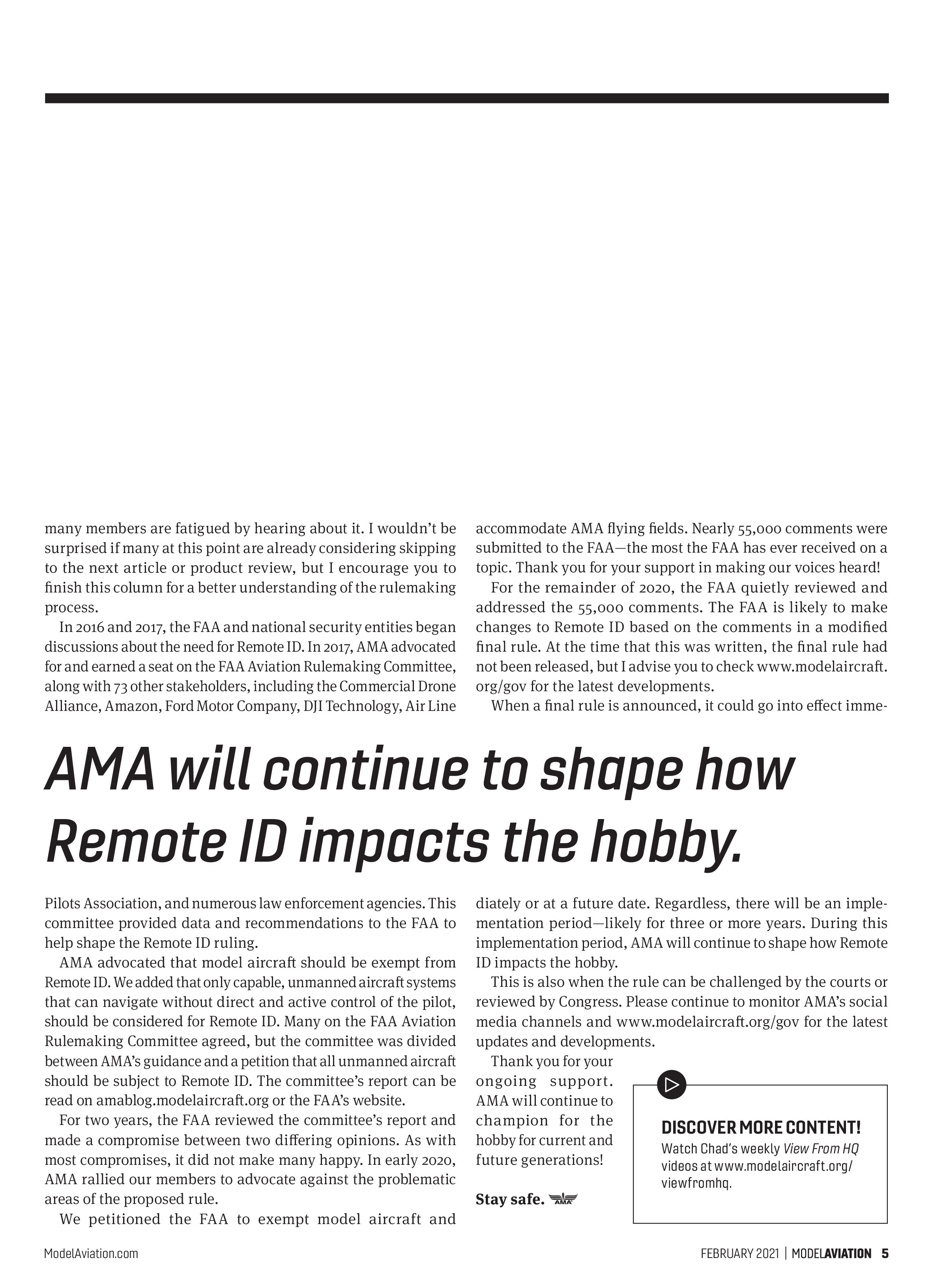
In 2016 and 2017, the FAA and national security entities began discussions about the need for Remote ID. In 2017, AMA advocated for and earned a seat on the FAA Aviation Rulemaking Committee, along with 73 other stakeholders, including the Commercial Drone Alliance, Amazon, Ford Motor Company, DJI Technology, Air Line Pilots Association, and numerous law enforcement agencies. This committee provided data and recommendations to the FAA to help shape the Remote ID ruling.
AMA advocated that model aircraft should be exempt from Remote ID. We added that only capable, unmanned aircraft systems that can navigate without direct and active control of the pilot, should be considered for Remote ID. Many on the FAA Aviation Rulemaking Committee agreed, but the committee was divided between AMA’s guidance and a petition that all unmanned aircraft should be subject to Remote ID. The committee’s report can be read on amablog.modelaircraft.org or the FAA’s website.
For two years, the FAA reviewed the committee’s report and made a compromise between two differing opinions. As with most compromises, it did not make many happy. In early 2020, AMA rallied our members to advocate against the problematic areas of the proposed rule.
We petitioned the FAA to exempt model aircraft and accommodate AMA flying fields. Nearly 55,000 comments were submitted to the FAA—the most the FAA has ever received on a topic. Thank you for your support in making our voices heard!
For the remainder of 2020, the FAA quietly reviewed and addressed the 55,000 comments. The FAA is likely to make changes to Remote ID based on the comments in a modified final rule. At the time that this was written, the final rule had not been released, but I advise you to check www.modelaircraft.org/gov for the latest developments.
When a final rule is announced, it could go into effect imme-
AMA will continue to shape how
Remote ID impacts the hobby.
Pilots Association, and numerous law enforcement agencies. This committee provided data and recommendations to the FAA to help shape the Remote ID ruling.
AMA advocated that model aircraft should be exempt from Remote ID. We added that only capable, unmanned aircraft systems that can navigate without direct and active control of the pilot, should be considered for Remote ID. Many on the FAA Aviation Rulemaking Committee agreed, but the committee was divided between AMA’s guidance and a petition that all unmanned aircraft should be subject to Remote ID. The committee’s report can be read on amablog.modelaircraft.org or the FAA’s website.
For two years, the FAA reviewed the committee’s report and made a compromise between two differing opinions. As with most compromises, it did not make many happy. In early 2020, AMA rallied our members to advocate against the problematic areas of the proposed rule.
We petitioned the FAA to exempt model aircraft and accommodate AMA flying fields. Nearly 55,000 comments were submitted to the FAA—the most the FAA has ever received on a topic. Thank you for your support in making our voices heard!
For the remainder of 2020, the FAA quietly reviewed and addressed the 55,000 comments. The FAA is likely to make changes to Remote ID based on the comments in a modified final rule. At the time that this was written, the final rule had not been released, but I advise you to check www.modelaircraft.org/gov for the latest developments.
When a final rule is announced, it could go into effect immediately or at a future date. Regardless, there will be an implementation period—likely for three or more years. During this implementation period, AMA will continue to shape how Remote ID impacts the hobby.
This is also when the rule can be challenged by the courts or reviewed by Congress. Please continue to monitor AMA’s social media channels and www.modelaircraft.org/gov for the latest updates and developments.
Thank you for your ongoing support. AMA will continue to champion for the hobby for current and future generations!
Stay safe.