RC COMBAT

ENGINE
BREAK-IN
By William Drumm III | midair72@hotmail.com
BREAKING IN A NEW ENGINE is a tedious task that must be done to ensure that your engine performs well in the RC Combat arena. Before mounting the engine, remove the backplate and head to inspect for any machining debris that might be present. Remove any burrs and shavings and reassemble the engine.
After your airplane is fully assembled, it’s time to run some fuel through the new engine. For my break-in technique, I use an APC 6 x 3 propeller for a .15 engine and a Master Airscrew 8 x 3 propeller for a .25 engine. I set the needle rich and use a tachometer to keep the rpm between 18,000 and 19,000 and adjust the needle as needed. I run the engine for only 30 to 60 seconds at a time. I then let it completely cool in between each run. I run two full tanks of fuel through the engine this way.
After I put on the correct propeller for the class of engine, I continuously run two more tanks of fuel through, again letting the engine cool down in between runs. The needle is set rich and I pinch the fuel line every 30 seconds to bring the rpm up. After the four tanks of fuel have been run through, I then proceed to test-fly the airplane, keeping the needle set on the rich side.
Engine Tuning
A good motor run is a major key to being able to aggressively compete in RC Combat. Setting the needle on the rich side leaves power on the table that could be advantageous in the air. On the other hand, you are prone to having an engine flameout if the needle is set too lean. Finding the sweet spot is easy if you have a good ear. Using a tachometer helps the rest of us.
After the engine is started, move behind the wing and fully open the throttle. Hold your tachometer up behind the propeller and pinch the fuel line between the fuel tank and the needle-valve. If the motor starts to stall, place a finger briefly over the exhaust stinger. This will increase the fuel flow to the carburetor from an increase in tank pressure. Richen the needle setting by turning it counterclockwise.
If the needle setting is too rich, the rpm will increase when the fuel line is pinched. Turn the needle clockwise to lean out the engine. In my opinion, the ideal needle setting is a 100 to 200 rpm increase when the fuel line is pinched. For the limited classes, such as Slow Survivable Combat (SSC), I check the rpm every couple of rounds. Atmospheric changes throughout the day can affect the needle setting.
Engine Issues
There are a few issues that could arise during a competition. The most common is getting a hole in the fuel line. This occurs frequently during midair collisions or a hard dirt nap. The telltale signs of a hole are when there is fuel dripping while the airplane is on the stand or the engine quits shortly after launch. If the engine quits halfway through a round, there is probably a hole in the line inside the tank. Inspect the lines and replace them as needed.
Another issue is getting air bubbles in the fuel lines. To avoid this, make sure to use foam rubber in between the tank and the fuselage. I use 1/2-inch foam rubber and have no issues. Make sure to not squish the foam too much when attaching the fuel tank.
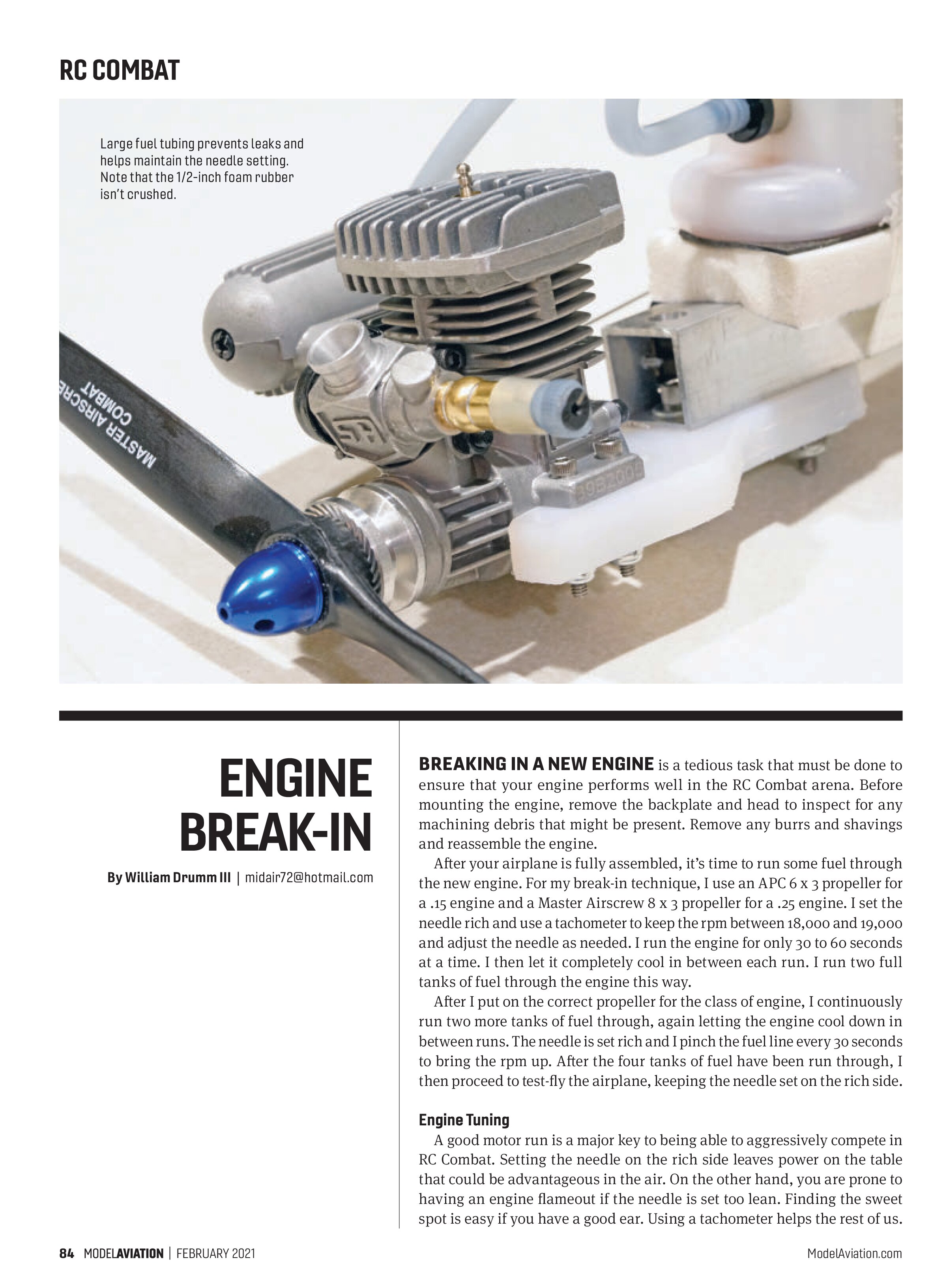
Needle valves can start to leak fuel over time as the O-rings wear out. You could replace them if you can find the right size. An easy fix is to use large-diameter fuel tubing placed over the needle. Use needle-nose pliers to stretch open the tubing and slide it over the needle valve. Large fuel tubing can also be used when the needle valve is not keeping its setting throughout a round.
SH .15 Engine
SSC engine offerings are pretty slim these days. The O.S. .15LA engine is still being manufactured and requires an extensive break-in to reach the 17,500 rpm limit. Unfortunately, the price has increased beyond the limit set in the current rules. The Magnum XLS 15 was a great engine for the price. Out of the box, it would easily turn the maximum rpm. Unfortunately, it is no longer in production.
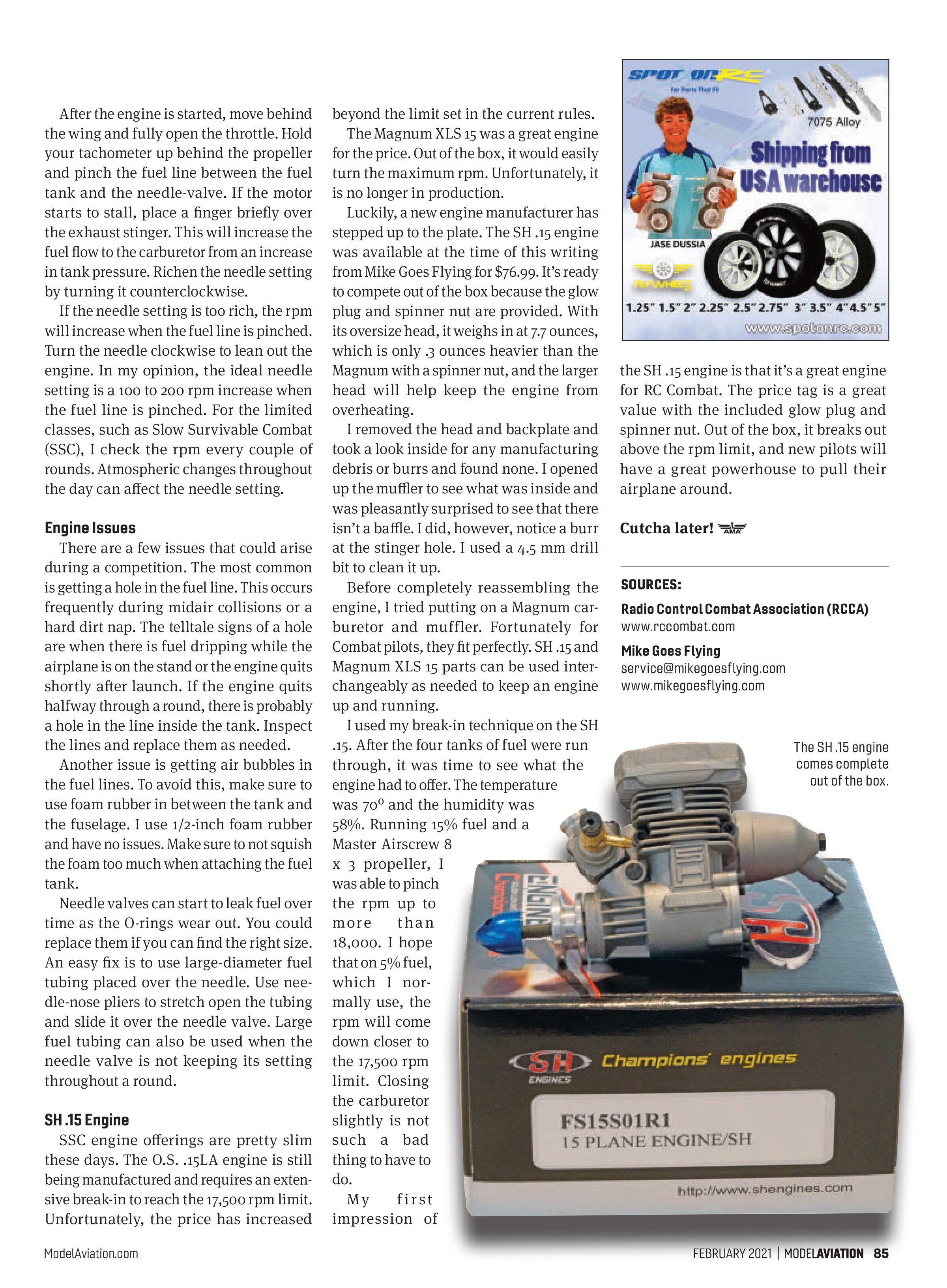
Luckily, a new engine manufacturer has stepped up to the plate. The SH .15 engine was available at the time of this writing from Mike Goes Flying for $76.99. It’s ready to compete out of the box because the glow plug and spinner nut are provided. With its oversize head, it weighs in at 7.7 ounces, which is only .3 ounces heavier than the Magnum with a spinner nut, and the larger head will help keep the engine from overheating.
I removed the head and backplate and took a look inside for any manufacturing debris or burrs and found none. I opened up the muffler to see what was inside and was pleasantly surprised to see that there isn’t a baffle. I did, however, notice a burr at the stinger hole. I used a 4.5 mm drill bit to clean it up.
Before completely reassembling the engine, I tried putting on a Magnum carburetor and muffler. Fortunately for Combat pilots, they fit perfectly. SH .15 and Magnum XLS 15 parts can be used interchangeably as needed to keep an engine up and running.
I used my break-in technique on the SH .15. After the four tanks of fuel were run through, it was time to see what the engine had to offer. The temperature was 70° and the humidity was 58%. Running 15% fuel and a Master Airscrew 8 x 3 propeller, I was able to pinch the rpm up to more than 18,000. I hope that on 5% fuel, which I normally use, the rpm will come down closer to the 17,500 rpm limit. Closing the carburetor slightly is not such a bad thing to have to do.
My first impression of the SH .15 engine is that it’s a great engine for RC Combat. The price tag is a great value with the included glow plug and spinner nut. Out of the box, it breaks out above the rpm limit, and new pilots will have a great powerhouse to pull their airplane around.

Cutcha later!
SOURCES:
Radio Control Combat Association (RCCA)
www.rccombat.com
Mike Goes Flying
service@mikegoesflying.com
www.mikegoesflying.com