LIFE GOES ON
By Bob Angel
samrcflier@verizon.net

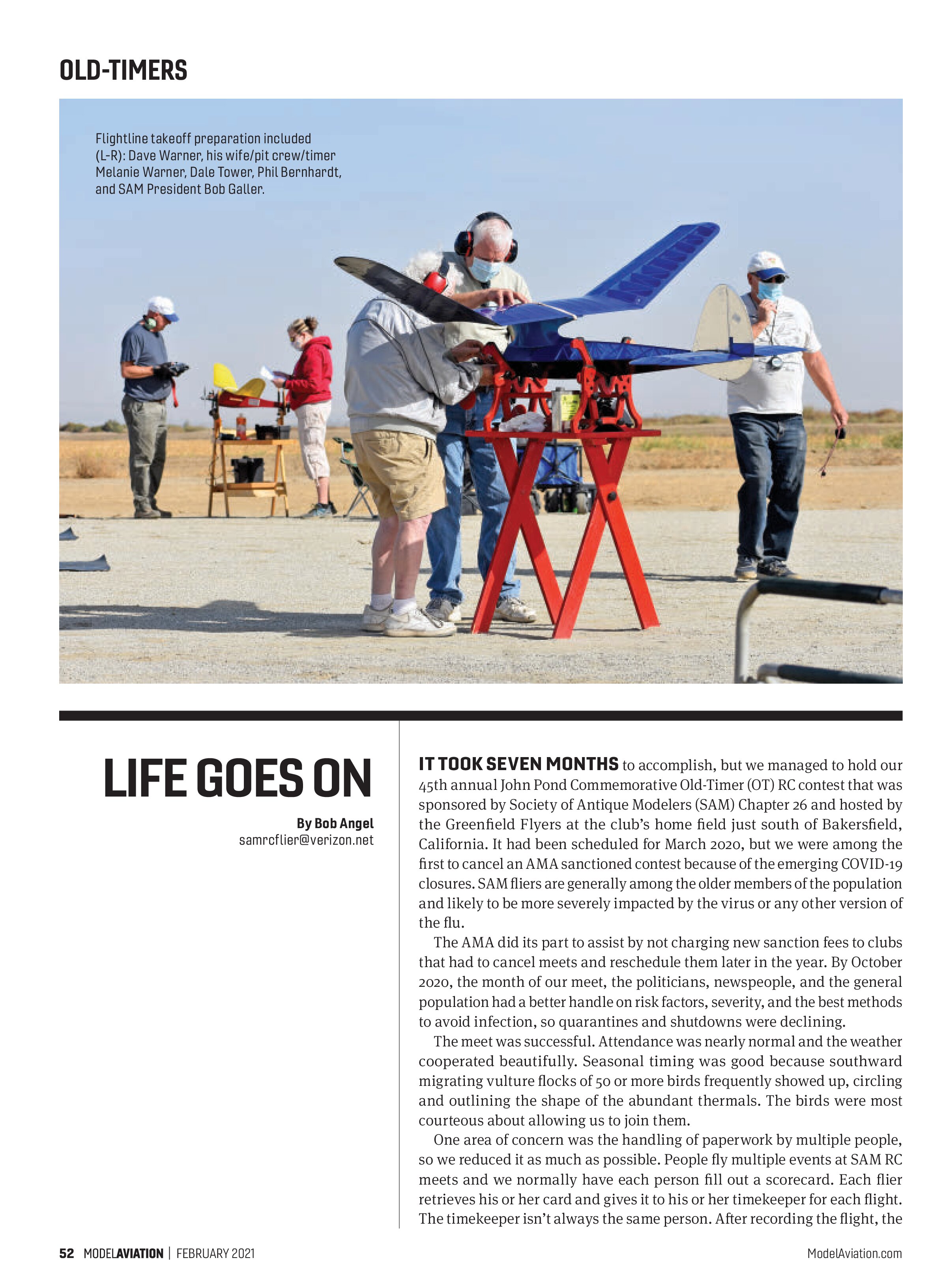
IT TOOK SEVEN MONTHS to accomplish, but we managed to hold our 45th annual John Pond Commemorative Old-Timer (OT) RC contest that was sponsored by Society of Antique Modelers (SAM) Chapter 26 and hosted by the Greenfield Flyers at the club’s home field just south of Bakersfield, California. It had been scheduled for March 2020, but we were among the first to cancel an AMA sanctioned contest because of the emerging COVID-19 closures. SAM fliers are generally among the older members of the population and likely to be more severely impacted by the virus or any other version of the flu.
The AMA did its part to assist by not charging new sanction fees to clubs that had to cancel meets and reschedule them later in the year. By October 2020, the month of our meet, the politicians, newspeople, and the general population had a better handle on risk factors, severity, and the best methods to avoid infection, so quarantines and shutdowns were declining.
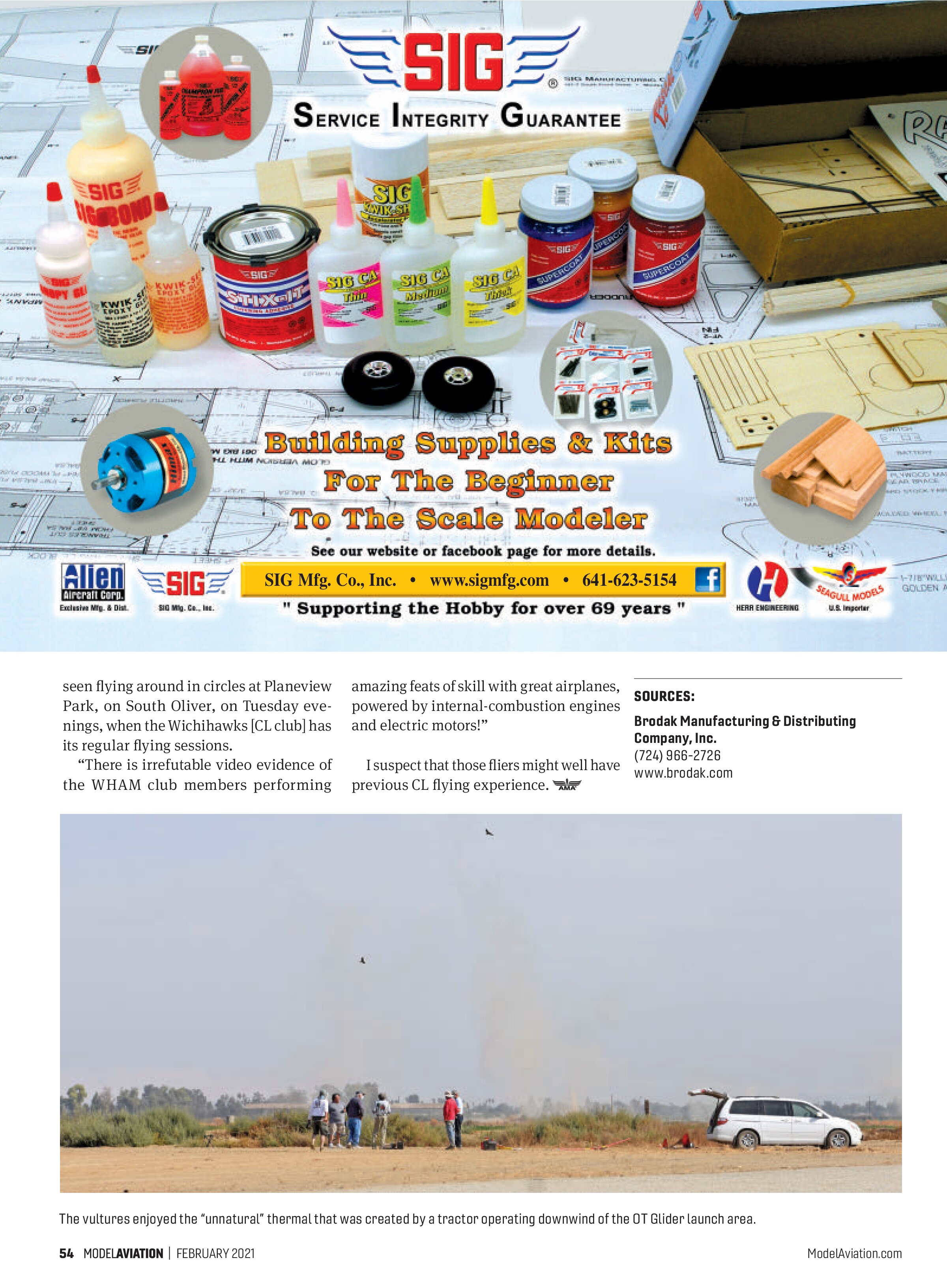
The meet was successful. Attendance was nearly normal and the weather cooperated beautifully. Seasonal timing was good because southward migrating vulture flocks of 50 or more birds frequently showed up, circling and outlining the shape of the abundant thermals. The birds were most courteous about allowing us to join them.
One area of concern was the handling of paperwork by multiple people, so we reduced it as much as possible. People fly multiple events at SAM RC meets and we normally have each person fill out a scorecard. Each flier retrieves his or her card and gives it to his or her timekeeper for each flight. The timekeeper isn’t always the same person. After recording the flight, the card is returned to the recording area, posted to a master scoresheet by a contest official, and either returned to the flightline or filed for later retrieval.
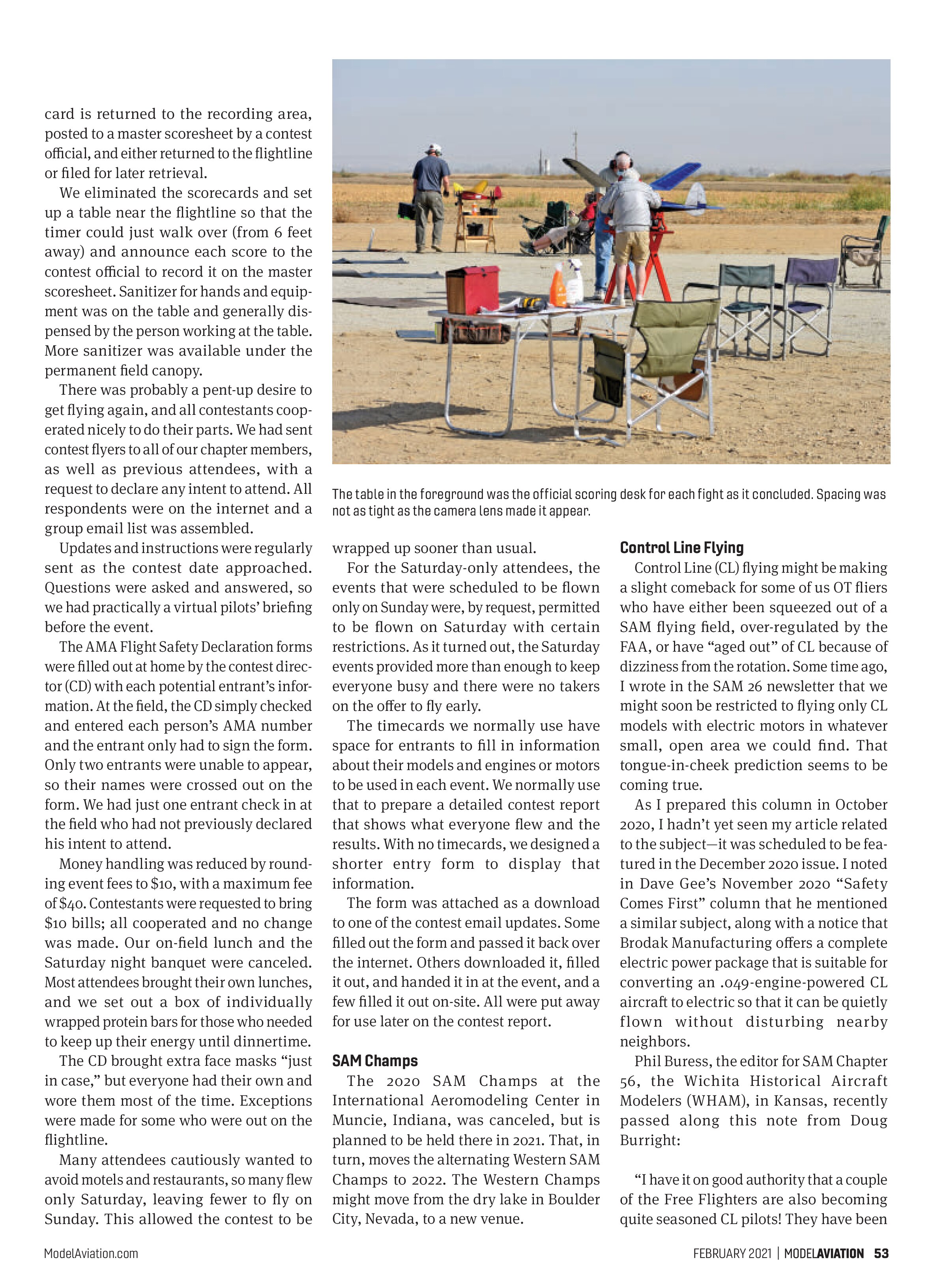
We eliminated the scorecards and set up a table near the flightline so that the timer could just walk over (from 6 feet away) and announce each score to the contest official to record it on the master scoresheet. Sanitizer for hands and equipment was on the table and generally dispensed by the person working at the table. More sanitizer was available under the permanent field canopy.
There was probably a pent-up desire to get flying again, and all contestants cooperated nicely to do their parts. We had sent contest flyers to all of our chapter members, as well as previous attendees, with a request to declare any intent to attend. All respondents were on the internet and a group email list was assembled.
Updates and instructions were regularly sent as the contest date approached. Questions were asked and answered, so we had practically a virtual pilots’ briefing before the event.
The AMA Flight Safety Declaration forms were filled out at home by the contest director (CD) with each potential entrant’s information. At the field, the CD simply checked and entered each person’s AMA number and the entrant only had to sign the form. Only two entrants were unable to appear, so their names were crossed out on the form. We had just one entrant check in at the field who had not previously declared his intent to attend.
Money handling was reduced by rounding event fees to $10, with a maximum fee of $40. Contestants were requested to bring $10 bills; all cooperated and no change was made. Our on-field lunch and the Saturday night banquet were canceled. Most attendees brought their own lunches, and we set out a box of individually wrapped protein bars for those who needed to keep up their energy until dinnertime.
The CD brought extra face masks “just in case,” but everyone had their own and wore them most of the time. Exceptions were made for some who were out on the flightline.
Many attendees cautiously wanted to avoid motels and restaurants, so many flew only Saturday, leaving fewer to fly on Sunday. This allowed the contest to be wrapped up sooner than usual.

For the Saturday-only attendees, the events that were scheduled to be flown only on Sunday were, by request, permitted to be flown on Saturday with certain restrictions. As it turned out, the Saturday events provided more than enough to keep everyone busy and there were no takers on the offer to fly early.
The timecards we normally use have space for entrants to fill in information about their models and engines or motors to be used in each event. We normally use that to prepare a detailed contest report that shows what everyone flew and the results. With no timecards, we designed a shorter entry form to display that information.
The form was attached as a download to one of the contest email updates. Some filled out the form and passed it back over the internet. Others downloaded it, filled it out, and handed it in at the event, and a few filled it out on-site. All were put away for use later on the contest report.
SAM Champs
The 2020 SAM Champs at the International Aeromodeling Center in Muncie, Indiana, was canceled, but is planned to be held there in 2021. That, in turn, moves the alternating Western SAM Champs to 2022. The Western Champs might move from the dry lake in Boulder City, Nevada, to a new venue.
Control Line Flying
Control Line (CL) flying might be making a slight comeback for some of us OT fliers who have either been squeezed out of a SAM flying field, over-regulated by the FAA, or have “aged out” of CL because of dizziness from the rotation. Some time ago, I wrote in the SAM 26 newsletter that we might soon be restricted to flying only CL models with electric motors in whatever small, open area we could find. That tongue-in-cheek prediction seems to be coming true.
As I prepared this column in October 2020, I hadn’t yet seen my article related to the subject—it was scheduled to be featured in the December 2020 issue. I noted in Dave Gee’s November 2020 “Safety Comes First” column that he mentioned a similar subject, along with a notice that Brodak Manufacturing offers a complete electric power package that is suitable for converting an .049-engine-powered CL aircraft to electric so that it can be quietly flown without disturbing nearby neighbors.
Phil Buress, the editor for SAM Chapter 56, the Wichita Historical Aircraft Modelers (WHAM), in Kansas, recently passed along this note from Doug Burright:
“I have it on good authority that a couple of the Free Flighters are also becoming quite seasoned CL pilots! They have been
seen flying around in circles at Planeview Park, on South Oliver, on Tuesday evenings, when the WichitaHawks [CL club] has its regular flying sessions.
“There is irrefutable video evidence of the WHAM club members performing amazing feats of skill with great airplanes, powered by internal-combustion engines and electric motors!”
I suspect that those fliers might well have previous CL flying experience.
SOURCES:
Brodak Manufacturing & Distributing Company, Inc.
(724) 966-2726
www.brodak.com