FREE FLIGHT DURATION

A P-30 THAT
WAS 40
YEARS IN THE
MAKING
By Louis Joyner | joynerduration@gmail.com
WHY WOULD ANYONE BUILD a P-30 with a two-piece wing? The event rules limit the wingspan and fuselage length to 30 inches, so storage and transportation are not the problems that they are with larger models.
A two-piece wing allows the relative angle of attack of each wing half to be adjusted for wash-in or washout. You can even change the incidence of one wing half during flight. Known as a wing wiggler, this technique is widely used for F1B Wakefield rubber-powered models to help control the powered portion of the flight. It has been used on a few P-30s. A two-piece wing that plugs into a pylon also provides an accurate way to key the wing.
Ross Jahnke has come up with the best reason to use a two-piece wing on a P-30: to get the model down out of a strong thermal. Small, lightweight models such as the P-30 are notoriously hard to dethermalize (DT) in strong thermals. The pop-up stabilizer that works well with larger models is ineffective. Other DT methods, such as pop-up and pop-off wings, are more effective, but problems with fuselage damage can result during landing.
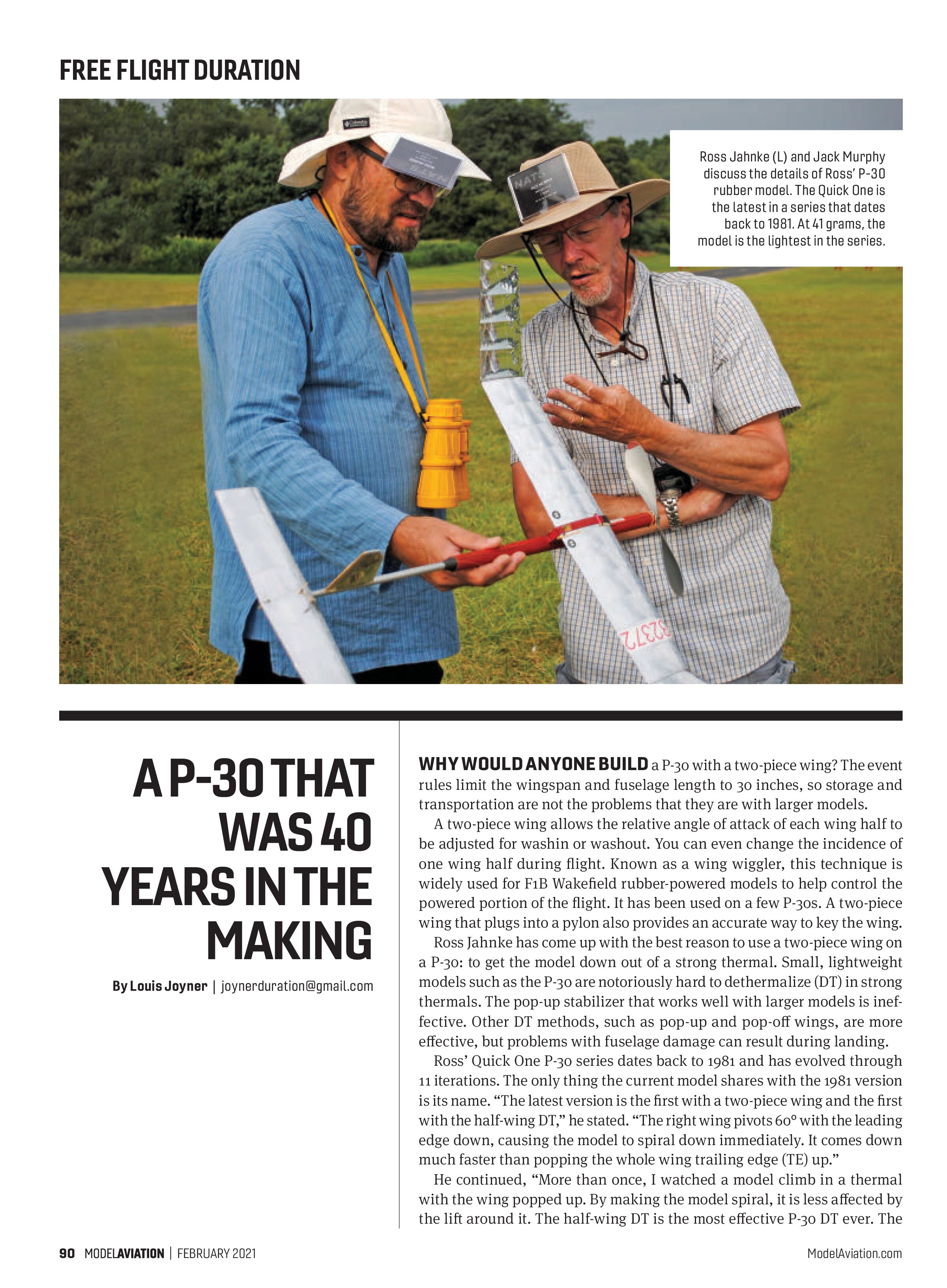
Ross’ Quick One P-30 series dates back to 1981 and has evolved through 11 iterations. The only thing the current model shares with the 1981 version is its name. “The latest version is the first with a two-piece wing and the first with the half-wing DT,” he stated. “The right wing pivots 60° with the leading edge down, causing the model to spiral down immediately. It comes down much faster than popping the whole wing trailing edge (TE) up.”
He continued, “More than once, I watched a model climb in a thermal with the wing popped up. By making the model spiral, it is less affected by the lift around it. The half-wing DT is the most effective P-30 DT ever. The model just screws itself into the ground.”
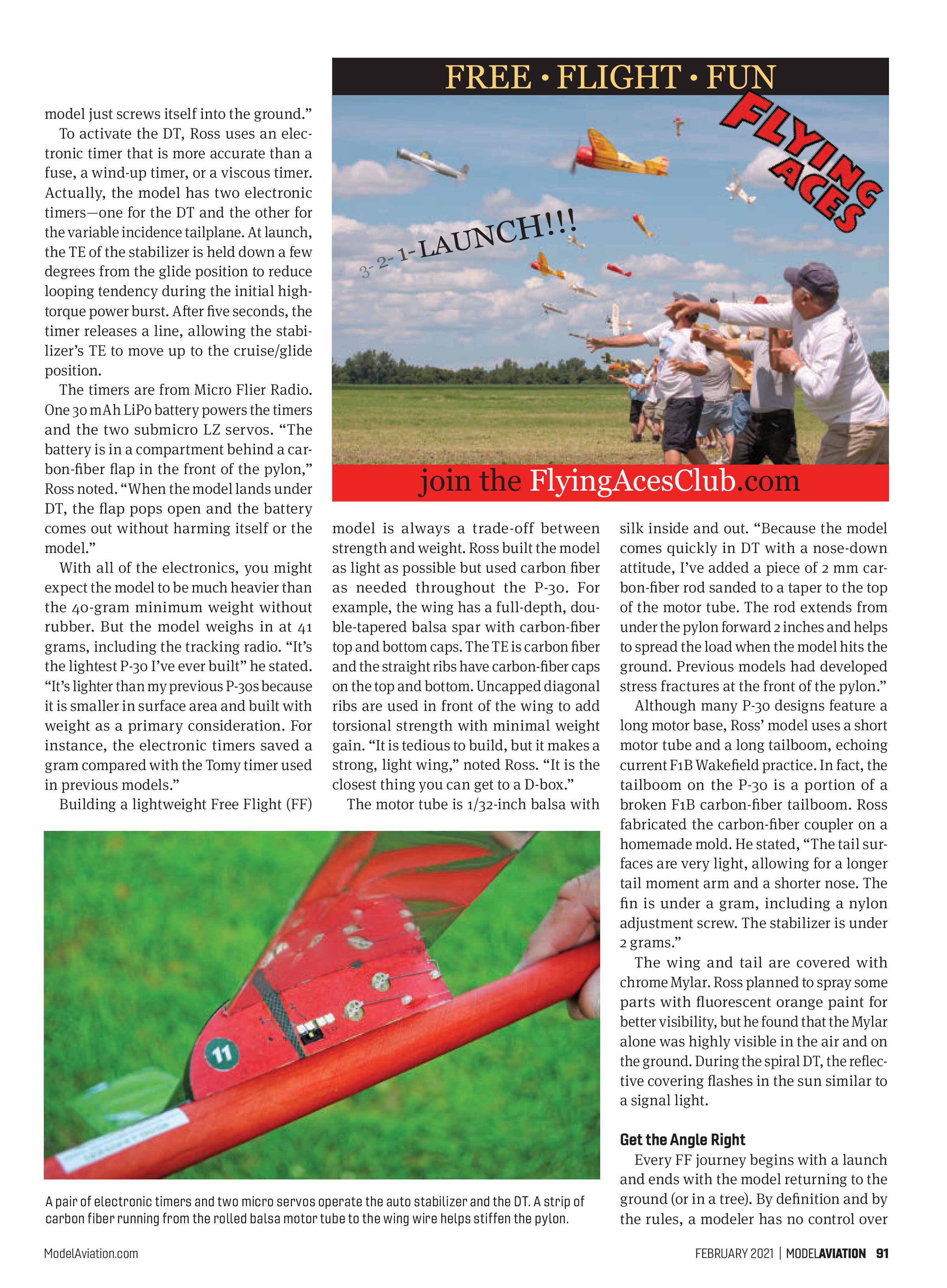
To activate the DT, Ross uses an electronic timer that is more accurate than a fuse, a wind-up timer, or a viscous timer. Actually, the model has two electronic timers—one for the DT and the other for the variable incidence tailplane. At launch, the TE of the stabilizer is held down a few degrees from the glide position to reduce looping tendency during the initial high-torque power burst. After five seconds, the timer releases a line, allowing the stabilizer’s TE to move up to the cruise/glide position.
The timers are from Micro Flier Radio. One 30 mAh LiPo battery powers the timers and the two submicro LZ servos. “The battery is in a compartment behind a carbon-fiber flap in the front of the pylon,” Ross noted. “When the model lands under DT, the flap pops open and the battery comes out without harming itself or the model.”
With all of the electronics, you might expect the model to be much heavier than the 40-gram minimum weight without rubber. But the model weighs in at 41 grams, including the tracking radio. “It’s the lightest P-30 I’ve ever built” he stated. “It’s lighter than my previous P-30s because it is smaller in surface area and built with weight as a primary consideration. For instance, the electronic timers saved a gram compared with the Tomy timer used in previous models.”
Building a lightweight Free Flight (FF) model is always a trade-off between strength and weight. Ross built the model as light as possible but used carbon fiber as needed throughout the P-30. For example, the wing has a full-depth, double-tapered balsa spar with carbon-fiber top and bottom caps. The TE is carbon fiber and the straight ribs have carbon-fiber caps on the top and bottom. Uncapped diagonal ribs are used in front of the wing to add torsional strength with minimal weight gain. “It is tedious to build, but it makes a strong, light wing,” noted Ross. “It is the closest thing you can get to a D-box.”
The motor tube is 1/32-inch balsa with silk inside and out. “Because the model comes quickly in DT with a nose-down attitude, I’ve added a piece of 2 mm carbon-fiber rod sanded to a taper to the top of the motor tube. The rod extends from under the pylon forward 2 inches and helps to spread the load when the model hits the ground. Previous models had developed stress fractures at the front of the pylon.”
Although many P-30 designs feature a long motor base, Ross’ model uses a short motor tube and a long tailboom, echoing current F1B Wakefield practice. In fact, the tailboom on the P-30 is a portion of a broken F1B carbon-fiber tailboom. Ross fabricated the carbon-fiber coupler on a homemade mold. He stated, “The tail surfaces are very light, allowing for a longer tail moment arm and a shorter nose. The fin is under a gram, including a nylon adjustment screw. The stabilizer is under 2 grams.”
The wing and tail are covered with chrome Mylar. Ross planned to spray some parts with fluorescent orange paint for better visibility, but he found that the Mylar alone was highly visible in the air and on the ground. During the spiral DT, the reflective covering flashes in the sun similar to a signal light.

Get the Angle Right
Every FF journey begins with a launch and ends with the model returning to the ground (or in a tree). By definition and by the rules, a modeler has no control over