Focal Point
Interested in sharing your handiwork? Visit www.ModelAviation.com for submission guidelines.
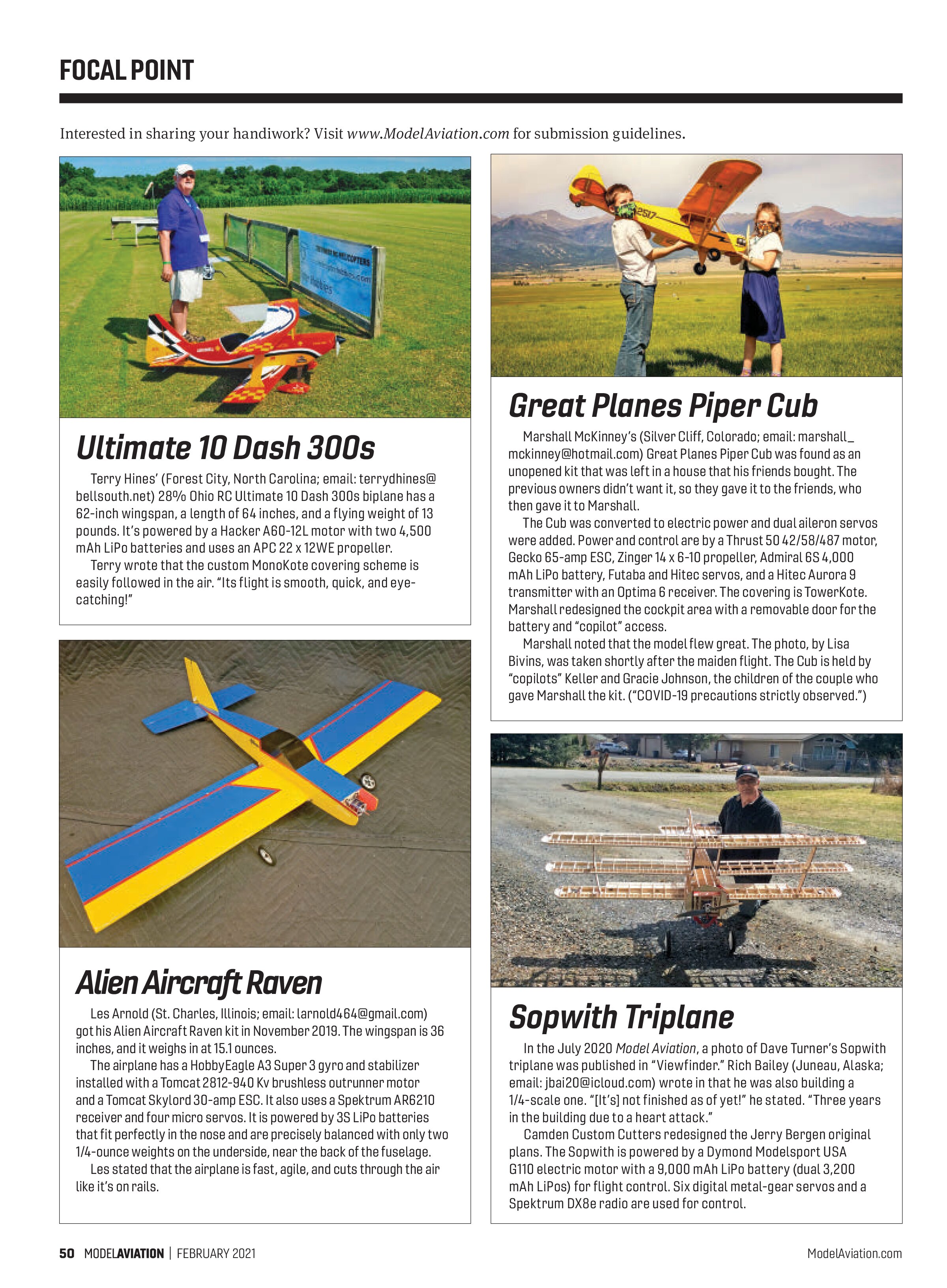
Ultimate 10 Dash 300s
Terry Hines’ (Forest City, North Carolina; email: terrydhines@bellsouth.net) 28% Ohio RC Ultimate 10 Dash 300s biplane has a 62-inch wingspan, a length of 64 inches, and a flying weight of 13 pounds. It’s powered by a Hacker A60-12L motor with two 4,500 mAh LiPo batteries and uses an APC 22 x 12WE propeller.
Terry wrote that the custom MonoKote covering scheme is easily followed in the air. “Its flight is smooth, quick, and eye-catching!”

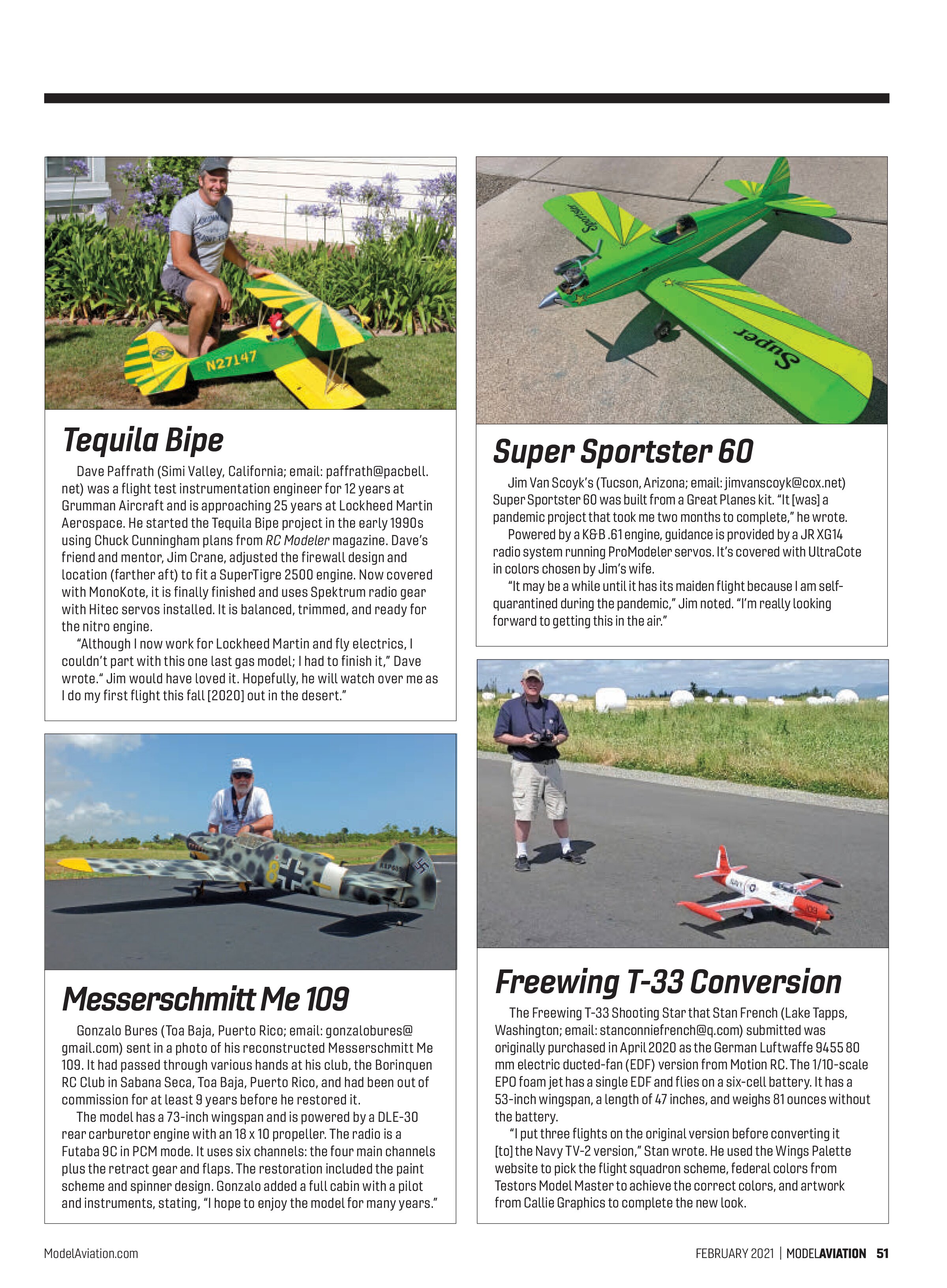
Alien Aircraft Raven
Les Arnold (St. Charles, Illinois; email: larnold464@gmail.com) got this Alien Aircraft Raven kit in November 2019. The wingspan is 36 inches, and it weighs in at 15.1 ounces.
The airplane has a HobbyEagle A3 Super 3 gyro and stabilizer installed with a Tomcat 2812-940 Kv brushless outrunner motor and a Tomcat Skylord 30-amp ESC. It also uses a Spektrum AR6210 receiver and four micro servos. It is powered by 3S LiPo batteries that fit perfectly in the nose and are precisely balanced with only two 1/4-ounce weights on the underside, near the back of the fuselage.
Les stated that the airplane is fast, agile, and cuts through the air like it’s on rails.

Great Planes Piper Cub
Marshall McKinney’s (Silver Cliff, Colorado; email: marshall_mckinney@hotmail.com) Great Planes Piper Cub was found as an unopened kit that was left in a house that his friends bought. The previous owners didn’t want it, so they gave it to the friends, who then gave it to Marshall.
The Cub was converted to electric power and dual aileron servos were added. Power and control are by a Thrust 50 42/58/487 motor, Gecko 65-amp ESC, Zinger 14 x 6-10 propeller, Admiral 6S 4,000 mAh LiPo battery, Futaba and Hitec servos, and a Hitec Aurora 9 transmitter with an Optima 6 receiver. The covering is TowerKote. Marshall redesigned the cockpit area with a removable door for the battery and “copilot” access.
Marshall noted that the model flew great. The photo, by Lisa Bivins, was taken shortly after the maiden flight. The Cub is held by “copilots” Keller and Gracie Johnson, the children of the couple who gave Marshall the kit. (“COVID-19 precautions strictly observed.”)

Sopwith Triplane
In the July 2020 Model Aviation, a photo of Dave Turner’s Sopwith triplane was published in “Viewfinder.” Rich Bailey (Juneau, Alaska; email: ibai20@icloud.com) wrote in that he was also building a 1/4-scale one. “[It’s] not finished as of yet!” he stated. “Three years in the building due to a heart attack.”
Camden Custom Cutters redesigned the Jerry Bergen original plans. The Sopwith is powered by a Dymond Modelsport USA G110 electric motor with a 9,000 mAh LiPo battery (dual 3,200 mAh LiPos) for flight control. Six digital metal-gear servos and a Spektrum DX8e radio are used for control.

Tequila Bipe
Dave Paffrath (Simi Valley, California; email: paffrath@pacbell.net) was a flight test instrumentation engineer for 12 years at Grumman Aircraft and is approaching 25 years at Lockheed Martin Aerospace. He started the Tequila Bipe project in the early 1990s using Chuck Cunningham plans from RC Modeler magazine. Dave’s friend and mentor, Jim Crane, adjusted the firewall design and location (farther aft) to fit a SuperTigre 2500 engine. Now covered with MonoKote, it is finally finished and uses Spektrum radio gear with Hitec servos installed. It is balanced, trimmed, and ready for the nitro engine.
“Although I now work for Lockheed Martin and fly electronics, I couldn’t part with this one last gas model; I had to finish it,” Dave wrote. “Jim would have loved it. Hopefully, he will watch over me as I do my first flight this fall (2020) out in the desert.”

Super Sportster 60
Jim Van Scoyk’s (Tucson, Arizona; email: jimvanscoyk@cox.net) Super Sportster 60 was built from a Great Planes kit. “[It was] a pandemic project that took me two months to complete,” he wrote.
Powered by a K&B .61 engine, guidance is provided by a JR XG14 radio system running ProModeler servos. It’s covered with UltraCote in colors chosen by Jim’s wife.
“It may be a while until it has its maiden flight because I am self-quarantined during the pandemic,” Jim muttered. “I’m really looking forward to getting this in the air.”

Messerschmitt Me 109
Gonzalo Bures (Toa Baja, Puerto Rico; email: gonzalobures@gmail.com) sent in a photo of his reconstructed Messerschmitt Me 109. It had passed through various hands at his club, the Borinquen RC Club in Sabana Seca, Toa Baja, Puerto Rico, and had been out of commission for at least 9 years before he restored it.
The model has a 73-inch wingspan and is powered by a DLE-30 rear carburetor engine with an 18 x 10 propeller. The radio is a Futaba 9C in PCM mode. It uses six channels: the four main channels plus the retract gear and flaps. The restoration included the paint scheme and spinner design. Gonzalo added a full cabin with a pilot and instruments, stating, “I hope to enjoy the model for many years.”

Freewing T-33 Conversion
The Freewing T-33 Shooting Star that Stan French (Lake Tapps, Washington; email: stanconniefrench@q.com) submitted was originally purchased in April 2020 as the German Luftwaffe 9455 80 mm electric ducted-fan (EDF) version from Motion RC. The 1/10-scale EPO foam jet has a single EDF and flies on a six-cell battery. It has a 53-inch wingspan, a length of 47 inches, and weighs 81 ounces without the battery.
“I put three flights on the original version before converting it [to] the Navy TV-2 version,” Stan wrote. He used the Wings Palette website to pick the flight squadron scheme, federal colors from Testors Model Master to achieve the correct colors, and artwork from Callie Graphics to complete the new look.