VINTAGE VIEWPOINT


ZEL RITCHIE
By Bob Noll | bobrc@aol.com
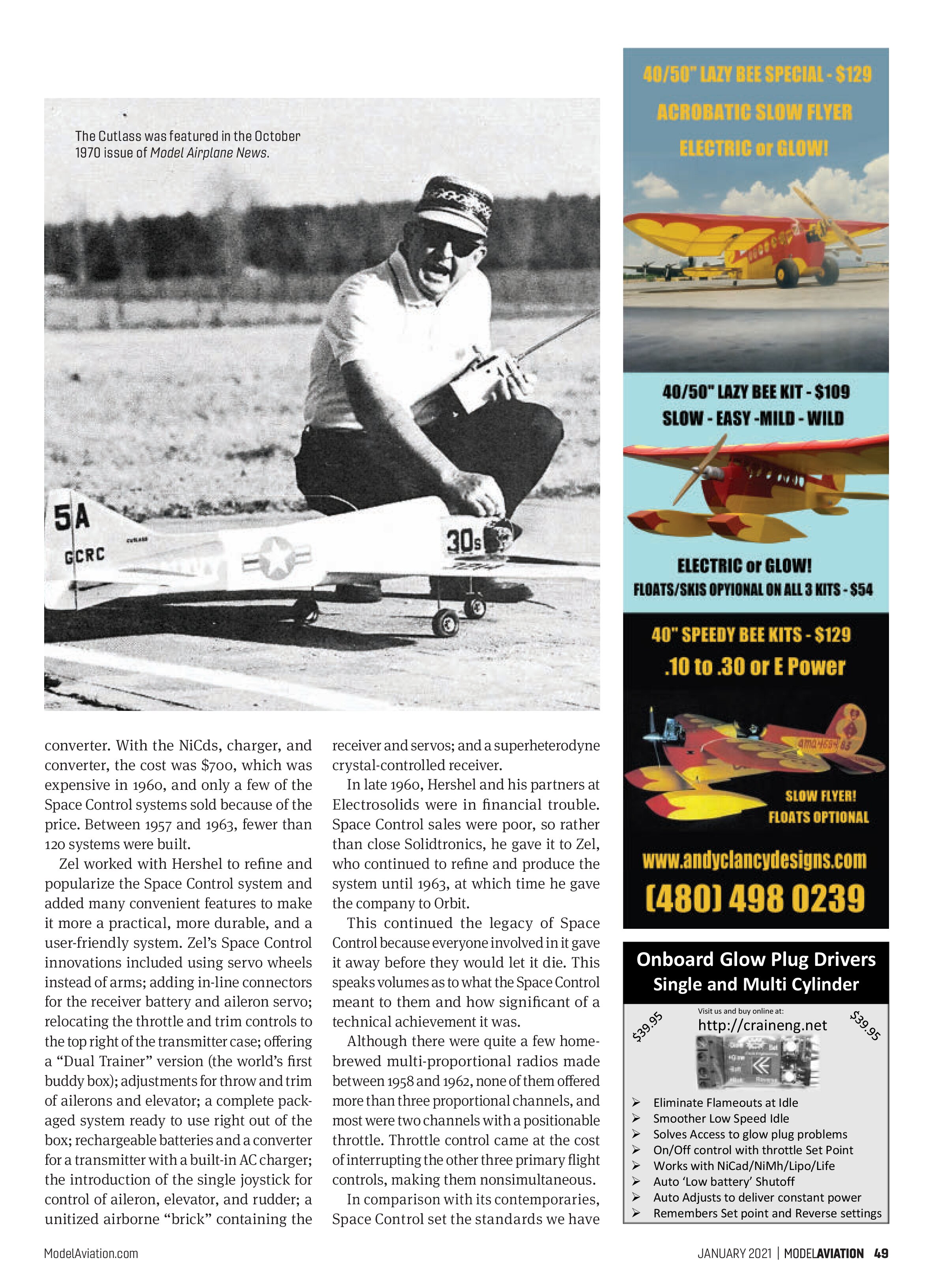
I JUST RETRIEVED FOUR magazines from my library that are dated October 1970 and was ready to write about RC 50 years ago when I opened the following email from Jay Mendoza about Zel Ritchie. I met Zel at one of several DC Symposiums I attended in the 1960s, so I decided to change paths and let Jay tell you about the man who was one of the pioneers of RC. Jay wrote:
Here is some information for your “Vintage Viewpoint” about one of the pioneers of modern proportional, Mr. Space Control, Zel Ritchie, who died in early 2018. Zel worked closely with Hershel Toomin of Solidtronics in Van Nuys, California, who designed the Space Control, a groundbreaking proportional radio control system. During an interview published in 1961, Hershel related that he had begun the design some 15 years earlier, following World War II.
By the late 1950s, lightweight electronic components and radio-frequency transistors became available, making Hershel’s design practical to manufacture. The earliest-known example of the Space Control system contains parts date-coded from 1957, confirming Hershel’s claim that he had been testing it for 3 years before releasing it for sale.
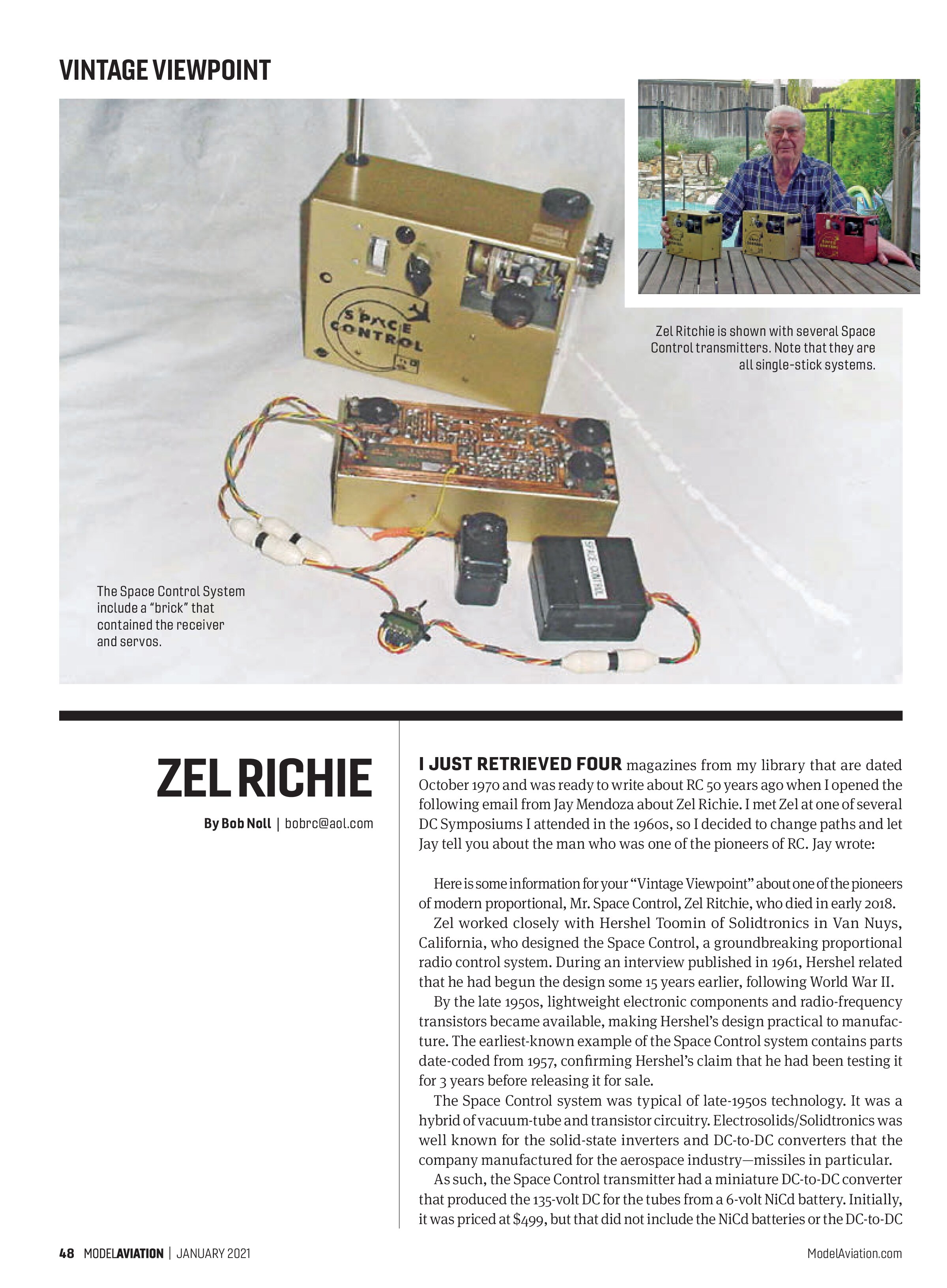
The Space Control system was typical of late-1950s technology. It was a hybrid of vacuum-tube and transistor circuitry. Electrosolids/Solidtronics was well known for the solid-state inverters and DC-to-DC converters that the company manufactured for the aerospace industry—missiles in particular.
As such, the Space Control transmitter had a miniature DC-to-DC converter that produced the 135-volt DC for the tubes from a 6-volt NiCd battery. Initially, it was priced at $499, but that did not include the NiCd batteries or the DC-to-DC converter.

With the NiCds, charger, and converter, the cost was $700, which was expensive in 1960, and only a few of the Space Control systems sold because of the price. Between 1957 and 1963, fewer than 120 systems were built.
Zel worked with Hershel to refine and popularize the Space Control system and added many convenient features to make it more a practical, more durable, and a user-friendly system. Zel’s Space Control innovations included using servo wheels instead of arms; adding in-line connectors for the receiver battery and aileron servo; relocating the throttle and trim controls to the top right of the transmitter case; offering a “Dual Trainer” version (the world’s first buddy box); adjustments for throw and trim of ailerons and elevator; a complete packaged system ready to use right out of the box; rechargeable batteries and a converter for a transmitter with a built-in AC charger; the introduction of the single joystick for control of aileron, elevator, and rudder; a unitized airborne “brick” containing the receiver and servos; and a superheterodyne crystal-controlled receiver.
In late 1960, Hershel and his partners at Electrosolids were in financial trouble. Space Control sales were poor, so rather than close Solidtronics, he gave it to Zel, who continued to refine and produce the system until 1963, at which time he gave the company to Orbit.
This continued the legacy of Space Control because everyone involved in it gave it away before they would let it die. This speaks volumes as to what the Space Control meant to them and how significant of a technical achievement it was.
Although there were quite a few home-brewed multi-proportional radios made between 1958 and 1962, none of them offered more than three proportional channels, and most were two channels with a positionable throttle. Throttle control came at the cost of interrupting the other three primary flight controls, making them nonsimultaneous.
In comparison with its contemporaries, Space Control set the standards we have
come to expect today—most significantly, full proportional control of all channels simultaneously.
Mr. Space Control has taken his final flight, but he has left a legacy that we all continue to enjoy to this day and for years to come.
Don Coleman’s Cutlass
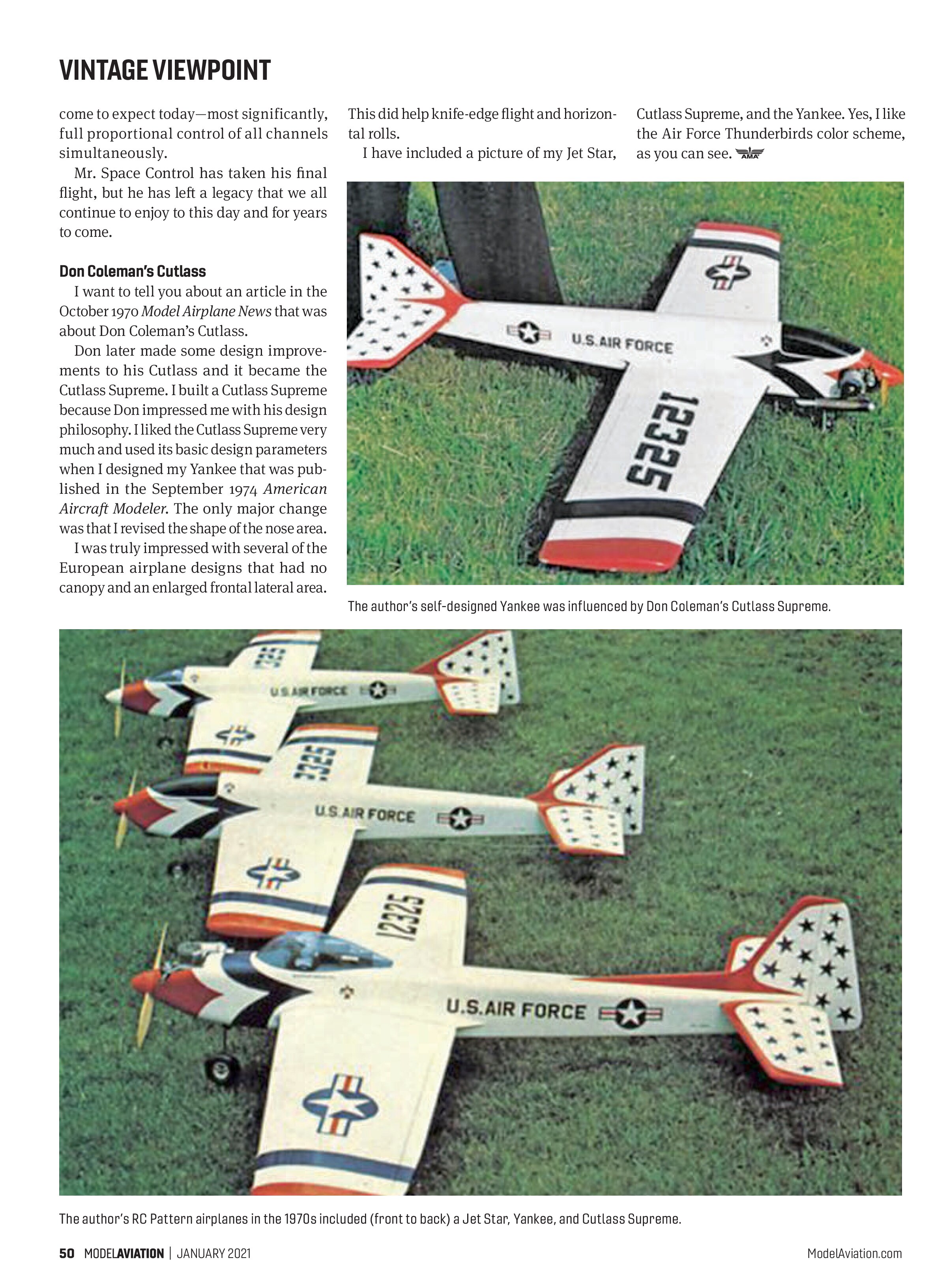
I want to tell you about an article in the October 1970 Model Airplane News that was about Don Coleman’s Cutlass.
Don later made some design improvements to his Cutlass and it became the Cutlass Supreme. I built a Cutlass Supreme because Don impressed me with his design philosophy. I liked the Cutlass Supreme very much and used its basic design parameters when I designed my Yankee that was published in the September 1974 American Aircraft Modeler. The only major change was that I revised the shape of the nose area.
I was truly impressed with several of the European airplane designs that had no canopy and an enlarged frontal lateral area. This did help knife-edge flight and horizontal rolls.
I have included a picture of my Jet Star,