FROM SEAPLANES TO
RC SCALE
Photos provided by Dale Parks | dparks1935@outlook.com


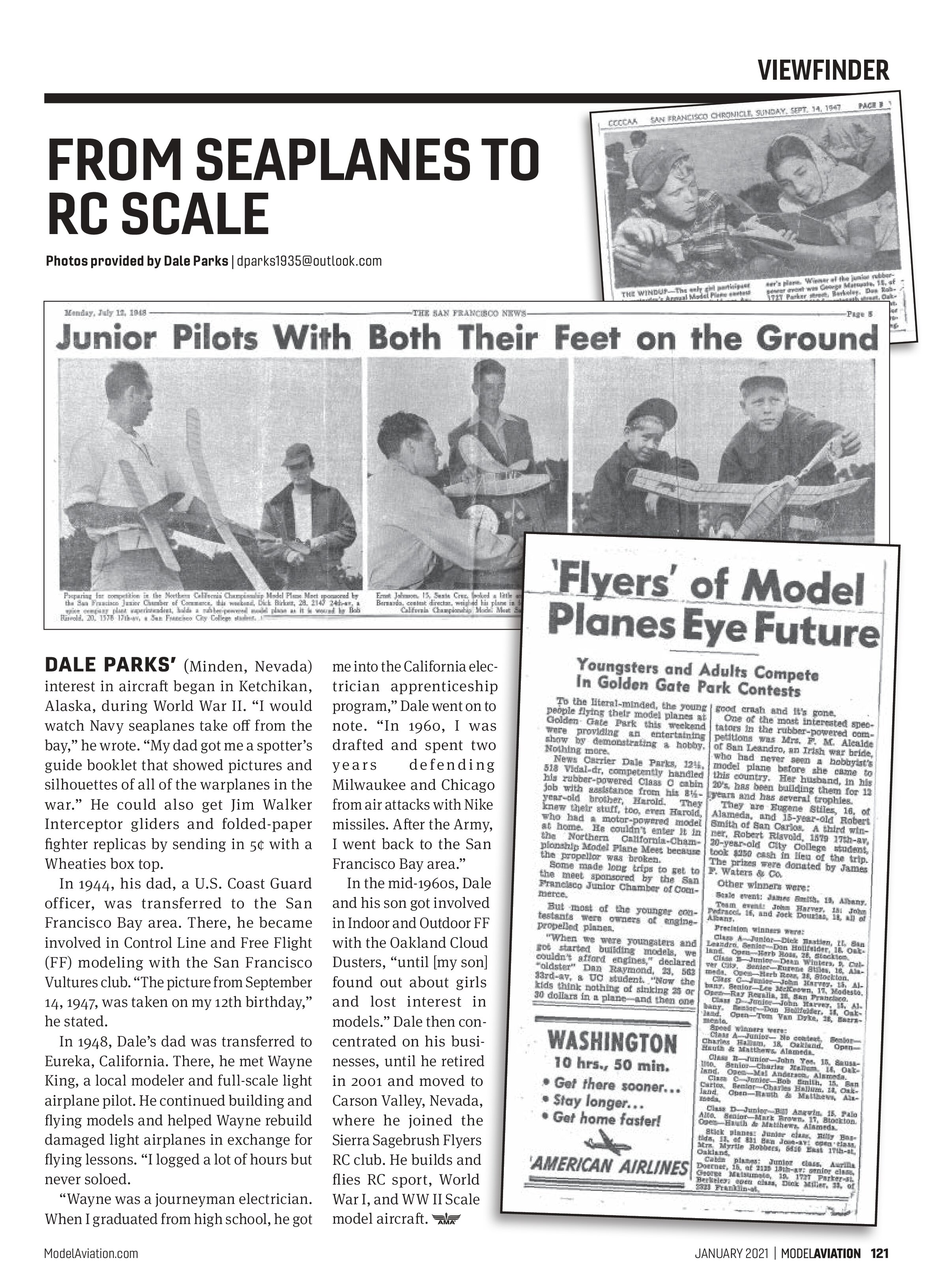
DALE PARKS’ (Minden, Nevada) interest in aircraft began in Ketchikan, Alaska, during World War II. “I would watch Navy seaplanes take off from the bay,” he wrote. “My dad got me a spotter’s guide booklet that showed pictures and silhouettes of all of the warplanes in the war.” He could also get Jim Walker Interceptor gliders and folded-paper fighter replicas by sending in 5¢ with a Wheaties box top.
In 1944, his dad, a U.S. Coast Guard officer, was transferred to the San Francisco Bay area. There, he became involved in Control Line and Free Flight (FF) modeling with the San Francisco Vultures club. “The picture from September 14, 1947, was taken on my 12th birthday,” he stated.
In 1948, Dale’s dad was transferred to Eureka, California. There, he met Wayne King, a local modeler and full-scale light airplane pilot. He continued building and flying models and helped Wayne rebuild damaged light airplanes in exchange for flying lessons. “I logged a lot of hours but never soloed.
“Wayne was a journeyman electrician. When I graduated from high school, he got me into the California electrician apprenticeship program,” Dale went on to note. “In 1960, I was drafted and spent two years defending Milwaukee and Chicago from air attacks with Nike missiles. After the Army, I went back to the San Francisco Bay area.”
In the mid-1960s, Dale and his son got involved in Indoor and Outdoor FF with the Oakland Cloud Dusters, “until [my son] found out about girls and lost interest in models.” Dale then concentrated on his businesses, until he retired in 2001 and moved to Carson Valley, Nevada, where he joined the Sierra Sagebrush Flyers RC club. He builds and flies RC sport, World War I, and WW II Scale model aircraft.
HAL
DEBOLT
CHAMP
Photos by Walt Throne | wthrone909@aol.com

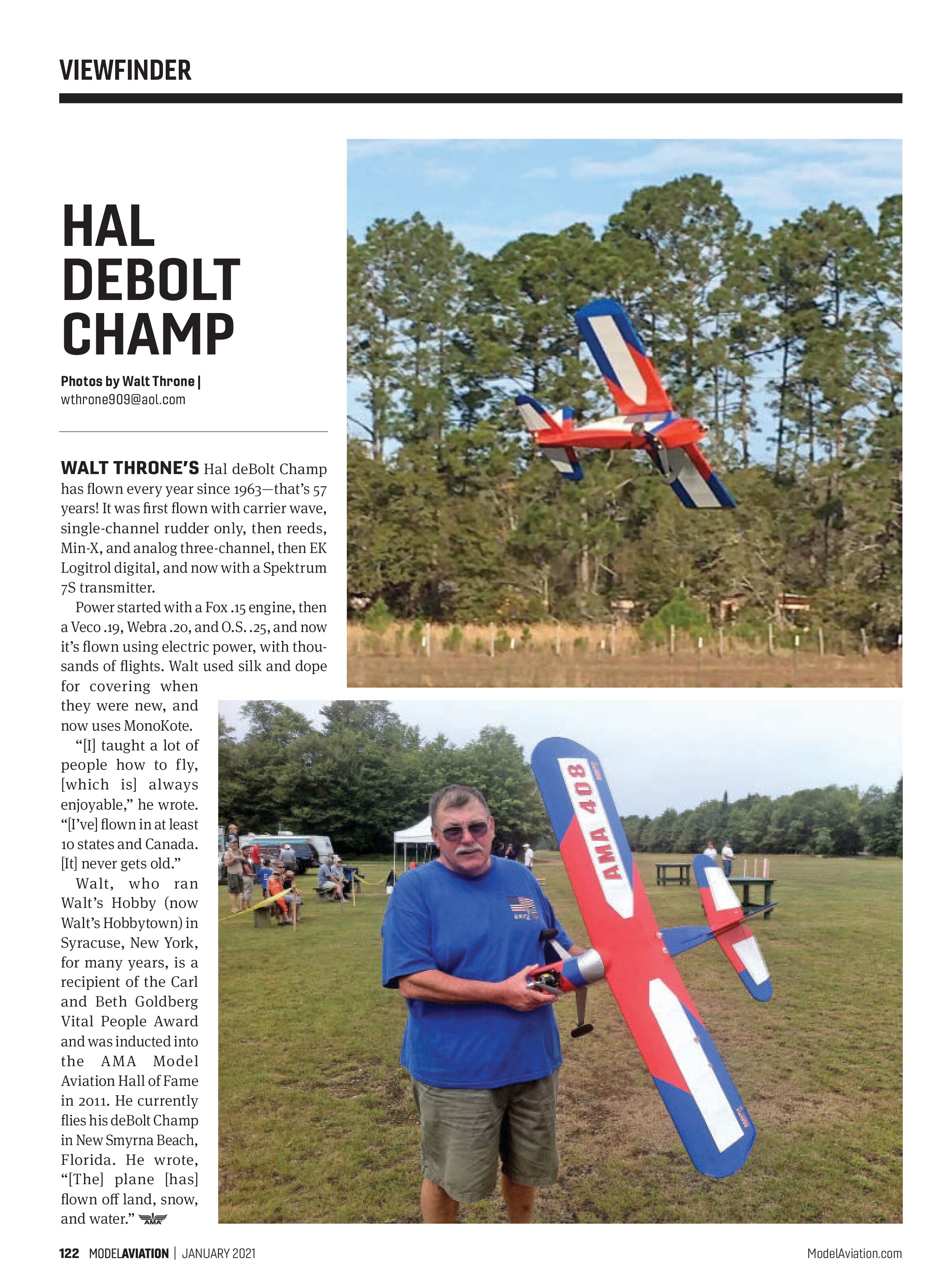
WALT THRONE’S Hal deBolt Champ has flown every year since 1963—that’s 57 years! It was first flown with carrier wave, single-channel rudder only, then reeds, Min-X, and analog three-channel, then EK Logitrol digital, and now with a Spektrum 7S transmitter.
Power started with a Fox .15 engine, then a Veco .19, Webra .20, and O.S. .25, and now it’s flown using electric power, with thousands of flights. Walt used silk and dope for covering when they were new, and now uses MonoKote.

“[I] taught a lot of people how to fly, [which is] always enjoyable,” he wrote. “[I’ve] flown in at least 10 states and Canada. [It] never gets old.”
Walt, who ran Walt’s Hobby (now Walt’s Hobbytown) in Syracuse, New York, for many years, is a recipient of the Carl and Beth Goldberg Vital People Award and was inducted into the AMA Model Aviation Hall of Fame in 2011. He currently flies his deBolt Champ in New Smyrna Beach, Florida. He wrote, “[The] plane [has] flown off land, snow, and water.”
LADDIE MIKULASKO
ARROWS
Joe Hass | joehass@gmail.com
Photo by David Hass

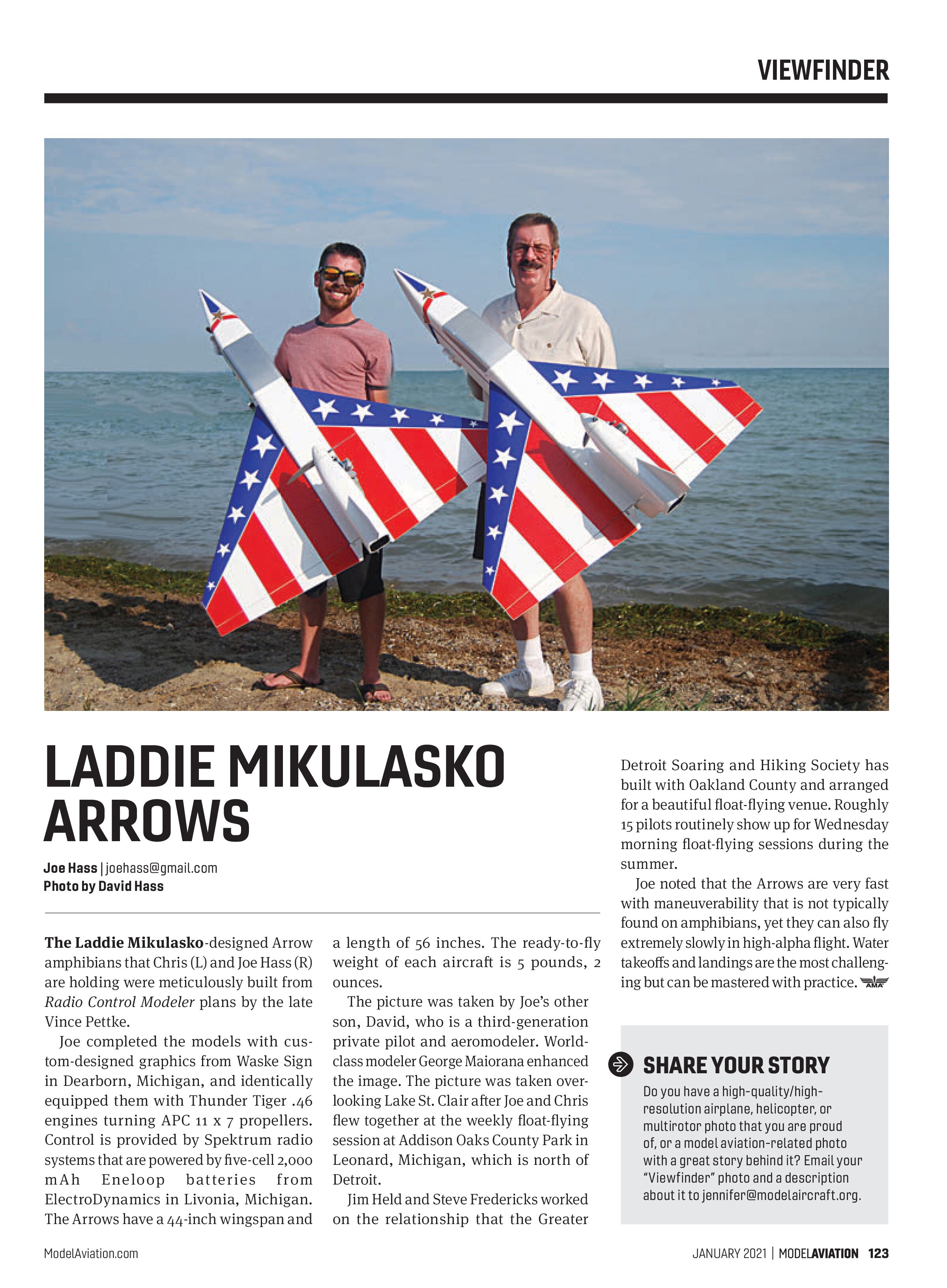
The Laddie Mikulasko-designed Arrow amphibians that Chris (L) and Joe Hass (R) are holding were meticulously built from Radio Control Modeler plans by the late Vince Pettke.
Joe completed the models with custom-designed graphics from Waske Sign in Dearborn, Michigan, and identically equipped them with Thunder Tiger .46 engines turning APC 11 x 7 propellers. Control is provided by Spektrum radio systems that are powered by five-cell 2,000 mAh Eneloop batteries from ElectroDynamics in Livonia, Michigan. The Arrows have a 44-inch wingspan and a length of 56 inches. The ready-to-fly weight of each aircraft is 5 pounds, 2 ounces.
The picture was taken by Joe’s other son, David, who is a third-generation private pilot and aeromodeler. World-class modeler George Maiorana enhanced the image. The picture was taken overlooking Lake St. Clair after Joe and Chris flew together at the weekly float-flying session at Addison Oaks County Park in Leonard, Michigan, which is north of Detroit.
Jim Held and Steve Fredericks worked on the relationship that the Greater Detroit Soaring and Hiking Society has built with Oakland County and arranged for a beautiful float-flying venue. Roughly 15 pilots routinely show up for Wednesday morning float-flying sessions during the summer.
Joe noted that the Arrows are very fast with maneuverability that is not typically found on amphibians, yet they can also fly extremely slowly in high-alpha flight. Water takeoffs and landings are the most challenging but can be mastered with practice.
SHARE YOUR STORY
Do you have a high-quality/high-resolution airplane, helicopter, or multirotor photo that you are proud of, or a model aviation-related photo with a great story behind it? Email your “Viewfinder” photo and a description about it to jennifer@modelaircraft.org.