SAFETY COMES FIRST
By Dave Gee | safetycolumn@cs.com

DOCTOR DAVE’S ANECDOTAL CLINIC is open! Here, you’ll get rumor-level medical advice from a guy who is not a doctor, based on unverified stories from modelers who are also not doctors. Our subject today is “adverse reactions to aeromodeling materials.”
Balsa is a classic building material for our aircraft. Despite being all-natural, organic, and environmentally sustainable, balsa sanding dust can produce an allergic reaction in some people. I developed problems after many years of exposure, and I now must wear a dust mask when I sand balsa to avoid coughing and respiratory discomfort. Take my advice and wear a dust mask when sanding, even if you aren’t yet bothered by breathing it in.
Dope, paint, and off-label finishes make your model look great, but they might cause problems if improperly used. Old-fashioned model airplane dope (fairly rare these days) requires lots of ventilation and is highly flammable.
Most builders use hobby paints or general-use products. These materials tend to be less hazardous than older formulas, but I still strongly advise spraying or brushing paint outdoors or in a well-ventilated area. Even the mildest product might cause irritation in some people, and avoidance is best.
Do you see the common thread here? Limiting your exposure to potentially harmful substances is the key. Avoidance (an upstream preventative measure) is better than treatment (downstream, after harm has been done). I put a big box fan in the window, pointing outward, then open another window across the room and get powerful airflow across my workbench. Even those who don’t regularly have mild weather should try to get the best possible workshop ventilation.
Cyanoacrylate (CA) Super Glue revolutionized aeromodeling and remains a common workbench item. Early anecdotal reports seemed to show that it was possible to develop allergic reactions to CA after an individual’s threshold had been reached. More recent stories might indicate that newer CA formulas are milder. Kicker accelerator seems to encapsulate the fumes and reduce our exposure.
I have no hard evidence to confirm this, except for my own personal experience. Using my drip bottle of accelerator eliminates my own sensitivity to CA fumes. A famous modeler and aviation innovator, Matt Keenon, taught me about this and gave me his own kicker drip bottle at a long-ago modeling event. I was working on an airplane and inadvertently annoying him with clouds of CA accelerator spray. He taught me a better way. I owe him a lot for solving my CA allergy problem!
Be a Mentor!
Matt’s mentoring made a big difference to me. Expert advice and mentoring are great ways to safely enhance our modeling skills. We learn so much about our sport through word of mouth.
Were you mentored? Now is your chance to help out the next generation of model aviators by teaching and training a new builder/pilot.
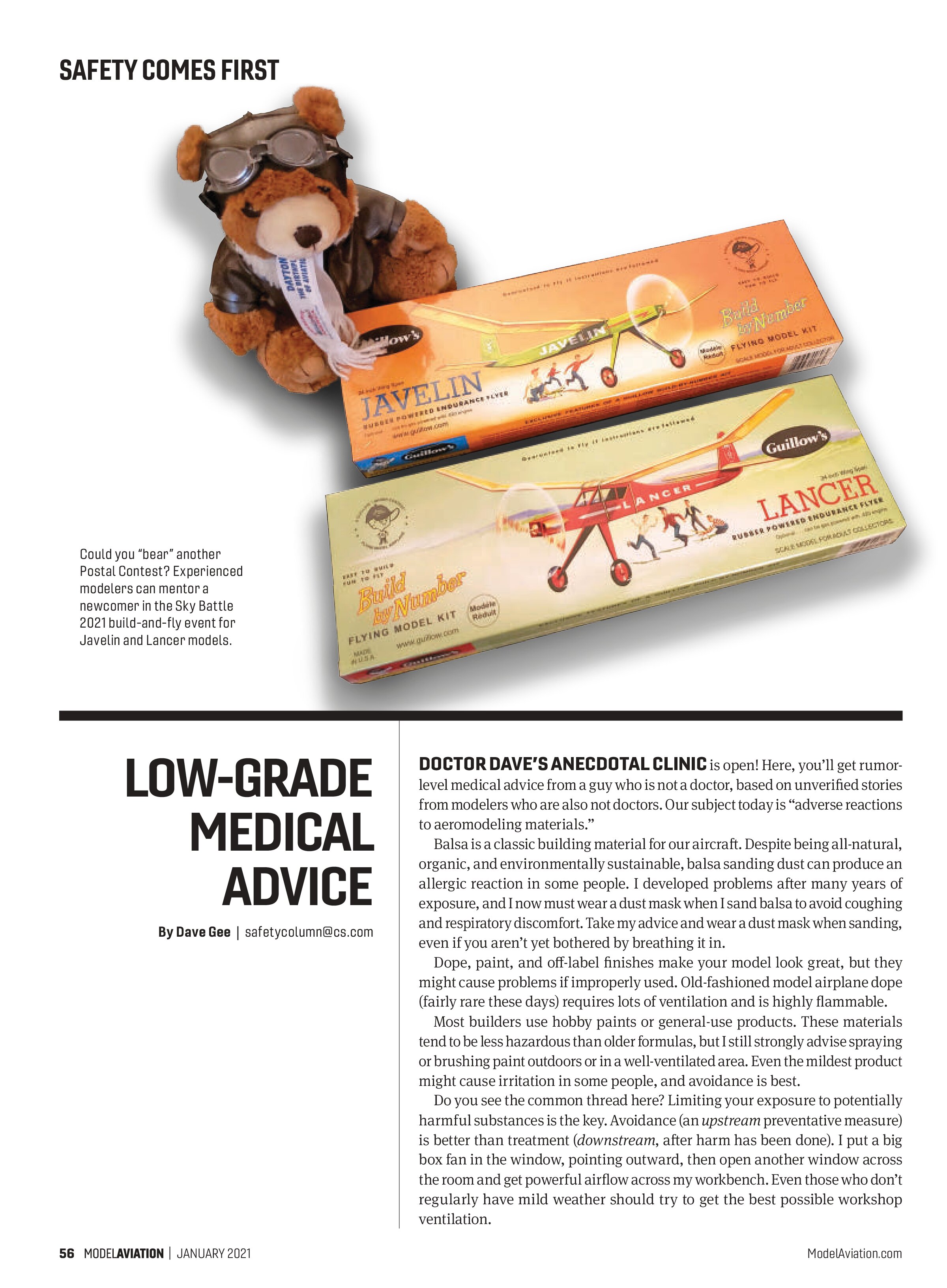
Sky Battle 2021 is a national Postal Contest aimed at bringing new pilots into our sport. If you’re an experienced builder, please consider helping a young or old newcomer construct a Guillows’s Lancer or Javelin airplane.
These nearly identical kits have been in production since the 1960s. Build-by-number construction ensures that even a nonmodeler can produce a good flying aircraft. The basic skills that a mentor can teach a student during this build will help in any area of aeromodeling that he or she chooses to pursue.
Official flights must be made between Saturday, April 24, and Sunday, April 25, 2021. Everyone flies individually from his or her local field and reports the results to Sky Battle 2021 headquarters via email; pilots can participate even if COVID-19 restrictions persist in their area. Details, advice, and discussion about this event can be found on social media, linked from the main contest website.
This is a follow-up event to the recent Bill Warner Memorial Sky Bunny Postal Contest, which was planned before the pandemic. Because it was a Postal Contest, modelers were still able to compete. Pilots of all ages sent flight scores from across the country.
The proof of success for this event is that a good number of new modelers participated by building and flying their first model airplane. Now it is hoped that a fresh crop of fledglings will feel that thrill by seeing their Lancers or Javelins zooming skyward.
Pick an Airplane—Any Airplane
Walt Moore tells of a sad episode that left him with a scarred finger.
“I was showing my new model to a visiting relative. I plugged in the arming switch and powered up the model. As I moved the transmitter sticks, I realized that I didn’t have the correct model selected. Suddenly, the model blasted off the table. I instinctively grabbed it and found that a little plastic 6 x 4 propeller can chew up fingers pretty well.
“Lesson? Use the transmitter to select models only with the airplane’s power system off.”
These newfangled, computerized RC systems are great, and they have many safety features, but it is still possible to outsmart them and get into trouble. I find that a little cheat card checklist for each airplane and transmitter helps me stay on track.
Sometimes I don’t fly a particular airplane or helicopter for a while and this reminder comes in handy. Walt was very kind to share his story. Perhaps reading it will save someone else from problems.
Eternal Flame?
Harlan Falkin knows how a battery fire can refuse to be put out. Well, he knows it now, after a harrowing experience!
Damaged or improperly charged LiPo batteries are capable of igniting, but the resulting “fire” isn’t your standard douse-it-with-water event. The violent chemical reaction is hard to stop. It can recommence even after you’ve used a fire extinguisher. Harlan wrote:
“I had a battery experience with a LiPo cell that was two weeks old. Charging it on my kitchen counter that is tile (thank

“As I opened the window to let out the smoke and fumes, the battery burst into flames, running up the face of my cabinets! Fortunately, I have a kitchen fire extinguisher, grabbed it, and put out the flames, but the battery reignited and required emptying the entire extinguisher on it. After that episode, I invested in a heat-resistant LiPo bag, which I always use when charging and storing my batteries.”
Plane on a Plinth
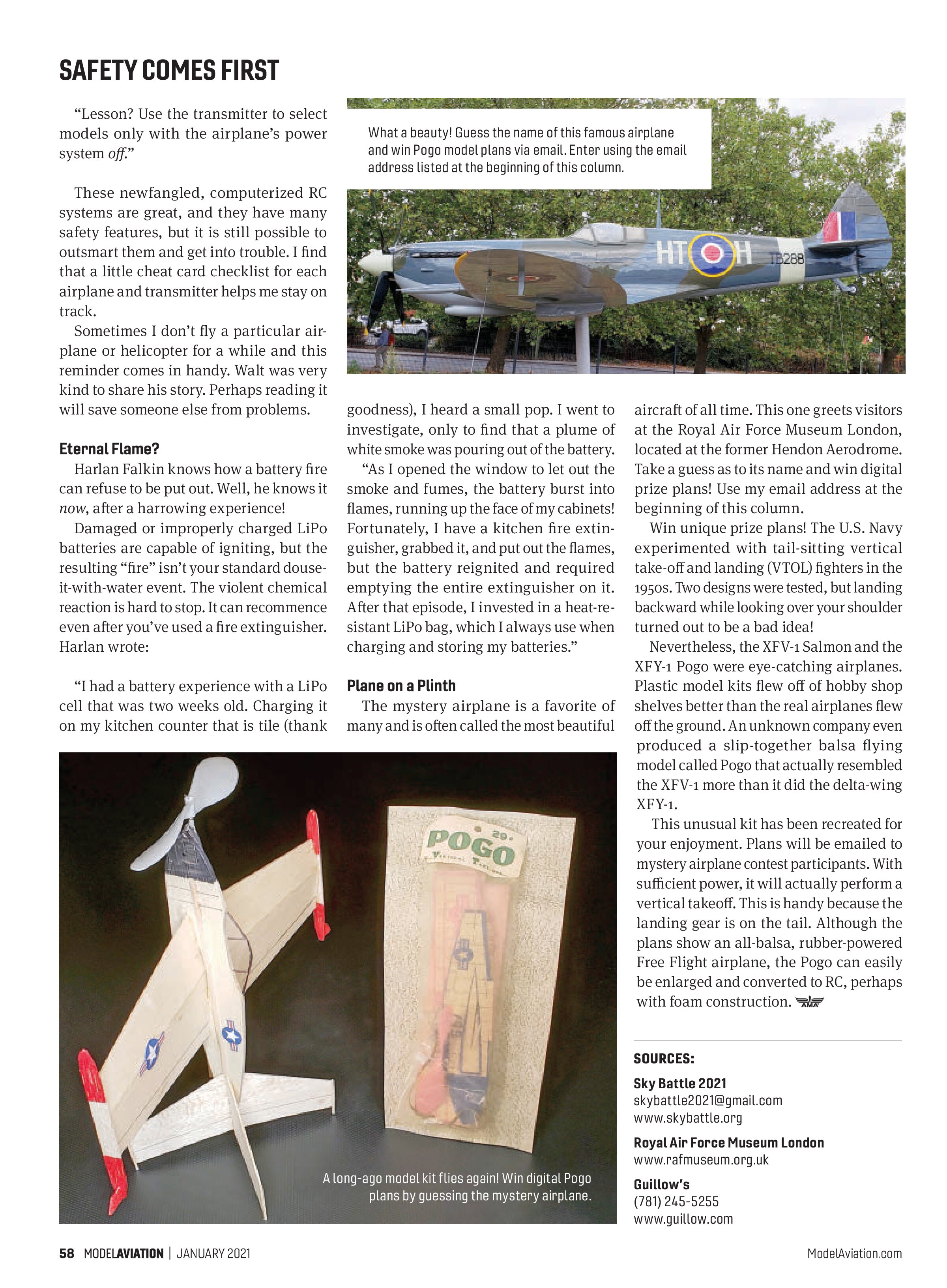
The mystery airplane is a favorite of many and is often called the most beautiful aircraft of all time. This one greets visitors at the Royal Air Force Museum London, located at the former Hendon Aerodrome. Take a guess as to its name and win digital prize plans! Use my email address at the beginning of this column.
Win unique prize plans! The U.S. Navy experimented with tail-sitting vertical take-off and landing (VTOL) fighters in the 1950s. Two designs were tested, but landing backward while looking over your shoulder turned out to be a bad idea!
Nevertheless, the XF V-1 Salmon and the XF Y-1 Pogo were eye-catching airplanes. Plastic model kits flew off of hobby shop shelves better than the real airplanes flew off the ground. An unknown company even produced a slip-together balsa flying model called Pogo that actually resembled the XF V-1 more than it did the delta-wing XFY-1.
This unusual kit has been recreated for your enjoyment. Plans will be emailed to mystery airplane contest participants. With sufficient power, it will actually perform a vertical takeoff. This is handy because the landing gear is on the tail. Although the plans show an all-balsa, rubber-powered Free Flight airplane, the Pogo can easily be enlarged and converted to RC, perhaps with foam construction.

SOURCES:
Sky Battle 2021
skybattle2021@gmail.com
www.skybattle.org
Royal Air Force Museum London
www.rafmuseum.org.uk
Guillow’s
(781) 245-5255
www.guillow.com