VENTURI
By Tim Lampe | tim.lampe@hotmail.com
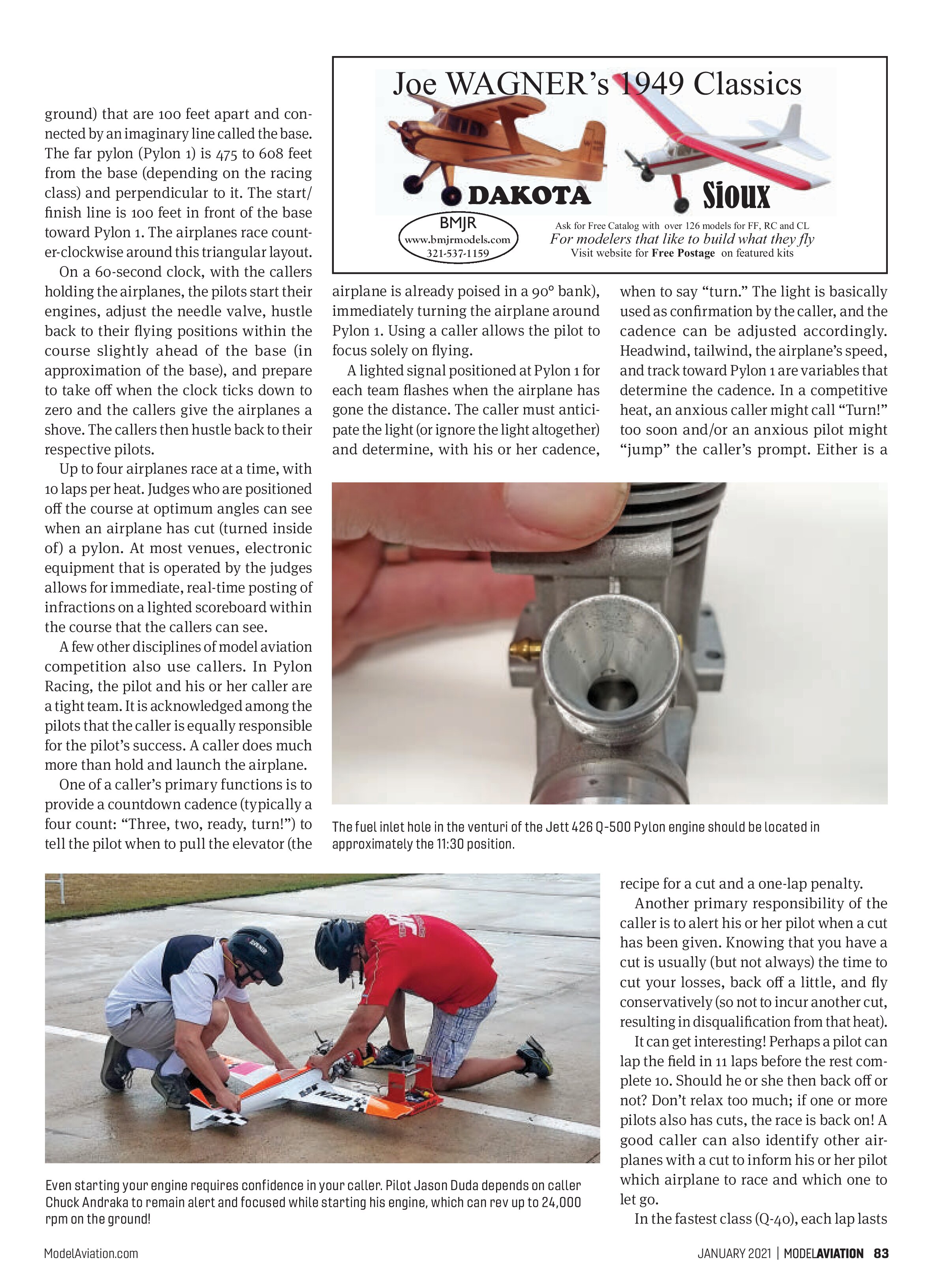
AT A RECENT PYLON RACE, a fellow pilot, Terry Frazer, asked me if I knew the position of the fuel outlet hole in the intake venturi on the Jett 426 Q-500 Pylon engine. I understand that the fuel hole in a venturi must be aligned with the spray bar for optimum fuel flow, and I work on my own engines, but I didn’t know the answer to that one.
I grabbed my airplane with the newest engine to have a look with Terry. I hadn’t had this engine apart, so the way the venturi was positioned was how the engine was built. Sure enough, the hole is positioned at approximately 11:00 to 11:30 as viewed from the front of the engine.
When I returned home, I disassembled one of my older engines and the outlet in the spray bar was slightly off to the right side of the engine. I called Dub Jett to confirm the following before sharing it.
Dub said that the engine would still run if the hole was mistakenly positioned straight back at 12:00, but then the needle would probably be really sensitive. Yes, the fuel hole should be positioned at approximately 11:30.
This might seem obvious, but without removing the venturi and seeing that the hole in the spray bar is off to the side, you could mistakenly assume that the hole goes straight back. So now you know.
Teammates
This month, I thought I would give non-Pylon Racing pilots a glimpse into the relationship between a pilot and his or her caller. First, you have to know a little about Pylon Racing, so I’ll attempt to describe it briefly.
Imagine a triangular layout with two pylons (typically PVC poles in the ground) that are 100 feet apart and connected by an imaginary line called the base. The far pylon (Pylon 1) is 475 to 608 feet from the base (depending on the racing class) and perpendicular to it. The start/finish line is 100 feet in front of the base toward Pylon 1. The airplanes race counter-clockwise around this triangular layout.
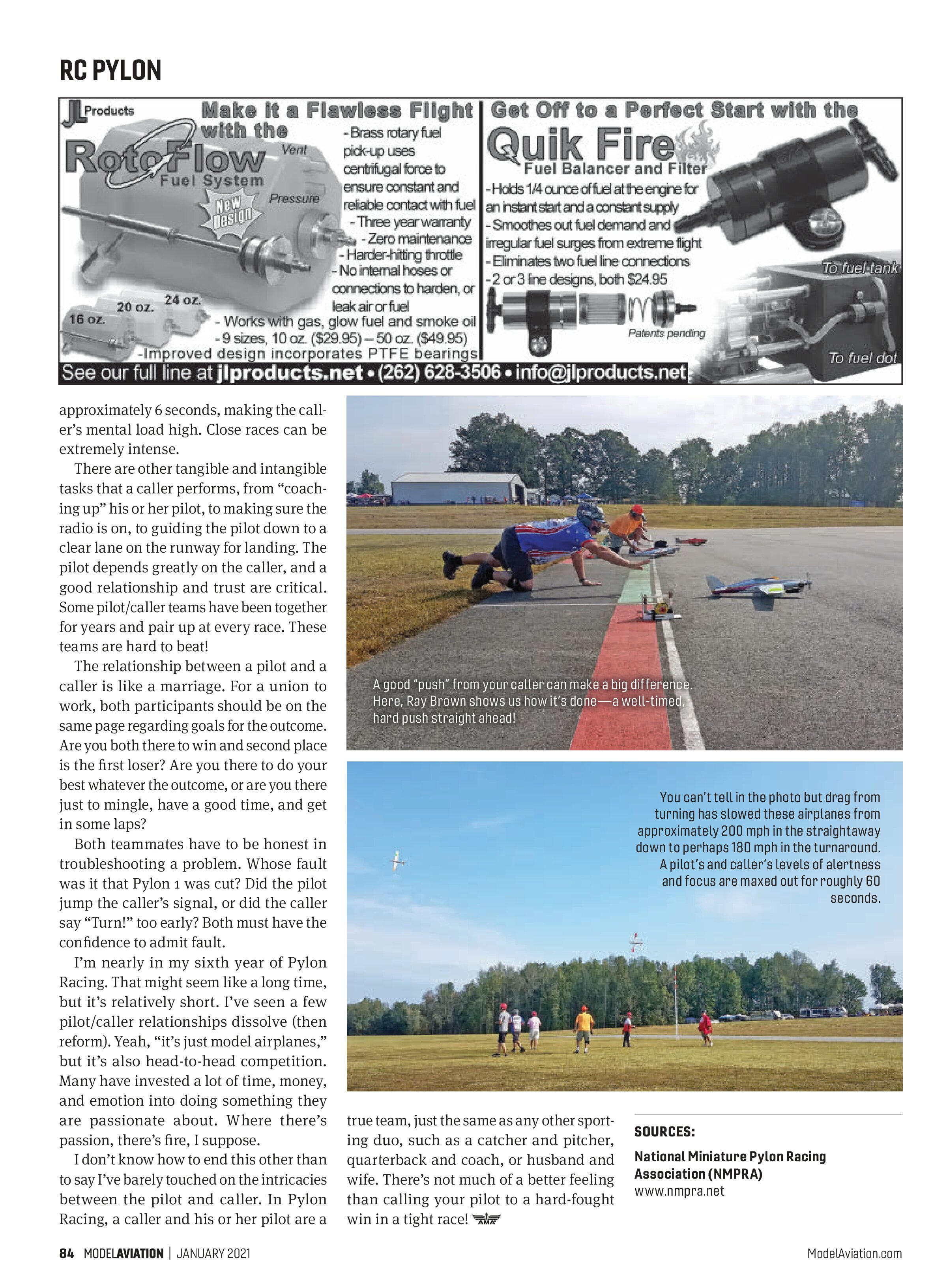
On a 60-second clock, with the callers holding the airplanes, the pilots start their engines, adjust the needle valve, hustle back to their flying positions within the course slightly ahead of the base (in approximation of the base), and prepare to take off when the clock ticks down to zero and the callers give the airplanes a shove. The callers then hustle back to their respective pilots.
Up to four airplanes race at a time, with 10 laps per heat. Judges who are positioned off the course at optimum angles can see when an airplane has cut (turned inside of) a pylon. At most venues, electronic equipment that is operated by the judges allows for immediate, real-time posting of infractions on a lighted scoreboard within the course that the callers can see.
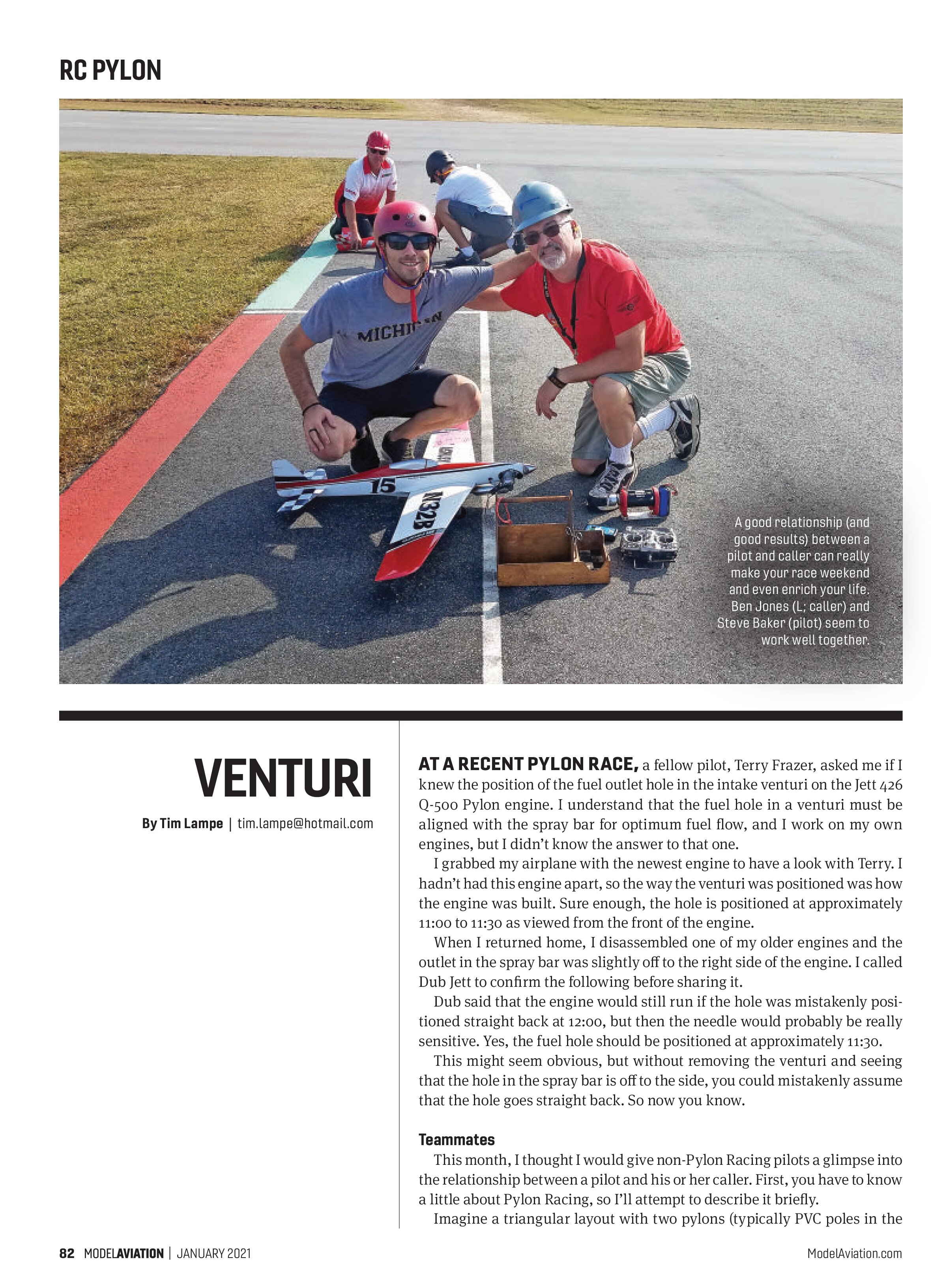
A few other disciplines of model aviation competition also use callers. In Pylon Racing, the pilot and his or her caller are a tight team. It is acknowledged among the pilots that the caller is equally responsible for the pilot’s success. A caller does much more than hold and launch the airplane.
One of a caller’s primary functions is to provide a countdown cadence (typically a four count: “Three, two, ready, turn!”) to tell the pilot when to pull the elevator (the airplane is already poised in a 90° bank), immediately turning the airplane around Pylon 1. Using a caller allows the pilot to focus solely on flying.
A lighted signal positioned at Pylon 1 for each team flashes when the airplane has gone the distance. The caller must anticipate the light (or ignore the light altogether) and determine, with his or her cadence, when to say “turn.” The light is basically used as confirmation by the caller, and the cadence can be adjusted accordingly. Headwind, tailwind, the airplane’s speed, and track toward Pylon 1 are variables that determine the cadence. In a competitive heat, an anxious caller might call “Turn!” too soon and/or an anxious pilot might “jump” the caller’s prompt. Either is a recipe for a cut and a one-lap penalty.
Another primary responsibility of the caller is to alert his or her pilot when a cut has been given. Knowing that you have a cut is usually (but not always) the time to cut your losses, back off a little, and fly conservatively (so not to incur another cut, resulting in disqualification from that heat).
It can get interesting! Perhaps a pilot can lap the field in 11 laps before the rest complete 10. Should he or she then back off or not? Don’t relax too much; if one or more pilots also has cuts, the race is back on! A good caller can also identify other airplanes with a cut to inform his or her pilot which airplane to race and which one to let go.
In the fastest class (Q-40), each lap lasts


approximately 6 seconds, making the caller’s mental load high. Close races can be extremely intense.
There are other tangible and intangible tasks that a caller performs, from “coaching up” his or her pilot, to making sure the radio is on, to guiding the pilot down to a clear lane on the runway for landing. The pilot depends greatly on the caller, and a good relationship and trust are critical. Some pilot/caller teams have been together for years and pair up at every race. These teams are hard to beat!
The relationship between a pilot and a caller is like a marriage. For a union to work, both participants should be on the same page regarding goals for the outcome. Are you both there to win and second place is the first loser? Are you there to do your best whatever the outcome, or are you there just to mingle, have a good time, and get in some laps?
Both teammates have to be honest in troubleshooting a problem. Whose fault was it that Pylon 1 was cut? Did the pilot jump the caller’s signal, or did the caller say “Turn!” too early? Both must have the confidence to admit fault.
I’m nearly in my sixth year of Pylon Racing. That might seem like a long time, but it’s relatively short. I’ve seen a few pilot/caller relationships dissolve (then reform). Yeah, “it’s just model airplanes,” but it’s also head-to-head competition. Many have invested a lot of time, money, and emotion into doing something they are passionate about. Where there’s passion, there’s fire, I suppose.
I don’t know how to end this other than to say I’ve barely touched on the intricacies between the pilot and caller. In Pylon Racing, a caller and his or her pilot are a true team, just the same as any other sporting duo, such as a catcher and pitcher, quarterback and coach, or husband and wife. There’s not much of a better feeling than calling your pilot to a hard-fought win in a tight race!


SOURCES:
National Miniature Pylon Racing Association (NMPRA)
www.nmpra.net