POWERBOX
MERCURY SRS
By Jim Hiller | jetmodeler@earthlink.net
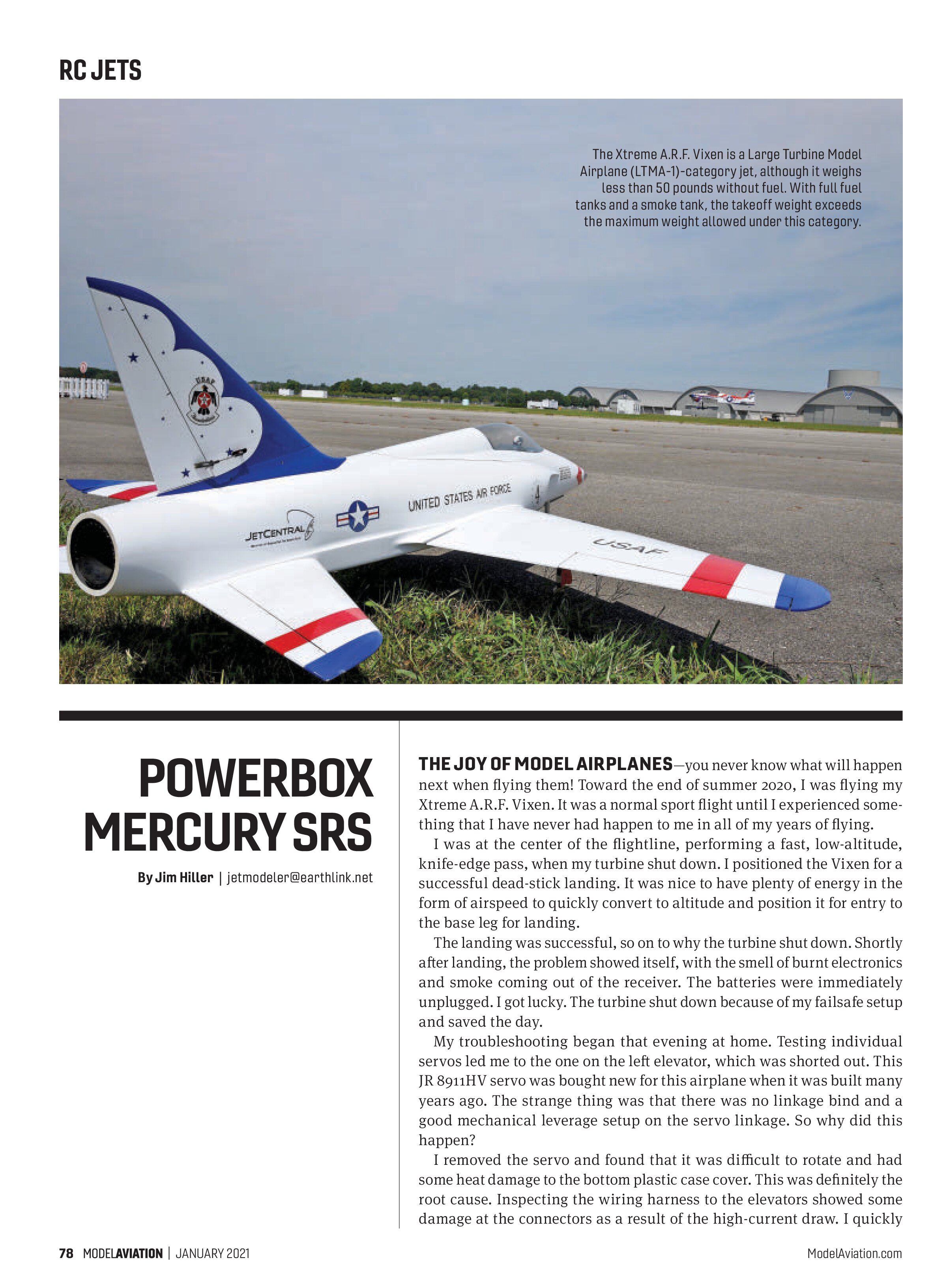
THE JOY OF MODEL AIRPLANES—you never know what will happen next when flying them! Toward the end of summer 2020, I was flying my Xtreme A.R.F. Vixen. It was a normal sport flight until I experienced something that I have never had happen to me in all of my years of flying.
I was at the center of the flightline, performing a fast, low-altitude, knife-edge pass, when my turbine shut down. I positioned the Vixen for a successful dead-stick landing. It was nice to have plenty of energy in the form of airspeed to quickly convert to altitude and position it for entry to the base leg for landing.
The landing was successful, so on to why the turbine shut down. Shortly after landing, the problem showed itself, with the smell of burnt electronics and smoke coming out of the receiver. The batteries were immediately unplugged. I got lucky. The turbine shut down because of my failsafe setup and saved the day.
My troubleshooting began that evening at home. Testing individual servos led me to the one on the left elevator, which was shorted out. This JR 8911HV servo was bought new for this airplane when it was built many years ago. The strange thing was that there was no linkage bind and a good mechanical leverage setup on the servo linkage. So why did this happen?
I removed the servo and found that it was difficult to rotate and had some heat damage to the bottom plastic case cover. This was definitely the root cause. Inspecting the wiring harness to the elevators showed some damage at the connectors as a result of the high-current draw. I quickly made repairs and replaced both elevator servos with new matching units.
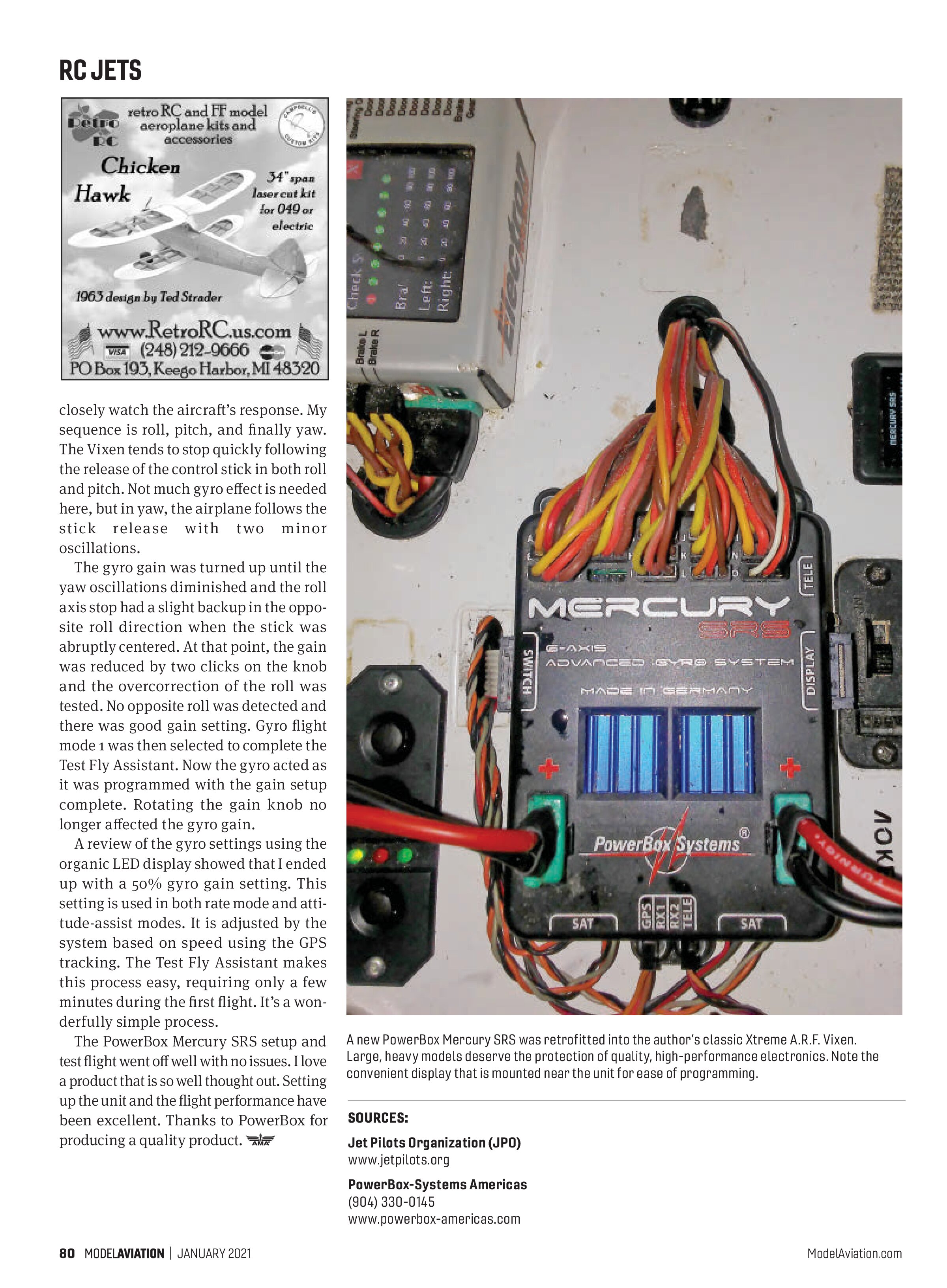
The old standard receiver needed to be replaced, along with the PowerBox iGyro 3e because it too was suspect, so I decided it was a good time to upgrade to a PowerBox Mercury SRS. The Mercury SRS is a receiver with a built-in regulator and gyro.
With the optional GPS sensor, the gyro has speed-adjusted gain control, and it is economically a breakeven cost to replace the existing receiver and gyro. The other features of the PowerBox Mercury SRS, combined with its quality reputation, made this an easy upgrade for my beloved Vixen.
I have flown jets using a Mercury SRS, but this was would be my first time to set up this system. I spent some time becoming acquainted with the unit and the features, pushing buttons and running through all of the menus, then I developed my setup strategy. The Vixen has a lot of flights and all of the programming adjustments were in the transmitter program, so I really didn’t want to lose this setup. I spent a lot of time getting the Vixen flying so well with many little mixes and fine-tuning.
The Mercury SRS has programmable inputs and outputs. I had the option of bringing in one aileron command, while having two separate outputs to each aileron servo with separate endpoint and centering set points for each.
This is a nice feature on a fresh setup, but again, I wanted to retain the existing transmitter programming, so I set up the unit to pass through both the right aileron and left aileron channels directly to outputs to the matching servo. The same option was used on the elevator servos.
There are separate channels on the transmitter, so I used separate channels through the Mercury SRS.
The result of my programming efforts was that there were no changes to the transmitter programming except setup features that are unique to the Mercury SRS gyro application. Gyro gain was moved to a rotary knob, and a switch controls gyro flight modes. These flight modes have no relation to your transmitter’s flight modes. A transmitter channel is used to set up various flight modes under which the gyro operates, and you can use up to three gyro flight modes on one three-position switch.
Flight mode 3 on my gyro setup is for rate modes on all three axes, and flight mode 2 (the center switch position) is for zero gyro gain and no gyro corrections.
Flight mode 1 is set up with a rate gyro on the rudder and elevator and an attitude-assist function on the ailerons. This means that the rudder and elevator setups generally provide reduction in wind gust-type corrections to stop movement. The ailerons, however, are set up to lock into a position.
An example of when this is useful is an abrupt entry into knife-edge flight when the rudder is pushed rapidly following a fast-rolling entry. The Vixen tends to rock its wing when the rudder is pushed this quickly for knife-edge flight without an active gyro. With a rate gyro, it will still rock the wing, but with the attitude-assist function turned on, the airplane no longer rocks the wing when rudder control is abruptly applied. This is the only time on the Vixen that I notice a difference between rate gyro mode and attitude-assist gyro mode on the ailerons.
The gyro gain setup on this latest version of the Mercury SRS is neat. Go through the menus to the “Test Fly Assistant” with your gyro flight mode switch in mode 2, center position, and your gain setting at 0, then go fly the aircraft. In flight, you can now slowly turn the knob to increase the gyro gain until you like its response. Let’s review my Vixen setup flight as an example.
Take off and climb to a comfortable altitude then cruise at moderate airspeed and turn up the gain knob. Check each axis by abruptly knocking each one and

closely watch the aircraft’s response. My sequence is roll, pitch, and finally yaw. The Vixen tends to stop quickly following the release of the control stick in both roll and pitch. Not much gyro effect is needed here, but in yaw, the airplane follows the stick release with two minor oscillations.
The gyro gain was turned up until the yaw oscillations diminished and the roll axis stop had a slight backup in the opposite roll direction when the stick was abruptly centered. At that point, the gain was reduced by two clicks on the knob and the overcorrection of the roll was tested. No opposite roll was detected and there was good gain setting. Gyro flight mode 1 was then selected to complete the Test Fly Assistant. Now the gyro acted as it was programmed with the gain setup complete. Rotating the gain knob no longer affected the gyro gain.
A review of the gyro settings using the organic LED display showed that I ended up with a 50% gyro gain setting. This setting is used in both rate mode and attitude-assist modes. It is adjusted by the system based on speed using the GPS tracking. The Test Fly Assistant makes this process easy, requiring only a few minutes during the first flight. It’s a wonderfully simple process.
The PowerBox Mercury SRS setup and test flight went off well with no issues. I love a product that is so well thought out. Setting up the unit and the flight performance have been excellent. Thanks to PowerBox for producing a quality product.

SOURCES:
Jet Pilots Organization (JPO)
www.jetpilots.org
PowerBox-Systems Americas
(904) 330-0145
www.powerbox-americas.com