THE NEW FIELD OF DREAMS
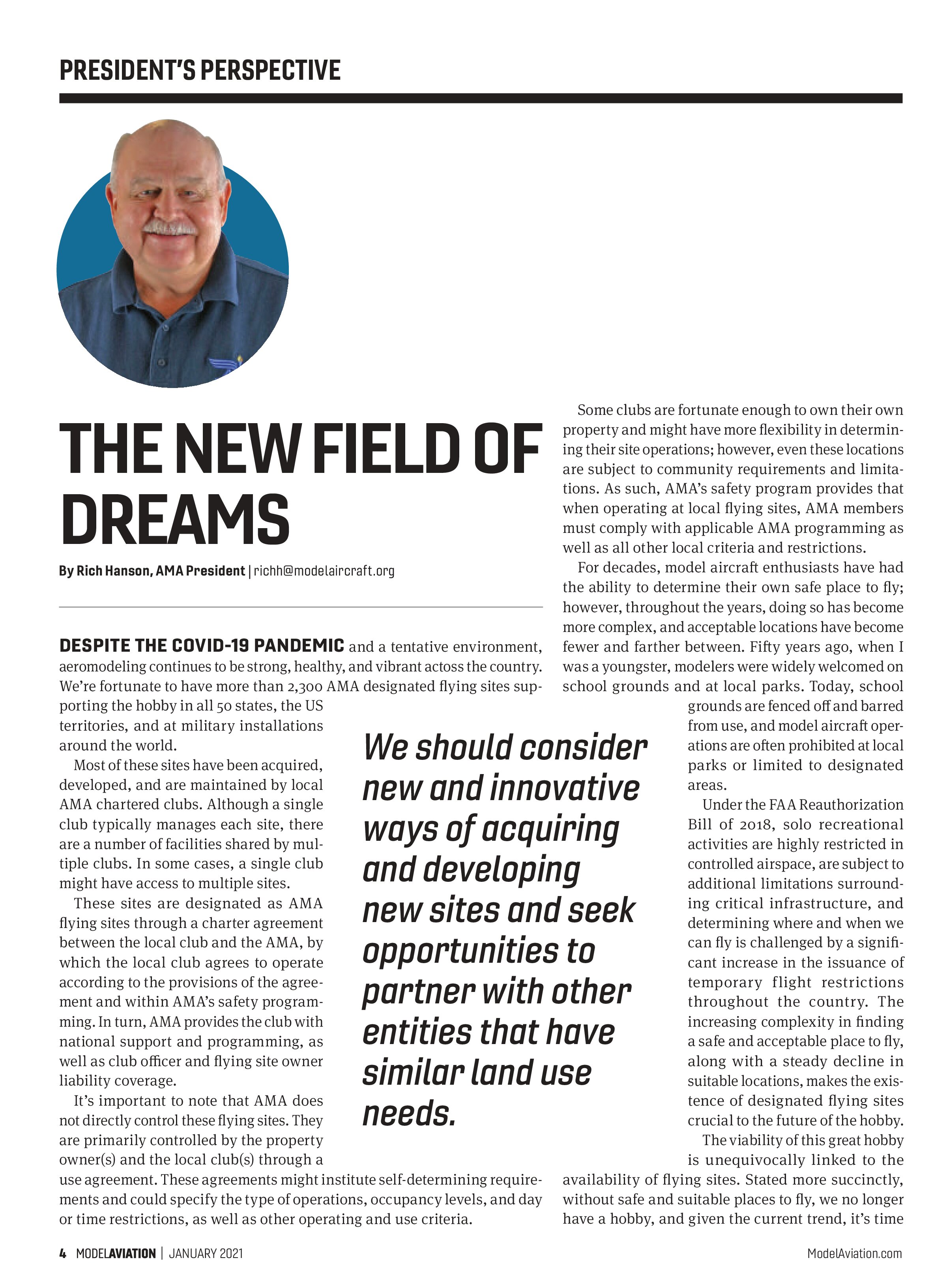
By Rich Hanson, AMA President | richh@modelaircraft.org

DESPITE THE COVID-19 PANDEMIC and a tentative environment, aeromodeling continues to be strong, healthy, and vibrant across the country. We’re fortunate to have more than 2,300 AMA designated flying sites supporting the hobby in all 50 states, the US territories, and at military installations around the world.
Most of these sites have been acquired, developed, and are maintained by local AMA chartered clubs. Although a single club typically manages each site, there are a number of facilities shared by multiple clubs. In some cases, a single club might have access to multiple sites.
These sites are designated as AMA flying sites through a charter agreement between the local club and the AMA, by which the local club agrees to operate according to the provisions of the agreement and within AMA’s safety programming. In turn, AMA provides the club with national support and programming, as well as club officer and flying site owner liability coverage.
It’s important to note that AMA does not directly control these flying sites. They are primarily controlled by the property owner(s) and the local club(s) through a use agreement. These agreements might institute self-determining requirements and could specify the type of operations, occupancy levels, and day or time restrictions, as well as other operating and use criteria.
We should consider new and innovative ways of acquiring and developing new sites and seek opportunities to partner with other entities that have similar land use needs.
Some clubs are fortunate enough to own their own property and might have more flexibility in determining their site operations; however, even these locations are subject to community requirements and limitations. As such, AMA’s safety program provides that when operating at local flying sites, AMA members must comply with applicable AMA programming as well as all other local criteria and restrictions.
For decades, model aircraft enthusiasts have had the ability to determine their own safe place to fly; however, throughout the years, doing so has become more complex, and acceptable locations have become fewer and farther between. Fifty years ago, when I was a youngster, modelers were widely welcomed on school grounds and at local parks. Today, school grounds are fenced off and barred from use, and model aircraft operations are often prohibited at local parks or limited to designated areas.
Under the FAA Reauthorization Bill of 2018, solo recreational activities are highly restricted in controlled airspace, are subject to additional limitations surrounding critical infrastructure, and determining where and when we can fly is challenged by a significant increase in the issuance of temporary flight restrictions throughout the country. The increasing complexity in finding a safe and acceptable place to fly, along with a steady decline in suitable locations, makes the existence of designated flying sites crucial to the future of the hobby. The viability of this great hobby is unequivocally linked to the availability of flying sites. Stated more succinctly, without safe and suitable places to fly, we no longer have a hobby, and given the current trend, it’s time for AMA to revamp and expand its flying site program. We should consider new and innovative ways of acquiring and developing new sites and seek opportunities to partner with other entities that have similar land use needs.
There is no replacement for a dedicated and impassioned group of modelers who are seeking a suitable place to fly; however, AMA should play a greater role in identifying potential flying sites, encouraging and incentivizing landowners to work with local clubs, and encouraging communities to set aside a portion of their public lands for model aircraft use.
AMA must push back against unwarranted restrictions that limit access to government lands, build cooperative affiliations with entities that have similar interests, and continue to work with regulators, policymakers, and politicians in engendering a greater understanding of aeromodeling’s significant contribution to our society and culture.
If you have any thoughts, ideas, or suggestions for how AMA can improve and expand its flying site program, please pass them on to your district vice president, associate vice president, or share them directly with the AMA staff.
I sincerely believe that there are hundreds of thousands of likeminded aviation enthusiasts out there who have not yet been introduced to the captivating allure of model aviation ... “If you build it, they will come!”
Casa Grande RC Flyers Follow-Up
As I reported in my last column, the Casa Grande Radio Control Flyers of Casa Grande, Arizona, recently netted the “Triple Crown” by becoming the first club to be designated as an AMA Gold Leader Club, to receive the Award of Excellence, and, most recently, to be recognized as an AMA Club of the Month.
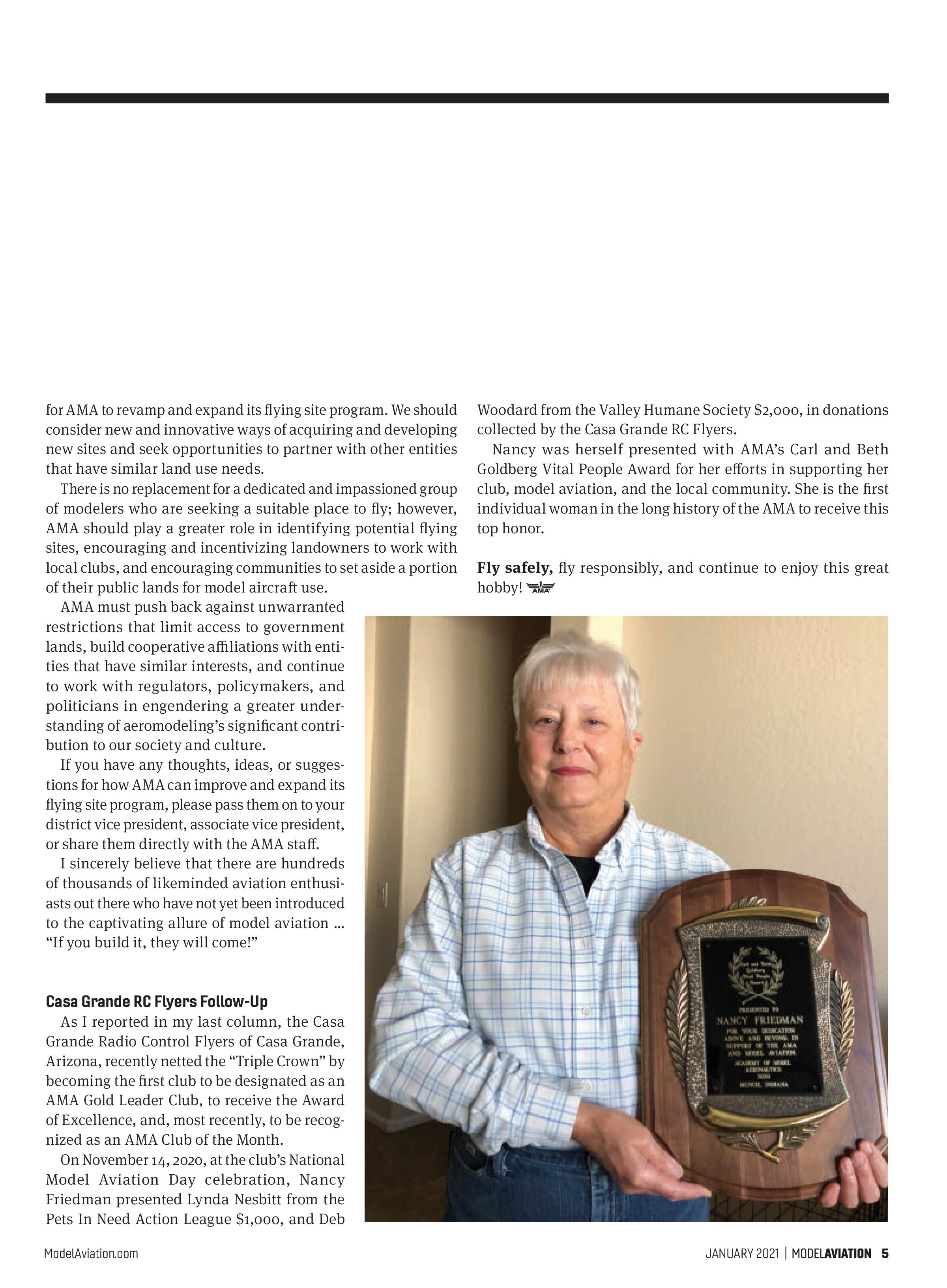
On November 14, 2020, at the club’s National Model Aviation Day celebration, Nancy Friedman presented Lynda Nesbitt from the Pets In Need Action League $1,000, and Deb Woodard from the Valley Humane Society $2,000, in donations collected by the Casa Grande RC Flyers.
Nancy was herself presented with AMA’s Carl and Beth Goldberg Vital People Award for her efforts in supporting her club, model aviation, and the local community. She is the first individual woman in the long history of the AMA to receive this top honor.
Fly safely, fly responsibly, and continue to enjoy this great hobby!