A BALSA MODEL AT FOAM AIRCRAFT PRICES
OMP Models BigHorn
By Jay Smith | jays@modelaircraft.org
Photos by the author
TODAY'S MODEL AIRCRAFT offerings cater to both builders and pilots. Aircraft that require little effort to reach flight-ready status are readily available, aircraft can be built from scratch, or a kit can be purchased. Beyond that, we have countless types of aircraft models, so it shouldn’t be too difficult to find something that appeals to you.
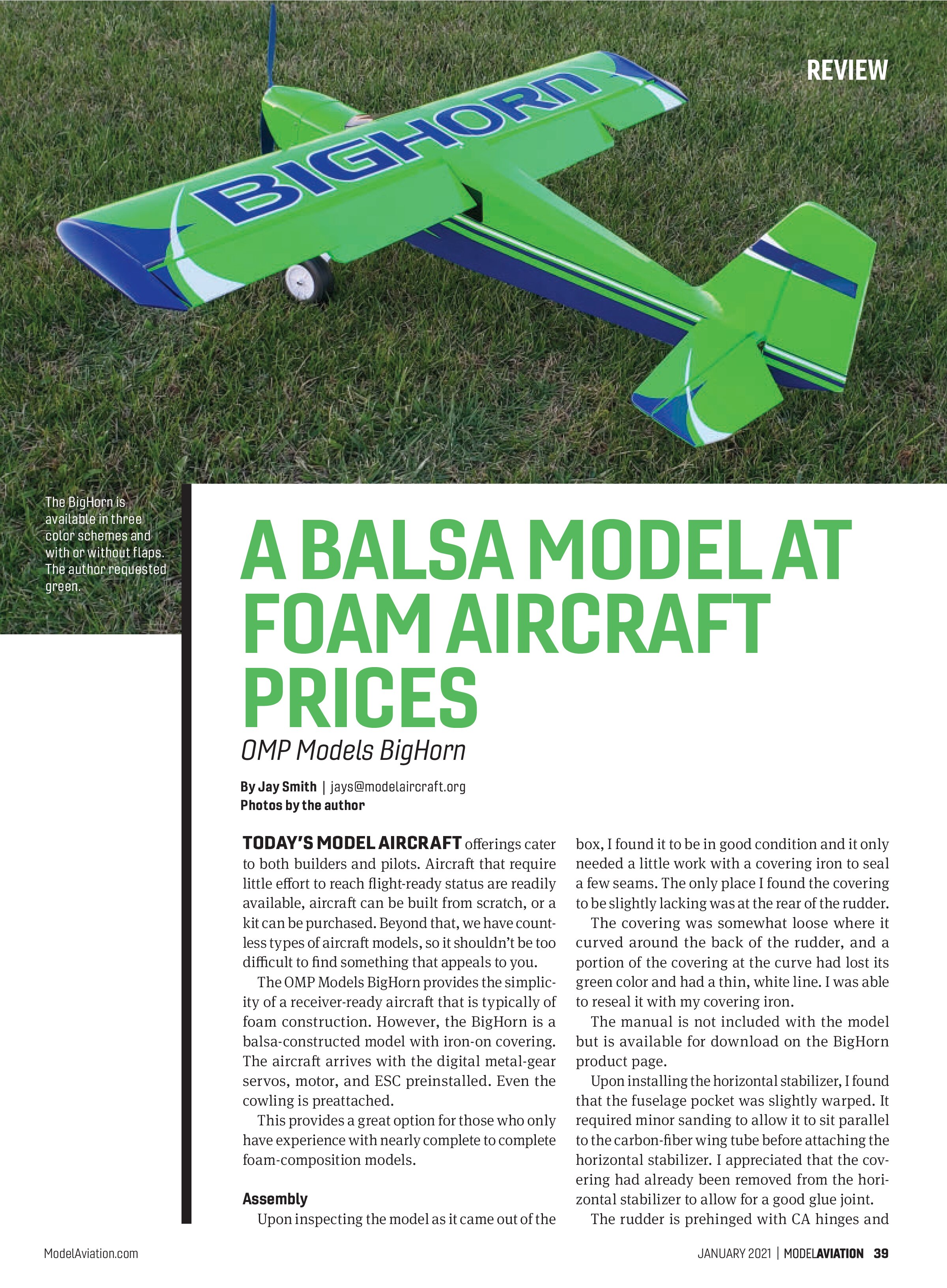
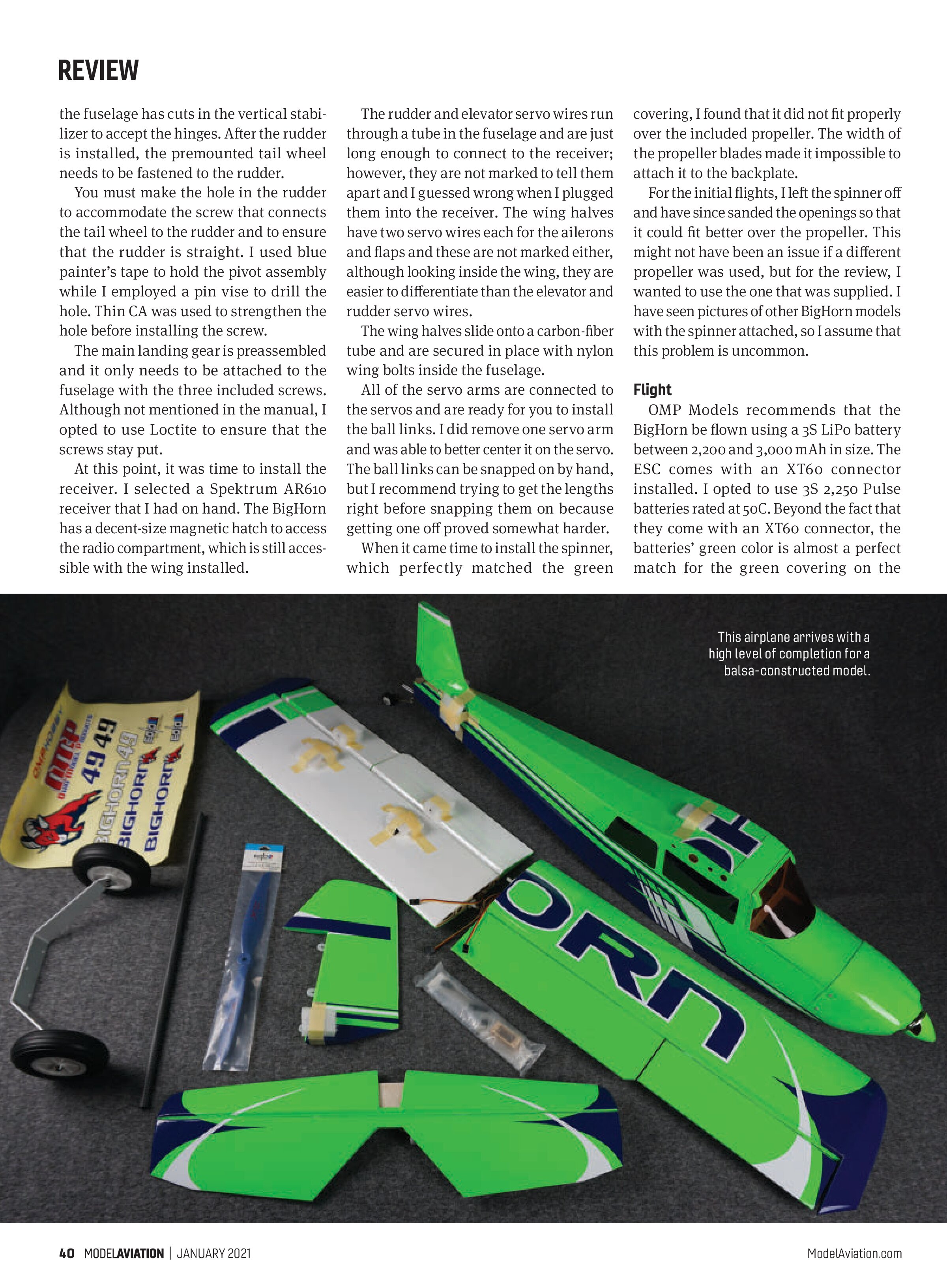
The OMP Models BigHorn provides the simplicity of a receiver-ready aircraft that is typically of foam construction. However, the BigHorn is a balsa-constructed model with iron-on covering. The aircraft arrives with the digital metal-gear servos, motor, and ESC preinstalled. Even the cowling is pretattached.
This provides a great option for those who only have experience with nearly complete to complete foam-composition models.
Assembly
Upon inspecting the model as it came out of the box, I found it to be in good condition and it only needed a little work with a covering iron to seal a few seams. The only place I found the covering to be slightly lacking was at the rear of the rudder.
The covering was somewhat loose where it curved around the back of the rudder, and a portion of the covering at the curve had lost its green color and had a thin, white line. I was able to reseal it with my covering iron.
The manual is not included with the model but is available for download on the BigHorn product page.
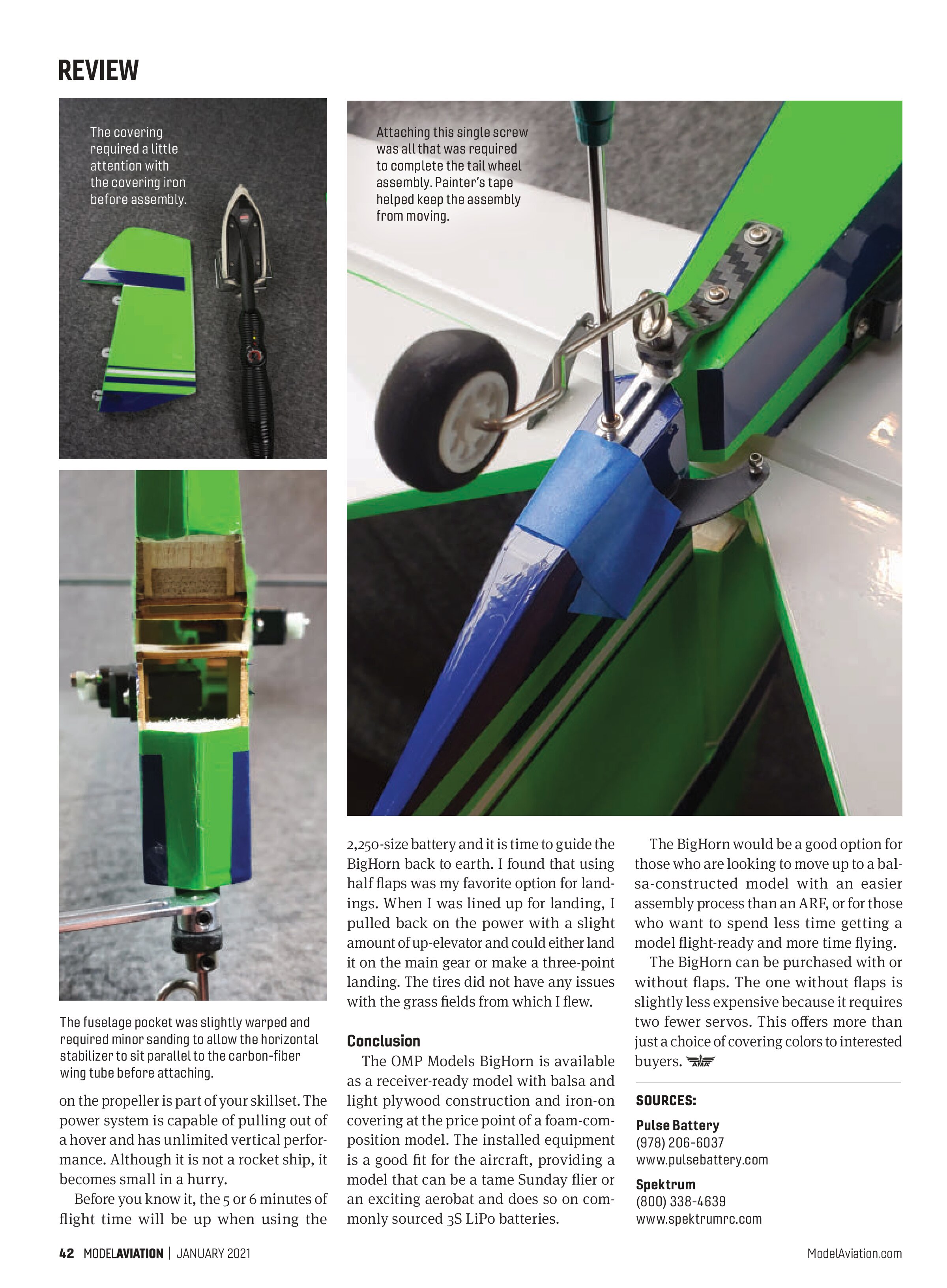
Upon installing the horizontal stabilizer, I found that the fuselage pocket was slightly warped. It required minor sanding to allow it to sit parallel to the carbon-fiber wing tube before attaching the horizontal stabilizer. I appreciated that the covering had already been removed from the horizontal stabilizer to allow for a good glue joint.
The rudder is prehinged with CA hinges and
the fuselage has cuts in the vertical stabilizer to accept the hinges. After the rudder is installed, the premounted tail wheel needs to be fastened to the rudder.
You must make the hole in the rudder to accommodate the screw that connects the tail wheel to the rudder and to ensure that the rudder is straight. I used blue painter’s tape to hold the pivot assembly while I employed a pin vise to drill the hole. Thin CA was used to strengthen the hole before installing the screw.
The main landing gear is preassembled and it only needs to be attached to the fuselage with the three included screws. Although not mentioned in the manual, I opted to use Loctite to ensure that the screws stay put.
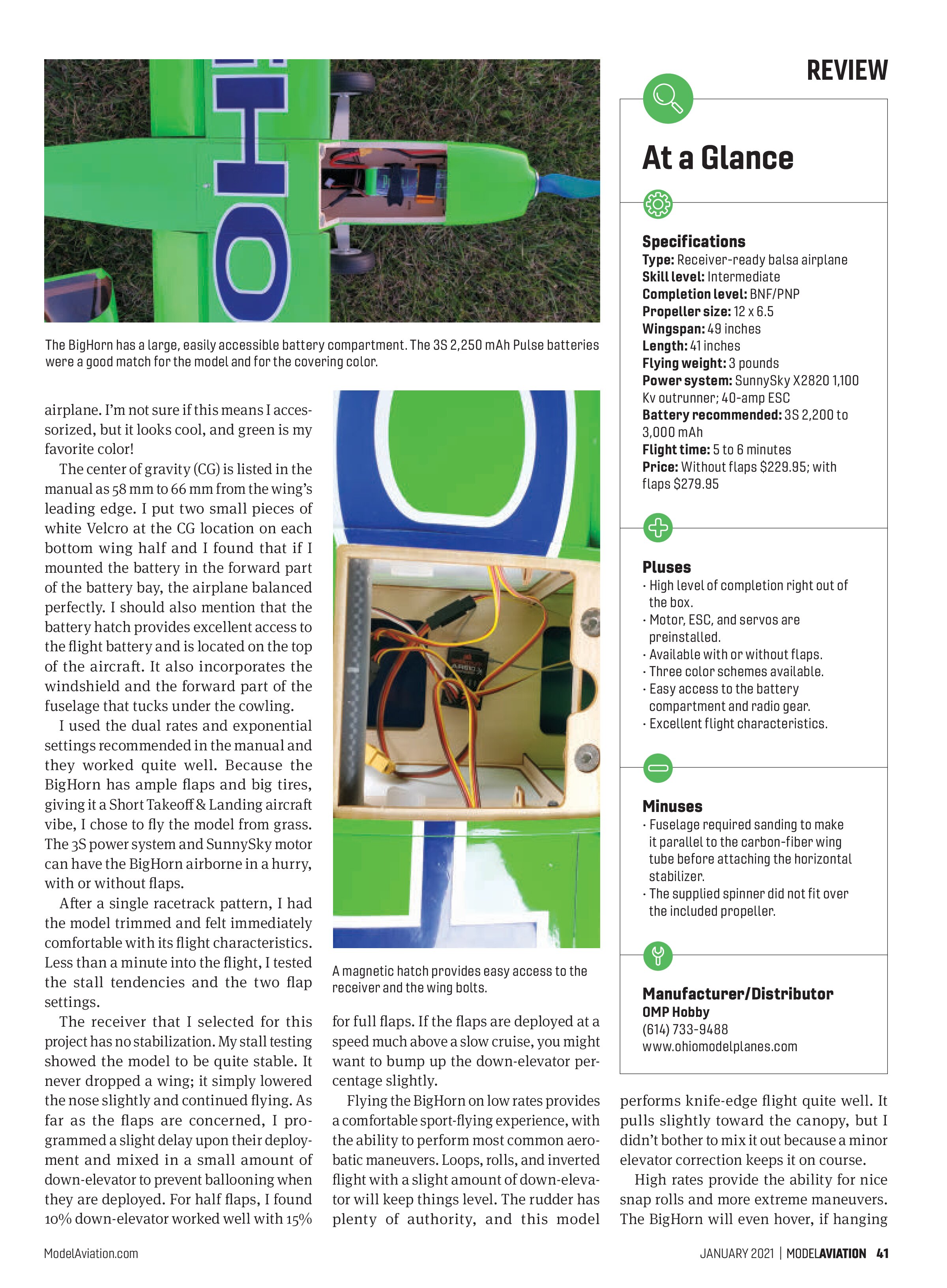
At this point, it was time to install the receiver. I selected a Spektrum AR610 receiver that I had on hand. The BigHorn has a decent-size magnetic hatch to access the radio compartment, which is still accessible with the wing installed.
The rudder and elevator servo wires run through a tube in the fuselage and are just long enough to connect to the receiver; however, they are not marked to tell them apart and I guessed wrong when I plugged them into the receiver. The wing halves have two servo wires each for the ailerons and flaps and these are not marked either, although looking inside the wing, they are easier to differentiate than the elevator and rudder servo wires.
The wing halves slide onto a carbon-fiber tube and are secured in place with nylon wing bolts inside the fuselage.
All of the servo arms are connected to the servos and are ready for you to install the ball links. I did remove one servo arm and was able to better center it on the servo. The ball links can be snapped on by hand, but I recommend trying to get the lengths right before snapping them on because getting one off proved somewhat harder.
When it came time to install the spinner, which perfectly matched the green covering, I found that it did not fit properly over the included propeller. The width of the propeller blades made it impossible to attach it to the backplate.
For the initial flights, I left the spinner off and have since sanded the openings so that it could fit better over the propeller. This might not have been an issue if a different propeller was used, but for the review, I wanted to use the one that was supplied. I have seen pictures of other BigHorn models with the spinner attached, so I assume that this problem is uncommon.
Flight
OMP Models recommends that the BigHorn be flown using a 3S LiPo battery between 2,200 and 3,000 mAh in size. The ESC comes with an XT60 connector installed. I opted to use 3S 2,250 Pulse batteries rated at 50C. Beyond the fact that they come with an XT60 connector, the batteries’ green color is almost a perfect match for the green covering on the airplane.

airplane. I’m not sure if this means I accessorized, but it looks cool, and green is my favorite color!
The center of gravity (CG) is listed in the manual as 58 mm to 66 mm from the wing’s leading edge. I put two small pieces of white Velcro at the CG location on each bottom wing half and I found that if I mounted the battery in the forward part of the battery bay, the airplane balanced perfectly. I should also mention that the battery hatch provides excellent access to the flight battery and is located on the top of the aircraft. It also incorporates the windshield and the forward part of the fuselage that tucks under the cowling.
I used the dual rates and exponential settings recommended in the manual and they worked quite well. Because the BigHorn has ample flaps and big tires, giving it a Short Takeoff & Landing aircraft vibe, I chose to fly the model from grass. The 3S power system and SunnySky motor can have the BigHorn airborne in a hurry, with or without flaps.
After a single racetrack pattern, I had the model trimmed and felt immediately comfortable with its flight characteristics. Less than a minute into the flight, I tested the stall tendencies and the two flap settings.
The receiver that I selected for this project has no stabilization. My stall testing showed the model to be quite stable. It never dropped a wing; it simply lowered the nose slightly and continued flying. As far as the flaps are concerned, I programmed a slight delay upon their deployment and mixed in a small amount of down-elevator to prevent ballooning when they are deployed. For half flaps, I found 10% down-elevator worked well with 15%

for full flaps. If the flaps are deployed at a speed much above a slow cruise, you might want to bump up the down-elevator percentage slightly.
Flying the BigHorn on low rates provides a comfortable sport-flying experience, with the ability to perform most common aerobatic maneuvers. Loops, rolls, and inverted flight with a slight amount of down-elevator will keep things level. The rudder has plenty of authority, and this model performs knife-edge flight quite well. It pulls slightly toward the canopy, but I didn’t bother to mix it out because a minor elevator correction keeps it on course.
High rates provide the ability for nice snap rolls and more extreme maneuvers. The BigHorn will even hover, if hanging
At a Glance
Specifications
Type: Receiver-ready balsa airplane
Skill level: Intermediate
Completion level: BNF/PNP
Propeller size: 12 x 6.5
Wingspan: 49 inches
Length: 41 inches
Flying weight: 3 pounds
Power system: SunnySky X2820 1,100 Kv outrunner; 40-amp ESC
Battery recommended: 3S 2,200 to 3,000 mAh
Flight time: 5 to 6 minutes
Price: Without flaps $229.95; with flaps $279.95
Pluses
- High level of completion right out of the box.
- Motor, ESC, and servos are preinstalled.
- Available with or without flaps.
- Three color schemes available.
- Easy access to the battery compartment and radio gear.
- Excellent flight characteristics.
Minuses
- Fuselage required sanding to make it parallel to the carbon-fiber wing tube before attaching the horizontal stabilizer.
- The supplied spinner did not fit over the included propeller.
Manufacturer/Distributor
OMP Hobby
(614) 733-9488
www.ohiomodelplanes.com


on the propeller is part of your skillset. The power system is capable of pulling out of a hover and has unlimited vertical performance. Although it is not a rocket ship, it becomes small in a hurry.
Before you know it, the 5 or 6 minutes of flight time will be up when using the 2,250-size battery and it is time to guide the BigHorn back to earth. I found that using half flaps was my favorite option for landings. When I was lined up for landing, I pulled back on the power with a slight amount of up-elevator and could either land it on the main gear or make a three-point landing. The tires did not have any issues with the grass fields from which I flew.
Conclusion
The OMP Models BigHorn is available as a receiver-ready model with balsa and light plywood construction and iron-on covering at the price point of a foam-composition model. The installed equipment is a good fit for the aircraft, providing a model that can be a tame Sunday flier or an exciting aerobat and does so on commonly sourced 3S LiPo batteries.
The BigHorn would be a good option for those who are looking to move up to a balsa-constructed model with an easier assembly process than an ARF, or for those who want to spend less time getting a model flight-ready and more time flying.
The BigHorn can be purchased with or without flaps. The one without flaps is slightly less expensive because it requires two fewer servos. This offers more than just a choice of covering colors to interested buyers.
SOURCES:
Pulse Battery
(978) 206-6037
www.pulsebattery.com
Spektrum
(800) 338-4639
www.spektrumrc.com