FOCAL POINT
Interested in sharing your handiwork? Visit www.ModelAviation.com for submission guidelines.
Freewing Phantom

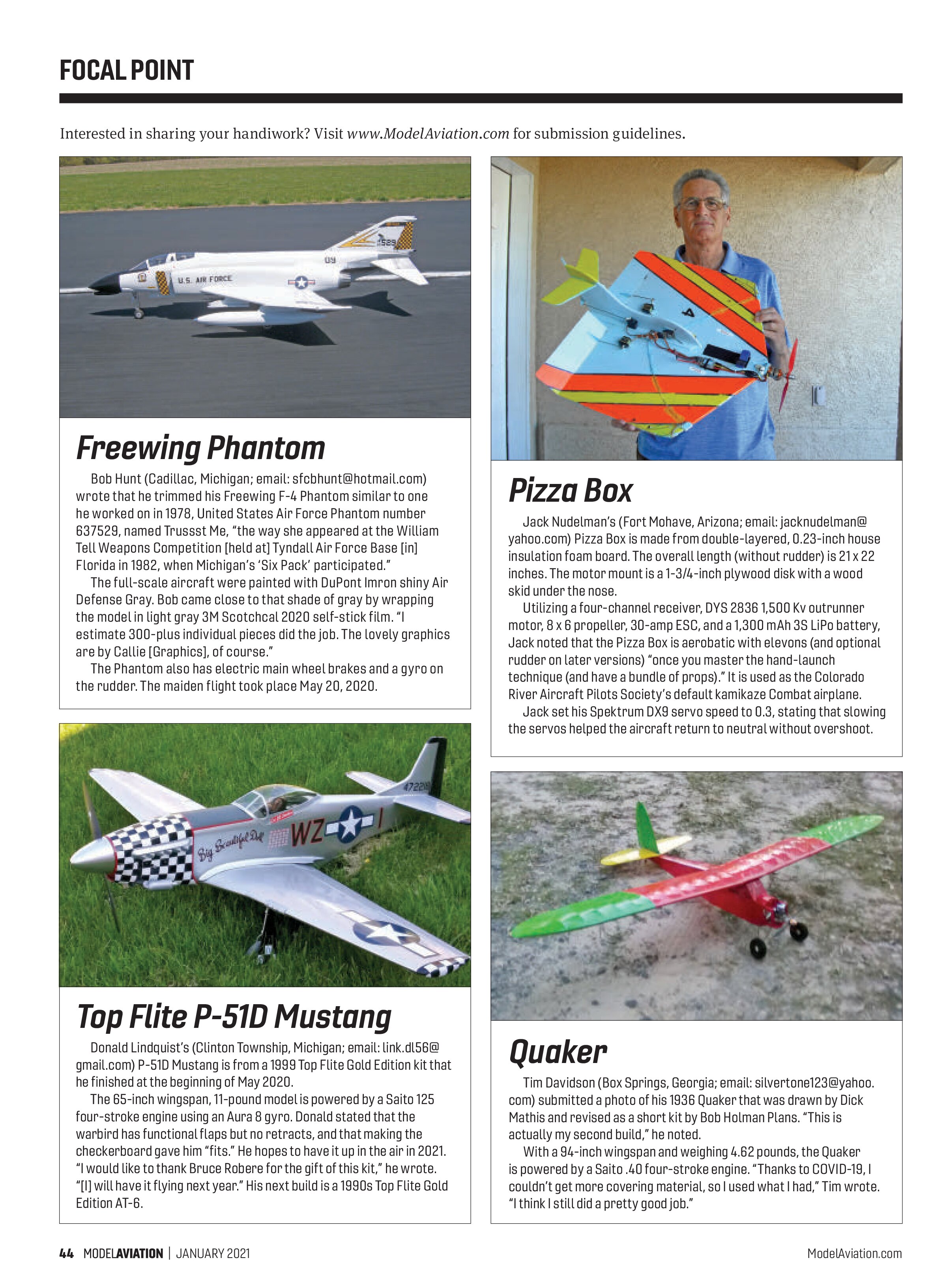
Bob Hunt (Cadillac, Michigan; email: sfcbhunt@hotmail.com) wrote that he trimmed his Freewing F-4 Phantom similar to one he worked on in 1978, United States Air Force Phantom number 637529, named Trussst Me, “the way she appeared at the William Tell Weapons Competition [held at] Tyndall Air Force Base [in] Florida in 1982, when Michigan’s ‘Six Pack’ participated.”
The full-scale aircraft were painted with DuPont Imron shiny Air Defense Gray. Bob came close to that shade of gray by wrapping the model in light gray 3M Scotchcal 2020 self-stick film. “I estimate 300-plus individual pieces did the job. The lovely graphics are by Callie [Graphics], of course.”
The Phantom also has electric main wheel brakes and a gyro on the rudder. The maiden flight took place May 20, 2020.
Top Flite P-51D Mustang

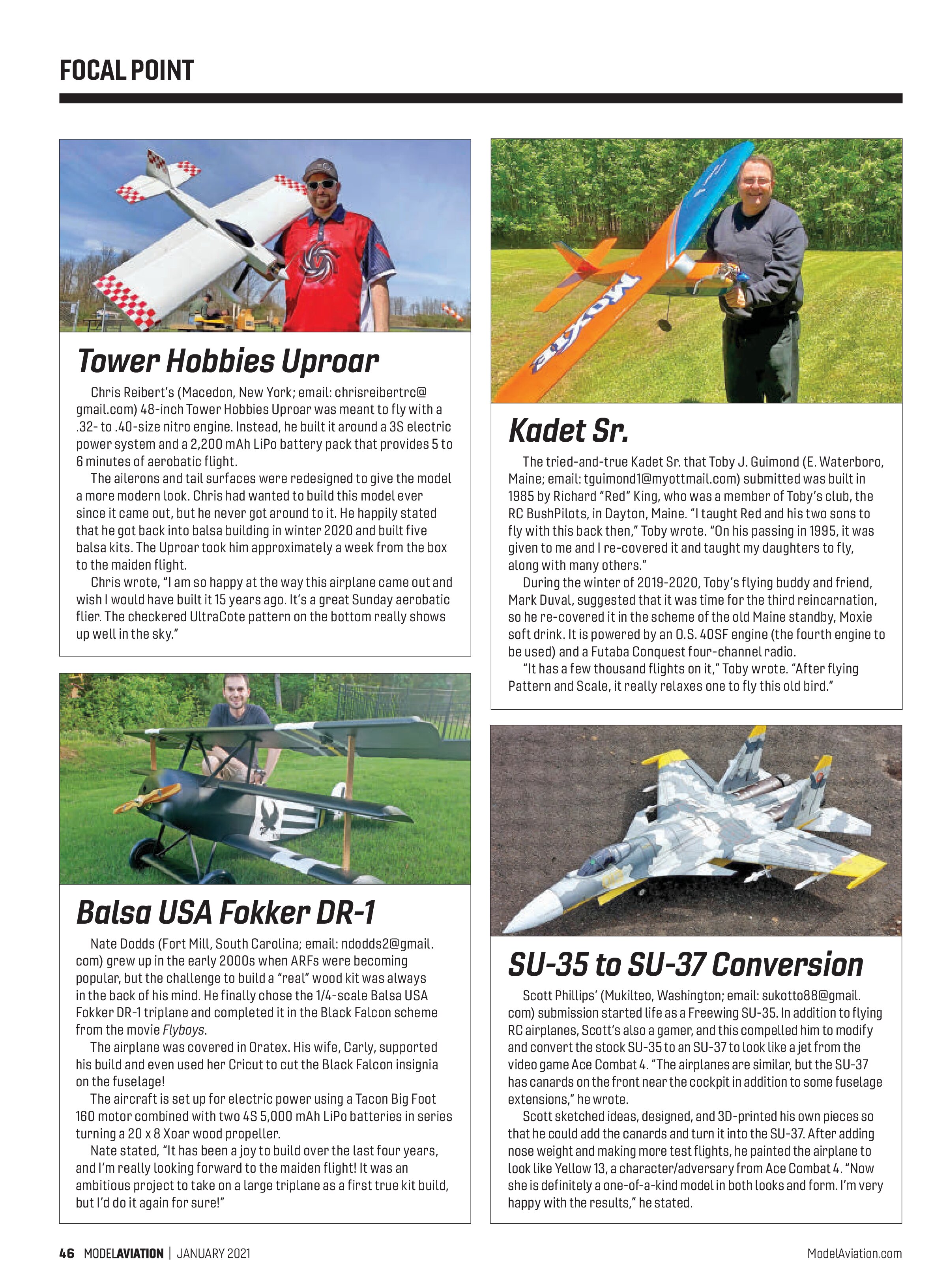
Donald Lindquist’s (Clinton Township, Michigan; email: link.dl56@gmail.com) P-51D Mustang is from a 1999 Top Flite Gold Edition kit that he finished at the beginning of May 2020.
The 65-inch wingspan, 11-pound model is powered by a Saito 125 four-stroke engine using an Aura 8 gyro. Donald stated that the warbird has functional flaps but no retracts, and that making the checkerboard gave him “fits.” He hopes to have it up in the air in 2021. “I would like to thank Bruce Rubere for the gift of this kit,” he wrote. “[I] will have it flying next year.” His next build is a 1990s Top Flite Gold Edition AT-6.
Pizza Box

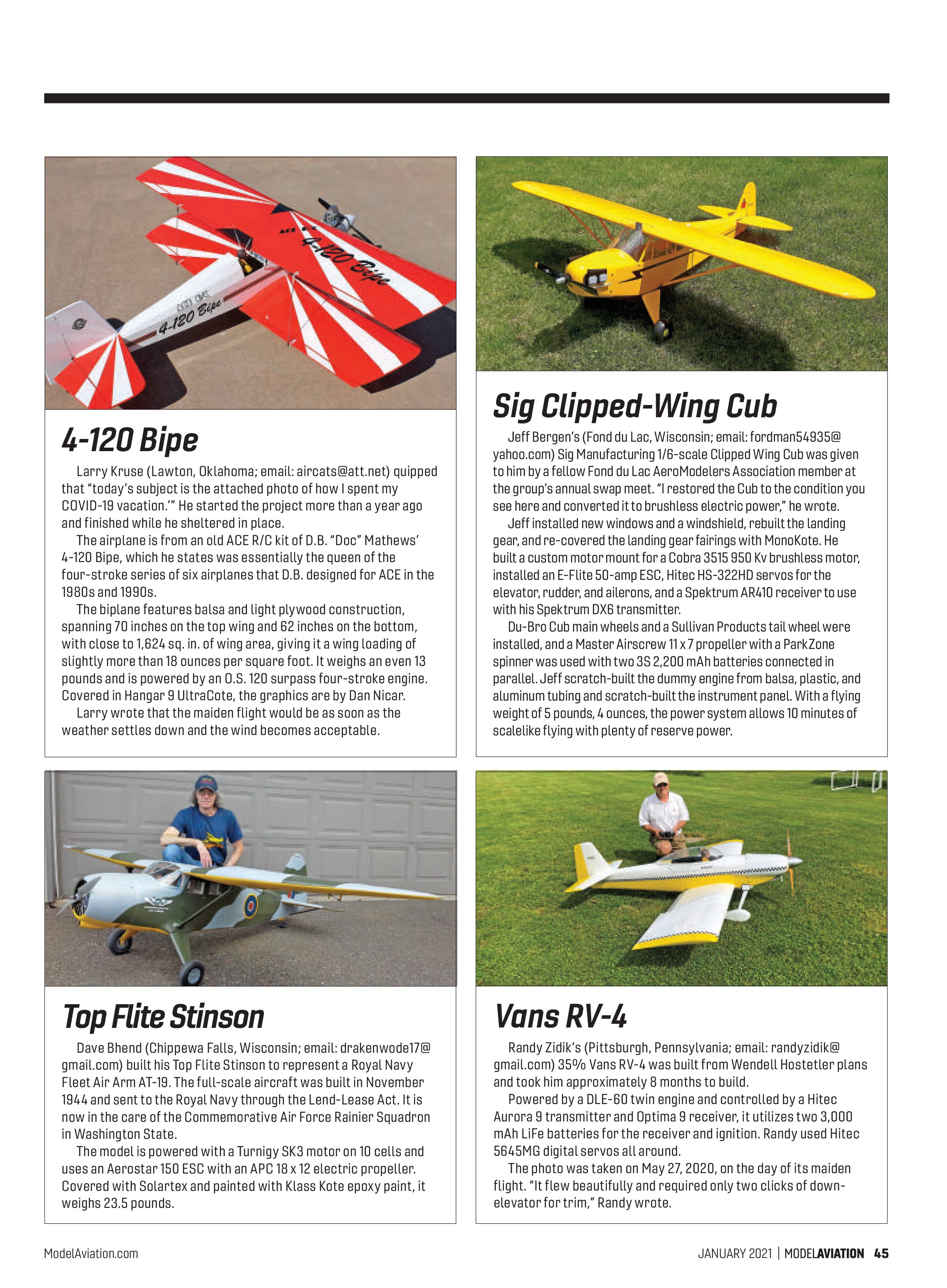
Jack Nudelman’s (Fort Mohave, Arizona; email: jacknudelman@yahoo.com) Pizza Box is made from double-layered, 0.23-inch house insulation foam board. The overall length (without rudder) is 21 x 22 inches. The motor mount is a 1-3/4-inch plywood disk with a wood skid under the nose.
Utilizing a four-channel receiver, DYS 2836 1,500 Kv outrunner motor, 8 x 6 propeller, 30-amp ESC, and a 1,300 mAh 3S LiPo battery, Jack noted that the Pizza Box is aerobatic with elevons (and optional rudder on later versions) “once you master the hand-launch technique (and have a bundle of props).” It is used as the Colorado River Aircraft Pilots Society’s default kamikaze Combat airplane.
Jack set his Spektrum DX9 servo speed to 0.3, stating that slowing the servos helped the aircraft return to neutral without overshoot.
Quaker

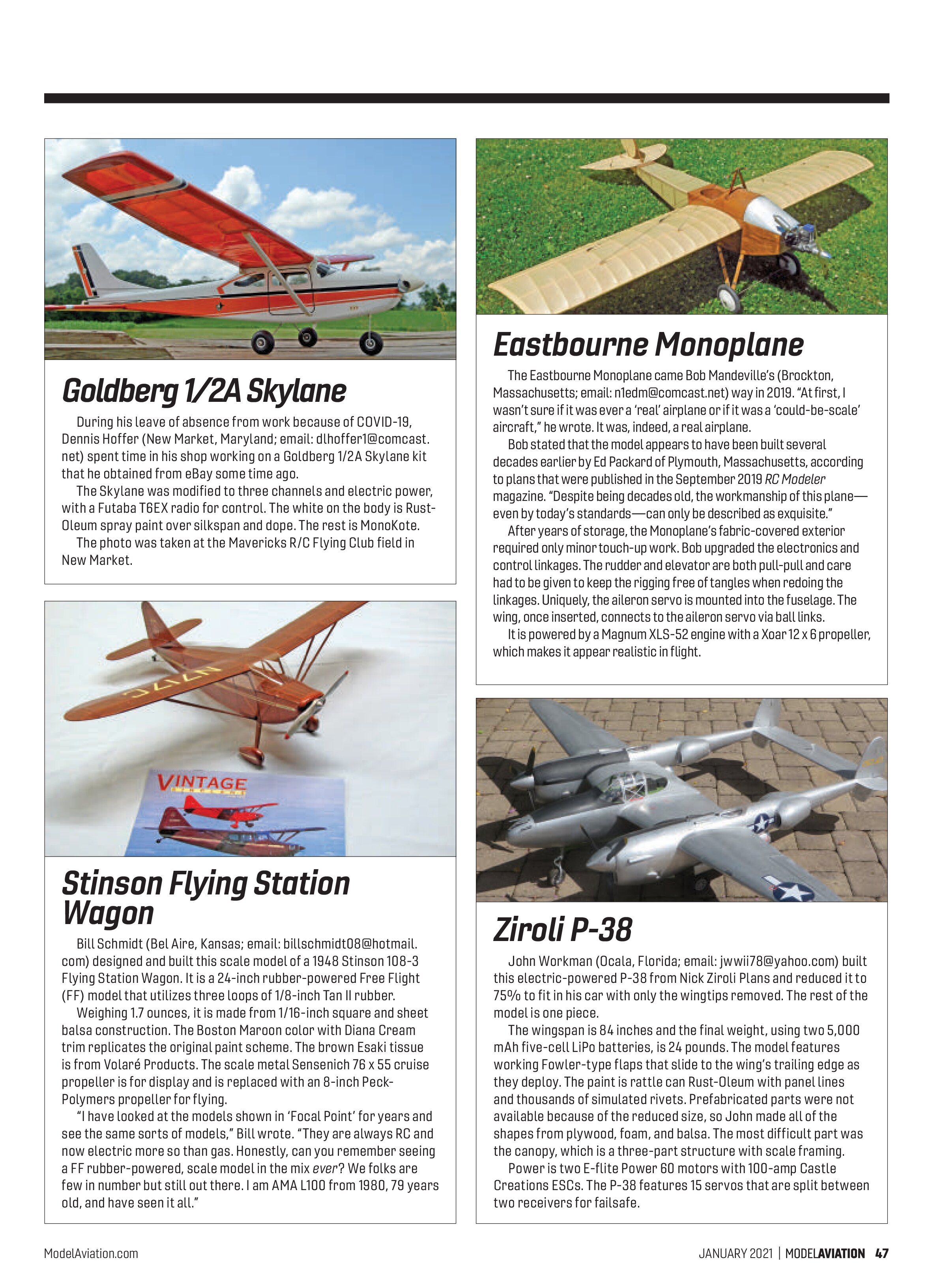
Tim Davidson (Box Springs, Georgia; email: silvertone123@yahoo.com) submitted a photo of his 1936 Quaker that was drawn by Dick Mathis and revised as a short kit by Bob Holman Plans. “This is actually my second build,” he noted.
With a 94-inch wingspan and weighing 4.62 pounds, the Quaker is powered by a Saito .40 four-stroke engine. “Thanks to COVID-19, I couldn’t get more covering material, so I used what I had,” Tim wrote. “I think I still did a pretty good job.”
4-120 Bipe

Larry Kruse (Lawton, Oklahoma; email: aircats@att.net) quipped that “today’s subject is the attached photo of how I spent my COVID-19 vacation.” He started the project more than a year ago and finished while he sheltered in place.
The airplane is from an old ACE R/C kit of D.B. “Doc” Mathews’ 4-120 Bipe, which he states was essentially the queen of the four-stroke series of six airplanes that D.B. designed for ACE in the 1980s and 1990s.
The biplane features balsa and light plywood construction, spanning 70 inches on the top wing and 62 inches on the bottom, with close to 1,624 sq. in. of wing area, giving it a wing loading of slightly more than 18 ounces per square foot. It weighs an even 13 pounds and is powered by an O.S. 120 surpass four-stroke engine. Covered in Hangar 9 UltraCote, the graphics are by Dan Nicar.
Larry wrote that the maiden flight would be as soon as the weather settles down and the wind becomes acceptable.
Sig Clipped-Wing Cub

Jeff Bergen’s (Fond du Lac, Wisconsin; email: fordman54935@yahoo.com) Sig Manufacturing 1/6-scale Clipped Wing Cub was given to him by a fellow Fond du Lac AeroModelers Association member at the group’s annual swap meet. “I restored the Cub to the condition you see here and converted it to brushless electric power,” he wrote.
Jeff installed new windows and a windshield, rebuilt the landing gear, and re-covered the landing gear fairings with MonKote. He built a custom motor mount for a Cobra 3515 950 Kv brushless motor, installed an E-Flite 50-amp ESC, Hitec HS-322HD servos for the elevator, rudder, and ailerons, and a Spektrum AR410 receiver to use with his Spektrum DX6 transmitter.
Du-Bro Cub main wheels and a Sullivan Products tail wheel were installed, and a Master Airscrew 11 x 7 propeller with a ParkZone spinner was used with two 3S 2,200 mAh batteries connected in parallel. Jeff scratch-built the dummy engine from balsa, plastic, and aluminum tubing and scratch-built the instrument panel. With a flying weight of 5 pounds, 4 ounces, the power system allows 10 minutes of scalelike flying with plenty of reserve power.
Top Flite Stinson

Dave Bhlend (Chippewa Falls, Wisconsin; email: drakenwuede17@gmail.com) built his Top Flite Stinson to represent a Royal Navy Fleet Air Arm AT-19. The full-scale aircraft was built in November 1944 and sent to the Royal Navy through the Lend-Lease Act. It is now in the care of the Commemorative Air Force Rainier Squadron in Washington State.
The model is powered with a Turnigy SK3 motor on 10 cells and uses an Aerostar 150 ESC with an APC 18 x 12 electric propeller. Covered with Solartex and painted with Klass Kote epoxy paint, it weighs 23.5 pounds.
Vans RV-4

Randy Ziudik’s (Pittsburgh, Pennsylvania; email: randyziudik@gmail.com) 35% Vans RV-4 was built from Wendell Hostettler plans and took him approximately 8 months to build.
Powered by a DLE-60 twin engine and controlled by a Hitec Aurora 9 transmitter and Optima 9 receiver, it utilizes two 3,000 mAh LiFe batteries for the receiver and ignition. Randy used Hitec 5645MG digital servos all around.
The photo was taken on May 27, 2020, on the day of its maiden flight. “It flew beautifully and required only two clicks of down-elevator for trim,” Randy wrote.
Tower Hobbies Uproar
Chris Reibert’s (Macedon, New York; email: chrisreibertrc@gmail.com) 48-inch Tower Hobbies Uproar was meant to fly with a .32- to .40-size nitro engine. Instead, he built it around a 3S electric power system and a 2,200 mAh LiPo battery pack that provides 5 to 6 minutes of aerobatic flight.
The ailerons and tail surfaces were redesigned to give the model a more modern look. Chris had wanted to build this model ever since it came out, but he never got around to it. He happily stated that he got back into balsa building in winter 2020 and built five balsa kits. The Uproar took him approximately a week from the box to the maiden flight.
Chris wrote, “I am so happy at the way this airplane came out and wish I would have built it 15 years ago. It’s a great Sunday aerobatic flier. The checkered UltraCote pattern on the bottom really shows up well in the sky.”

Balsa USA Fokker DR-1
Nate Dodds (Fort Mill, South Carolina; email: ndodds2@gmail.com) grew up in the early 2000s when ARFs were becoming popular, but the challenge to build a “real” wood kit was always in the back of his mind. He finally chose the 1/4-scale Balsa USA Fokker DR-1 triplane and completed it in the Black Falcon scheme from the movie Flyboys.
The airplane was covered in Oratex. His wife, Carly, supported his build and even used her Cricut to cut the Black Falcon insignia on the fuselage!
The aircraft is set up for electric power using a Tacon Big Foot 160 motor combined with two 4S 5,000 mAh LiPo batteries in series turning a 20 x 8 Xoar wood propeller.
Nate stated, “It has been a joy to build over the last four years, and I’m really looking forward to the maiden flight! It was an ambitious project to take on a large triplane as a first true kit build, but I’d do it again for sure!”

Kadet Sr.
The tried-and-true Kadet Sr. that Toby J. Guimond (E. Waterboro, Maine; email: tguimond1@myottmail.com) submitted was built in 1985 by Richard “Red” King, who was a member of Toby’s club, the RC BushPilots, in Dayton, Maine. “I taught Red and his two sons to fly with this back then,” Toby wrote. “On his passing in 1995, it was given to me and I re-covered it and taught my daughters to fly, along with many others.”
During the winter of 2019–2020, Toby’s flying buddy and friend, Mark Duval, suggested that it was time for the third reincarnation, so he re-covered it in the scheme of the old Maine standby, Moxie soft drink. It is powered by an O.S. 40SF engine (the fourth engine to be used) and a Futaba Conquest four-channel radio.
“It has a few thousand flights on it,” Toby wrote. “After flying Pattern and Scale, it really relaxes one to fly this old bird.”

SU-35 to SU-37 Conversion
Scott Phillips’ (Mukilteo, Washington; email: sukotto88@gmail.com) submission started life as a Freewing SU-35. In addition to flying RC airplanes, Scott’s also a gamer, and this compelled him to modify and convert the stock SU-35 to an SU-37 to look like a jet from the video game Ace Combat 4. “The airplanes are similar, but the SU-37 has canards on the front near the cockpit in addition to some fuselage extensions,” he wrote.
Scott sketched ideas, designed, and 3D-printed his own pieces so that he could add the canards and turn it into the SU-37. After adding nose weight and making more test flights, he painted the airplane to look like Yellow 13, a character/adversary from Ace Combat 4. “Now she is definitely a one-of-a-kind model in both looks and form. I’m very happy with the results,” he stated.

Goldberg 1/2A Skylane
During his leave of absence from work because of COVID-19, Dennis Hoffer (New Market, Maryland; email: dlh offer1@comcast.net) spent time in his shop working on a Goldberg 1/2A Skylane kit that he obtained from eBay some time ago.
The Skylane was modified to three channels and electric power, with a Futaba T6EX radio for control. The white on the body is Rust-Oleum spray paint over silkspan and dope. The rest is MonoKote.
The photo was taken at the Mavericks R/C Flying Club field in New Market.

Stinson Flying Station Wagon
Bill Schmidt (Bel Aire, Kansas; email: bill.schmidt08@hotmail.com) designed and built this scale model of a 1948 Stinson 108-3 Flying Station Wagon. It is a 24-inch rubber-powered Free Flight (FF) model that utilizes three loops of 1/8-inch Tan II rubber.
Weighing 1.7 ounces, it is made from 1/16-inch square and sheet balsa construction. The Boston Maroon color with Diana Cream trim replicates the original paint scheme. The brown Esaki tissue is from Volaré Products. The scale metal Sensenich 76 x 65 cruise propeller is for display and is replaced with an 8-inch Peck-Polymers propeller for flying.
“I have looked at the models shown in ‘Focal Point’ for years and see the same sorts of models,” Bill wrote. “They are always RC and now electric more so than gas. Honestly, can you remember seeing a FF rubber-powered, scale model in the mix ever? We folks are few in number but still out there. I am AMA L100 from 1880, 79 years old, and have seen it all.”

Eastbourne Monoplane
The Eastbourne Monoplane came Bob Mandeville’s (Brockton, Massachusetts; email: n1edm@comcast.net) way in 2019. “At first, I wasn’t sure if it was ever a ‘real airplane or if it was a ‘could-be-scale’ aircraft,” he wrote. It was, indeed, a real airplane.
Bob stated that the model appears to have been built several decades earlier by Ed Packard of Plymouth, Massachusetts, according to plans that were published in the September 2019 RC Modeler magazine. “Despite being decades old, the workmanship of this plane—even by today’s standards—can only be described as exquisite.”
After years of storage, the Monoplane’s fabric-covered exterior required only minor touch-up work. Bob upgraded the electronics and control linkages. The rudder and elevator are both pull-pull and care had to be given to keep the rigging free of tangles when redoing the linkages. Uniquely, the aileron servo is mounted into the fuselage. The wing, once inserted, connects to the aileron servo via ball links.
It is powered by a Magnum XLS-52 engine with a Xoar 12 x 6 propeller, which makes it appear realistic in flight.

Ziroli P-38
John Workman (Ocala, Florida; email: jwwii78@yahoo.com) built this electric-powered P-38 from Nick Ziroli Plans and reduced it to 75% to fit in his car with only the wingtips removed. The rest of the model is one piece.
The wingspan is 84 inches and the final weight, using two 5,000 mAh five-cell LiPo batteries, is 24 pounds. The model features working Fowler-type flaps that slide to the wing’s trailing edge as they deploy. The paint is rattle can Rust-Oleum with panel lines and thousands of simulated rivets. Prefabricated parts were not available because of the reduced size, so John made all of the shapes from plywood, foam, and balsa. The most difficult part was the canopy, which is a three-part structure with scale framing.
Power is two E-flite Power 60 motors with 100-amp Castle Creations ESCs. The P-38 features 15 servos that are split between two receivers for failsafe.