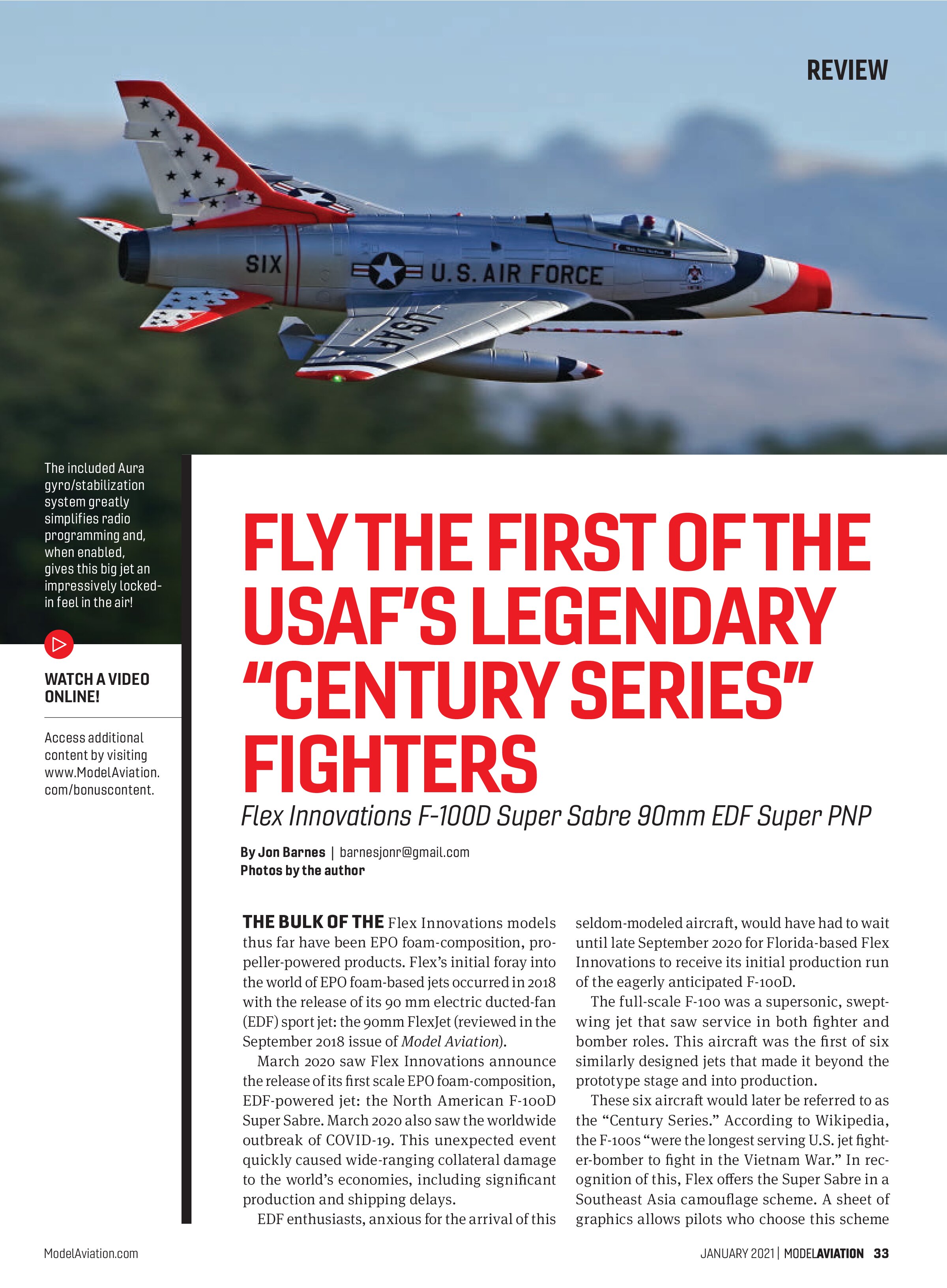
FLY THE FIRST OF THE USAF’S LEGENDARY “CENTURY SERIES” FIGHTERS
Flex Innovations F-100D Super Sabre 90mm EDF Super PNP
By Jon Barnes | barnesjonr@gmail.com
Photos by the author

THE BULK OF THE Flex Innovations models thus far have been EPO foam-composition, propeller-powered products. Flex’s initial foray into the world of EPO foam-based jets occurred in 2018 with the release of its 90 mm electric ducted-fan (EDF) sport jet: the 90mm FlexJet (reviewed in the September 2018 issue of Model Aviation).
March 2020 saw Flex Innovations announce the release of its first scale EPO foam-composition, EDF-powered jet: the North American F-100D Super Sabre. March 2020 also saw the worldwide outbreak of COVID-19. This unexpected event quickly caused wide-ranging collateral damage to the world’s economies, including significant production and shipping delays.
EDF enthusiasts, anxious for the arrival of this seldom-modeled aircraft, would have had to wait until late September 2020 for Florida-based Flex Innovations to receive its initial production run of the eagerly anticipated F-100D.
The full-scale F-100 was a supersonic, swept-wing jet that saw service in both fighter and bomber roles. This aircraft was the first of six similarly designed jets that made it beyond the prototype stage and into production.
These six aircraft would later be referred to as the “Century Series.” According to Wikipedia, the F-100s “were the longest serving U.S. jet fighter-bomber to fight in the Vietnam War.” In recognition of this, Flex offers the Super Sabre in a Southeast Asia camouflage scheme. A sheet of graphics allows pilots who choose this scheme
to represent one of four historical squadrons.
The F-100 also gained the unique distinction of being the aircraft used to make up the world’s first supersonic demonstration team! In 1956, the United States Air Force Thunderbirds demonstration team switched from the F-84F Thunderstreak to the F-100C. The team used Super Sabres until 1964, at which time they switched to the heavier Republic F-105 ThunderChief.
A serious accident, after only six performances with the F-105, caused the team to revert to the F-100, specifically the D variant. Flex pays homage to the version of the USAF Thunderbirds aircraft that was used from 1964 to 1969, with its silver color scheme.
Although most of the Thunderbird graphics, including the large, iconic, dark blue bird that dominates the underside of the fuselage, are factory applied, builders do have the responsibility of selecting the pilot and formation position that they want their Super Sabre to represent. The pilots’ roster that was used by Flex appears to cover the 1966-67 team (see the link to a 20-page USAF Thunderbirds brochure in the “Sources” listing).
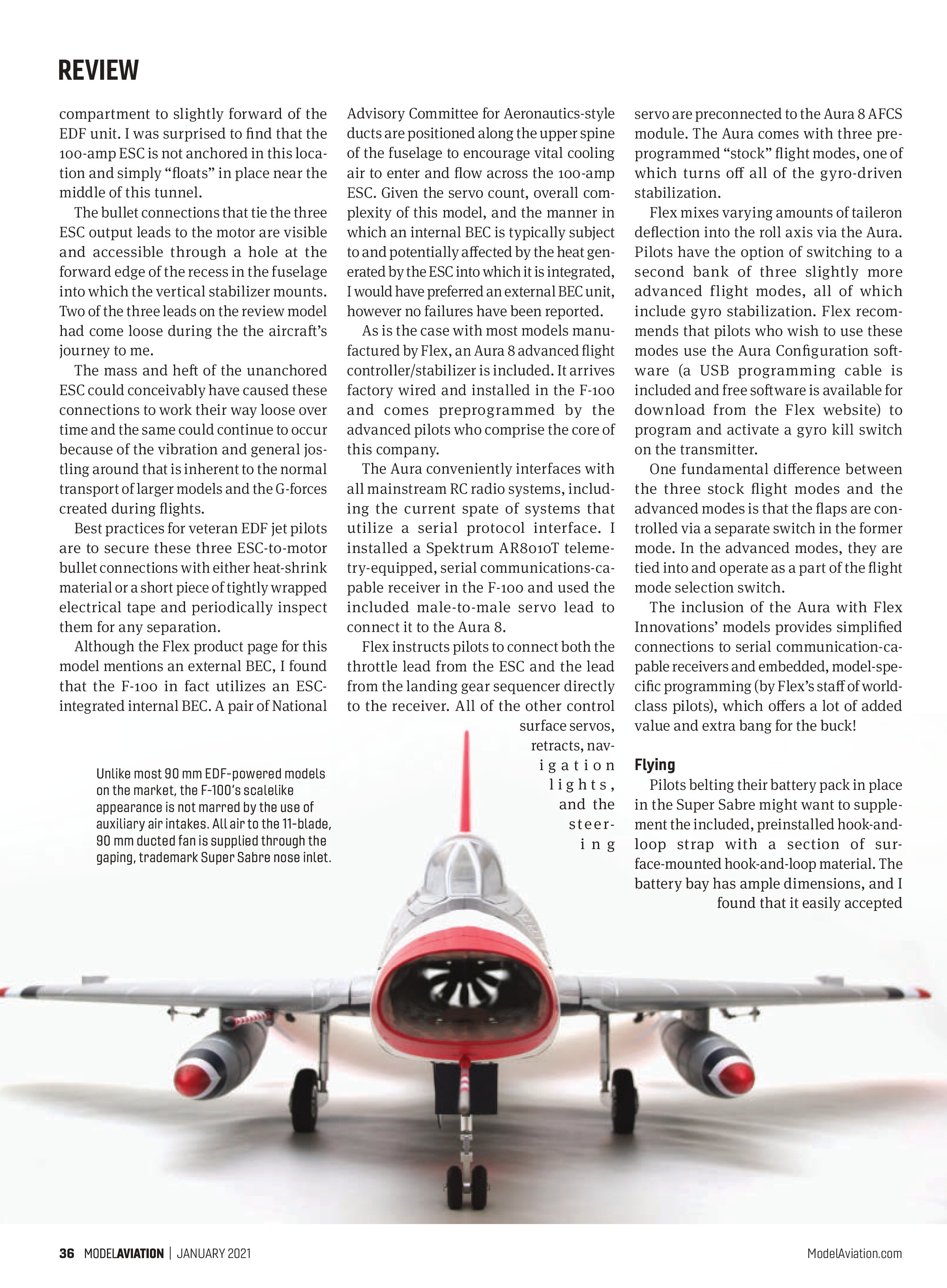
An initial walk-around and perusal of the kit components right out of the box had me admiring the following notable features: digital 15-gram metal gear servos used on all flight control surfaces and ball links are used on both ends of all of the control surface pushrods. Scale inlet ducting is unmarred by any use of auxiliary inlet ducts (aka cheater holes) and the exhaust ducting utilizes an exhaust tube, sturdy, removable pitot tube, and refueling probe. The model uses accurately scaled, full-flying stabilizers.
Flex even recreated the subtle discoloration of the aft part of the fuselage that is typically evident on full-scale F-100s with unpainted, polished aluminum finishes!
I also noted a couple of features that this model lacks (perhaps to keep the cost of the kit and complexities manageable and within established project design goals), including the absence of gear doors on the main gear, the use of an ESC-integrated internal BEC instead of a typically more robust external BEC, and the manner in which the ESC is placed in the fuselage.
Assembly
Although the current generation of EPO foam-composition models comes out of the box requiring little more than an hour or two of assembly time, EDF pilots who like to preserve their potentially pricey jet models always spend time inspecting the airframe and electronics.
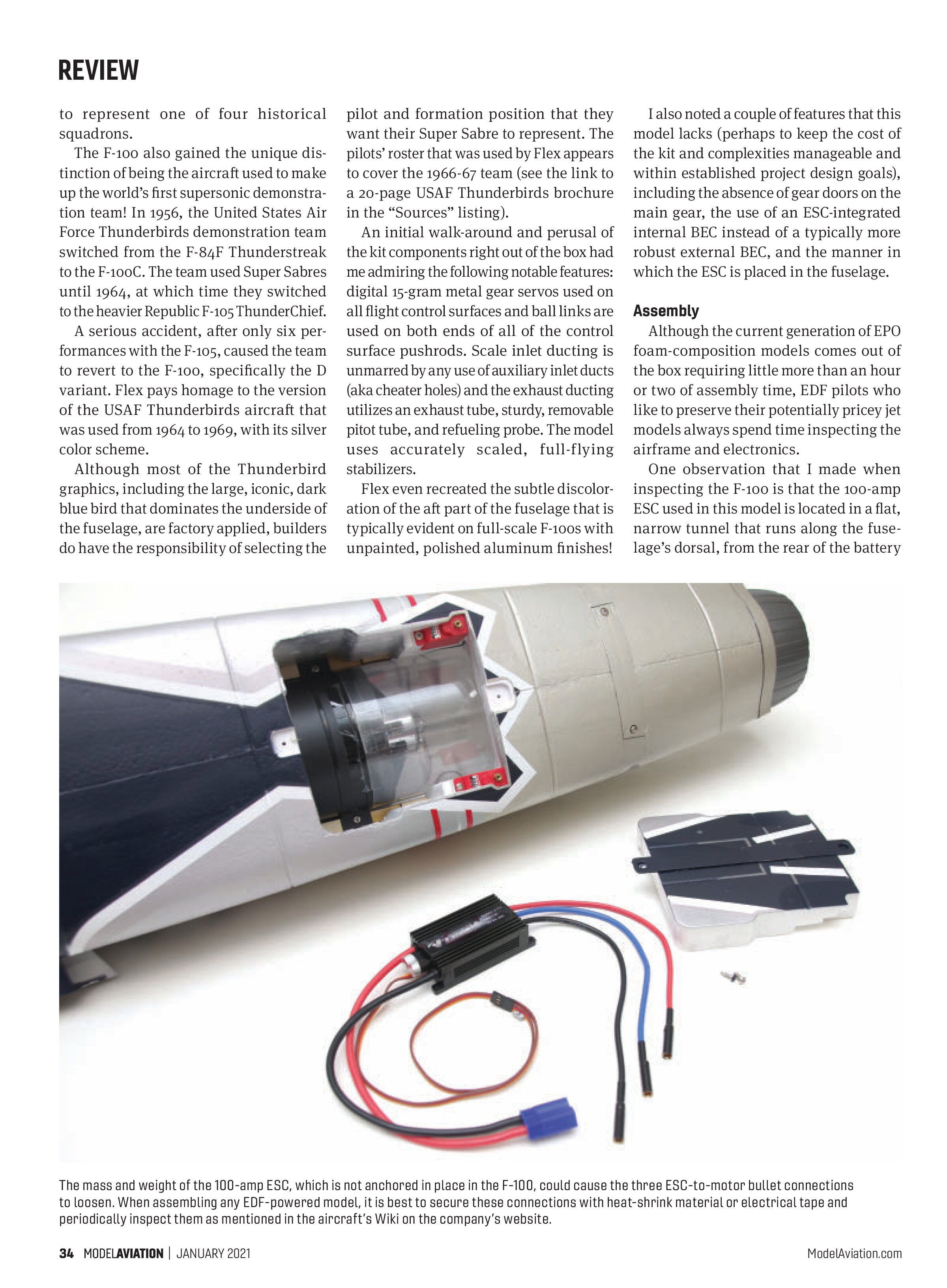
One observation that I made when inspecting the F-100 is that the 100-amp ESC used in this model is located in a flat, narrow tunnel that runs along the fuselage’s dorsal, from the rear of the battery

The mass and weight of the 100-amp ESC, which is not anchored in place in the F-100, could cause the three ESC-to-motor bullet connections to loosen. When assembling any EDF-powered model, it is best to secure these connections with heat-shrink material or electrical tape and periodically inspect them as mentioned in the aircraft’s Wiki on the company’s website.

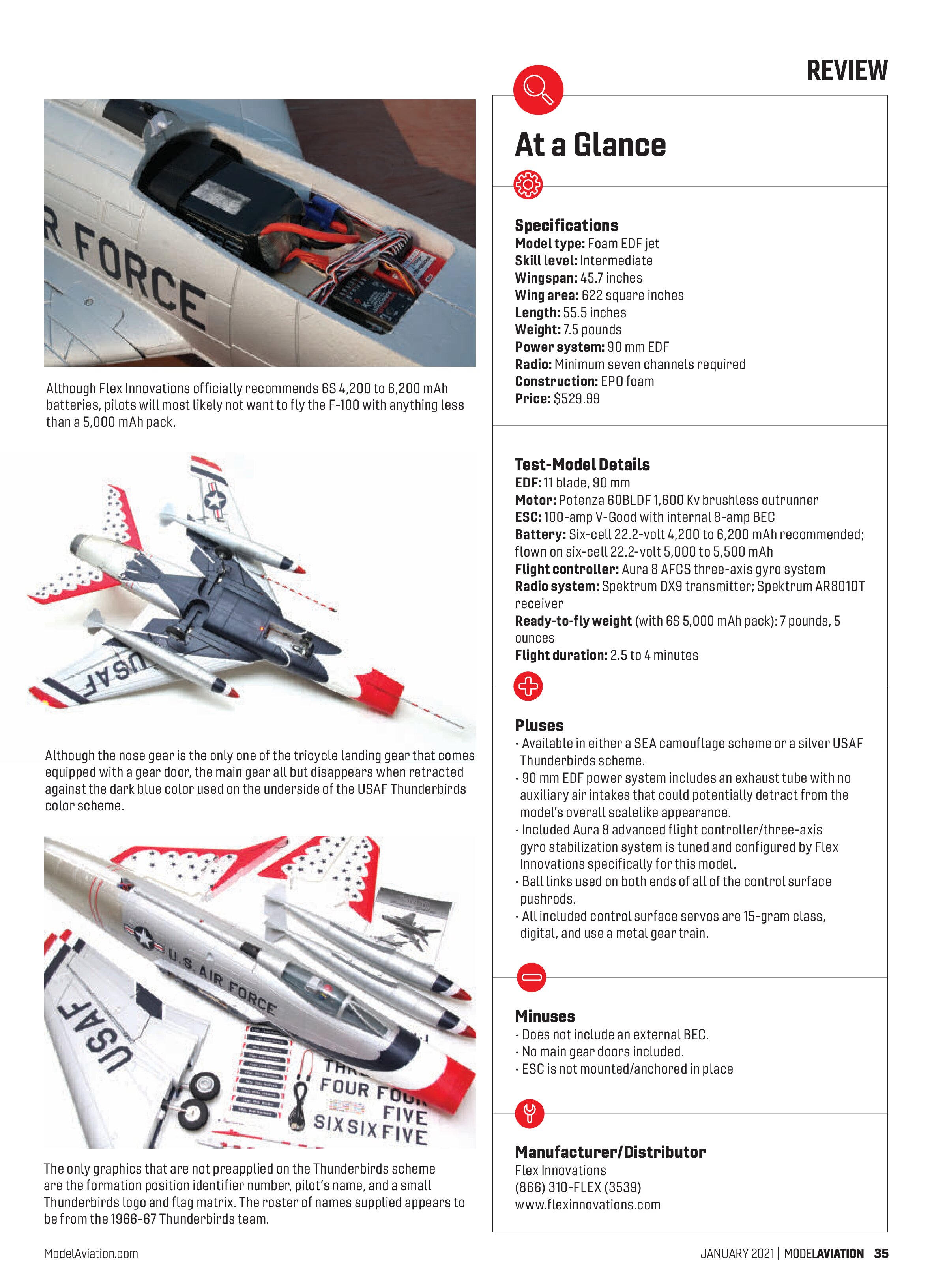
Although Flex Innovations officially recommends 6S 4,200 to 6,200 mAh batteries, pilots will most likely not want to fly the F-100 with anything less than a 5,000 mAh pack.

Although the nose gear is the only one of the tricycle landing gear that comes equipped with a gear door, the main gear all but disappears when retracted against the dark blue color used on the underside of the USAF Thunderbirds color scheme.

The only graphics that are not preapplied on the Thunderbirds scheme are the formation position identifier number, pilot’s name, and a small Thunderbirds logo and flag matrix. The roster of names supplied appears to be from the 1966-67 Thunderbirds team.
At a Glance
Specifications
Model type: Foam EDF jet
Skill level: Intermediate
Wingspan: 45.7 inches
Wing area: 622 square inches
Length: 55.5 inches
Weight: 7.5 pounds
Power system: 90 mm EDF
Radio: Minimum seven channels required
Construction: EPO foam
Price: $529.99
Test-Model Details
EDF: 11 blade, 90 mm
Motor: Potenza 60BLDF 1,600 Kv brushless outrunner
ESC: 100-amp V-Good with internal 8-amp BEC
Battery: Six-cell 22.2-volt, 4,200 to 6,200 mAh recommended; flown on six-cell 22.2-volt 5,000 to 5,500 mAh
Flight controller: Aura 8 AFCS three-axis gyro system
Radio system: Spektrum DX9 transmitter; Spektrum AR8010T receiver
Ready-to-fly weight (with 6S 5,000 mAh pack): 7 pounds, 5 ounces
Flight duration: 2.5 to 4 minutes
Pluses
- Available in either a SEA camouflage scheme or a silver USAF Thunderbirds scheme.
- 90 mm EDF power system includes an exhaust tube with no auxiliary air intakes that could potentially detract from the model’s overall scalelike appearance.
- Included Aura 8 advanced flight controller/three-axis gyro stabilization system is tuned and configured by Flex Innovations specifically for this model.
- Ball links used on both ends of all of the control surface pushrods.
- All included control surface servos are 15-gram class, digital, and use a metal gear train.
Minuses
- Does not include an external BEC.
- No main gear doors included.
- ESC is not mounted/anchored in place.
Manufacturer/Distributor
Flex Innovations
(866) 310-FLEX (3539)
www.flexinnovations.com
REVIEW
compartment to slightly forward of the EDF unit. I was surprised to find that the 100-amp ESC is not anchored in this location and simply “floats” in place near the middle of this tunnel.
The bullet connections that tie the three ESC output leads to the motor are visible and accessible through a hole at the forward edge of the recess in the fuselage into which the vertical stabilizer mounts. Two of the three leads on the review model had come loose during the the aircraft’s journey to me.
The mass and heft of the unanchored ESC could conceivably have caused these connections to work their way loose over time and the same could continue to occur because of the vibration and general jostling around that is inherent to the normal transport of larger models and the G-forces created during flights.
Best practices for veteran EDF jet pilots are to secure these three ESC-to-motor bullet connections with either heat-shrink material or a short piece of tightly wrapped electrical tape and periodically inspect them for any separation.
Although the Flex product page for this model mentions an external BEC, I found that the F-100 in fact utilizes an ESC-integrated internal BEC. A pair of National Advisory Committee for Aeronautics-style ducts are positioned along the upper spine of the fuselage to encourage vital cooling air to enter and flow across the 100-amp ESC. Given the servo count, overall complexity of this model, and the manner in which an internal BEC is typically subject to and potentially affected by the heat generated by the ESC into which it is integrated, I would have preferred an external BEC unit, however no failures have been reported.
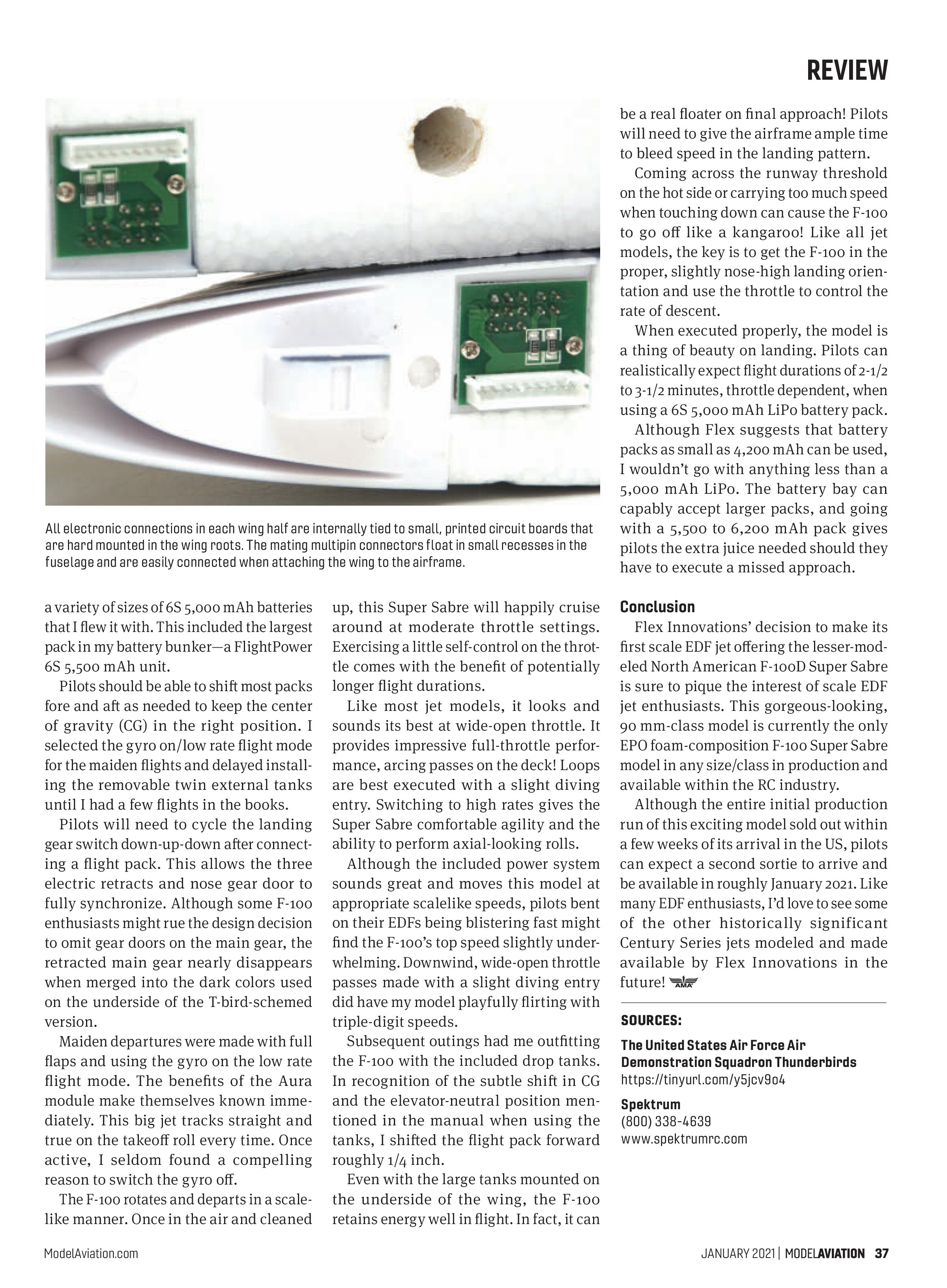
As is the case with most models manufactured by Flex, an Aura 8 advanced flight controller/stabilizer is included. It arrives factory wired and installed in the F-100 and comes preprogrammed by the advanced pilots who comprise the core of this company.
The Aura conveniently interfaces with all mainstream RC radio systems, including the current spate of systems that utilize a serial protocol interface. I installed a Spektrum AR8010T telemetry-equipped, serial communications-capable receiver in the F-100 and used the included male-to-male servo lead to connect it to the Aura 8.
Flex instructs pilots to connect both the throttle lead from the ESC and the lead from the landing gear sequencer directly to the receiver. All of the other control surface servos, retracts, navigation lights, and the steering servo are preconnected to the Aura 8 AFCS module. The Aura comes with three preprogrammed “stock” flight modes, one of which turns off all of the gyro-driven stabilization.
Flex mixes varying amounts of taileron deflection into the roll axis via the Aura. Pilots have the option of switching to a second bank of three slightly more advanced flight modes, all of which include gyro stabilization. Flex recommends that pilots who wish to use these modes use the Aura Configuration software (a USB programming cable is included and free software is available for download from the Flex website) to program and activate a gyro kill switch on the transmitter.
One fundamental difference between the three stock flight modes and the advanced modes is that the flaps are controlled via a separate switch in the former mode. In the advanced modes, they are tied into and operate as a part of the flight mode selection switch.
The inclusion of the Aura with Flex Innovations’ models provides simplified connections to serial communication-capable receivers and embedded, model-specific programming (by Flex’s staff of world-class pilots), which offers a lot of added value and extra bang for the buck!

Flying
Pilots belting their battery pack in place in the Super Sabre might want to supplement the included, preinstalled hook-and-loop strap with a section of surface-mounted hook-and-loop material. The battery bay has ample dimensions, and I found that it easily accepted a variety of sizes of 6S 5,000 mAh batteries that I flew it with. This included the largest pack in my battery bunker—a FlightPower 6S 5,500 mAh unit.
Pilots should be able to shift most packs fore and aft as needed to keep the center of gravity (CG) in the right position. I selected the gyro on/low rate flight mode for the maiden flights and delayed installing the removable twin external tanks until I had a few flights in the books.
Pilots will need to cycle the landing gear switch down-up-down after connecting a flight pack. This allows the three electric retracts and nose gear door to fully synchronize. Although some F-100 enthusiasts might rue the design decision to omit gear doors on the main gear, the retracted main gear nearly disappears when merged into the dark colors used on the underside of the T-bird-schemed version.
Maiden departures were made with full flaps and using the gyro on the low rate flight mode. The benefits of the Aura module make themselves known immediately. This big jet tracks straight and true on the takeoff roll every time. Once active, I seldom found a compelling reason to switch the gyro off.
The F-100 rotates and departs in a scalelike manner. Once in the air and cleaned up, this Super Sabre will happily cruise around at moderate throttle settings. Exercising a little self-control on the throttle comes with the benefit of potentially longer flight durations.
Like most jet models, it looks and sounds its best at wide-open throttle. It provides impressive full-throttle performance, arcing passes on the deck! Loops are best executed with a slight diving entry. Switching to high rates gives the Super Sabre comfortable agility and the ability to perform axial-looking rolls.
Although the included power system sounds great and moves this model at appropriate scalelike speeds, pilots bent on their EDFs being blistering fast might find the F-100’s top speed slightly underwhelming. Downwind, wide-open throttle passes made with a slight diving entry did have my model playfully flirting with triple-digit speeds.
Subsequent outings had me outfitting the F-100 with the included drop tanks. In recognition of the subtle shift in CG and the elevator-neutral position mentioned in the manual when using the tanks, I shifted the flight pack forward roughly 1/4 inch.
Even with the large tanks mounted on the underside of the wing, the F-100 retains energy well in flight. In fact, it can be a real floater on final approach! Pilots will need to give the airframe ample time to bleed speed in the landing pattern.
Coming across the runway threshold on the hot side or carrying too much speed when touching down can cause the F-100 to go off like a kangaroo! Like all jet models, the key is to get the F-100 in the proper, slightly nose-high landing orientation and use the throttle to control the rate of descent.
When executed properly, the model is a thing of beauty on landing. Pilots can realistically expect flight durations of 2-1/2 to 3-1/2 minutes, throttle dependent, when using a 6S 5,000 mAh LiPo battery pack.
Although Flex suggests that battery packs as small as 4,200 mAh can be used, I wouldn’t go with anything less than a 5,000 mAh LiPo. The battery bay can capably accept larger packs, and going with a 5,500 to 6,200 mAh pack gives pilots the extra juice needed should they have to execute a missed approach.

Conclusion
Flex Innovations’ decision to make its first scale EDF jet offering the lesser-modeled North American F-100D Super Sabre is sure to pique the interest of scale EDF jet enthusiasts. This gorgeous-looking, 90 mm-class model is currently the only EPO foam-composition F-100 Super Sabre model in any size/class in production and available within the RC industry.
Although the entire initial production run of this exciting model sold out within a few weeks of its arrival in the US, pilots can expect a second sortie to arrive and be available in roughly January 2021. Like many EDF enthusiasts, I’d love to see some of the other historically significant Century Series jets modeled and made available by Flex Innovations in the future!
SOURCES:
The United States Air Force Air Demonstration Squadron Thunderbirds
https://tinyurl.com/y5jcv9o4
Spektrum
(800) 338-4639
www.spektrumrc.com