AROUND THE PATCH

LINGERING PROJECTS FROM READERS
By Thayer Syme | thayer@flying-models.com
WITH ALL THAT 2020 threw at us, it seems as though a lifetime has passed since I wrote my January 2020 column. In those pages, I mentioned finishing some models that had languished for far too long. I apparently struck a nerve with some readers, and it has been fun to learn about your lingering projects.
Starting off this month is an example from Camille Goudeseune of Urbana, Illinois, with Burt Rutan’s Quickie.
Burt’s single-seat Quickie was introduced to the world at the 1978 EAA Fly-In Convention in Oshkosh, Wisconsin, and immediately captured widespread attention throughout the aviation world. In my mid-teens at the time, I spent countless hours daydreaming about boring holes in the sky with this futuristic aerial go-kart. My dreams never materialized, but to this day, I still peruse every Quickie photo and model plans that pass my eyes.
The maturation of small, electric power systems and sheet-foam construction allowed prolific experimentation with smaller models by the mid-2000s. Werner Schaefer, from Germany, used these materials and techniques to circle back to Rutan’s Quickie. His plans were published in the January 2005 issue of Flugmodell und Technik (FMT), where Camille’s story picks up. He wrote:
“Within two weeks of the plans’ publication, I’d bought 3 mm Depron foam sheet, carbon-fiber rods, and some electric motors. A month later, I’d finished testing the motors with various propellers on a static thrust stand to measure current and thrust, whereupon I chose the best combination.
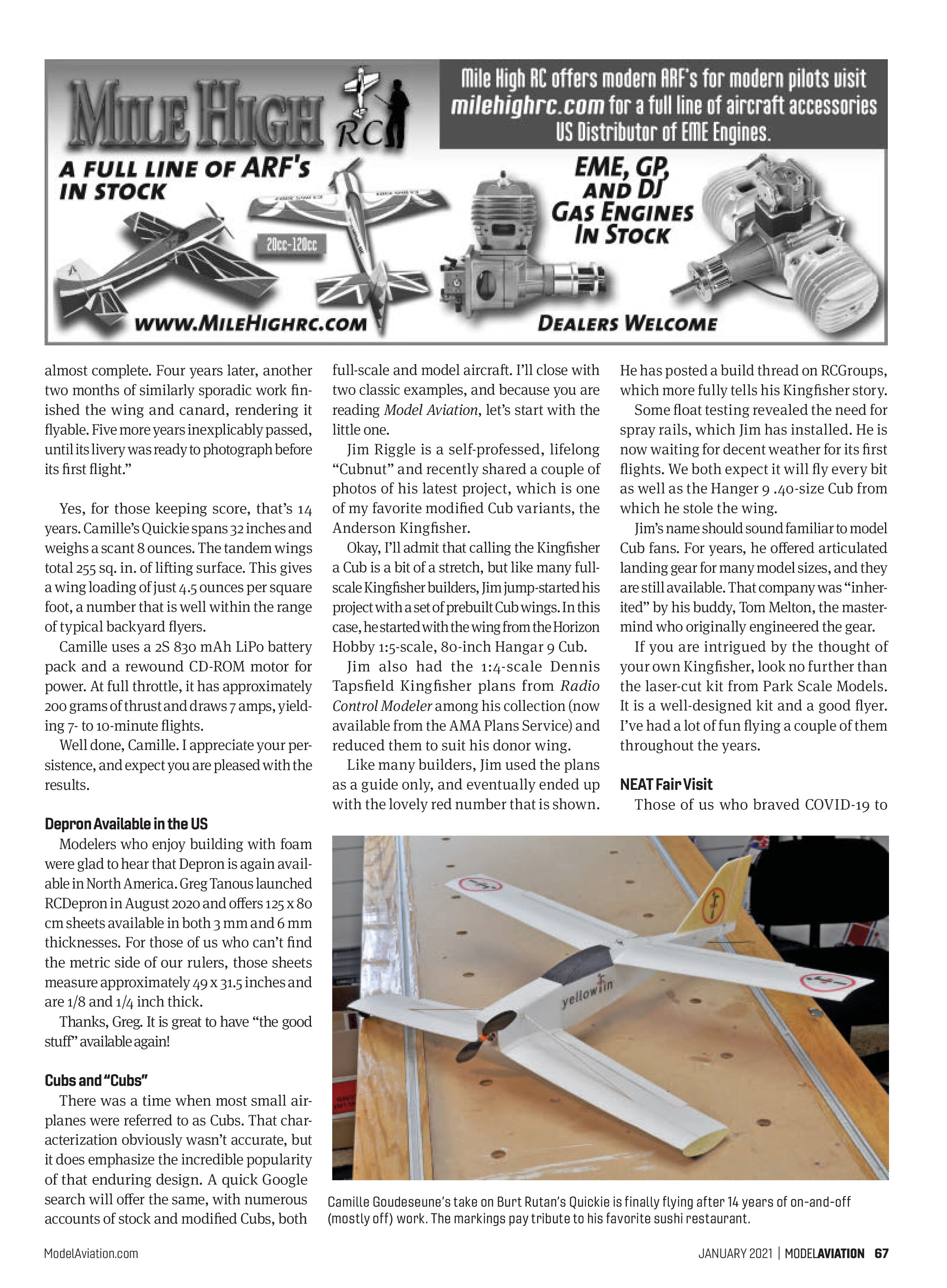
“Five years then passed while I built and flew other airplanes. Once I’d started building, within a month, all of the foam had been cut and the fuselage was almost complete. Four years later, another two months of similarly sporadic work finished the wing and canard, rendering it flyable. Five more years inexplicably passed, until its livery was ready to photograph before its first flight.”
Yes, for those keeping score, that’s 14 years. Camille’s Quickie spans 32 inches and weighs a scant 8 ounces. The tandem wings total 255 sq. in. of lifting surface. This gives a wing loading of just 4.5 ounces per square foot, a number that is well within the range of typical backyard flyers.
Camille uses a 2S 830 mAh LiPo battery pack and a rewound CD-ROM motor for power. At full throttle, it has approximately 200 grams of thrust and draws 7 amps, yielding 7- to 10-minute flights.
Well done, Camille. I appreciate your persistence, and expect you are pleased with the results.
Depron Available in the US
Modelers who enjoy building with foam were glad to hear that Depron is again available in North America. Greg Tanous launched RCDepron in August 2020 and offers 125 x 80 cm sheets available in both 3 mm and 6 mm thicknesses. For those of us who can’t find the metric side of our rulers, those sheets measure approximately 49 x 31.5 inches and are 1/8 and 1/4 inch thick.
Thanks, Greg. It is great to have “the good stuff” available again!
Cubs and “Cubs”
There was a time when most small airplanes were referred to as Cubs. That characterization obviously wasn’t accurate, but it does emphasize the incredible popularity of that enduring design. A quick Google search will offer the same, with numerous accounts of stock and modified Cubs, both full-scale and model aircraft. I’ll close with two classic examples, and because you are reading Model Aviation, let’s start with the little one.
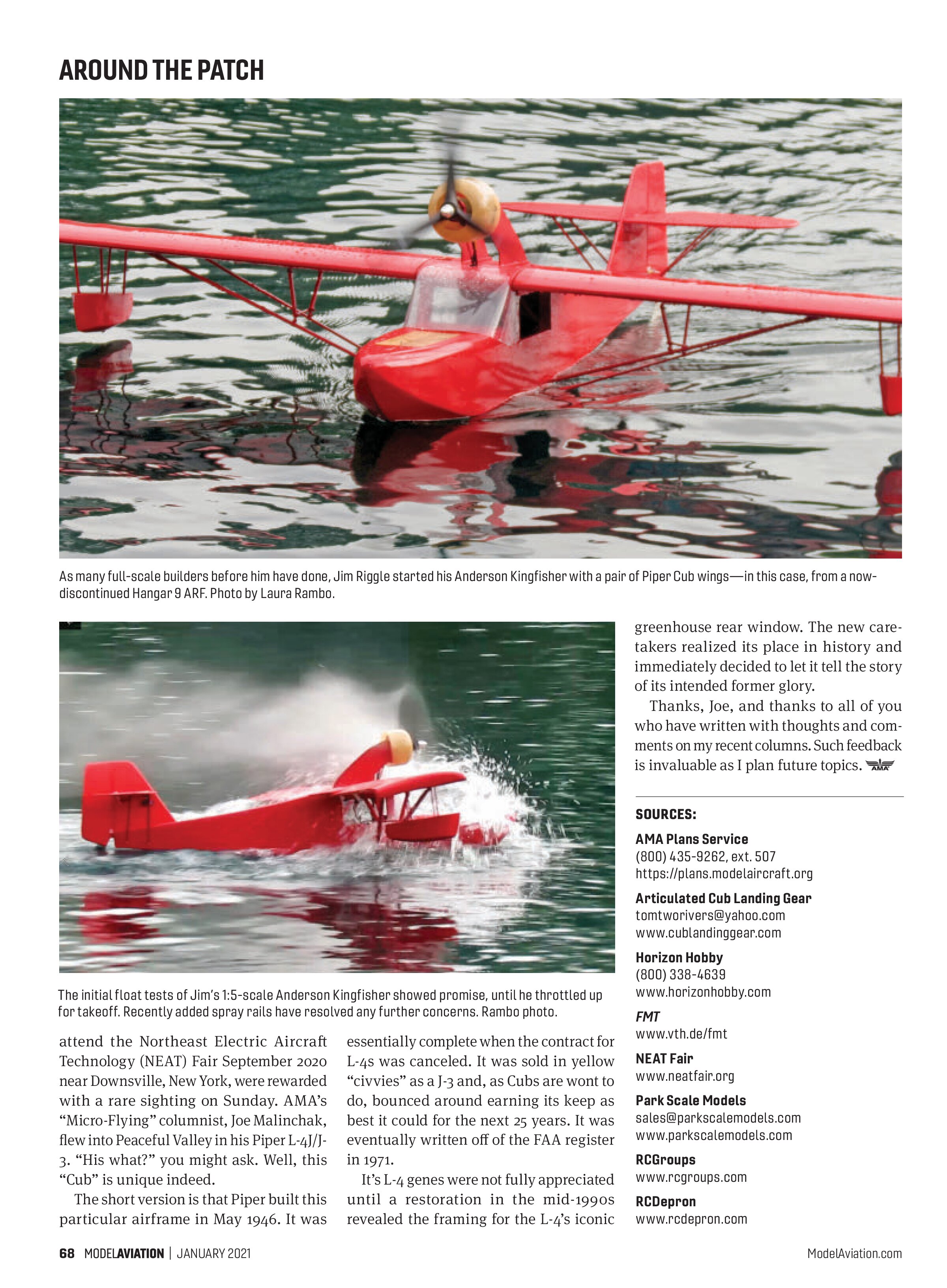
Jim Riggle is a self-professed, lifelong “Cubnut” and recently shared a couple of photos of his latest project, which is one of my favorite modified Cub variants, the Anderson Kingfisher.
Okay, I’ll admit that calling the Kingfisher a Cub is a bit of a stretch, but like many full-scale Kingfisher builders, Jim jump-started his project with a set of prebuilt Cub wings. In this case, he started with the wing from the Horizon Hobby 1:5-scale, 80-inch Hanger 9 Cub.
Jim also had the 1:4-scale Dennis Tapsfield Kingfisher plans from Radio Control Modeler among his collection (now available from the AMA Plans Service) and reduced them to suit his donor wing.
Like many builders, Jim used the plans as a guide only, and eventually ended up with the lovely red number that is shown.
He has posted a build thread on RCGroups, which more fully tells his Kingfisher story.
Some float testing revealed the need for spray rails, which Jim has installed. He is now waiting for decent weather for its first flights. We both expect it will fly every bit as well as the Hanger 9 .40-size Cub from which he stole the wing.
Jim’s name should sound familiar to model Cub fans. For years, he offered articulated landing gear for many model sizes, and they are still available. That company was “inherited” by his buddy, Tom Melton, the mastermind who originally engineered the gear.
If you are intrigued by the thought of your own Kingfisher, look no further than the laser-cut kit from Park Scale Models. It is a well-designed kit and a good flyer. I’ve had a lot of fun flying a couple of them throughout the years.
NEAT Fair Visit
Those of us who braved COVID-19 to


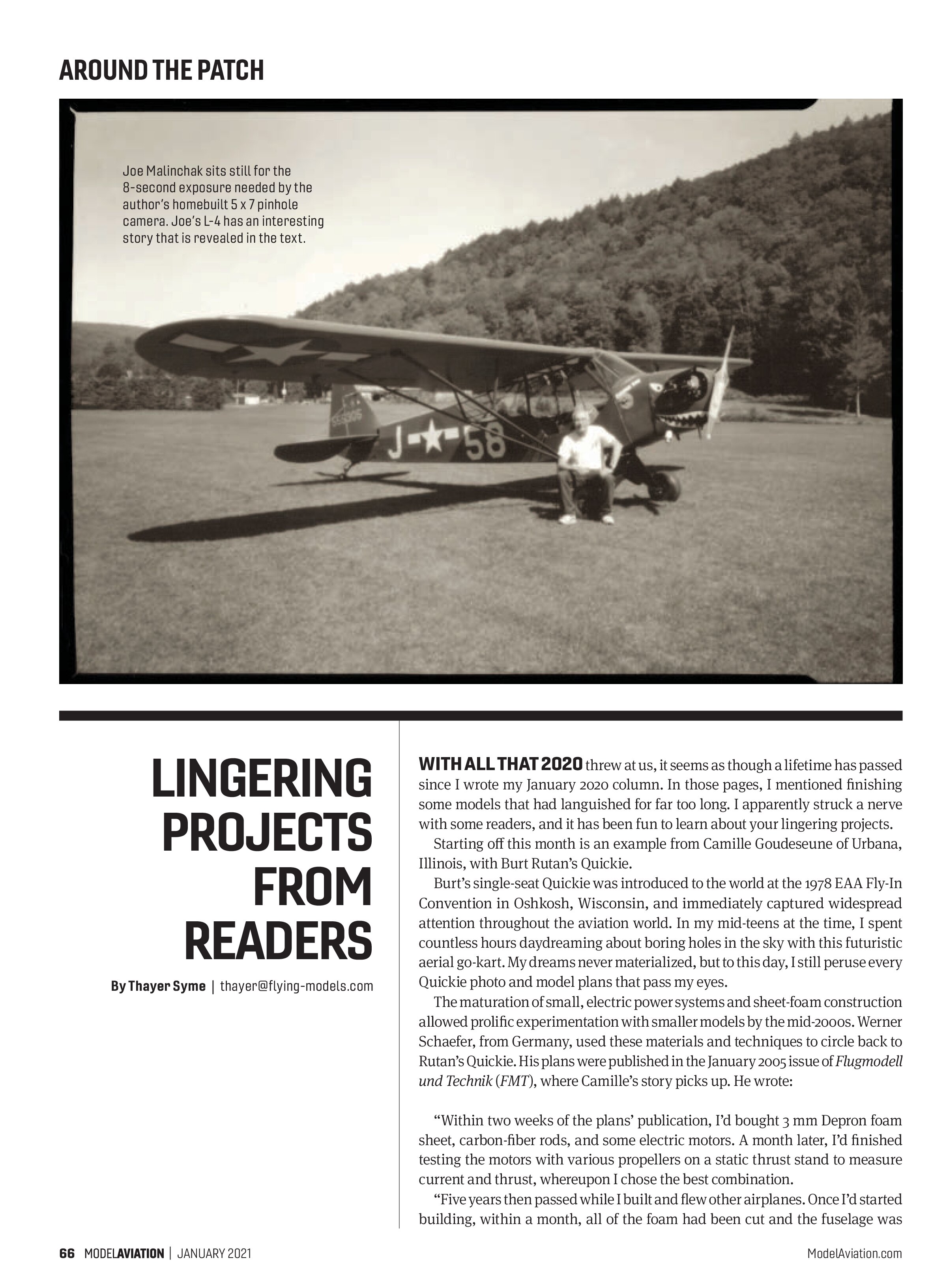
greenhouse rear window. The new caretakers realized its place in history and immediately decided to let it tell the story of its intended former glory.
Thanks, Joe, and thanks to all of you who have written with thoughts and comments on my recent columns. Such feedback is invaluable as I plan future topics.
attend the Northeast Electric Aircraft Technology (NEAT) Fair September 2020 near Downsville, New York, were rewarded with a rare sighting on Sunday. AMA’s “Micro-Flying” columnist, Joe Malinchak, flew into Peaceful Valley in his Piper L-4J/J-3. “His what?” you might ask. Well, this “Cub” is unique indeed.
The short version is that Piper built this particular airframe in May 1946. It was essentially complete when the contract for L-4s was canceled. It was sold in yellow “civvies” as a J-3 and, as Cubs are wont to do, bounced around earning its keep as best it could for the next 25 years. It was eventually written off of the FAA register in 1971.
It’s L-4 genes were not fully appreciated until a restoration in the mid-1990s revealed the framing for the L-4’s iconic
SOURCES:
AMA Plans Service
(800) 435-9262, ext. 507
https://plans.modelaircraft.org
Articulated Cub Landing Gear
tomtworivers@yahoo.com
www.cublandinggear.com
Horizon Hobby
(800) 338-4639
www.horizonhobby.com
NEAT Fair
www.neatfair.org
Park Scale Models
sales@parkscalemodels.com
www.parkscalemodels.com
RCGroups
www.rcgroups.com
RCDepron
www.rcdepron.com