SAFETY AND
KNOWLEDGE TEST
By Tyler Dobbs, Government Affairs director | tylerd@modelaircraft.org
ON OCTOBER 5, 2018, the FAA Reauthorization Act of 2018 was signed into law. It included a requirement for all recreational UAS users to pass a safety and knowledge test in order to operate a recreational model aircraft within the National Airspace System (NAS).
AMA has worked closely with the FAA to ensure that this upcoming test will meet the intent of Congress without placing an undue burden on our hobby. In the spring of 2019, AMA met with important stakeholders and the FAA, chairing a roundtable discussion to lay out the guidelines and administration of the safety and knowledge test.
In September 2019, AMA sent a request for information in order to officially declare its interest in becoming a test administrator. AMA is advocating that the test be available online and in a written format at fixed locations, such as an AMA flying site, to ensure that all members can easily take the test.
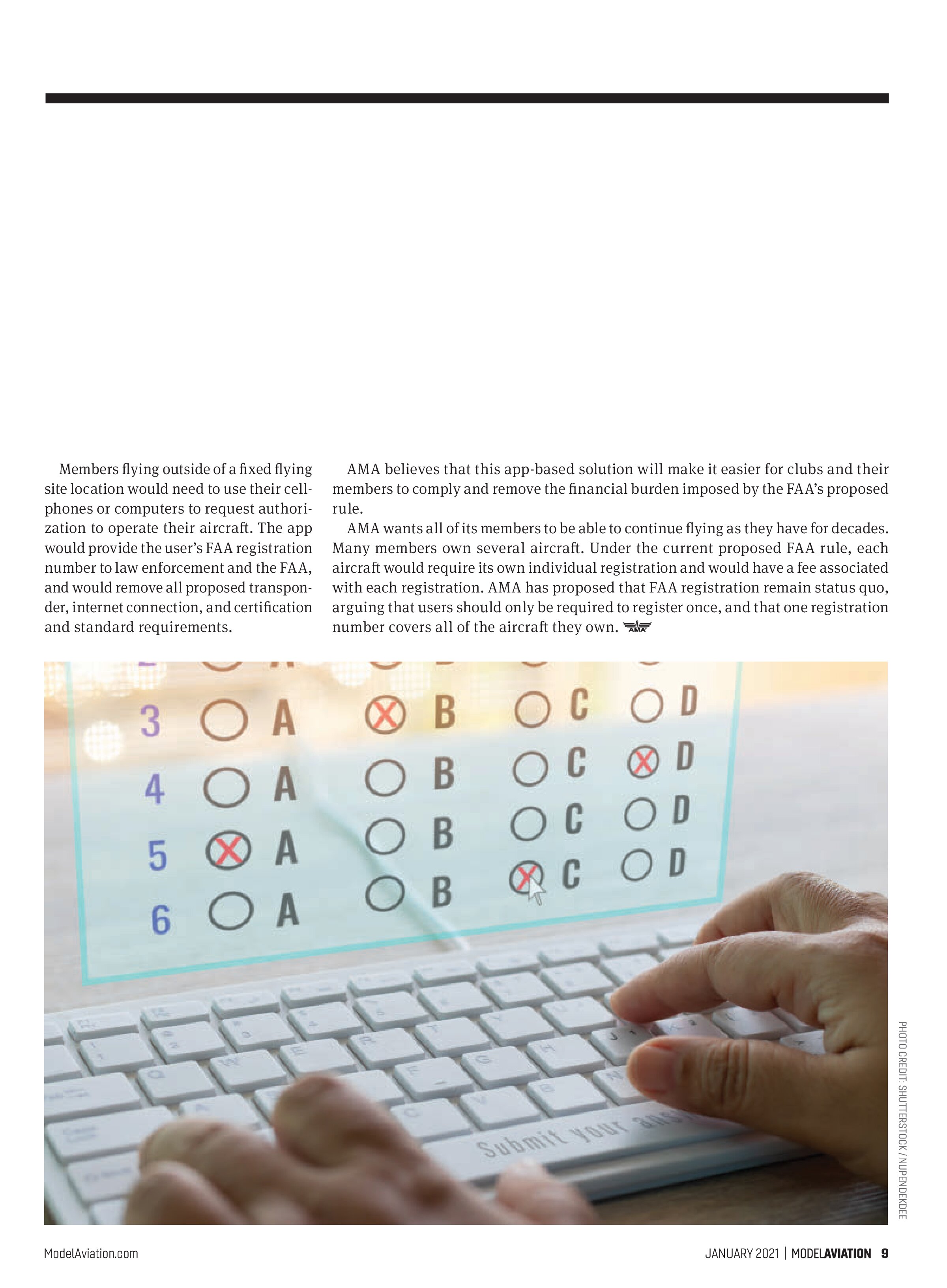
The test will have approximately 25 multiple-choice questions about basic safety guidelines and recreational flying knowledge. If a member misses a question, he or she will be able to go back and reselect an answer until the response is correct. The test is failproof and guarantees that every recreational user will be able to complete and pass it. It is important for everyone to understand that this test is designed to bring safety awareness to the airspace and not to exclude recreational users from operating in the NAS.
AMA expects to have the test-taking process outlined by the end of 2020 or early 2021 as part of Advisory Circular (AC) 91-57C. At the time of writing this article, AC 91-57C was preparing to be published in the Federal Register for public comments. In the meantime, AMA will continue to work with the FAA and keep its members updated on the process. If you have any questions, contact the Government Affairs team at (765) 287-1256 or amagov@modelaircraft.org.
AMA Meets With the OIRA
On October 22, 2020, AMA met with the Office of Information and Regulatory Affairs (OIRA) to discuss the FAA’s proposed Remote ID rule. OIRA is a statutory part of the Office of Management and Budget, which is an Executive Office of the President.
AMA began the conversation by pointing out the burden the FAA’s Remote ID proposal would place on model aviation hobbyists, UAS manufacturing, hobby shops, and the UAS industry as a whole. Many of AMA’s members fly aircraft that would be difficult, if not impossible, to retrofit in order to comply with the proposed Remote ID rule. In addition to retrofitting, AMA discussed the burden of per-aircraft registration, manufacturing certification and standards, and the 12-month request period for Remote ID-exempt flying sites.
AMA has more than 2,300 fixed flying site locations, along with several hundred junior ROTC locations within the US. The FAA has recognized these flying sites and the safe operations that occur within them; however, the FAA has given AMA a limited timeframe to request that these flying sites be exempt from the Remote ID rule. If a club’s flying site were to become unavailable, said club would not be allowed to change its site’s location after the 12-month request period ends.
AMA has approximately 60 fixed flying site location changes every year. Because of such frequent changes, it is imperative that AMA have the option to change and request new fixed flying site locations when needed, and that the FAA’s proposed 12-month requesting period be removed from the rule.
An app-based solution for AMA members who fly outside of a fixed flying site location was also discussed. Approximately half of AMA’s 180,000 members fly outside of a fixed flying site location. The app would work similar to the Low Altitude Authorization and Notification Capability (LAANC) app used for operating within controlled airspace.
Members flying outside of a fixed flying site location would need to use their cell-phones or computers to request authorization to operate their aircraft. The app would provide the user’s FAA registration number to law enforcement and the FAA, and would remove all proposed transponder, internet connection, and certification and standard requirements.
AMA believes that this app-based solution will make it easier for clubs and their members to comply and remove the financial burden imposed by the FAA’s proposed rule.
AMA wants all of its members to be able to continue flying as they have for decades. Many members own several aircraft. Under the current proposed FAA rule, each aircraft would require its own individual registration and would have a fee associated with each registration. AMA has proposed that FAA registration remain status quo, arguing that users should only be required to register once, and that one registration number covers all of the aircraft they own.