HOW UTM WILL AFFECT THE FUTURE OF MODEL AVIATION
By Patrick Sherman
lucidity@roswellflighttestcrew.com

APPROXIMATELY 2,500 YEARS AGO, Greek philosopher Heraclitus of Ephesus uttered a phrase that is a perfect fit for the hobby of model aviation and the UAS industry at this moment in history: “Change is the only constant in life.”
There has been plenty of change throughout the past few years. The Special Rule for Model Aircraft was passed by Congress then repealed by Congress. Aircraft registration was required, then not required, and then required again.
At the start of a new year, I thought we should try to get ahead of the game for once by reading the FAA’s playbook for the next decade: the UAS Traffic Management’s (UTM) Concept of Operations (ConOps), v2.0. This 70-page document was released by the FAA last year and provides an outline for how the agency will regulate the expansion of UAS operations and establish the infrastructure necessary to support them.
If you only fly hand-built models at your local AMA field or foamies at a local park, you might think that this does not apply to you. In that case, I have some bad news—it does. By definition, model airplanes are UAS, in that they are:
- Unmanned, because there is no room for a human pilot on the inside.
- Aircraft, defined by the FAA as “a device used or intended to be used for flight in the air.”
- Systems, being made up of airborne and terrestrial components that operate together in order to produce flight.
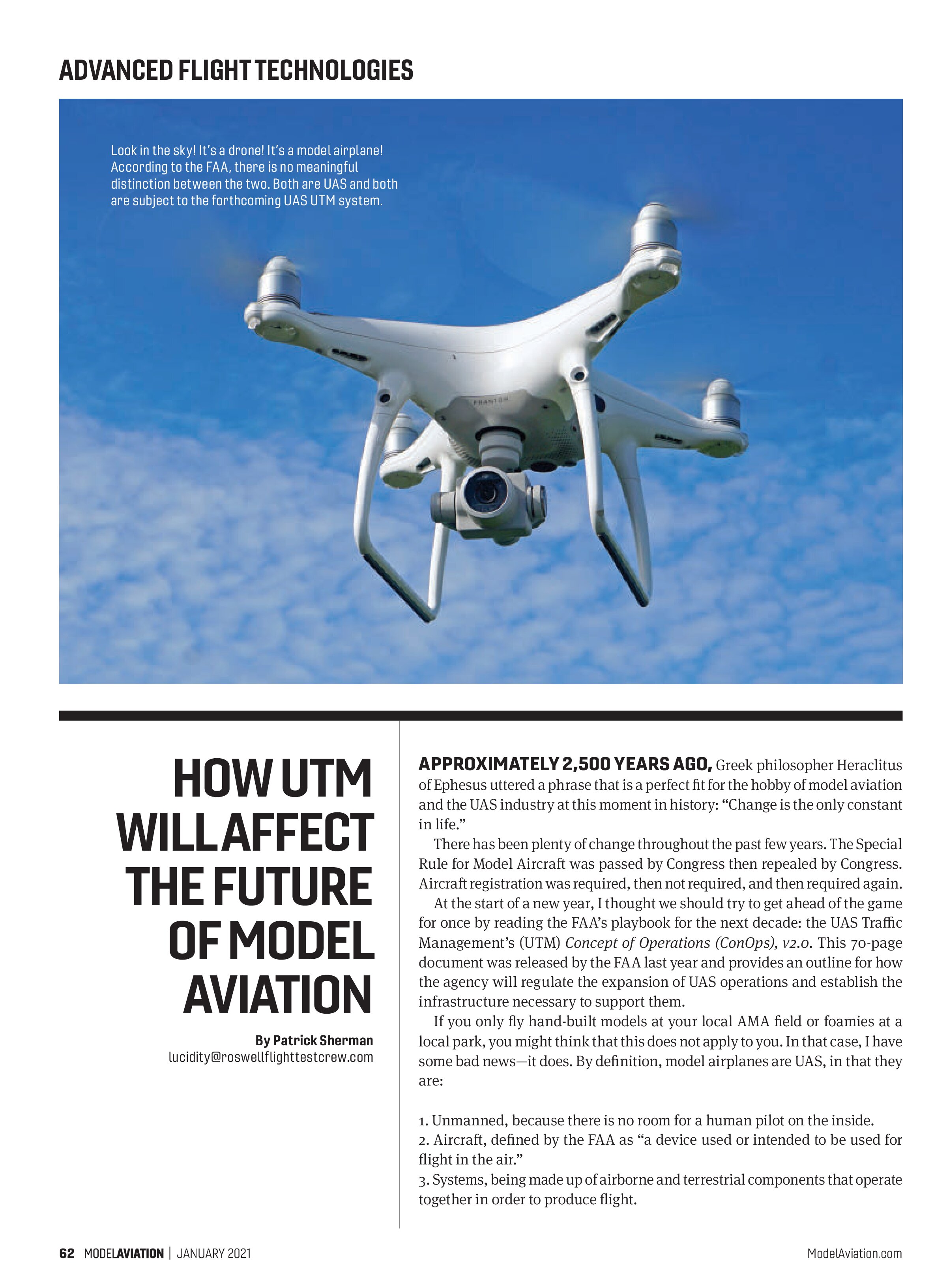
From a regulatory perspective, the distinction between drones and model airplanes has pretty much been erased at this point. The hardware doesn’t matter, only the reason for which you are flying it: recreation, to make money, or to serve some socially beneficial purpose, such as search and rescue.
Regardless of where, why, or how you fly, you’ve got a ticket on this train. You might as well take a look at where it is going.
Why Now?
The FAA is pushing ahead with the development of UTM because it must. Its ConOps document states, “With commercial UAS conducting multiple flights a day to support business needs, such as delivery and infrastructure inspections, the number of daily operations could potentially reach into the millions, taxing the [National Airspace System (NAS)] well beyond its current service requirements.”
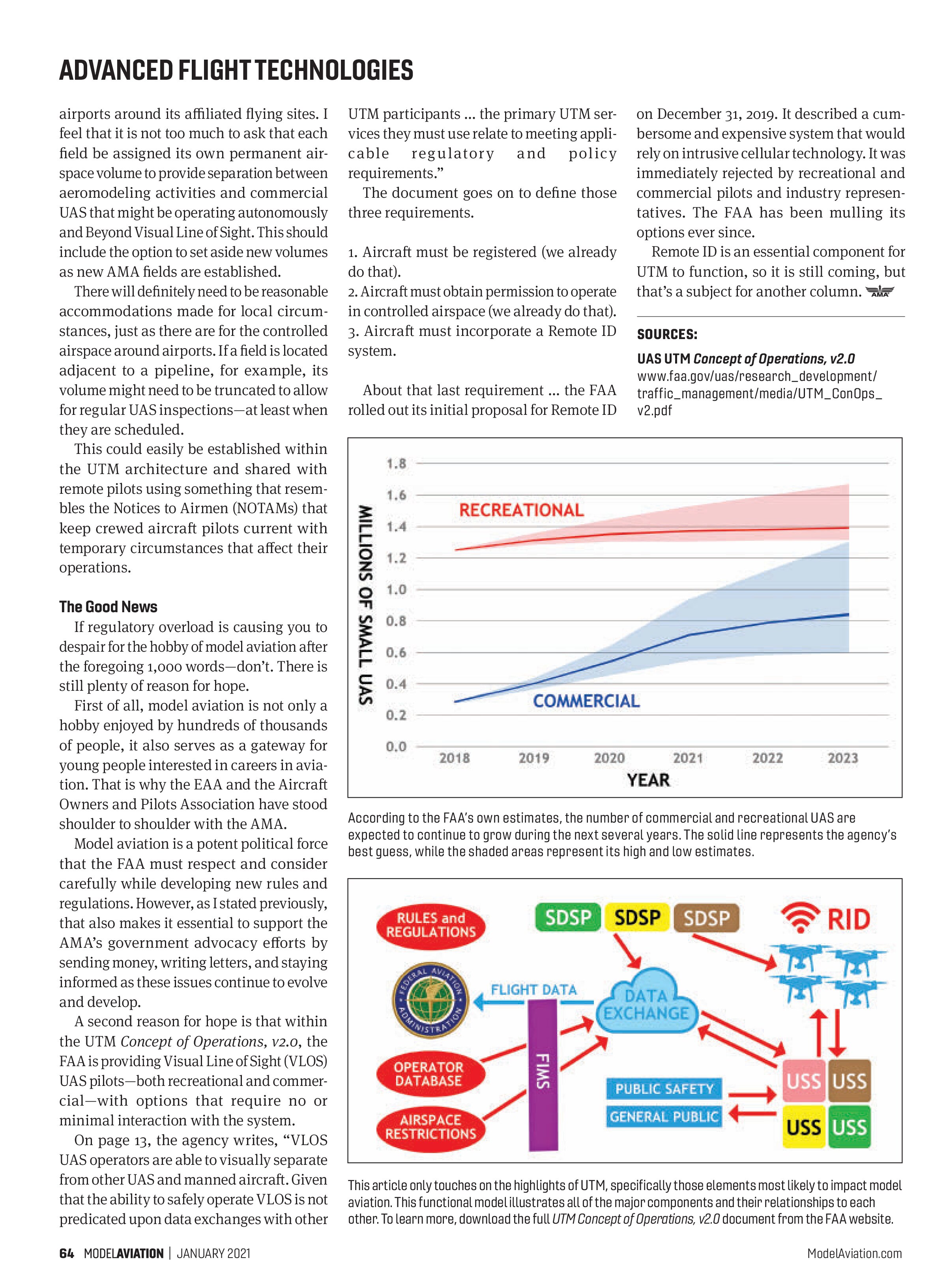
By the agency’s own estimates, which can be seen in the accompanying chart, there will be upward of 1.3 million commercial drones in operation by 2023, and nearly 1.7 million recreational model aircraft. In short, something new is required because the existing system can’t handle the volume.
These statistics also highlight another detail that merits consideration. Even three years from now, under the least-favorable projections from the hobby’s perspective, model aircraft will still outnumber commercial platforms. With each passing year, this is less likely to be true—and in less than a decade, it will not be true.
This is a critical moment in history to support the AMA, and its government advocacy programs in particular, while the organization and its members constitute the largest single group of UAS operators. Protections and regulatory gains for the hobby will be much harder to achieve with each passing year.
Understanding UTM
It’s easy to describe UTM as Air Traffic Control (ATC) for UAS; however, that metaphor obscures as much as it reveals because there are some profound differences between the two. Whereas ATC relies on government employees sitting in control towers and regional centers to direct air traffic, UAS traffic will be managed by a data exchange without direct human intervention.
As an individual UAS pilot, you will not interface with a government-run system, but rather a private company called a UAS Service Supplier (USS). Much like selecting a cellphone carrier, you will be able to choose from among several different USS, each with its own product offerings.
In fact, we likely already know the names of a few of them—Skyward, KittyHawk, and AirMap—all of which are currently in the business of providing airspace authorizations from the Low-Altitude Authorization and Notification Capability (LAANC) system.
Each pilot submits his or her own operations plan to the data exchange through his or her chosen USS. These are then reconciled with each other and the available airspace is parceled out by the system into what the FAA refers to as “volumes.” These are basically 4D blocks of sky, defined by their height, length, width, and a window of time.
Turn Up the Volume
Understanding that this is the agency’s plan, I think it is critical for the AMA to carve out something that resembles controlled airspace that surrounds and protects
airports around its affiliated flying sites. I feel that it is not too much to ask that each field be assigned its own permanent airspace volume to provide separation between aeromodeling activities and commercial UAS that might be operating autonomously and Beyond Visual Line of Sight. This should include the option to set aside new volumes as new AMA fields are established.
There will definitely need to be reasonable accommodations made for local circumstances, just as there are for the controlled airspace around airports. If a field is located adjacent to a pipeline, for example, its volume might need to be truncated to allow for regular UAS inspections—at least when they are scheduled.
This could easily be established within the UTM architecture and shared with remote pilots using something that resembles the Notices to Airmen (NOTAMs) that keep crewed aircraft pilots current with temporary circumstances that affect their operations.
The Good News
If regulatory overload is causing you to despair for the hobby of model aviation after the foregoing 1,000 words—don’t. There is still plenty of reason for hope.
First of all, model aviation is not only a hobby enjoyed by hundreds of thousands of people, it also serves as a gateway for young people interested in careers in aviation. That is why the EAA and the Aircraft Owners and Pilots Association have stood shoulder to shoulder with the AMA.
Model aviation is a potent political force that the FAA must respect and consider carefully while developing new rules and regulations. However, as I stated previously, that also makes it essential to support the AMA’s government advocacy efforts by sending money, writing letters, and staying informed as these issues continue to evolve and develop.
A second reason for hope is that within the UTM Concept of Operations, v2.0, the FAA is providing Visual Line of Sight (VLOS) UAS pilots—both recreational and commercial—with options that require no or minimal interaction with the system.
On page 13, the agency writes, “VLOS UAS operators are able to visually separate from other UAS and manned aircraft. Given that the ability to safely operate VLOS is not predicated upon data exchanges with other
UTM participants ... the primary UTM services they must use relate to meeting applicable regulatory and policy requirements.”
The document goes on to define those three requirements.
- Aircraft must be registered (we already do that).
- Aircraft must obtain permission to operate in controlled airspace (we already do that).
- Aircraft must incorporate a Remote ID system.
About that last requirement ... the FAA rolled out its initial proposal for Remote ID
on December 31, 2019. It described a cumbersome and expensive system that would rely on intrusive cellular technology. It was immediately rejected by recreational and commercial pilots and industry representatives. The FAA has been mulling its options ever since.
Remote ID is an essential component for UTM to function, so it is still coming, but that’s a subject for another column.
SOURCES:
UAS UTM Concept of Operations, v2.0
www.faa.gov/uas/research_development/
traffic_management/media/UTM_ConOps_v2.pdf