Reed systems
Bob Noll
bobrc@aol.com
recently had a conversation with a fellow club member who had heard the term “reeds” and wanted to know what that meant. This took me back to 1960, when I received my Orbit eight-channel system, which was a present from my wife.
I had told her that I wanted a Bramco system, but she, being better informed than I, bought me the Orbit. People with whom she had spoken suggested the Orbit because it was a handheld transmitter rather than a ground-based transmitter such as the Bramco. Having just moved to upstate New York, I had learned about Hal deBolt, who was an outstanding RC Aerobatics (Pattern) pilot, and he was flying with a Bramco system.
To show my friend a reed system, I went to my radio collection and got out an Orbit 10-channel reed system and explained how the transmitter would send out different tones, making the appropriate reed vibrate in the receiver, activating a servo. The transmitter had five two-position lever switches that would activate the appropriate reed and the servo for that command. Reed-system channels are an on/off output, not a proportional (or analog) signal.
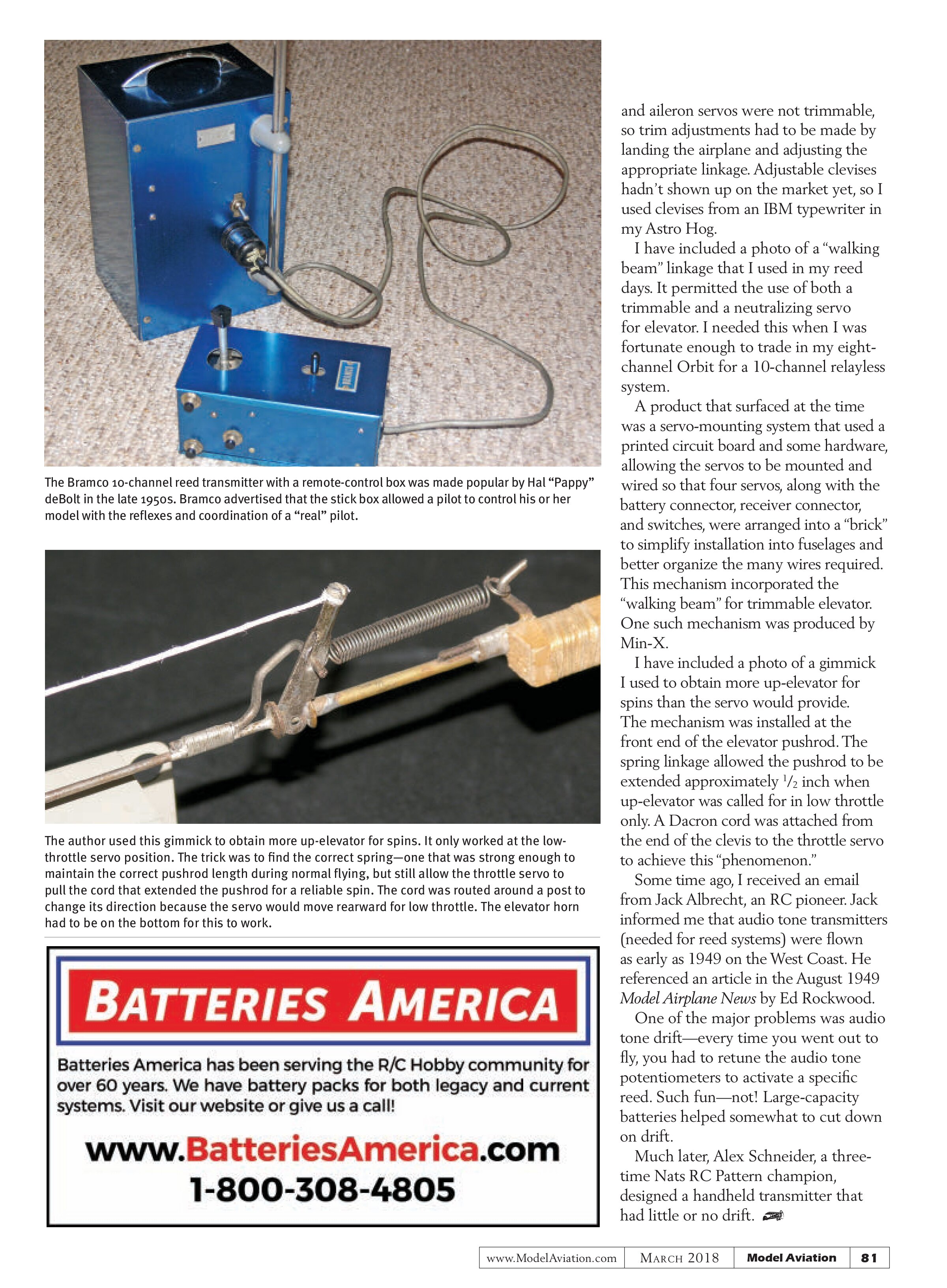
I showed my friend a new-in-the-box Bonner Duramite servo. He was shocked that there was no connector on the servo, which had eight wires protruding from the metal case. It measures 1 x 15/8 x 31/2 inches and weighs 21/2 ounces. The price on the plastic box was $12.95—relatively expensive for that time, considering that the least expensive servos available today cost less than that.
A few interesting specifications for the Duramite included “Thrust over 4 lbs.; Centering plus or minus .007; Versatile mounting (could be mounted either horizontally or vertically); Fine adjustment screw; and Featuring our own motor, not an import.” Only one Duramite model was produced, and the instructions explained how to do the wiring for “return-to-neutral” control

(self-neutralizing) or “trimmable” control.
A diagram in the Duramite instructions showed an escapement-driven electrical switch arrangement that drove the servo. It stated, “Single channel operation, too! Gets quick escapement switching with the drive of a servo.”

When affordable transistors came onto the scene, Bonner released the Transmite servo, which allowed radio manufacturers to eliminate the less-reliable relays in their receivers. It appeared in 1962 and cost $29.95 for the self-neutralizing/trimmable version,
and $27.95 for the trim-only version.
It was a common thing in those days for servos to be manufactured by companies other than the ones that sold the transmitters and receivers. This was the case with Orbit. Both Duramite and Transmite servos came without a connector on the end of the eight wires (Duramite) or six wires (Transmite) that exited the case. Connectors on receivers were not supplied and modelers had to learn how to solder a multi-pin connector.
I used a Cannon military-specification, gold-plated connector that was available in most electronics parts shops. Bonner sold an amplifier to convert the Duramite servos to Transmite servos at a kit price of $19.95. Some companies, such as Controlaire, sold an amplifier kit for those who wanted to save a few bucks.
Transmite servos were produced in two versions: a self-neutralizing servo and a trimmable servo. The neutralizing servos were used for ailerons, elevator, and rudder, while the trimmable servos were used for throttle and elevator trim. A 10-channel reed system was required to have elevator trim, which was a significant advancement over the eight-channel system.
Trimming an airplane with a reed system required patience. The rudder and aileron servos were not trimmable, so trim adjustments had to be made by landing the airplane and adjusting the appropriate linkage. Adjustable clevises hadn’t shown up on the market yet, so I used clevises from an IBM typewriter in my Astro Hog.
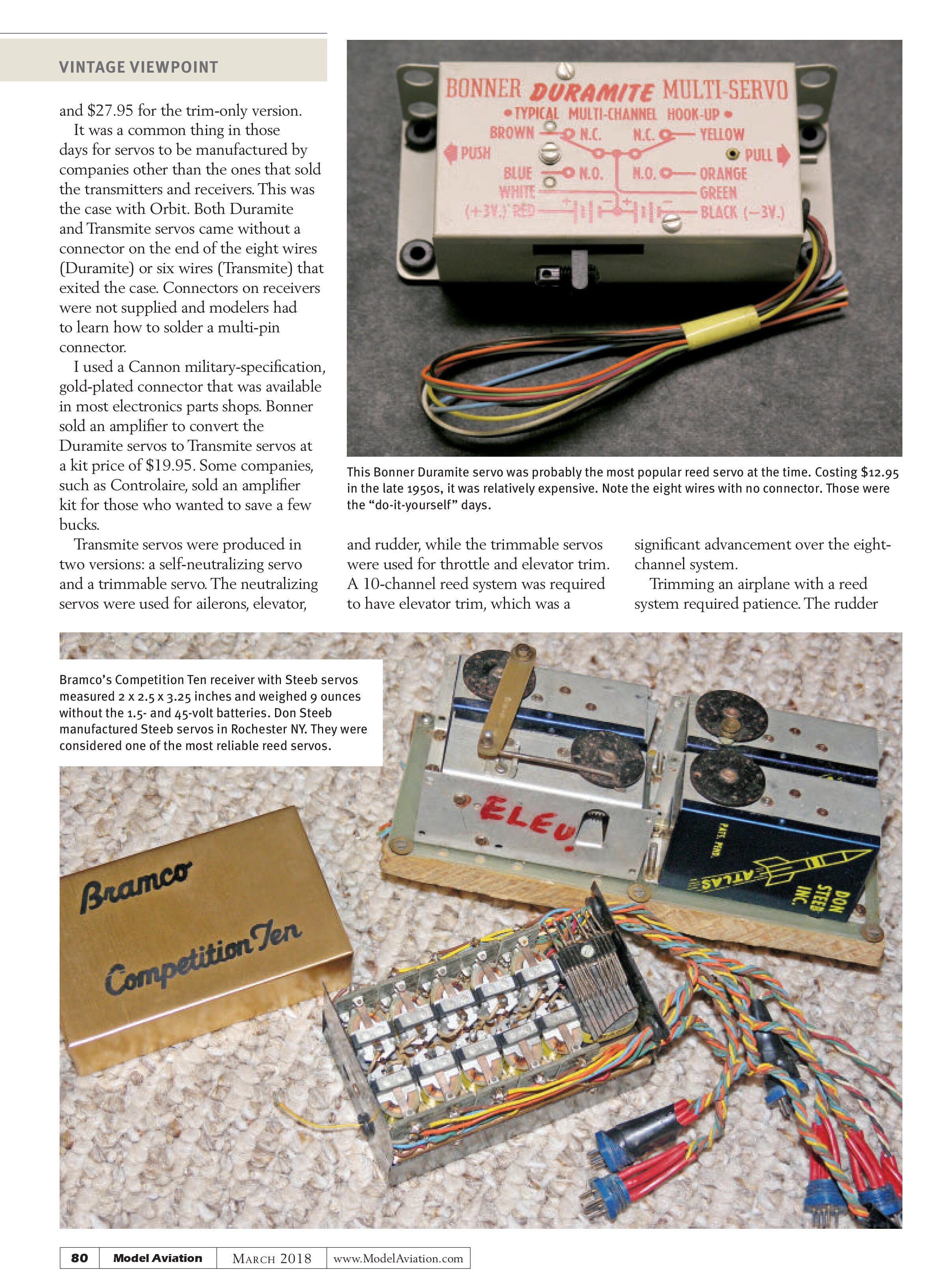
I have included a photo of a “walking beam” linkage that I used in my reed days. It permitted the use of both a trimmable and a neutralizing servo for elevator. I needed this when I was fortunate enough to trade in my eight-channel Orbit for a 10-channel relayless system.
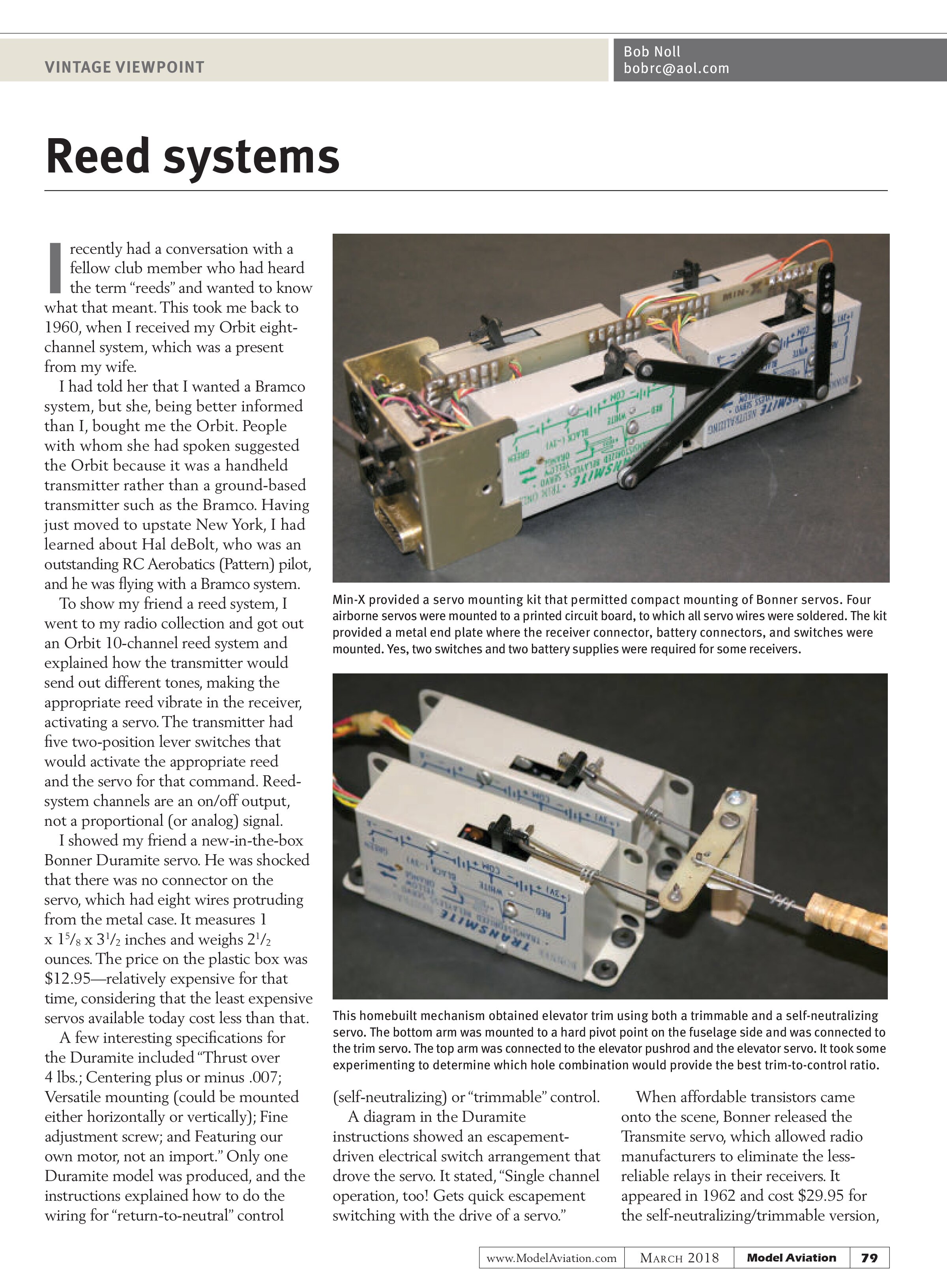
A product that surfaced at the time was a servo-mounting system that used a printed circuit board and some hardware, allowing the servos to be mounted and wired so that four servos, along with the battery connector, receiver connector, and switches, were arranged into a “brick” to simplify installation into fuselages and better organize the many wires required. This mechanism incorporated the “walking beam” for trimmable elevator. One such mechanism was produced by Min-X.
I have included a photo of a gimmick I used to obtain more up-elevator for spins than the servo would provide. The mechanism was installed at the front end of the elevator pushrod. The spring linkage allowed the pushrod to be extended approximately ½ inch when up-elevator was called for in low throttle only. A Dacron cord was attached from the end of the clevis to the throttle servo to achieve this “phenomenon.”
Some time ago, I received an email from Jack Albrecht, an RC pioneer. Jack informed me that audio tone transmitters (needed for reed systems) were flown as early as 1949 on the West Coast. He referenced an article in the August 1949 Model Airplane News by Ed Rockwood.
One of the major problems was audio tone drift—every time you went out to fly, you had to retune the audio tone potentiometers to activate a specific reed. Such fun—not! Large-capacity batteries helped somewhat to cut down on drift.
Much later, Alex Schneider, a three-time Nats RC Pattern champion, designed a handheld transmitter that had little or no drift.

Transmite servos were produced in two versions: a self-neutralizing servo and a trimmable servo. The neutralizing servos were used for ailerons, elevator, and rudder, while the trimmable servos were used for throttle and elevator trim.


and aileron servos were not trimmable, so trim adjustments had to be made by landing the airplane and adjusting the appropriate linkage. Adjustable clevises hadn’t shown up on the market yet, so I used clevises from an IBM typewriter in my Astro Hog.
I have included a photo of a “walking beam” linkage that I used in my reed days. It permitted the use of both a trimmable and a neutralizing servo for elevator. I needed this when I was fortunate enough to trade in my eight-channel Orbit for a 10-channel relayless system.