Taking your chances with statistics
Dave Gee
safetycolumn@cs.com
The numbers are in our favor! Aeromodeling is a safe activity, especially when it is compared with extreme sports such as golf and picking wild mushrooms. I’m not kidding, by the way. I looked it up.
How about this statistic: If you get hurt on a day when you’re enjoying your model airplane hobby, the odds are that the incident did not directly involve a model aircraft. More total injuries come from “other causes,” such as traffic accidents on the way to the flying site, tripping in a flightline gopher hole, or mishaps while mowing the flying field.
Still, we all understand that there are risky moments involved with operating our airplanes and rotorcraft. Caution, experience, and proper procedures keep us safe. What do you feel is the most dangerous part of your hobby activities? It’s different for each of us. Starting the gas engine on a 1/4-scale racer requires great care, but even a small park flyer can bite the unwary. Here’s my own story about getting hurt by the most harmless of models.
The Shrike Strikes
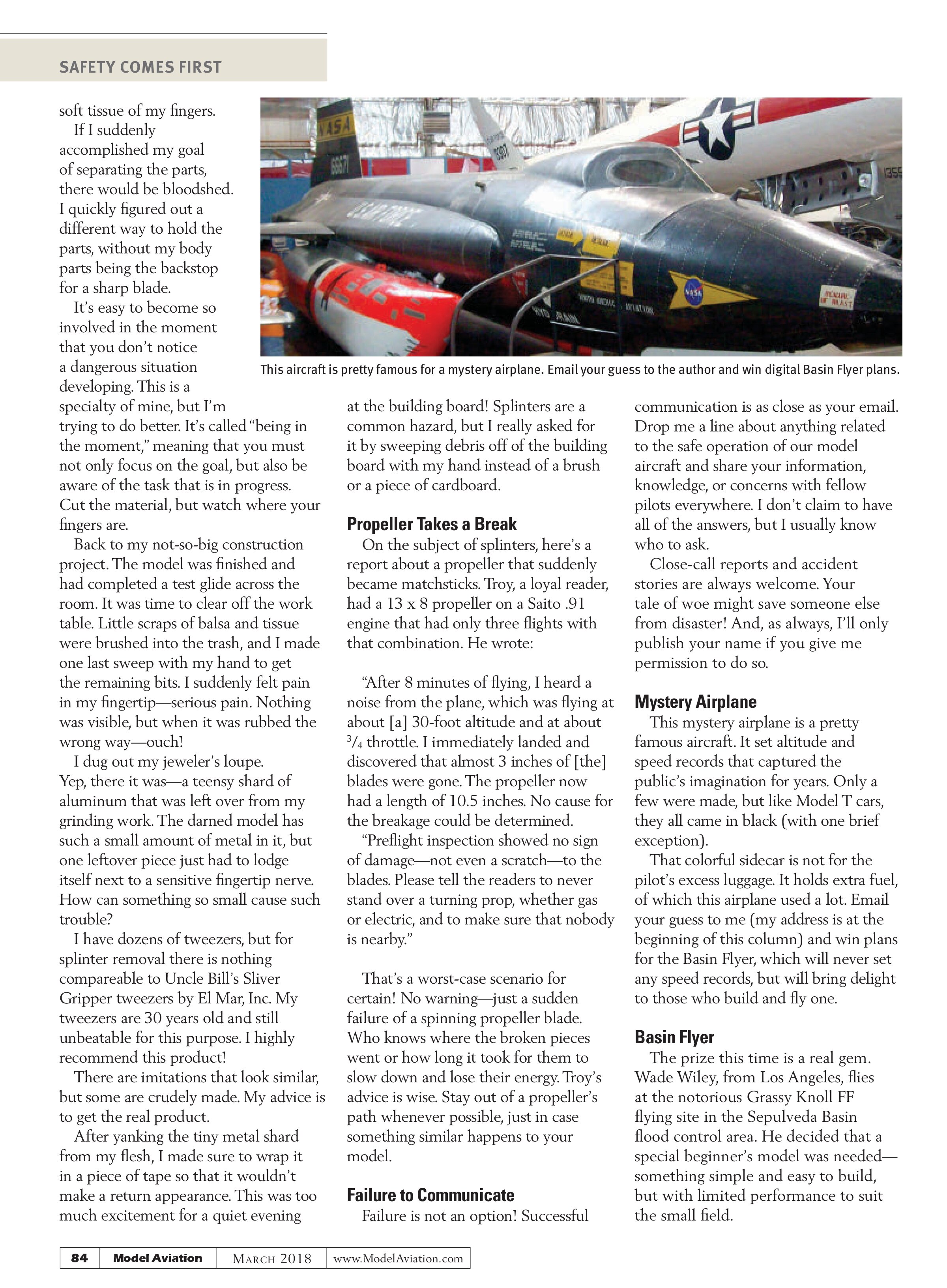
I recently built an 8-gram No-Cal version of the Curtiss Shrike. It is a rubber-powered Indoor Free Flight (FF) aircraft. It’s hard to imagine a less dangerous type of model, right? Well, I managed to have two close calls and an embarrassing injury before that airplane took to the sky.
The first was close work with a cutoff wheel on my rotary tool. It was simple stuff—just grinding a piece of 1/16-inch aluminum tubing—but I noticed that my fingers were awfully close to the action. A little slip would have let that grinder meet my skin. Dumb!
Later, I had to reposition some parts that were glued firmly together. It was time to grab my trusty razor blade and slice them apart. Of course, it took more force than expected, and again it dawned on me that the “line of fire” included the


soft tissue of my fingers. If I suddenly accomplished my goal of separating the parts, there would be bloodshed. I quickly figured out a different way to hold the parts, without my body parts being the backstop for a sharp blade.
It’s easy to become so involved in the moment that you don’t notice a dangerous situation developing. This is a specialty of mine, but I’m trying to do better. It’s called “being in the moment,” meaning that you must not only focus on the goal, but also be aware of the task that is in progress. Cut the material, but watch where your fingers are.
Back to my not-so-big construction project. The model was finished and had completed a test glide across the room. It was time to clear off the work table. Little scraps of balsa and tissue were brushed into the trash, and I made one last sweep with my hand to get the remaining bits. I suddenly felt pain in my fingertip—serious pain. Nothing was visible, but when it was rubbed the wrong way—ouch!
I dug out my jeweler’s loupe. Yep, there it was—a teensy shard of aluminum that was left over from my grinding work. The darned model has such a small amount of metal in it, but one leftover piece just had to lodge itself next to a sensitive fingertip nerve. How can something so small cause such trouble?
I have dozens of tweezers, but for splinter removal there is nothing comparable to Uncle Bill’s Sliver Gripper tweezers by El Mar, Inc. My tweezers are 30 years old and still unbeatable for this purpose. I highly recommend this product!
There are imitations that look similar, but some are crudely made. My advice is to get the real product.
After yanking the tiny metal shard from my flesh, I made sure to wrap it in a piece of tape so that it wouldn’t make a return appearance. This was too much excitement for a quiet evening at the building board! Splinters are a common hazard, but I really asked for it by sweeping debris off of the building board with my hand instead of a brush or a piece of cardboard.

Propeller Takes a Break
On the subject of splinters, here’s a report about a propeller that suddenly became matchsticks. Troy, a loyal reader, had a 13 x 8 propeller on a Saito .91 engine that had only three flights with that combination. He wrote:
“After 8 minutes of flying, I heard a noise from the plane, which was flying at about [a] 30-foot altitude and at about ¾ throttle. I immediately landed and discovered that almost 3 inches of [the] blades were gone. The propeller now had a length of 10.5 inches. No cause for the breakage could be determined.
“Preflight inspection showed no sign of damage—not even a scratch—to the blades. Please tell the readers to never stand over a turning prop, whether gas or electric, and to make sure that nobody is nearby.”
That’s a worst-case scenario for certain! No warning—just a sudden failure of a spinning propeller blade. Who knows where the broken pieces went or how long it took for them to slow down and lose their energy. Troy’s advice is wise. Stay out of a propeller’s path whenever possible, just in case something similar happens to your model.
Failure to Communicate
Failure is not an option! Successful communication is as close as your email. Drop me a line about anything related to the safe operation of our model aircraft and share your information, knowledge, or concerns with fellow pilots everywhere. I don’t claim to have all of the answers, but I usually know who to ask.
Close-call reports and accident stories are always welcome. Your tale of woe might save someone else from disaster! And, as always, I’ll only publish your name if you give me permission to do so.
Mystery Airplane
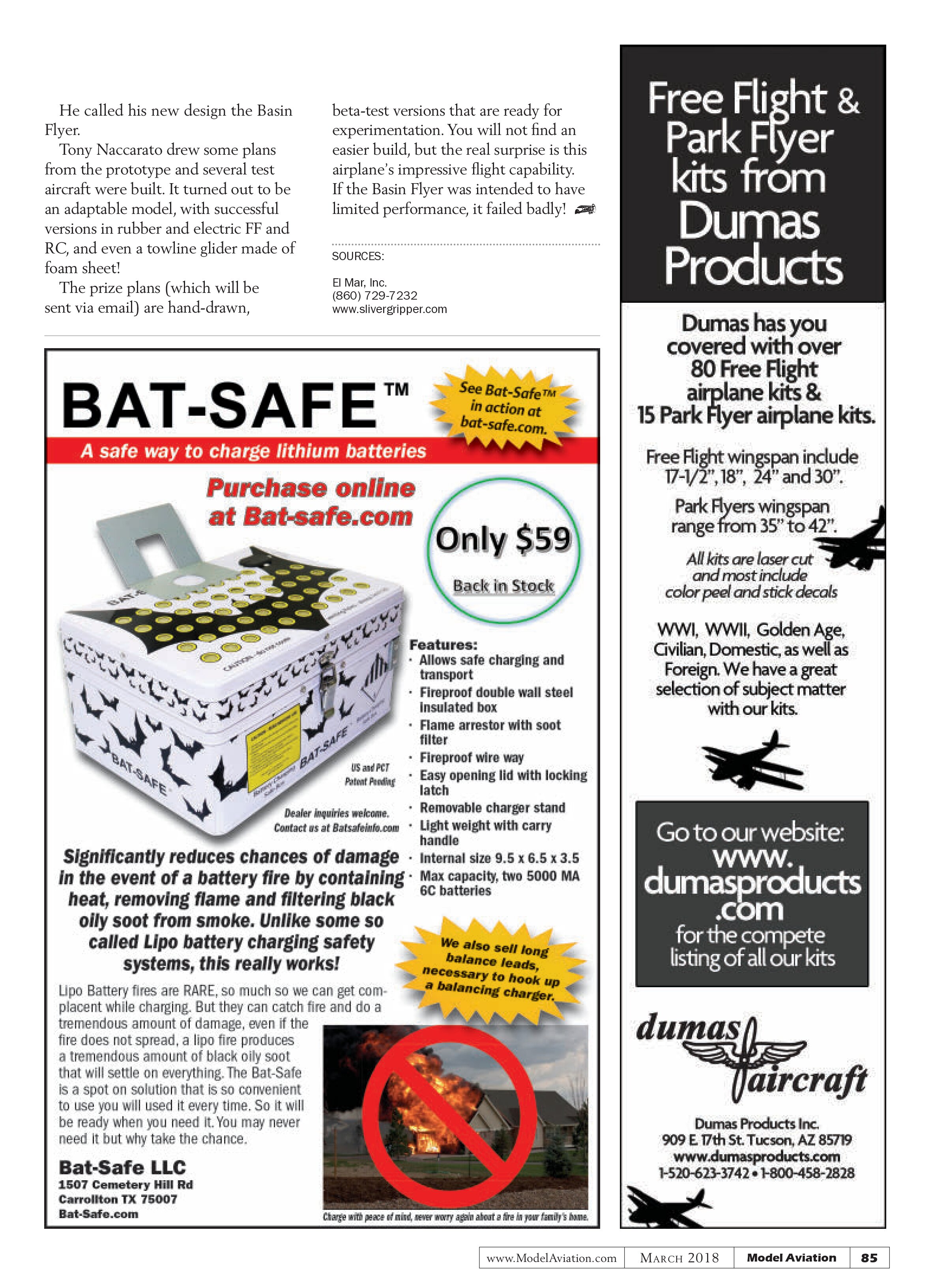
This mystery airplane is a pretty famous aircraft. It set altitude and speed records that captured the public’s imagination for years. Only a few were made, but like Model T cars, they all came in black (with one brief exception).
That colorful sidecar is not for the pilot’s excess luggage. It holds extra fuel, of which this airplane used a lot. Email your guess to me (my address is at the beginning of this column) and win plans for the Basin Flyer, which will never set any speed records, but will bring delight to those who build and fly one.
Basin Flyer
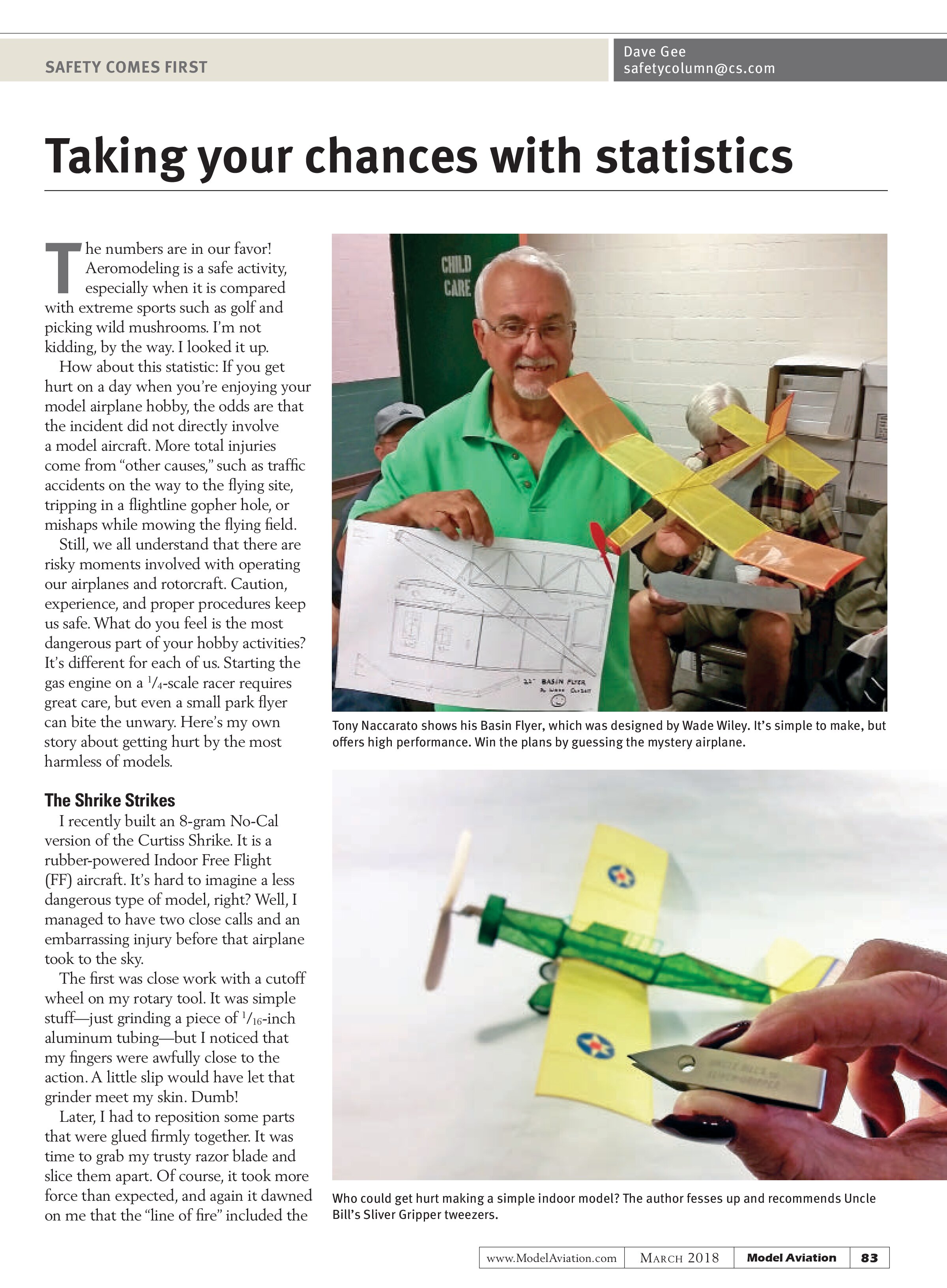
The prize this time is a real gem. Wade Wiley, from Los Angeles, flies at the notorious Grassy Knoll FF flying site in the Sepulveda Basin flood control area. He decided that a special beginner’s model was needed—something simple and easy to build, but with limited performance to suit the small field.
He called his new design the Basin Flyer.
Tony Naccarato drew some plans from the prototype and several test aircraft were built. It turned out to be an adaptable model, with successful versions in rubber and electric FF and RC, and even a towline glider made of foam sheet!
The prize plans (which will be sent via email) are hand-drawn,
beta-test versions that are ready for experimentation. You will not find an easier build, but the real surprise is this airplane’s impressive flight capability. If the Basin Flyer was intended to have limited performance, it failed badly!
SOURCES:
El Mar, Inc.
(860) 729-7232
www.slivergripper.com