The “new” Maxa by Kennedy Composites
by Gordon Buckland
gordon@gatorf3b.com

It is amazing how manufacturers have continued to advance the designs and performance of composite sailplanes—none more so than Vladimir Models and its latest Maxa sailplane (which follows the extremely successful Supra). Gordy Stahl got his hands on one of the new Maxa Pro High Modulus (HM) sailplanes and offered to write an article for your enjoyment. Thank you, Gordy.
Many people don’t know that the Maxa sailplane has gone through a few iterations since its introduction in 2011. It originally sported a full-flying, built-up horizontal stabilizer and rudder, as well as a lot of other things that evolved into today’s Maxa Pro HM sailplane. Even the wing skins are new! A previous version, the Maxa, had Carboline skins—material brought to us by Vladimir Models.
The new model comes in several versions—Light HM F3J, Windy HM F3J, and 4m (four-meter) Hard—that indicate their construction, weight, and wing “strength.” The Light version weighs in at 62 ounces, the Windy at 65 ounces, and the Hard at 72 ounces. There isn’t much difference in overall weight, but there is a lot of difference in wing strength. The previous Light versions were in jeopardy of having their wings and stabilizers break when they were launched into heavy wind from F3J winches.
One big improvement in the new version is the switch to an “articulated” stabilizer and a longer tailboom from a two-piece, conventional, full-flying stabilizer. The departure from full-flying stabilizers was because top pilots started balancing for zero stabilizer-to-wing incidence that made the whole moving mechanism and controlled pitch by changing incidence, to simply changing the “camber” of the stabilizer (the same as what has been done with rudders for years).
In addition to less weight, fewer parts, and less mechanics of a full-flying stabilizer setup, the articulated stabilizer allows the bigger, nonmoving front (stabilizer) part to keep the model on track. The moving part (elevator) could be far smaller, so less servo power is needed to do the work. (If you do the math, you’ll find that it’s only a few ounces
of servo power—not the roughly 40 ounces that we were previously using.)
The addition of longer tailbooms on new sailplanes quickly exposed a problem! The models didn’t fit in our wing bags or sport tubes. Vladimir Models addressed this on the Maxa Pro HM by making it have a removable vertical fin and rudder. It slips onto the tailboom, which is keyed to automatically align itself. A small piece of tape keeps it in place until it’s time for disassembly!
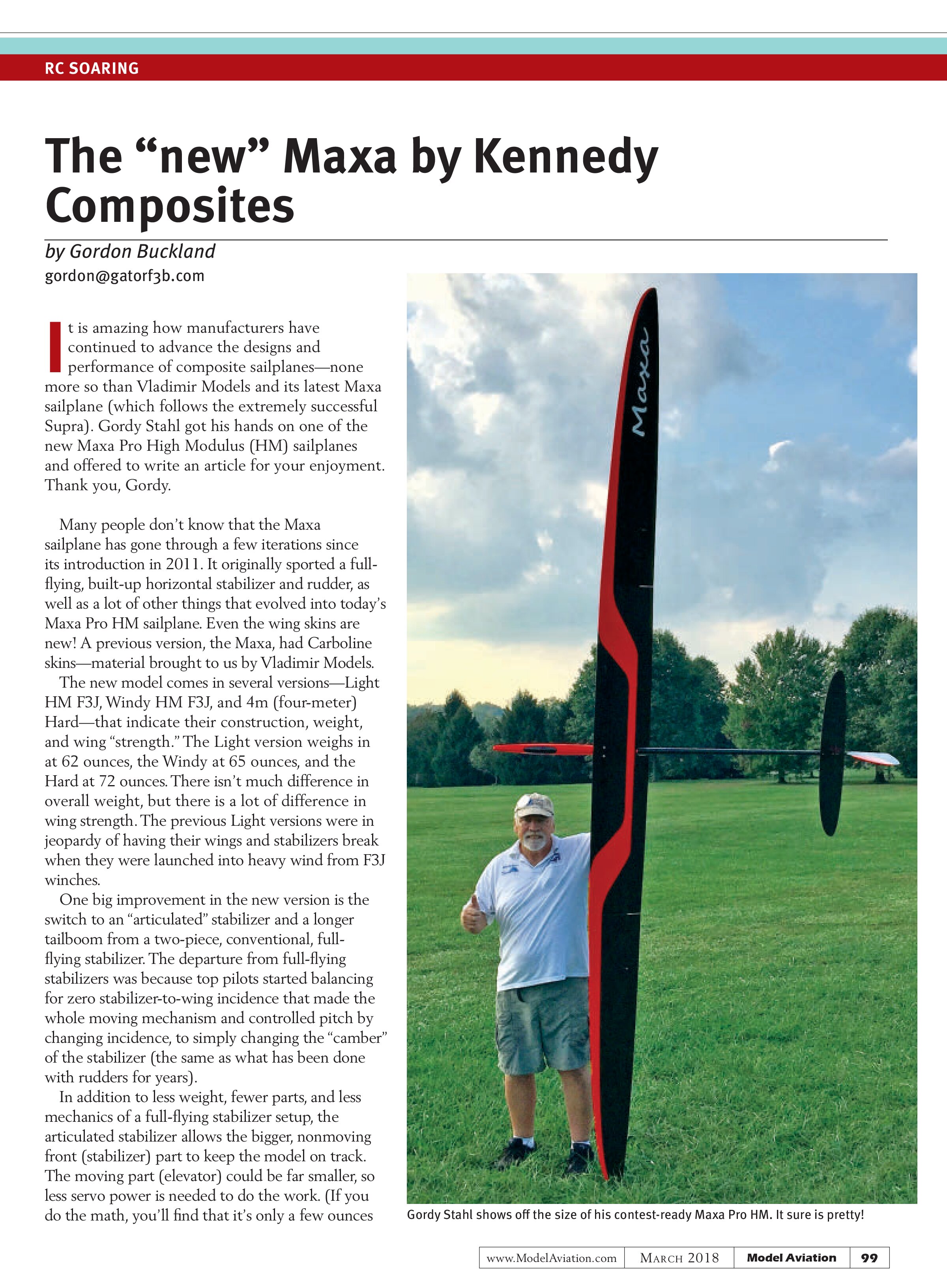
The major specifications of the Maxa Pro HM are a 154-inch wingspan, 73.2-inch length, and 1,273 square inches. It has all of the good stuff that I mentioned and more. The Light version is now as strong as the previous Carboline Windy version! Yes, it’s tough enough for extreme F3J tows and windy days using standard US winches.
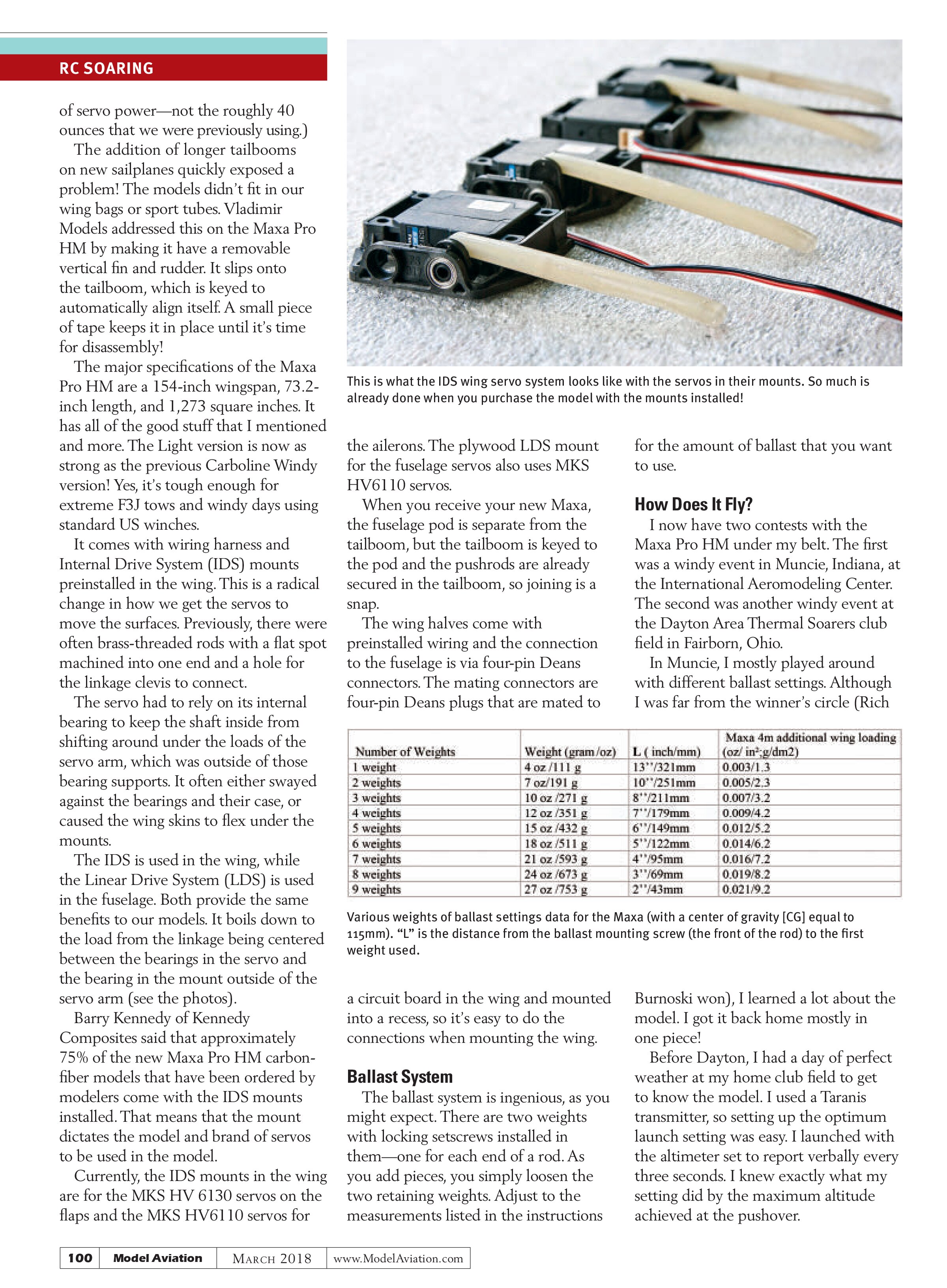
It comes with wiring harness and Internal Drive System (IDS) mounts preinstalled in the wing. This is a radical change in how we get the servos to move the surfaces. Previously, there were often brass-threaded rods with a flat spot machined into one end and a hole for the linkage clevis to connect.
The servo had to rely on its internal bearing to keep the shaft inside from shifting around under the loads of the servo arm, which was outside of those bearing supports. It often either swayed against the bearings and their case, or caused the wing skins to flex under the mounts.
The IDS is used in the wing, while the Linear Drive System (LDS) is used in the fuselage. Both provide the same benefits to our models. It boils down to the load from the linkage being centered between the bearings in the servo and the bearing in the mount outside of the servo arm (see the photos).
Barry Kennedy of Kennedy Composites said that approximately 75% of the new Maxa Pro HM carbon-fiber models that have been ordered by modelers come with the IDS mounts installed. That means that the mount dictates the model and brand of servos to be used in the model.
Currently, the IDS mounts in the wing are for the MKS HV 6130 servos on the flaps and the MKS HV6110 servos for the ailerons. The plywood LDS mount for the fuselage servos also uses MKS HV6110 servos.

When you receive your new Maxa, the fuselage pod is separate from the tailboom, but the tailboom is keyed to the pod and the pushrods are already secured in the tailboom, so joining is a snap.
The wing halves come with preinstalled wiring and the connection to the fuselage is via four-pin Deans connectors. The mating connectors are four-pin Deans plugs that are mated to a circuit board in the wing and mounted into a recess, so it’s easy to do the connections when mounting the wing.
Ballast System
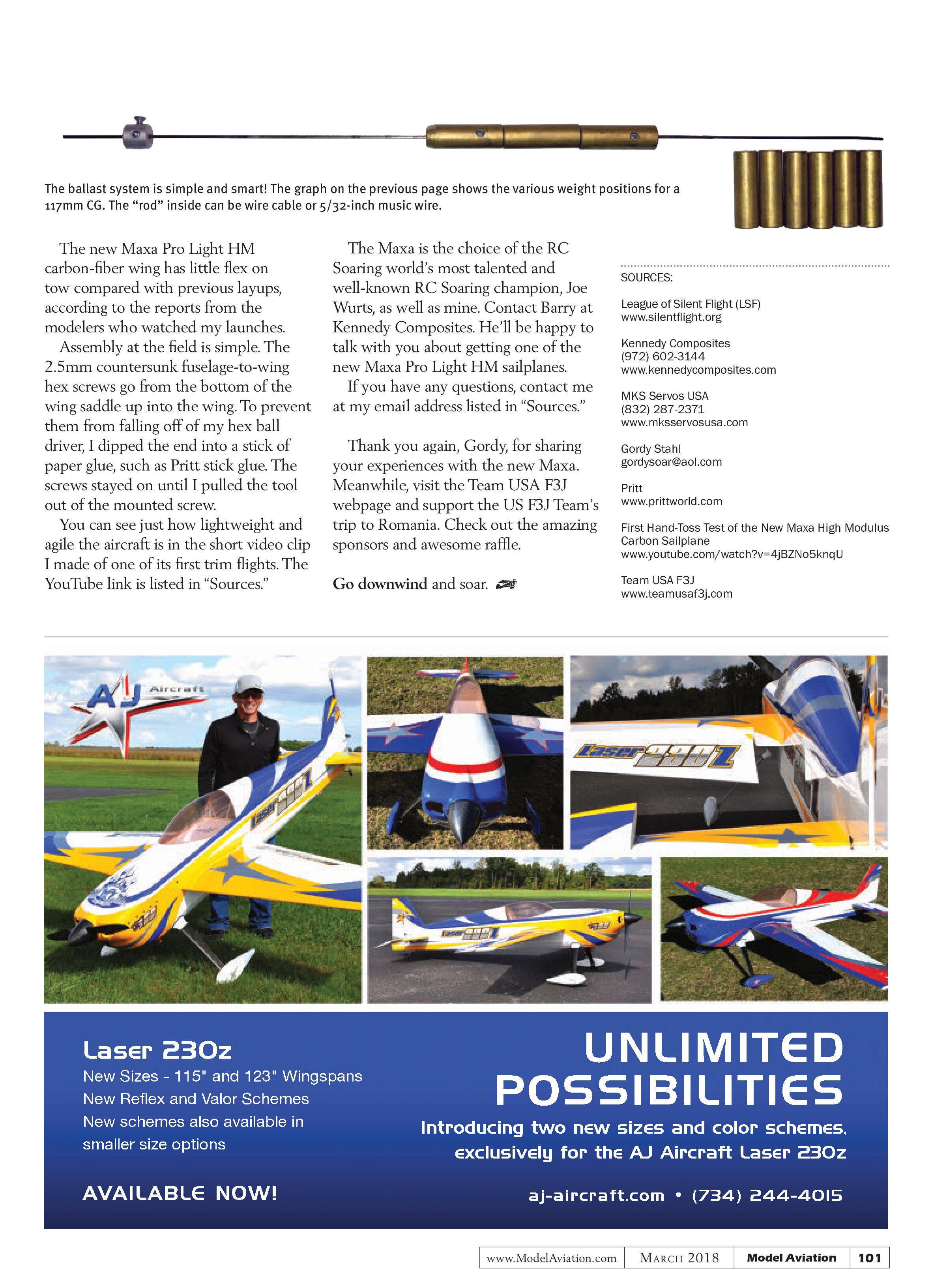
The ballast system is ingenious, as you might expect. There are two weights with locking setscrews installed in them—one for each end of a rod. As you add pieces, you simply loosen the two retaining weights. Adjust to the measurements listed in the instructions for the amount of ballast that you want to use.
How Does It Fly?
I now have two contests with the Maxa Pro HM under my belt. The first was a windy event in Muncie, Indiana, at the International Aeromodeling Center. The second was another windy event at the Dayton Area Thermal Soarers club field in Fairborn, Ohio.
In Muncie, I mostly played around with different ballast settings. Although I was far from the winner’s circle (Rich Burnoski won), I learned a lot about the model. I got it back home mostly in one piece!
Before Dayton, I had a day of perfect weather at my home club field to get to know the model. I used a Taranis transmitter, so setting up the optimum launch setting was easy. I launched with the altimeter set to report verbally every three seconds. I knew exactly what my setting did by the maximum altitude achieved at the pushover.

The new Maxa Pro Light HM carbon-fiber wing has little flex on tow compared with previous layups, according to the reports from the modelers who watched my launches.
Assembly at the field is simple. The 2.5mm countersunk fuselage-to-wing hex screws go from the bottom of the wing saddle up into the wing. To prevent them from falling off of my hex ball driver, I dipped the end into a stick of paper glue, such as Pritt stick glue. The screws stayed on until I pulled the tool out of the mounted screw.
You can see just how lightweight and agile the aircraft is in the short video clip I made of one of its first trim flights. The YouTube link is listed in “Sources.”
The Maxa is the choice of the RC Soaring world’s most talented and well-known RC Soaring champion, Joe Wurts, as well as mine. Contact Barry at Kennedy Composites. He’ll be happy to talk with you about getting one of the new Maxa Pro Light HM sailplanes.
If you have any questions, contact me at my email address listed in “Sources.”
Thank you again, Gordy, for sharing your experiences with the new Maxa. Meanwhile, visit the Team USA F3J webpage and support the US F3J Team’s trip to Romania. Check out the amazing sponsors and awesome raffle.
Go downwind and soar.
SOURCES:
League of Silent Flight (LSF)
www.silentflight.org
Kennedy Composites
(972) 602-3144
www.kennedycomposites.com
MKS Servos USA
(832) 287-2371
www.mksservosusa.com
Gordy Stahl
gordysoar@aol.com
Pritt
www.prittworld.com
First Hand-Toss Test of the New Maxa High Modulus Carbon Sailplane
www.youtube.com/watch?v=4jBZNo5knqU
Team USA F3J
www.teamusaf3j.com