New turbine on the market
by Jim Hiller
jetmodeler@earthlink.net
Have you heard of Swiw in Turbines? You might have, but under the Ace Turbine brand. They are now available in the US, with full service available.
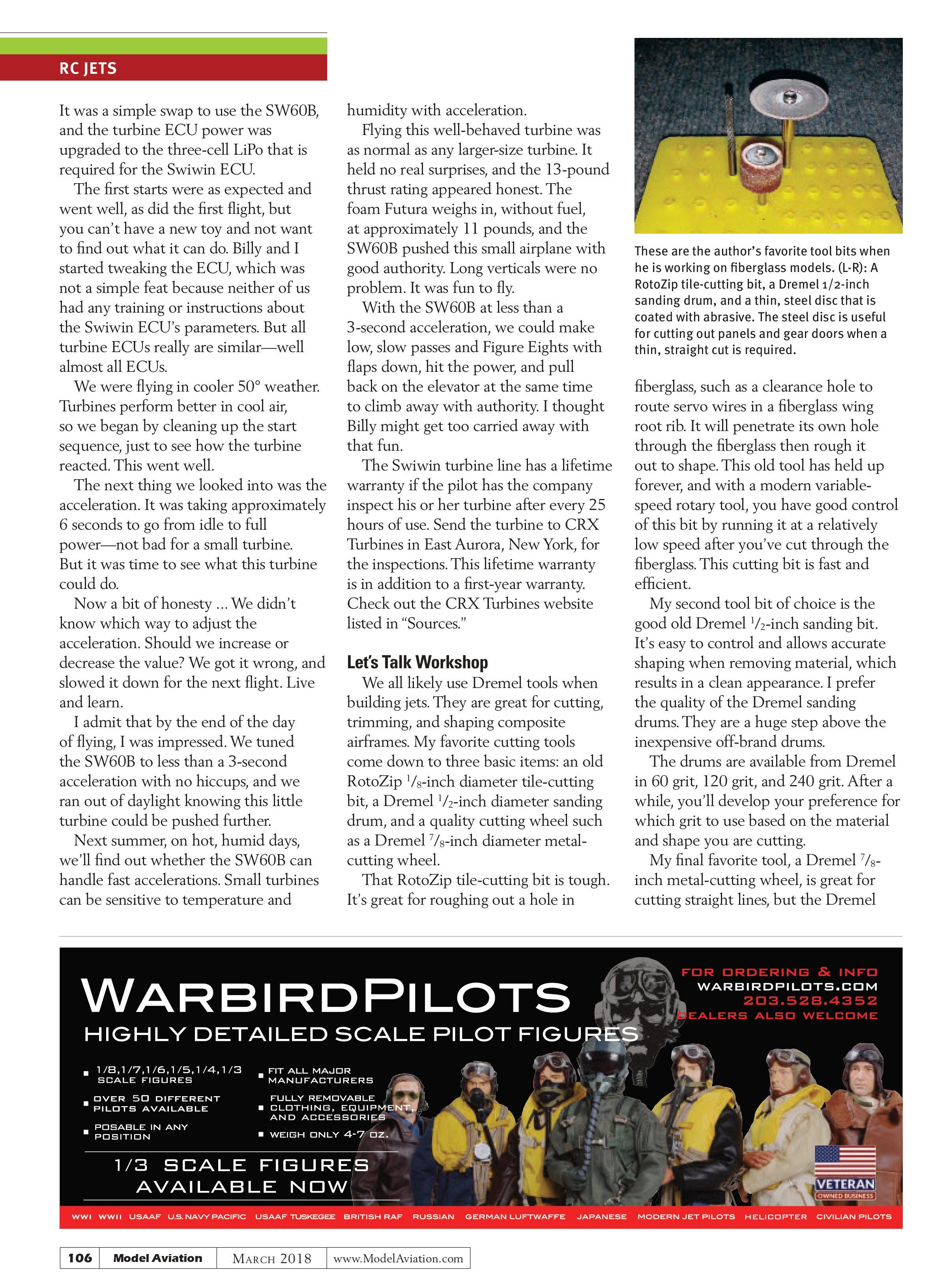
Andy Fioretti of CRX Turbines handles the distribution and service, solving the problem of where to get a turbine repaired, warranty or otherwise. The good news for me is that I fly with Billy Dorenzo who works at USA RC Jets, which is now a dealer for the Swiw in line. Billy has a new Swiw in SW60B turbine in his aircraft.
The five turbines in the Swiw in line range from a 60-newton thrust to a 210-newton thrust. For additional details, check out the website to see available products. Details, including a brushless starter motor and kerosene start, are standard throughout the complete product line. The kerosene solenoid valves for the gas and fuel side are both located inside of the turbine, so only a single kerosene line connects to the turbine.
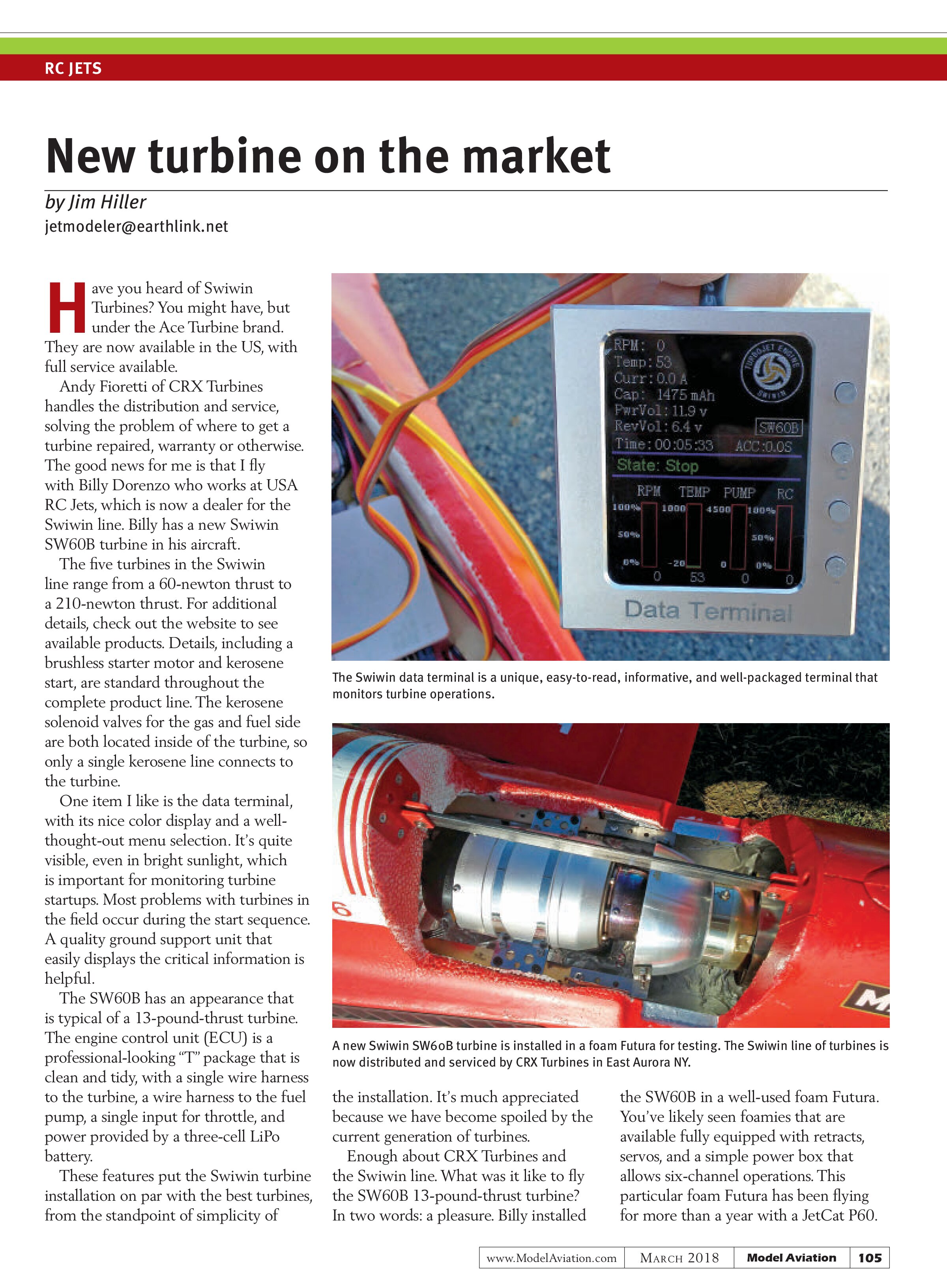
One item I like is the data terminal, with its nice color display and a well-thought-out menu selection. It’s quite visible, even in bright sunlight, which is important for monitoring turbine startups. Most problems with turbines in the field occur during the start sequence. A quality ground support unit that easily displays the critical information is helpful.
The SW60B has an appearance that is typical of a 13-pound-thrust turbine. The engine control unit (ECU) is a professional-looking “T” package that is clean and tidy, with a single wire harness to the turbine, a wire harness to the fuel pump, a single input for throttle, and power provided by a three-cell LiPo battery.
These features put the Swiw in turbine installation on par with the best turbines, from the standpoint of simplicity of the installation. It’s much appreciated because we have become spoiled by the current generation of turbines.


Enough about CRX Turbines and the Swiw in line. What was it like to fly the SW60B 13-pound-thrust turbine? In two words: a pleasure. Billy installed the SW60B in a well-used foam Futura. You’ve likely seen foamies that are available fully equipped with retracts, servos, and a simple power box that allows six-channel operations. This particular foam Futura has been flying for more than a year with a JetCat P60.
It was a simple swap to use the SW60B, and the turbine ECU power was upgraded to the three-cell LiPo that is required for the Swiw in ECU.
The first starts were as expected and went well, as did the first flight, but you can’t have a new toy and not want to find out what it can do. Billy and I started tweaking the ECU, which was not a simple feat because neither of us had any training or instructions about the Swiw in ECU’s parameters. But all turbine ECUs really are similar—well almost all ECUs.
We were flying in cooler 50° weather. Turbines perform better in cool air, so we began by cleaning up the start sequence, just to see how the turbine reacted. This went well.
The next thing we looked into was the acceleration. It was taking approximately 6 seconds to go from idle to full power—not bad for a small turbine. But it was time to see what this turbine could do.
Now a bit of honesty ... We didn’t know which way to adjust the acceleration. Should we increase or decrease the value? We got it wrong, and slowed it down for the next flight. Live and learn.
I admit that by the end of the day of flying, I was impressed. We tuned the SW60B to less than a 3-second acceleration with no hiccups, and we ran out of daylight knowing this little turbine could be pushed further.
Next summer, on hot, humid days, we’ll find out whether the SW60B can handle fast accelerations. Small turbines can be sensitive to temperature and humidity with acceleration.
Flying this well-behaved turbine was as normal as any larger-size turbine. It held no real surprises, and the 13-pound thrust rating appeared honest. The foam Futura weighs in, without fuel, at approximately 11 pounds, and the SW60B pushed this small airplane with good authority. Long verticals were no problem. It was fun to fly.
With the SW60B at less than a 3-second acceleration, we could make low, slow passes and Figure Eights with flaps down, hit the power, and pull back on the elevator at the same time to climb away with authority. I thought Billy might get too carried away with that fun.
The Swiw in turbine line has a lifetime warranty if the pilot has the company inspect his or her turbine after every 25 hours of use. Send the turbine to CRX Turbines in East Aurora, New York, for the inspections. This lifetime warranty is in addition to a first-year warranty. Check out the CRX Turbines website listed in “Sources.”
Let’s Talk Workshop
We all likely use Dremel tools when building jets. They are great for cutting, trimming, and shaping composite airframes. My favorite cutting tools come down to three basic items: an old RotoZip 1/8-inch diameter tile-cutting bit, a Dremel 1/2-inch diameter sanding drum, and a quality cutting wheel such as a Dremel 7/8-inch diameter metal-cutting wheel.
That RotoZip tile-cutting bit is tough. It’s great for roughing out a hole in fiberglass, such as a clearance hole to route servo wires in a fiberglass wing root rib. It will penetrate its own hole through the fiberglass then rough it out to shape. This old tool has held up forever, and with a modern variable-speed rotary tool, you have good control of this bit by running it at a relatively low speed after you’ve cut through the fiberglass. This cutting bit is fast and efficient.

My second tool bit of choice is the good old Dremel 1/2-inch sanding bit. It’s easy to control and allows accurate shaping when removing material, which results in a clean appearance. I prefer the quality of the Dremel sanding drums. They are a huge step above the inexpensive off-brand drums.
The drums are available from Dremel in 60 grit, 120 grit, and 240 grit. After a while, you’ll develop your preference for which grit to use based on the material and shape you are cutting.
My final favorite tool, a Dremel 7/8-inch metal-cutting wheel, is great for cutting straight lines, but the Dremel wheel is slightly wide at .040-inch thickness. It’s a nice tool, but the thickness doesn’t work out well when you are cutting out a panel or a landing gear door in a fiberglass fuselage. Throughout the years at trade shows, I have picked up some cheap, abrasive, metal-cutting wheels that are only .025-inch thick that I use for cutting out hatches and landing gear doors.
We all need the right tools for the right job.
SOURCES:
Jet Pilots’ Organization (JPO)
www.jetpilots.org
CRX Turbines
(716) 946-7493
www.crxturbines.com
Swiwin Turbine & Jets
(716) 946-7493
www.sw-jet.com
USA RC Jets
usarcjets@gmail.com
www.usarcjets.com
RotoZip
(800) 437-3635
www.rotozip.com