The Sportsman Sequence: Half Cuban 8
by Peter Vogel
vogel.peter@gmail.com
F3A World Championships
Huge congratulations to the 2017 F3A (RC Aerobatics) World Championship team! The USA Team again came home with the team gold, with Joseph Szczur taking the Junior individual gold, and Jason Schulman taking the adult individual bronze medal!
Even more impressive, though, for the first time in the history of the sport that I could find, a single country (USA) had all of its team members in the finals, and not just three competitors. Our Junior competitor was again also in the finals!
With only 10 pilots advancing to the finals, this is a huge achievement, especially because we had a World Championship competition rookie, AC Glenn, step in as the alternate from the team selection contest held at the 2016 Nats because Brett Wickizer had training obligations in his full-scale pilot job.
The team flew in incredibly adverse conditions (high wind and rain) and represented the US well!
Half Cuban 8
It’s funny, but the most common mistake I see Sportsman competitors make on this maneuver is flying the wrong maneuver! The other Half Cuban 8 maneuvers in the sequence are Half Reverse Cuban 8s—they begin with a pull to a 45° upline.
The classic Cuban 8 maneuver begins with the loop; therefore, the non-reverse form of the turnaround, the Half Cuban 8, begins with the loop and ends with the 45° downline! When I’m calling a Sportsman pilot through the sequence, I always emphasize this by saying, “Half Cuban 8—start with the loop!”
Because the center maneuver that follows is two inside loops, it’s important

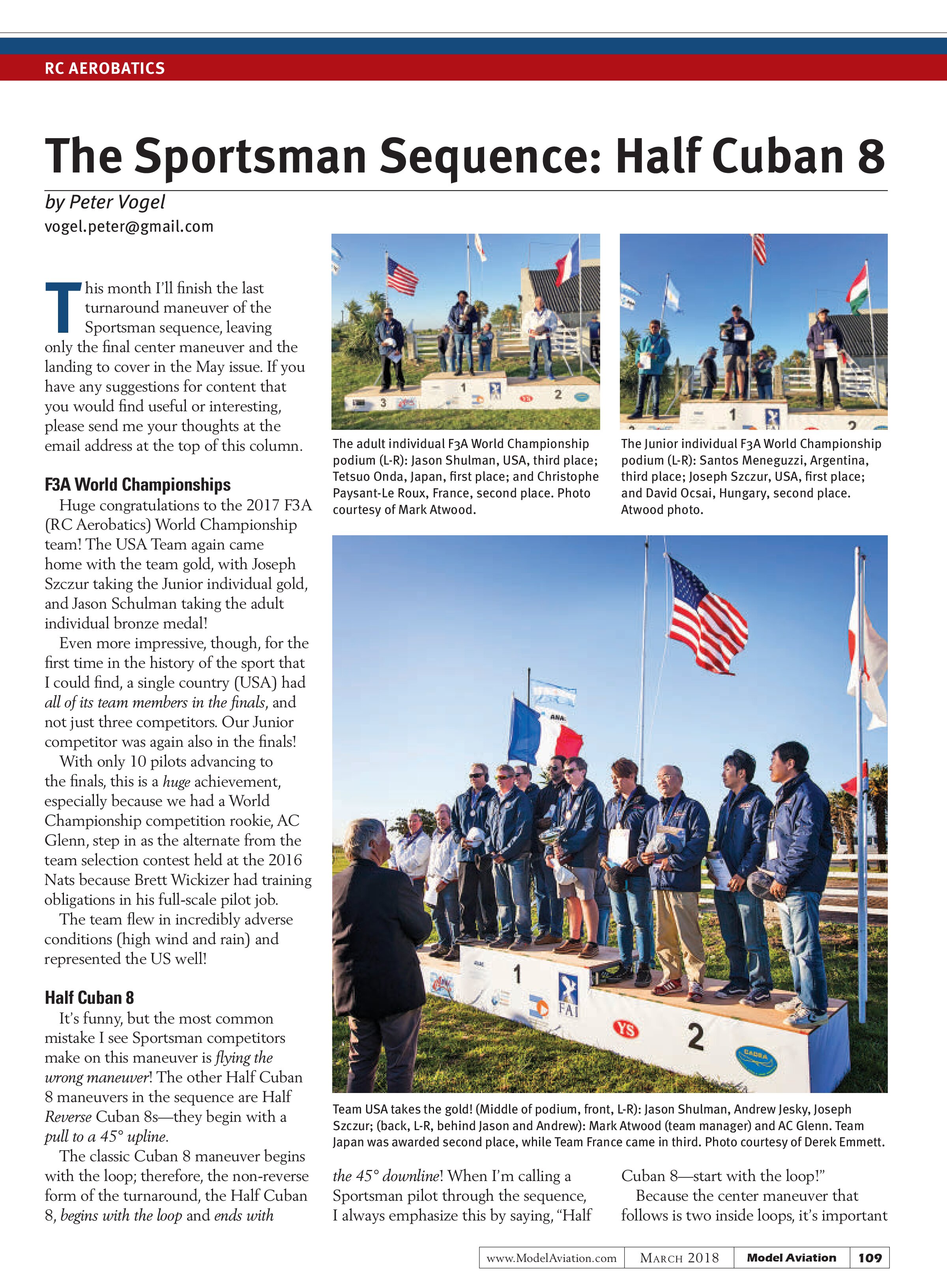
The adult individual F3A World Championship podium (L-R): Jason Shulman, USA, third place; Tetsuo Onda, Japan, first place; and Christophe Paysant-Le Roux, France, second place. Photo courtesy of Mark Atwood.

Team USA takes the gold! (Middle of podium, front, L-R): Jason Shulman, Andrew Jesky, Joseph Szczur; (back, L-R, behind Jason and Andrew): Mark Atwood (team manager) and AC Glenn. Team Japan was awarded second place, while Team France came in third. Photo courtesy of Derek Emmett.

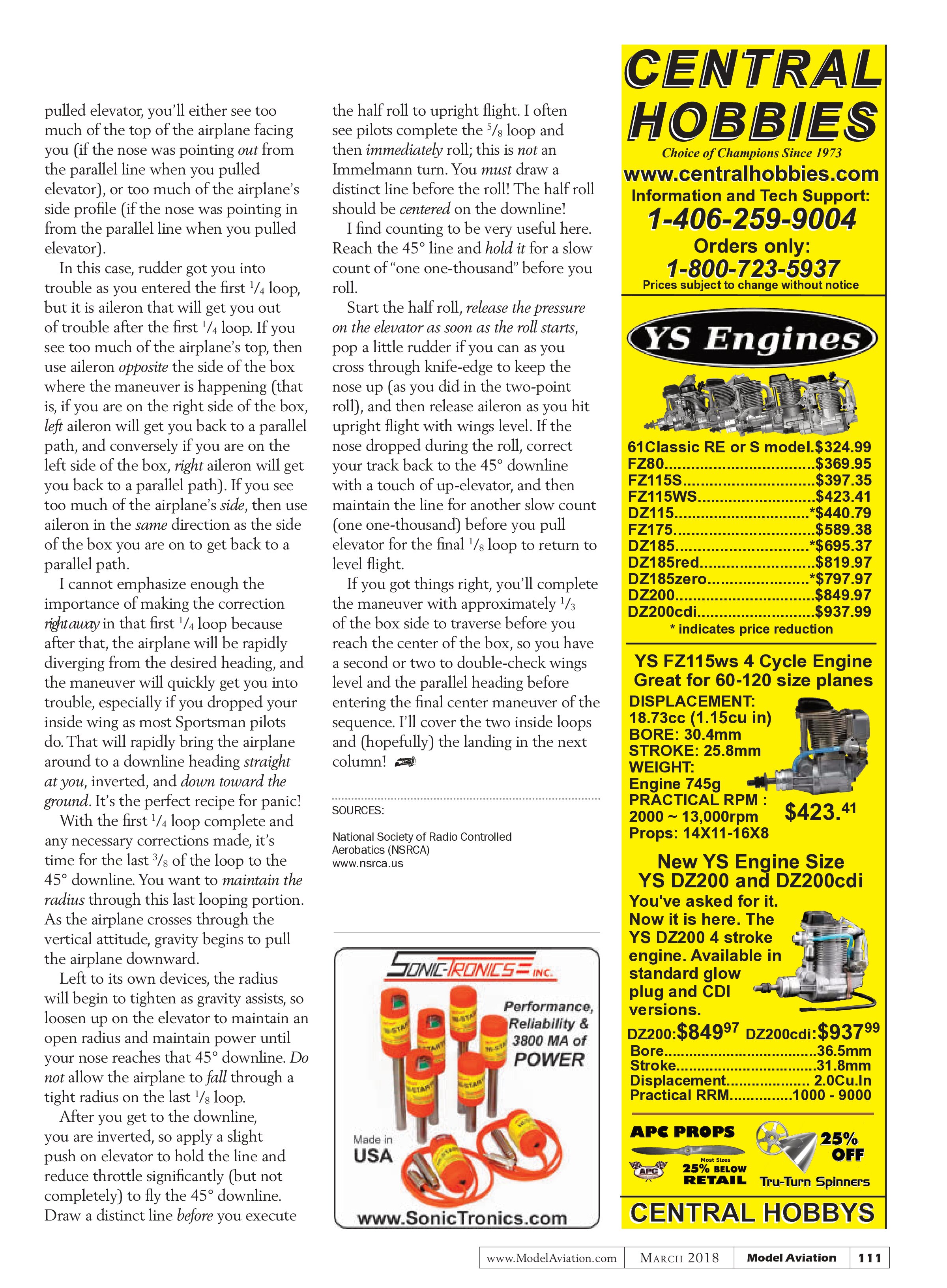
The Junior individual F3A World Championship podium (L-R): Santos Meneguzzi, Argentina, third place; Joseph Szczur, USA, first place; and David Ocsai, Hungary, second place. Atwood photo.
pulled elevator, you’ll either see too much of the top of the airplane facing you (if the nose was pointing out from the parallel line when you pulled elevator), or too much of the airplane’s side profile (if the nose was pointing in from the parallel line when you pulled elevator).
In this case, rudder got you into trouble as you entered the first ¼ loop, but it is aileron that will get you out of trouble after the first ¼ loop. If you see too much of the airplane’s top, then use aileron opposite the side of the box where the maneuver is happening (that is, if you are on the right side of the box, left aileron will get you back to a parallel path, and conversely if you are on the left side of the box, right aileron will get you back to a parallel path). If you see too much of the airplane’s side, then use aileron in the same direction as the side of the box you are on to get back to a parallel path.
I cannot emphasize enough the importance of making the correction right away in that first ¼ loop because after that, the airplane will be rapidly diverging from the desired heading, and the maneuver will quickly get you into trouble, especially if you dropped your inside wing as most Sportsman pilots do. That will rapidly bring the airplane around to a downline heading straight at you, inverted, and down toward the ground. It’s the perfect recipe for panic!
With the first ¼ loop complete and any necessary corrections made, it’s time for the last ⅜ of the loop to the 45° downline. You want to maintain the radius through this last looping portion. As the airplane crosses through the vertical attitude, gravity begins to pull the airplane downward.
Left to its own devices, the radius will begin to tighten as gravity assists, so loosen up on the elevator to maintain an open radius and maintain power until your nose reaches that 45° downline. Do not allow the airplane to fall through a tight radius on the last ⅛ loop.
After you get to the downline, you are inverted, so apply a slight push on elevator to hold the line and reduce throttle significantly (but not completely) to fly the 45° downline. Draw a distinct line before you execute the half roll to upright flight. I often see pilots complete the ⅝ loop and then immediately roll; this is not an Immelmann turn. You must draw a distinct line before the roll! The half roll should be centered on the downline!
I find counting to be very useful here. Reach the 45° line and hold it for a slow count of “one one-thousand” before you roll.
Start the half roll, release the pressure on the elevator as soon as the roll starts, pop a little rudder if you can as you cross through knife-edge to keep the nose up (as you did in the two-point roll), and then release aileron as you hit upright flight with wings level. If the nose dropped during the roll, correct your track back to the 45° downline with a touch of up-elevator, and then maintain the line for another slow count (one one-thousand) before you pull elevator for the final ⅛ loop to return to level flight.
If you got things right, you’ll complete the maneuver with approximately ⅓ of the box side to traverse before you reach the center of the box, so you have a second or two to double-check wings level and the parallel heading before entering the final center maneuver of the sequence. I’ll cover the two inside loops and (hopefully) the landing in the next column!
SOURCES:
National Society of Radio Controlled Aerobatics (NSRCA)
www.nsrca.us