More than merely the AMA Safety Code
Rich Hanson
richh@modelaircraft.org

When we speak of AMA’s safety program, we tend to refer to the AMA Safety Code. There’s no doubt that the safety code is the cornerstone of our safety program. It establishes the core principles by which we abide, ensuring that aeromodeling is conducted safely and responsibly in the national airspace. However, AMA’s safety program goes well beyond these core principles.
AMA’s community-based safety programming has been developed and has evolved throughout the past 82 years. It is community based in the sense that every member of the AMA—from the individual member, to the chartered club officer, to the president of the AMA—is an active participant and is expected to do his or her part to ensure the safety of the hobby, our fellow modelers, and the general public.
AMA’s safety program begins with the safety code and AMA’s related safety guidelines, but it also includes training, education, a safety management system, and a means of ensuring accountability.
Training is conducted primarily at the club level. Nearly every club has a training program that mentors newcomers to the hobby, coaches them on aeromodeling techniques, and educates them about the dos and don’ts of model aviation. Safety education is provided in many ways. It is prevalent in AMA’s flagship print publication, Model Aviation, where AMA officers and staff routinely speak of safety-related issues, and a monthly column is committed to aeromodeling safety.
AMA also has a robustly staffed Education department, which produces educational materials available through myriad online programs and digital publications. AMA’s safety management system routinely assesses risks, evaluates new technologies, and enacts modifications to the safety guidelines as needed in response to the changing environment.
The safety management system starts with the individual member and his or her interaction with the AMA and its safety program. It is formalized at the club level with the requirement that every club has an assigned safety officer who is tasked with overseeing the club operations and aeromodeling activity.
At the core of the safety management system is AMA’s Safety Committee. Its chairperson serves as AMA’s National Safety Officer. This standing committee meets throughout the year to address safety concerns that are presented by members and the chartered clubs. It evaluates existing safety guidelines and makes recommendations to the AMA Executive Council (EC) concerning new safety rules or modifications to existing guidelines. The pinnacle of the system is the EC, which represents the members in all 11 AMA districts across the country. The EC evaluates and ratifies the recommendations put forward by the Safety Committee, thus closing the loop in the safety management system.
Accountability is a key element of AMA’s safety program. In addition to efforts at the national level to address those who violate the safety guidelines, the AMA also relies on its members’ commitment to the hobby, their sense of camaraderie and respect for their fellow modelers, and their intrinsic desire to operate in a safe and respectful manner. When joining the AMA, every member affirms that he or she will follow AMA’s safety rules as a condition of membership.
The AMA has a formal complaint review process for dealing with egregious violations of AMA’s safety rules, and every chartered club is required to have a similar due-process clause in its bylaws. Those who intentionally and habitually violate the rules are no longer welcome as members of the AMA.
The Special Rule for Model Aircraft, enacted by Congress, requires that you “operate in accordance with a community-based set of safety guidelines and within the programming of a nationwide community-based organization” in order to be afforded the provisions of the rule. In order to operate within the programming of the AMA, you must be a participant in AMA’s safety program. Operating within AMA programming means you have read, understand, and are in compliance with, the AMA safety program.
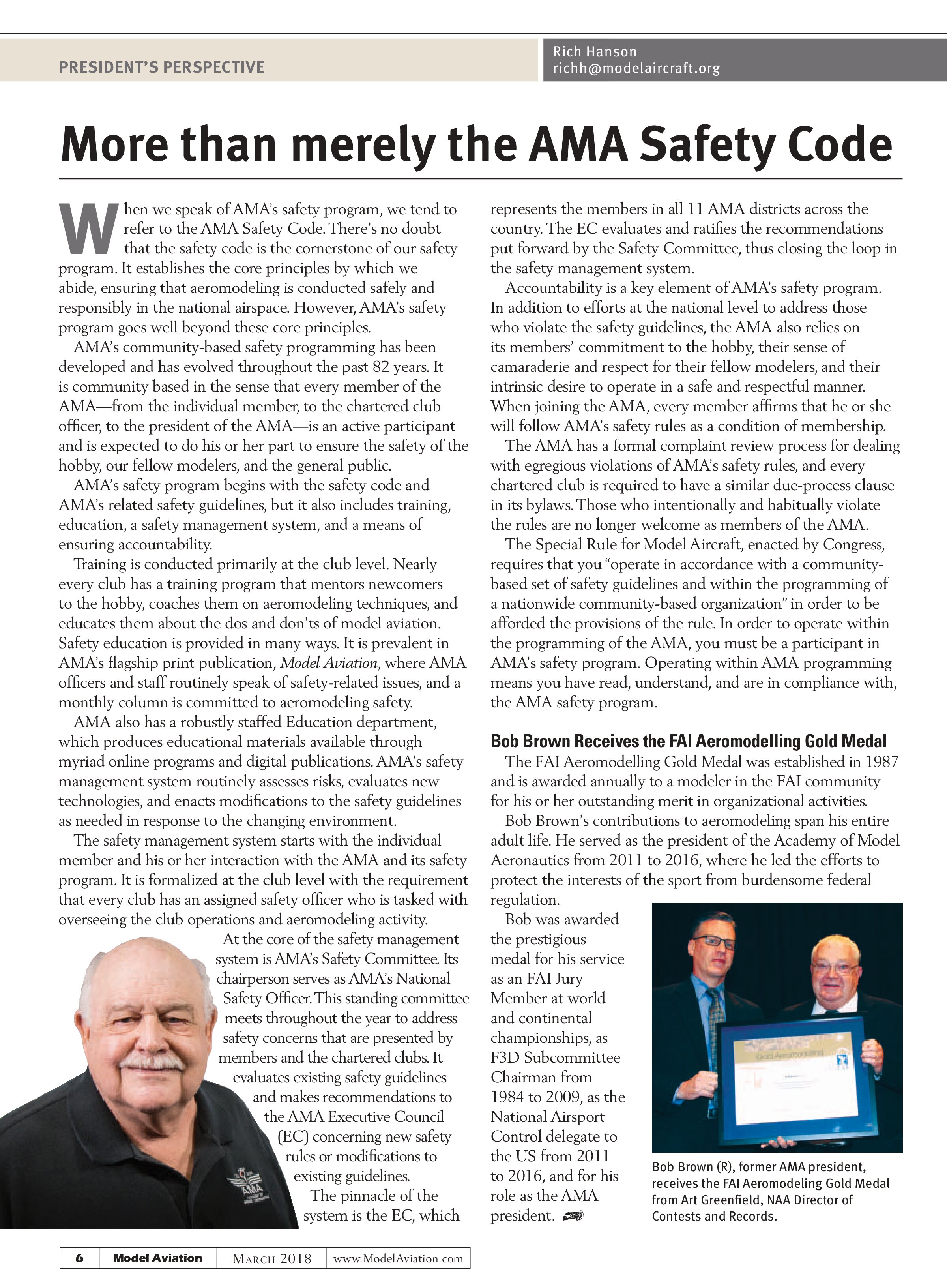
Bob Brown Receives the FAI Aeromodelling Gold Medal
The FAI Aeromodelling Gold Medal was established in 1987 and is awarded annually to a modeler in the FAI community for his or her outstanding merit in organizational activities.
Bob Brown’s contributions to aeromodeling span his entire adult life. He served as the president of the Academy of Model Aeronautics from 2011 to 2016, where he led the efforts to protect the interests of the sport from burdensome federal regulation.
Bob was awarded the prestigious medal for his service as an FAI Jury Member at world and continental championships, as F3D Subcommittee Chairman from 1984 to 2009, as the National Airsport Control delegate to the US from 2011 to 2016, and for his role as the AMA president.