Bob Benjamin
AMA Model Aviation Hall of Fame member and magazine contributor
by Jay Smith
Jay Smith: How did you get involved with model aviation?
Bob Benjamin: When I was about 5 years old, my father, who had been a World War II B-29 flight engineer, brought home one of those Strombecker solid-wood display kits of a B-29. I “helped” him build it, along with a few simple Comet stick-and-tissue models. I did progressively more of the work myself, and he did less, and before long, I found myself doing model airplane building alone.
I suspect that my father considered that B-29 to be an obligation of some sort. In any event, it was the beginning and the end of his model building career, and in the end my entire family turned out to be pretty much unsupportive of my growing interest. Fortunately, the big kid next door and his brother were dedicated model builders. Watching them fly from the farm pasture down the street, I caught a vision of what aeromodeling could be all about and I never looked back.
I have shared a lot more detail about those days in my book, Hey Mister, Will It Fly? It is currently out of print, but Amazon often has used copies for sale.
JS: How has model aviation impacted your life and/or career?
BB: Most of the good things that have happened to me in life came about because of model airplanes. Year after year, school subjects such as reading, writing, math, science, and history were easier for me in large part because I was already familiar with their concepts as a result of my never-ending story of wanting to learn to build more-challenging model airplanes.
My first real professional employment as a certificated public school math teacher happened as a direct result of knowing other dedicated aeromodelers, and since that day, I have never been far from one activity or another involving teaching others about the good things I have been fortunate enough to learn.
Even my career as a professional artist came about because of my ambition to learn to paint airplanes well enough to be on model magazine covers. But, that’s not all of it. Although I have spoken very little about it publicly until now, for most of my life I have had to deal with the effects of severe clinical depression. I would not have survived had aeromodeling not been there for me like a light at the end of one really dark tunnel or another.
JS: What disciplines of modeling do you participate in?
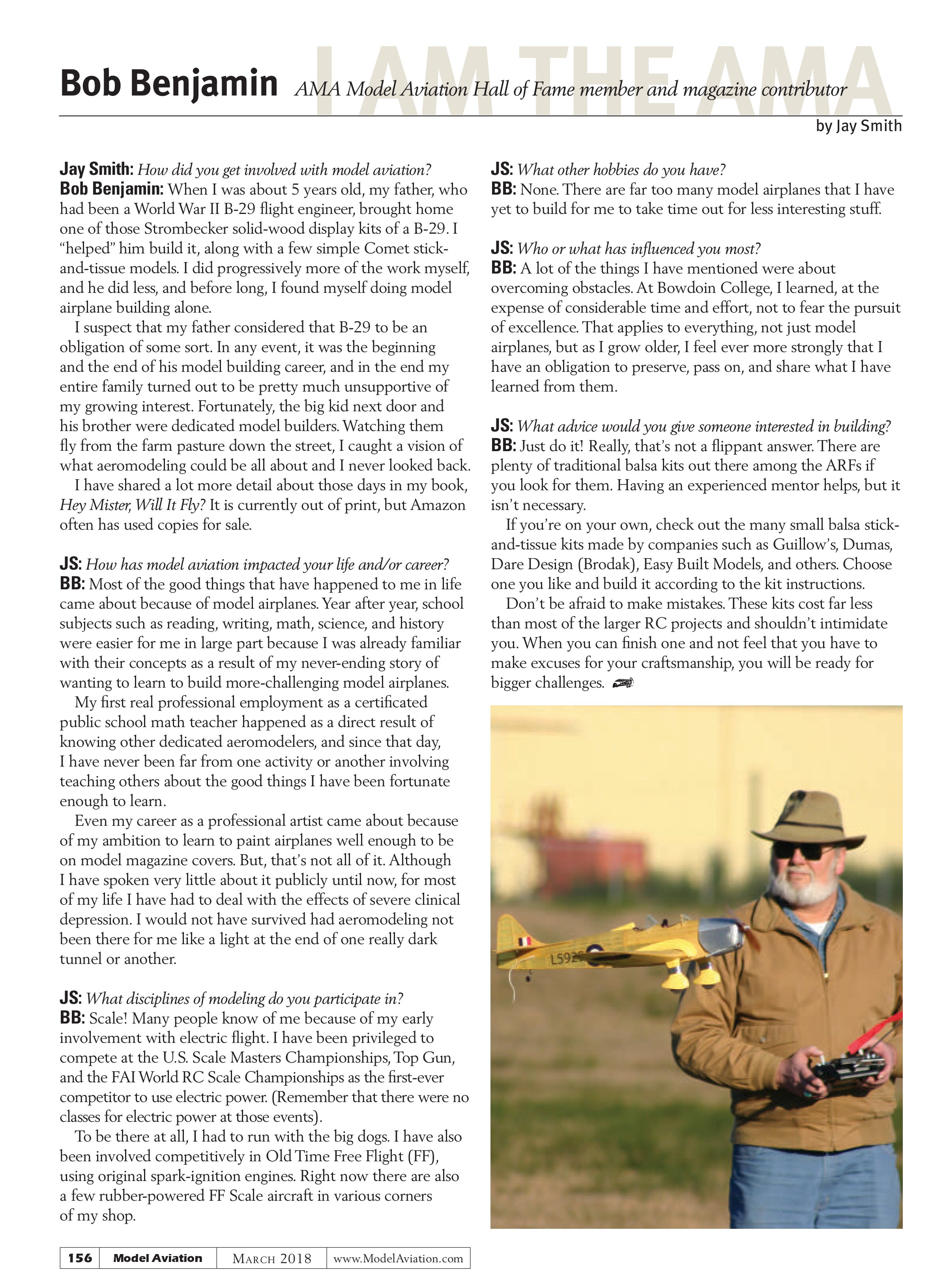
BB: Scale! Many people know of me because of my early involvement with electric flight. I have been privileged to compete at the U.S. Scale Masters Championships, Top Gun, and the FAI World RC Scale Championships as the first-ever competitor to use electric power. (Remember that there were no classes for electric power at those events).
To be there at all, I had to run with the big dogs. I have also been involved competitively in Old Time Free Flight (FF), using original spark-ignition engines. Right now there are also a few rubber-powered FF Scale aircraft in various corners of my shop.
JS: What other hobbies do you have?
BB: None. There are far too many model airplanes that I have yet to build for me to take time out for less interesting stuff.
JS: Who or what has influenced you most?
BB: A lot of the things I have mentioned were about overcoming obstacles. At Bowdoin College, I learned, at the expense of considerable time and effort, not to fear the pursuit of excellence. That applies to everything, not just model airplanes, but as I grow older, I feel ever more strongly that I have an obligation to preserve, pass on, and share what I have learned from them.
JS: What advice would you give someone interested in building?
BB: Just do it! Really, that’s not a flippant answer. There are plenty of traditional balsa kits out there among the ARFs if you look for them. Having an experienced mentor helps, but it isn’t necessary.
If you’re on your own, check out the many small balsa stick-and-tissue kits made by companies such as Guillows, Dumas, Dare Design (Brodak), Easy Built Models, and others. Choose one you like and build it according to the kit instructions.
Don’t be afraid to make mistakes. These kits cost far less than most of the larger RC projects and shouldn’t intimidate you. When you can finish one and not feel that you have to make excuses for your craftsmanship, you will be ready for bigger challenges.