Thoughts about AMA voting
and growth
by Dennis Norman
dennis@airacmodels.com
Last fall, the AMA membership was called upon to vote for several of the organization’s leadership positions. It is important that we vote—and many of us did. (Columns in Model Aviation are submitted months before they appear in print and might not be current when you read them.)
When AMA was founded, its members were nearly all engaged either in designing and building their own models, building from the plans of others, or building from commercial kits. Pioneers spent many happy hours making their models before attempting to fly them.
As aeromodeling has grown, its focus has changed. Nowadays, life is busier and time is at a premium. Many find that they must choose between building model aircraft and a host of other things. Because of this, many members elect to “buy and fly” their aircraft.
Drones are currently the rage. Many pilots treat drone flying as a sport. Drone fliers are often more interested in flying than in building. How many golfers make their own clubs?
I have designed, built, and flown Free Flight (FF) Scale models for decades and I still do. All modelers belong to the same “club” and in that camaraderie, we should respect diversity.
Pilot Busts
At last year’s Flying Aces Club (FAC) Non-Nats, Dave Niedzielski from Easy Built Models, and others, expressed interest in my methods for making pilot busts. I wrote about carving pilots in the June 2007 and the December 2010 issues of Model Aviation. You might want to refer to these articles, but I am happy to again discuss the subject.
Traditionally, neither the AMA nor the FAC requires including a pilot bust for FF Scale. When modelers feel compelled to include one, they are permitted to use a 2D line drawing or photograph. Some have said that they feel uncomfortable making pilot busts and derisively equate it to “playing with dolls,” but unless it’s a drone, I feel that a pilot bust is an integral part of any flying aircraft.
Carving a pilot bust from wood is best for larger models (¾-inch scale or larger). When building a model that is less than ¾-inch scale, I have found that Styrofoam is a better alternative to wood.
Several decades ago, the late Gerald Skrjanc (the founder of Micro-X, Inc.) introduced me to a dense, white, fine-grained Styrofoam that he used in his kits. I do not recall the name of the foam’s manufacturer.
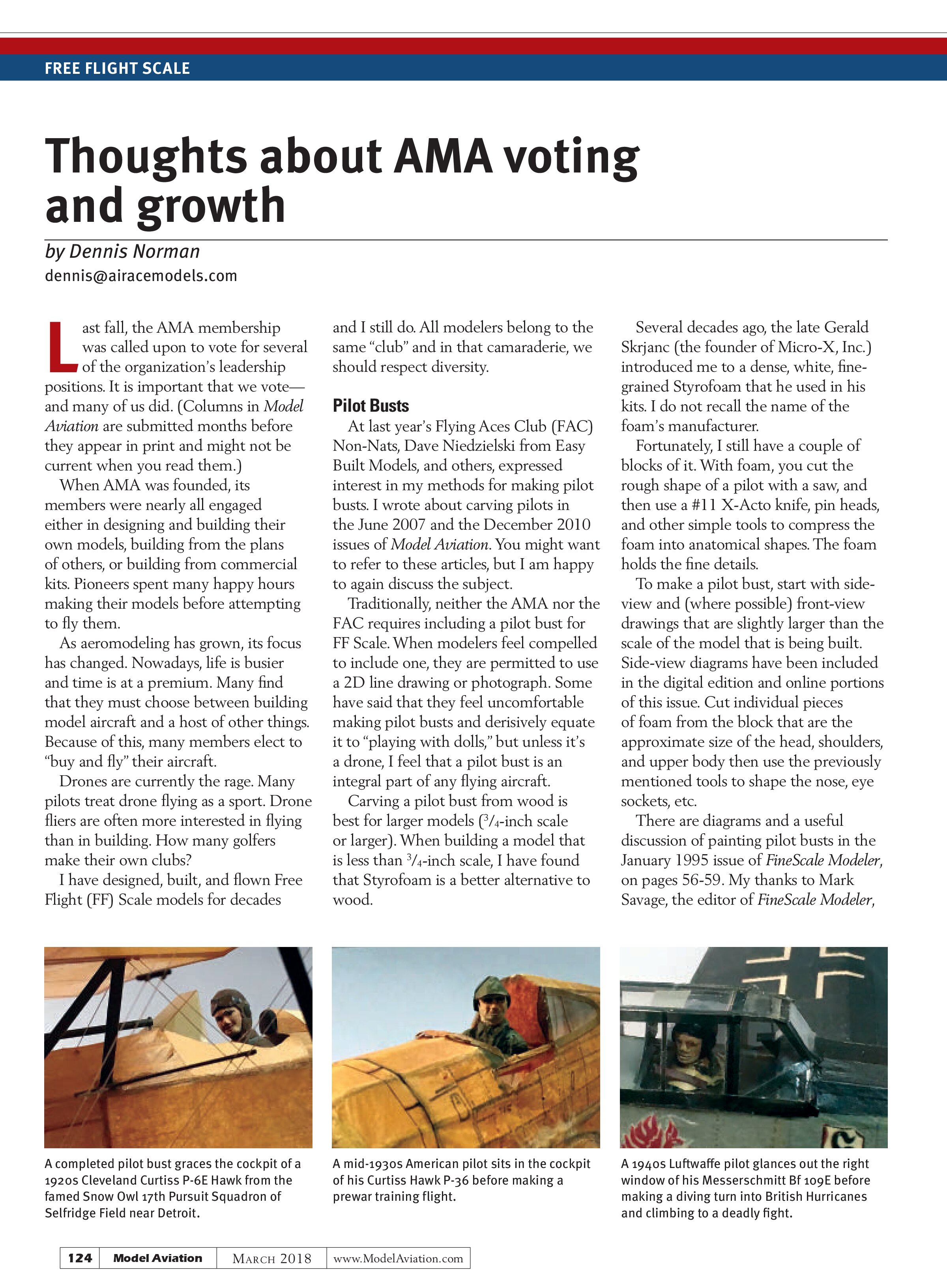
Fortunately, I still have a couple of blocks of it. With foam, you cut the rough shape of a pilot with a saw, and then use a #11 X-Acto knife, pin heads, and other simple tools to compress the foam into anatomical shapes. The foam holds the fine details.
To make a pilot bust, start with side-view and (where possible) front-view drawings that are slightly larger than the scale of the model that is being built. Side-view diagrams have been included in the digital edition and online portions of this issue. Cut individual pieces of foam from the block that are the approximate size of the head, shoulders, and upper body then use the previously mentioned tools to shape the nose, eye sockets, etc.
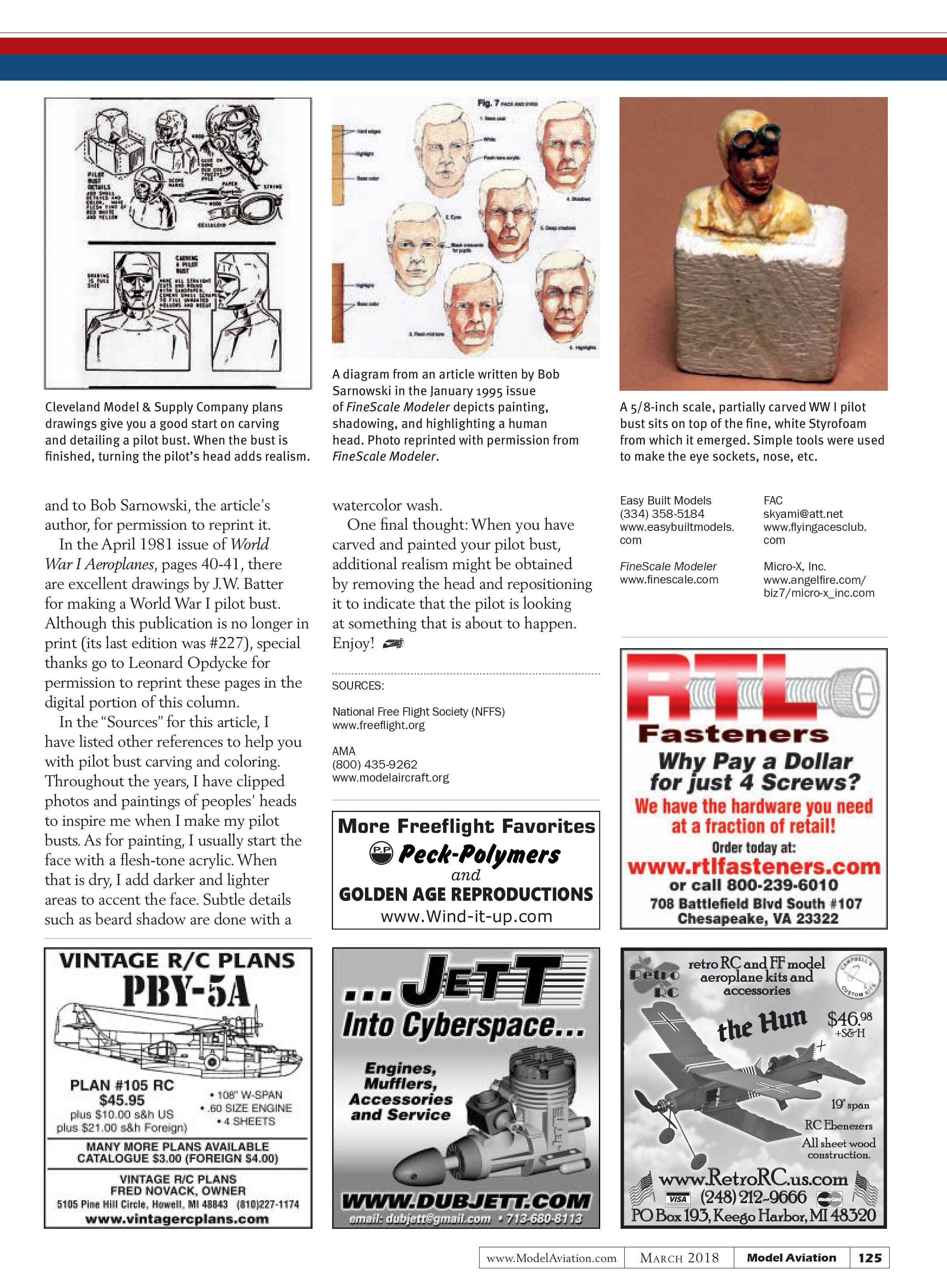
There are diagrams and a useful discussion of painting pilot busts in the January 1995 issue of FineScale Modeler, on pages 56-59. My thanks to Mark Savage, the editor of FineScale Modeler,


and to Bob Sarnowski, the article’s author, for permission to reprint it.
In the April 1981 issue of World War I Aeroplanes, pages 40-41, there are excellent drawings by J. W. Batter for making a World War I pilot bust. Although this publication is no longer in print (its last edition was #227), special thanks go to Leonard Opdycke for permission to reprint these pages in the digital portion of this column.
In the “Sources” for this article, I have listed other references to help you with pilot bust carving and coloring. Throughout the year, I have clipped photos and paintings of peoples’ heads to inspire me when I make my pilot busts. As for painting, I usually start the face with a flesh-tone acrylic. When that is dry, I add darker and lighter areas to accent the face. Subtle details such as beard shadow are done with a watercolor wash.
One final thought: When you have carved and painted your pilot bust, additional realism might be obtained by removing the head and repositioning it to indicate that the pilot is looking at something that is about to happen. Enjoy! ✈
SOURCES:
National Free Flight Society (NFFS)
www.freeflight.org
AMA
(800) 435-9262
www.modelaircraft.org