Focal Point
Dallaire Sportster
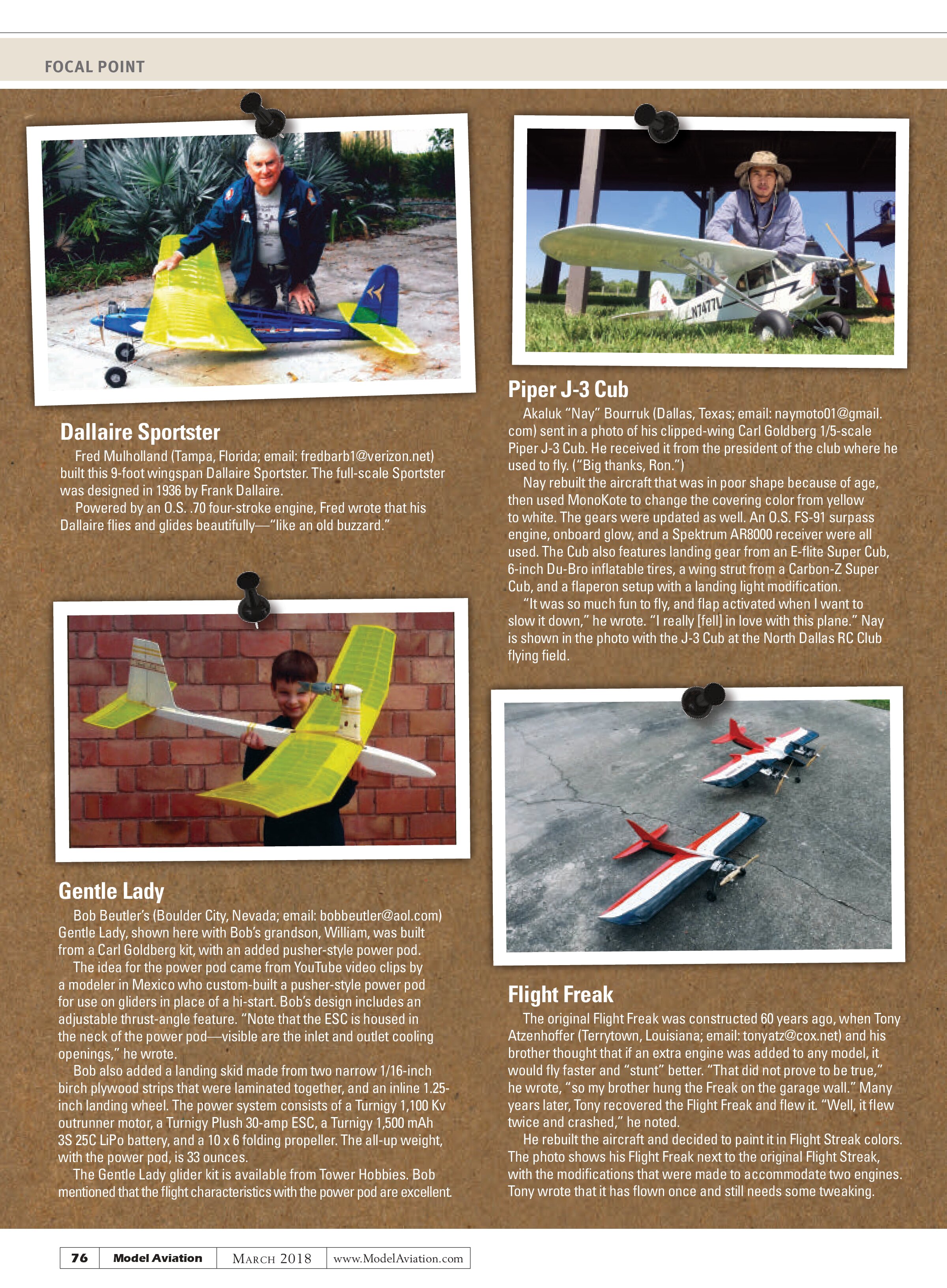
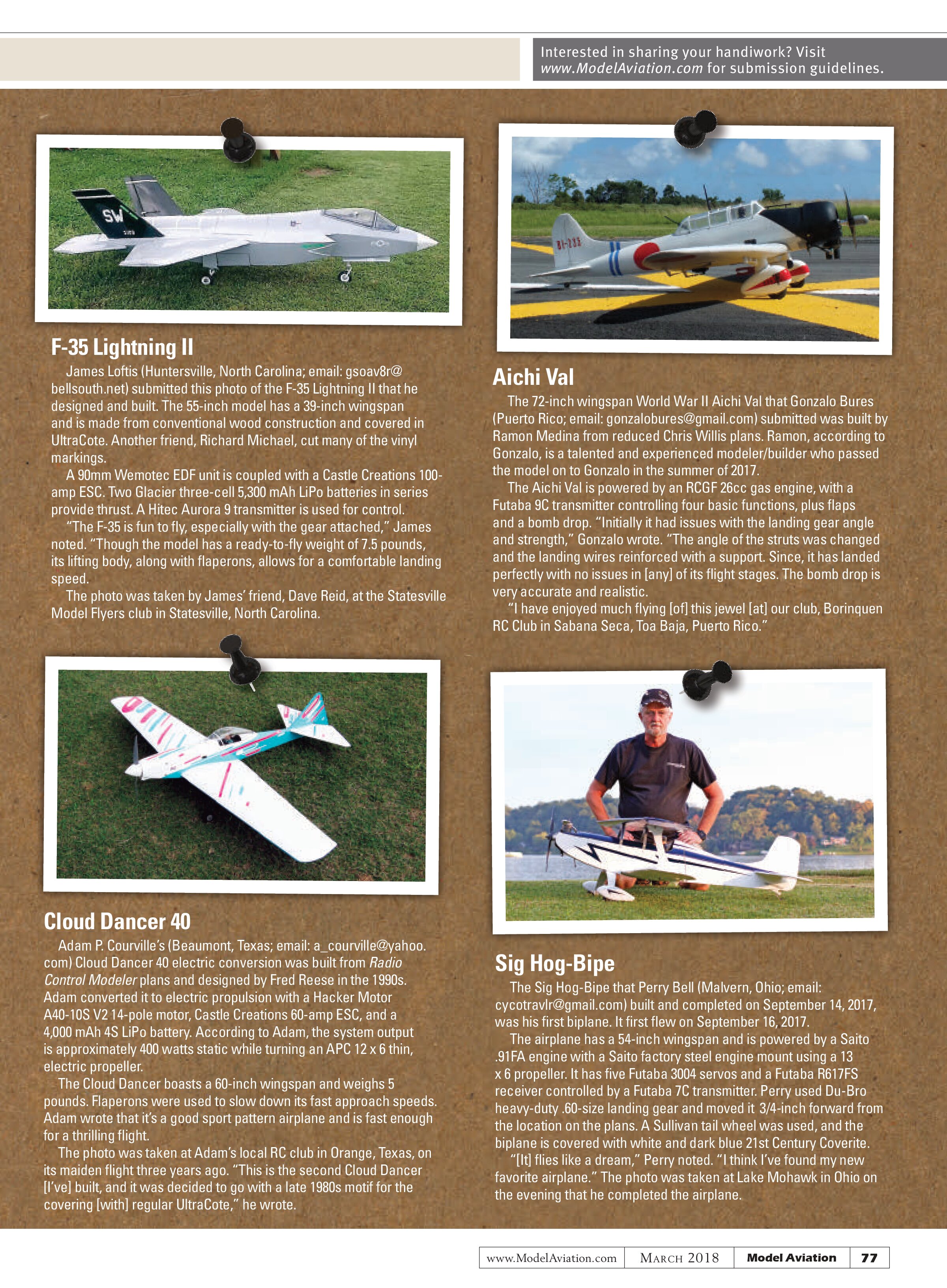
Fred Mulholland (Tampa, Florida; email: fredbarb1@verizon.net) built this 9-foot wingspan Dallaire Sportster. The full-scale Sportster was designed in 1936 by Frank Dallaire.
Powered by an O.S. .70 four-stroke engine, Fred wrote that his Dallaire flies and glides beautifully—“like an old buzzard.”

Gentle Lady
Bob Beutler’s (Boulder City, Nevada; email: bobbeutler@aol.com) Gentle Lady, shown here with Bob’s grandson, William, was built from a Carl Goldberg kit, with an added pusher-style power pod.
The idea for the power pod came from YouTube video clips by a modeler in Mexico who custom-built a pusher-style power pod for use on gliders in place of a hi-start. Bob’s design includes an adjustable thrust-angle feature. “Note that the ESC is housed in the neck of the power pod—visible are the inlet and outlet cooling openings,” he wrote.
Bob also added a landing skid made from two narrow 1/16-inch birch plywood strips that were laminated together, and an inline 1.25-inch landing wheel. The power system consists of a Turnigy 1,100 Kv outrunner motor, a Turnigy Plush 30-amp ESC, a Turnigy 1,500 mAh 3S 25C LiPo battery, and a 10 x 6 folding propeller. The all-up weight, with the power pod, is 33 ounces.
The Gentle Lady glider kit is available from Tower Hobbies. Bob mentioned that the flight characteristics with the power pod are excellent.

Piper J-3 Cub
Akaluk “Nay” Bourruk (Dallas, Texas; email: naymot001@gmail.com) sent in a photo of his clipped-wing Carl Goldberg 1/5-scale Piper J-3 Cub. He received it from the president of the club where he used to fly. (“Big thanks, Ron.”)
Nay rebuilt the aircraft that was in poor shape because of age, then used Monokote to change the covering color from yellow to white. The gears were updated as well. An O.S. FS-91 surpass engine, onboard glow, and a Spektrum AR8000 receiver were all used. The Cub also features landing gear from an E-flite Super Cub, 6-inch Du-Bro inflatable tires, a wing strut from a Carbon-Z Super Cub, and a flaperon setup with a landing light modification.
“It was so much fun to fly, and flap activated when I want to slow it down,” he wrote. “I really [fell] in love with this plane.” Nay is shown in the photo with the J-3 Cub at the North Dallas RC Club flying field.

Flight Freak
The original Flight Freak was constructed 60 years ago, when Tony Atzenhoffer (Terrytown, Louisiana; email: tonyatz@cox.net) and his brother thought that if an extra engine was added to any model, it would fly faster and “stunt” better. “That did not prove to be true,” he wrote, “so my brother hung the Freak on the garage wall.” Many years later, Tony recovered the Flight Freak and flew it. “Well, it flew twice and crashed,” he noted.
He rebuilt the aircraft and decided to paint it in Flight Streak colors. The photo shows his Flight Freak next to the original Flight Streak, with the modifications that were made to accommodate two engines. Tony wrote that it has flown once and still needs some tweaking.

F-35 Lightning II
James Loftis (Huntersville, North Carolina; email: gsoav8r@bellsouth.net) submitted this photo of the F-35 Lightning II that he designed and built. The 55-inch model has a 39-inch wingspan and is made from conventional wood construction and covered in UltraCote. Another friend, Richard Michael, cut many of the vinyl markings.
A 90mm Wemotec EDF unit is coupled with a Castle Creations 100-amp ESC. Two Glacier three-cell 5,300 mAh LiPo batteries in series provide thrust. A Hitec Aurora 9 transmitter is used for control.
“The F-35 is fun to fly, especially with the gear attached,” James noted. “Though the model has a ready-to-fly weight of 7.5 pounds, its lifting body, along with flaperons, allows for a comfortable landing speed.
The photo was taken by James’ friend, Dave Reid, at the Statesville Model Flyers club in Statesville, North Carolina.

Cloud Dancer 40
Adam P. Courville’s (Beaumont, Texas; email: a_courville@yahoo.com) Cloud Dancer 40 electric conversion was built from Radio Control Modeler plans and designed by Fred Reese in the 1990s. Adam converted it to electric propulsion with a Hacker Motor A40-10S V2 14-pole motor, Castle Creations 60-amp ESC, and a 4,000 mAh 4S LiPo battery. According to Adam, the system output is approximately 400 watts static while turning an APC 12 x 6 thin, electric propeller.
The Cloud Dancer boasts a 60-inch wingspan and weighs 5 pounds. Flaperons were used to slow down its fast approach speeds. Adam wrote that it’s a good sport pattern airplane and is fast enough for a thrilling flight.
The photo was taken at Adam’s local RC club in Orange, Texas, on its maiden flight three years ago. “This is the second Cloud Dancer [I’ve] built, and it was decided to go with a late 1980s motif for the covering [with] regular UltraCote,” he wrote.

Aichi Val
The 72-inch wingspan World War II Aichi Val that Gonzalo Bures (Puerto Rico; email: gonzalobures@gmail.com) submitted was built by Ramon Medina from reduced Chris Willis plans. Ramon, according to Gonzalo, is a talented and experienced modeler/builder who passed the model on to Gonzalo in the summer of 2017.
The Aichi Val is powered by an RCGF 26cc gas engine, with a Futaba 9C transmitter controlling four basic functions, plus flaps and a bomb drop. “Initially it had issues with the landing gear angle and strength,” Gonzalo wrote. “The angle of the struts was changed and the landing wires reinforced with a support. Since, it has landed perfectly with no issues in [any] of its flight stages. The bomb drop is very accurate and realistic.
“I have enjoyed much flying [of] this jewel [at] our club, Borinquen RC Club in Sabana Seca, Toa Baja, Puerto Rico.”

Sig Hog-Bipe
The Sig Hog-Bipe that Perry Bell (Malvern, Ohio; email: cycotravlr@gmail.com) built and completed on September 14, 2017, was his first biplane. It first flew on September 16, 2017.
The airplane has a 54-inch wingspan and is powered by a Saito .91FA engine with a Saito factory steel engine mount using a 13 x 6 propeller. It has five Futaba 3004 servos and a Futaba R617FS receiver controlled by a Futaba 7C transmitter. Perry used Du-Bro heavy-duty .60-size landing gear and moved it 3/4-inch forward from the location on the plans. A Sullivan tail wheel was used, and the biplane is covered with white and dark blue 21st Century Coverite.
“[It] flies like a dream,” Perry noted. “I think I’ve found my new favorite airplane.” The photo was taken at Lake Mohawk in Ohio on the evening that he completed the airplane.