Rules Proposals

March 15, 2018, is the deadline to file any new rules proposals for the 2019-2020 Competition Regulations. By the time you read this, the deadline will be coming up fast. Starting immediately after the deadline, the AMA Contest Boards for most competition events will be reviewing the proposals and preparing for the voting portion of this process. Three separate votes take place.
The first is the initial vote, which is used to discard proposals that the board finds obvious fault with. In most cases, the majority of proposals pass this vote.
Next comes cross-proposal time. This is where the board reviews the proposals and might look for a cross-proposal to resolve a specific issue that they have with a rules proposal, which can be easily resolved. It is important for AMA members interested in these proposals to communicate with their contest board members to let them know of their concerns and to write and send in a cross-proposal if needed.
After the deadline to submit for this is passed, the individual contest boards will vote on any cross-proposals that have been received. Those that pass will take the place of the original proposal. If they fail, or no cross-proposal is received, the basic proposal that passed the initial vote will move on to the final vote.
Proposals that pass the final vote will be included in the 2019-2020 Competition Regulations that will be posted in December 2019.
It is important that AMA members involved in these competitions remain informed by communicating with the specific contest boards and by monitoring the rules proposals page on the AMA website at www.modelaircraft.org/events/ruleproposals.aspx.
Policing Amateur Frequencies
At the January 2018, Executive Council meeting in Ontario, California, the council affirmed the policy that AMA clubs do not monitor or verify any federal government regulations.
This would include FAA registration as well as FCC licensing for operations using amateur radio frequencies (HAM band) for RC aircraft (50 and 53 MHz), including FPV video transmitters (5.8 GHz).
In the past, AMA event officials had been directed to verify FCC licensing for 50 and 53 MHz operations.
Although AMA recommends that all AMA members follow all applicable federal, state, and local laws, clubs are not responsible for monitoring and/or enforcing such laws. That is left to the appropriate governmental entities. Please make sure that your club officers and members are aware of this policy.
Large Model Airplane Program
With the continued growth (no pun intended!) of the large model aircraft scene, it is important to remember that AMA members are limited to flying aircraft that weigh 55 pounds or less, unless they are in compliance with the Large Model Airplane (LMA) program requirements. This applies to powered and unpowered aircraft of all types. There is no fee for the LMA program.
The LMA-1 category is designed for aircraft that weigh between 55 pounds and 77 pounds, 2 ounces (35 kg). After the airplane owner fills out the necessary forms and the airplane completes two successful demonstration flights, your airplane is LMA certified. It is important that you send all required documents to AMA within 30 days of that second demonstration flight. You can fly your airplane for 3 years, then you must renew the certification with AMA.
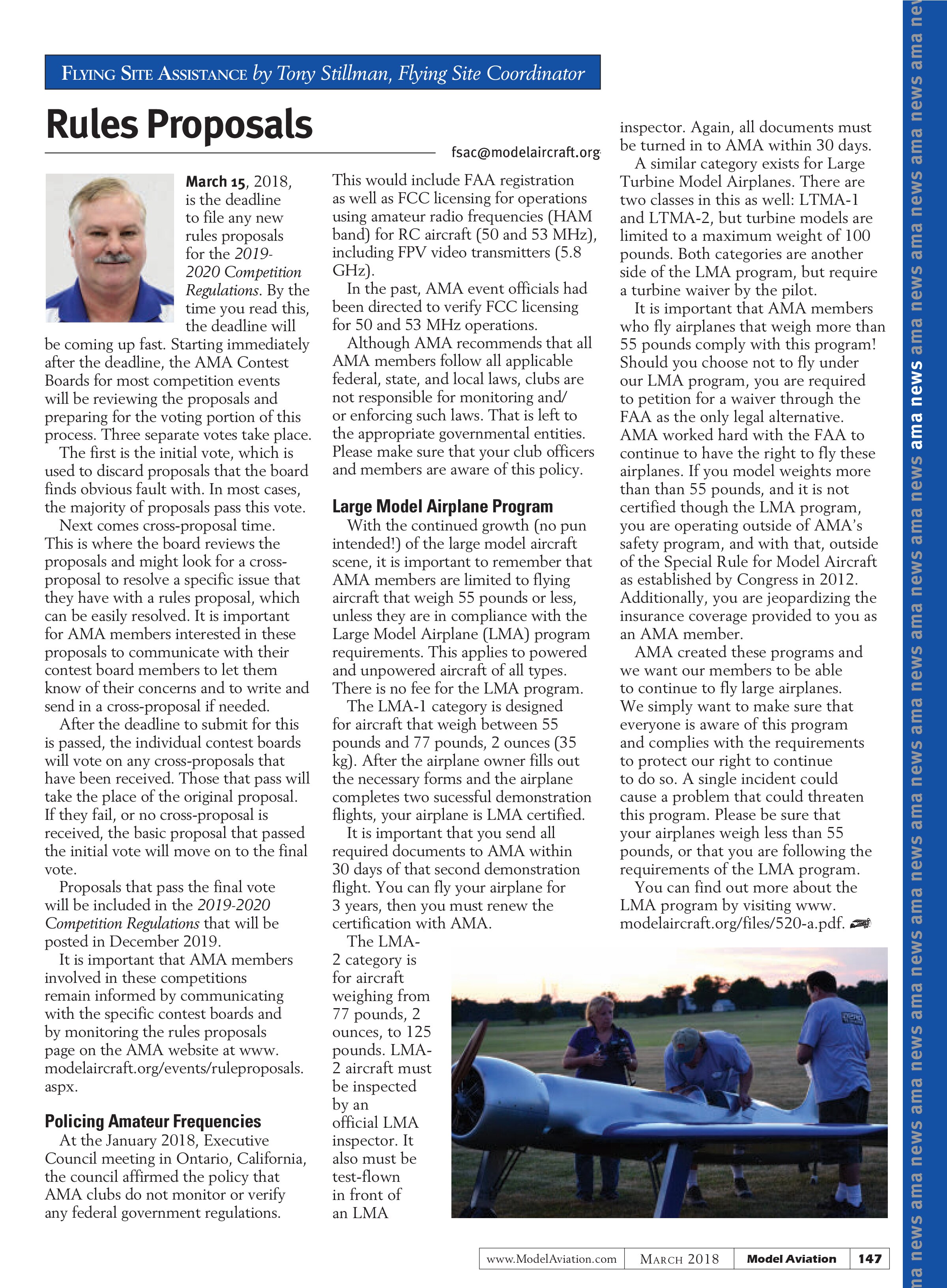
The LMA-2 category is for aircraft weighing from 77 pounds, 2 ounces, to 125 pounds. LMA-2 aircraft must be inspected by an official LMA inspector. It also must be test-flown in front of an LMA inspector. Again, all documents must be turned in to AMA within 30 days.
A similar category exists for Large Turbine Model Airplanes. There are two classes in this as well: LTMA-1 and LTMA-2, but turbine models are limited to a maximum weight of 100 pounds. Both categories are another side of the LMA program, but require a turbine waiver by the pilot.
It is important that AMA members who fly airplanes that weigh more than 55 pounds comply with this program! Should you choose not to fly under our LMA program, you are required to petition for a waiver through the FAA as the only legal alternative. AMA worked hard with the FAA to continue to have the right to fly these airplanes. If you model weights more than 55 pounds, and it is not certified though the LMA program, you are operating outside of AMA’s safety program, and with that, outside of the Special Rule for Model Aircraft as established by Congress in 2012. Additionally, you are jeopardizing the insurance coverage provided to you as an AMA member.
AMA created these programs and we want our members to be able to continue to fly large airplanes. We simply want to make sure that everyone is aware of this program and complies with the requirements to protect our right to continue to do so. A single incident could cause a problem that could threaten this program. Please be sure that your airplanes weigh less than 55 pounds, or that you are following the requirements of the LMA program.
You can find out more about the LMA program by visiting www.modelaircraft.org/files/520-a.pdf.