Why do we fly?
by Mark Rudner
mark.s.rudner@gmail.com
Why do we fly? For the fortune or the fame? The stakes could not be lower, but we do it all the same.
Some contests offer small prizes, but in the grand scheme of things, the investment of time and money that any of us puts in, far exceeds what would ever be obtained in return. If flying Control Line Combat isn’t putting bread on the table, or satisfying any of life’s other basic needs, then why do we do it?
I was led to think about this question after seeing a recent thread on Facebook that discussed prize money for contests. I was happy to see many thoughtful responses posted, which I felt captured the spirit of our hobby.
There are probably as many answers to the question of why we fly as there are pilots. To get the most out of the time, effort, and money that we spend on the hobby, it’s worthwhile to think about this.
A while back, I had the opportunity to talk with a friend of one of the Danish Combat fliers, who happens to be a sports psychologist. When talking about success in sports, she told me the first thing to figure out is how to define “success.” Again, the answer is relative—the meaning of success all comes down to what it is that one is really looking for in the first place.
To give some examples, she listed a number of different reasons for competing and the mindset that players (pilots) might have when they come to the field. Some people do it for the camaraderie, enjoying time with friends, and being part of a community. Some do it for the health benefits of exercise, some do it to relieve stress, while others do it for the intensity and the rush of adrenaline in fierce competition.
During battle, some are motivated


by the thrill of winning, and others by the fear of losing. For some, the biggest reward is the praise and admiration of their peers. For others, the rewards are more internal.
There is no right or wrong answer to the question of why we fly. By knowing what motivates you, she said, you will be in a much better position to achieve fulfillment and what it is

that you’re really after.
If we’ve talked about success then perhaps we should also talk about failure. Nobody likes to fail. Last night I saw a clip from an interview with Kobe Bryant, one of the most successful basketball players in NBA history. The interviewer asked him, as an extremely competitive player and person, how he handles failure.
His answer was unexpected: “I don’t believe in failure.” It wasn’t a cocky answer, saying that he simply doesn’t fail or that he easily brushes it off; rather, he rejects the very concept of failure itself. It sounds either deep or crazy, but what does he mean?
Kobe’s point, which really resonated with me, was his follow-up statement and refrain that he returned to
throughout the interview: “The story continues.”
If you didn’t achieve what you hoped for on a given day, or didn’t get the fulfillment you’d hoped for, you can ask why, learn from those reasons, and come back for the next time that much wiser.
It’s not just about winning and losing, but about whatever it is that you’re looking for when you go out to fly. There will be disappointments, but not failures. There will be more chances to try again and to do better. The story continues. It makes a lot of sense. Kobe’s words impressed me.
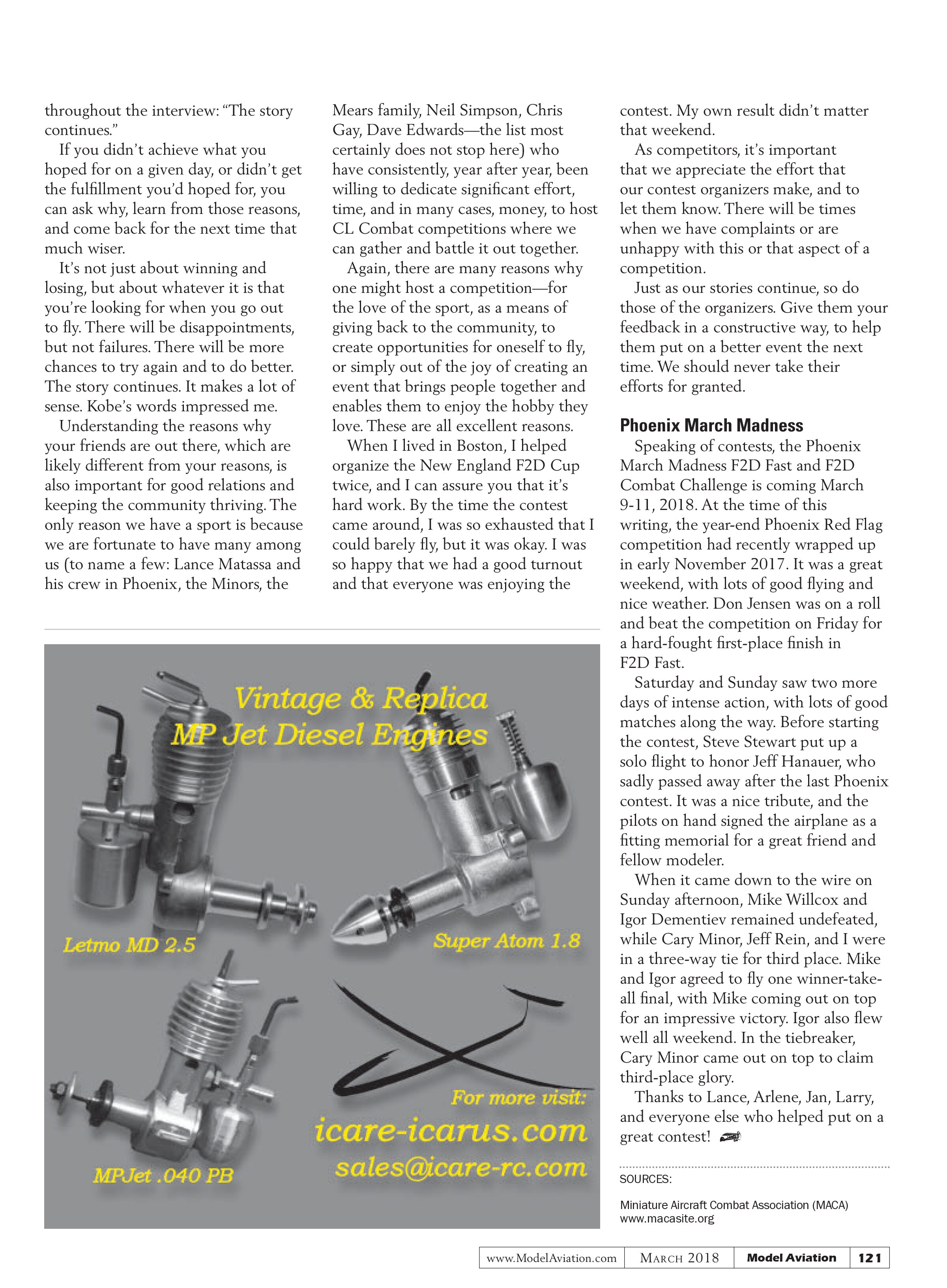
Understanding the reasons why your friends are out there, which are likely different from your reasons, is also important for good relations and keeping the community thriving. The only reason we have a sport is because we are fortunate to have many among us (to name a few: Lance Matassa and his crew in Phoenix, the Minors, the Mears family, Neil Simpson, Chris Gay, Dave Edwards—the list most certainly does not stop here) who have consistently, year after year, been willing to dedicate significant effort, time, and in many cases, money, to host CL Combat competitions where we can gather and battle it out together.
Again, there are many reasons why one might host a competition—for the love of the sport, as a means of giving back to the community, to create opportunities for oneself to fly, or simply out of the joy of creating an event that brings people together and enables them to enjoy the hobby they love. These are all excellent reasons.
When I lived in Boston, I helped organize the New England F2D Cup twice, and I can assure you that it’s hard work. By the time the contest came around, I was so exhausted that I could barely fly, but it was okay. I was so happy that we had a good turnout and that everyone was enjoying the contest. My own result didn’t matter that weekend.
As competitors, it’s important that we appreciate the effort that our contest organizers make, and to let them know. There will be times when we have complaints or are unhappy with this or that aspect of a competition.
Just as our stories continue, so do those of the organizers. Give them your feedback in a constructive way, to help them put on a better event the next time. We should never take their efforts for granted.
Phoenix March Madness
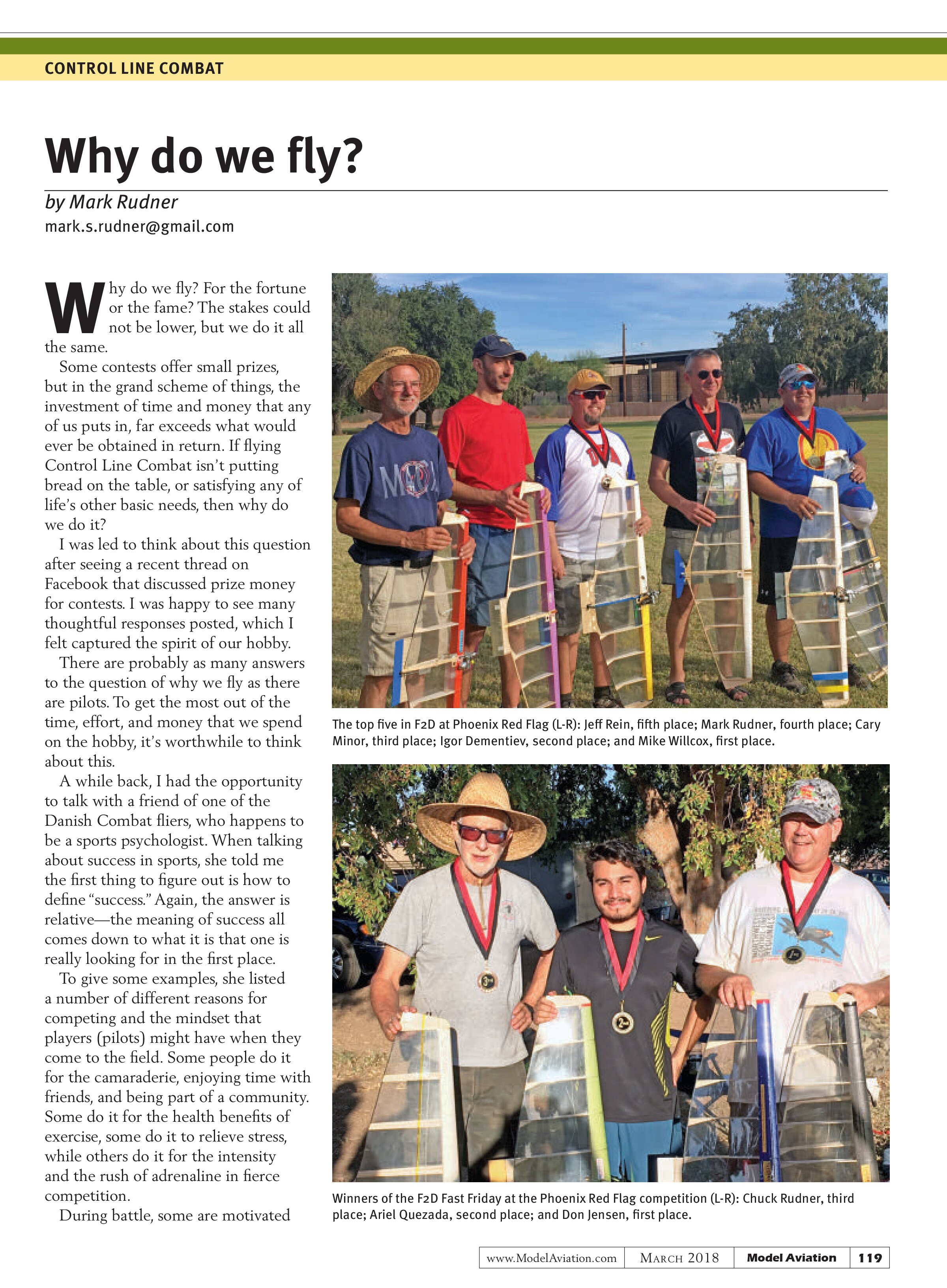
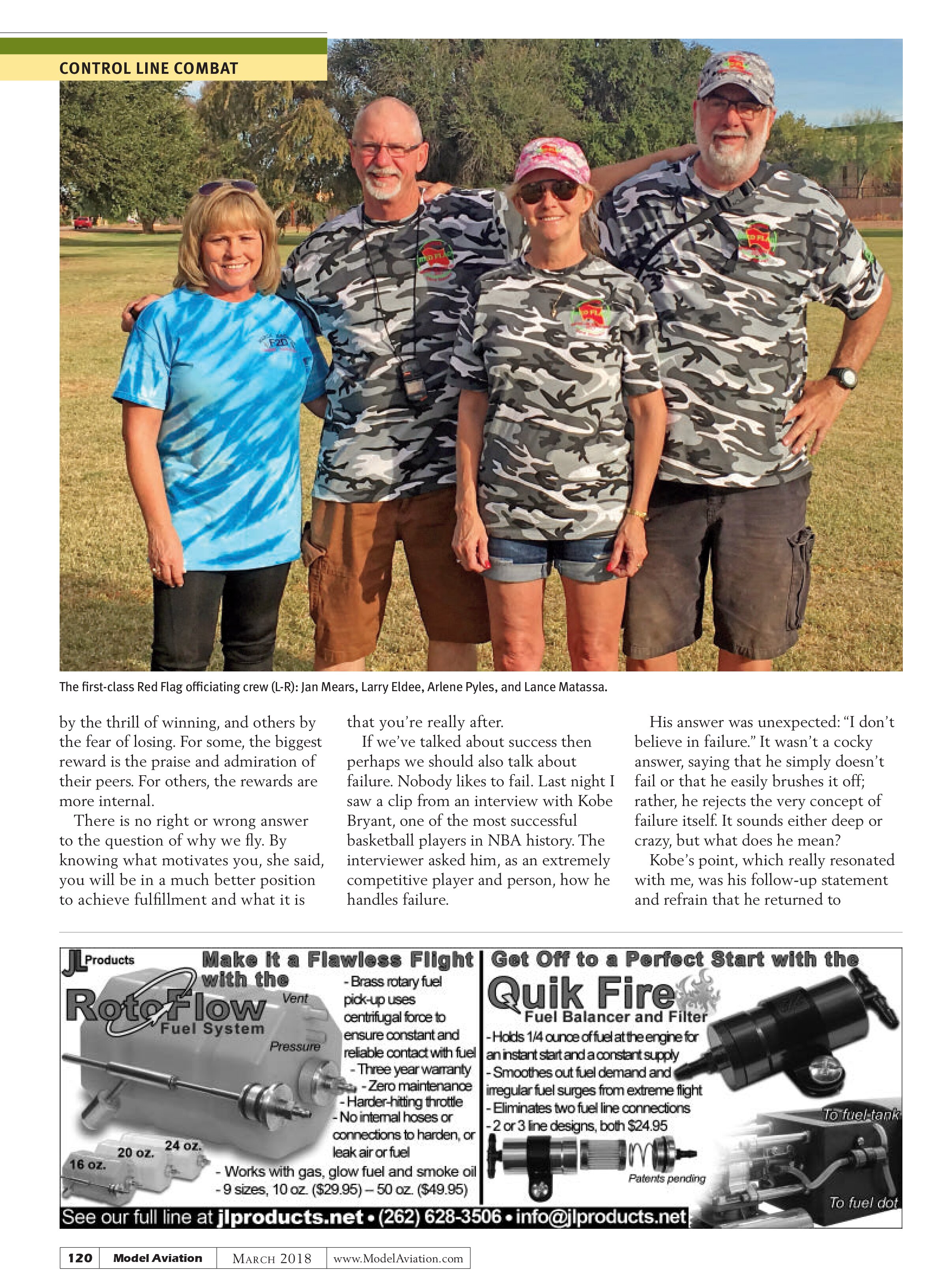
Speaking of contests, the Phoenix March Madness F2D Fast and F2D Combat Challenge is coming March 9-11, 2018. At the time of this writing, the year-end Phoenix Red Flag competition had recently wrapped up in early November 2017. It was a great weekend, with lots of good flying and nice weather. Don Jensen was on a roll and beat the competition on Friday for a hard-fought first-place finish in F2D Fast.
Saturday and Sunday saw two more days of intense action, with lots of good matches along the way. Before starting the contest, Steve Stewart put up a solo flight to honor Jeff Hanauer, who sadly passed away after the last Phoenix contest. It was a nice tribute, and the pilots on hand signed the airplane as a fitting memorial for a great friend and fellow modeler.
When it came down to the wire on Sunday afternoon, Mike Willcox and Igor Dementiev remained undefeated, while Cary Minor, Jeff Rein, and I were in a three-way tie for third place. Mike and Igor agreed to fly one winner-take-all final, with Mike coming out on top for an impressive victory. Igor also flew well all weekend. In the tiebreaker, Cary Minor came out on top to claim third-place glory.
Thanks to Lance, Arlene, Jan, Larry, and everyone else who helped put on a great contest!
SOURCES:
Miniature Aircraft Combat Association (MACA)
www.macasite.org