Sources of inspiration
Much like others who have built and flown models most of their lives, I’ve spent countless hours reading magazines and poring over plans, while dreaming about my next project. Most ideas brew for some time before getting to the workbench, and my magazine and plans collection is rarely idle for long.
For those who are looking for such inspiration, there is some good news. Quite a few people have asked about purchasing back issues of Flying Models magazine to accompany the plans sales. I am pleased to announce that they are now officially inventoried and will be available on the Flying Models website by the time you read this. The back issues are significantly discounted, with further savings based on volume.
A number of books have also been added to the Flying Models store, along with some hard-to-find supplies, such as preformed bamboo strut stock for small models and lithoplate. I’ve also added the brass calibration weights mentioned in my November 2017 column. The “Sources” link at the end of this article will point the way.
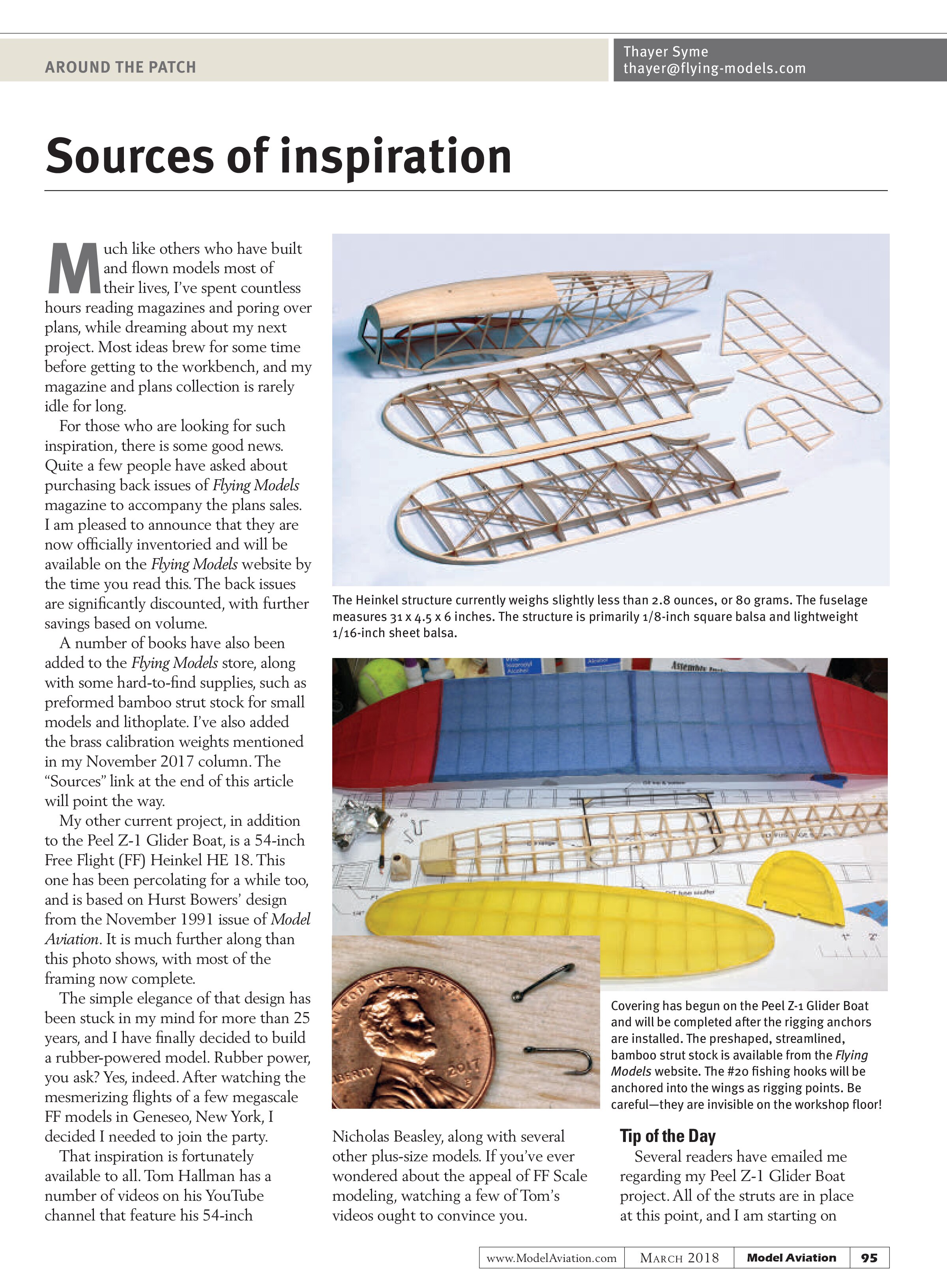
My other current project, in addition to the Peel Z-1 Glider Boat, is a 54-inch Free Flight (FF) Heinkel HE 18. This one has been percolating for a while too, and is based on Hurst Bowers’ design from the November 1991 issue of Model Aviation. It is much further along than this photo shows, with most of the framing now complete.
The simple elegance of that design has been stuck in my mind for more than 25 years, and I have finally decided to build a rubber-powered model. Rubber power, you ask? Yes, indeed. After watching the mesmerizing flights of a few megascale FF models in Geneseo, New York, I decided I needed to join the party.
That inspiration is fortunately available to all. Tom Hallman has a number of videos on his YouTube channel that feature his 54-inch

Heinkel structure currently weighs slightly less than 2.8 ounces, or 80 grams. The fuselage measures 31 × 4.5 × 6 inches. The structure is primarily 1/8-inch square balsa and lightweight 1/16-inch sheet balsa.


Nicholas Beasley, along with several other plus-size models. If you’ve ever wondered about the appeal of FF Scale modeling, watching a few of Tom’s videos ought to convince you.
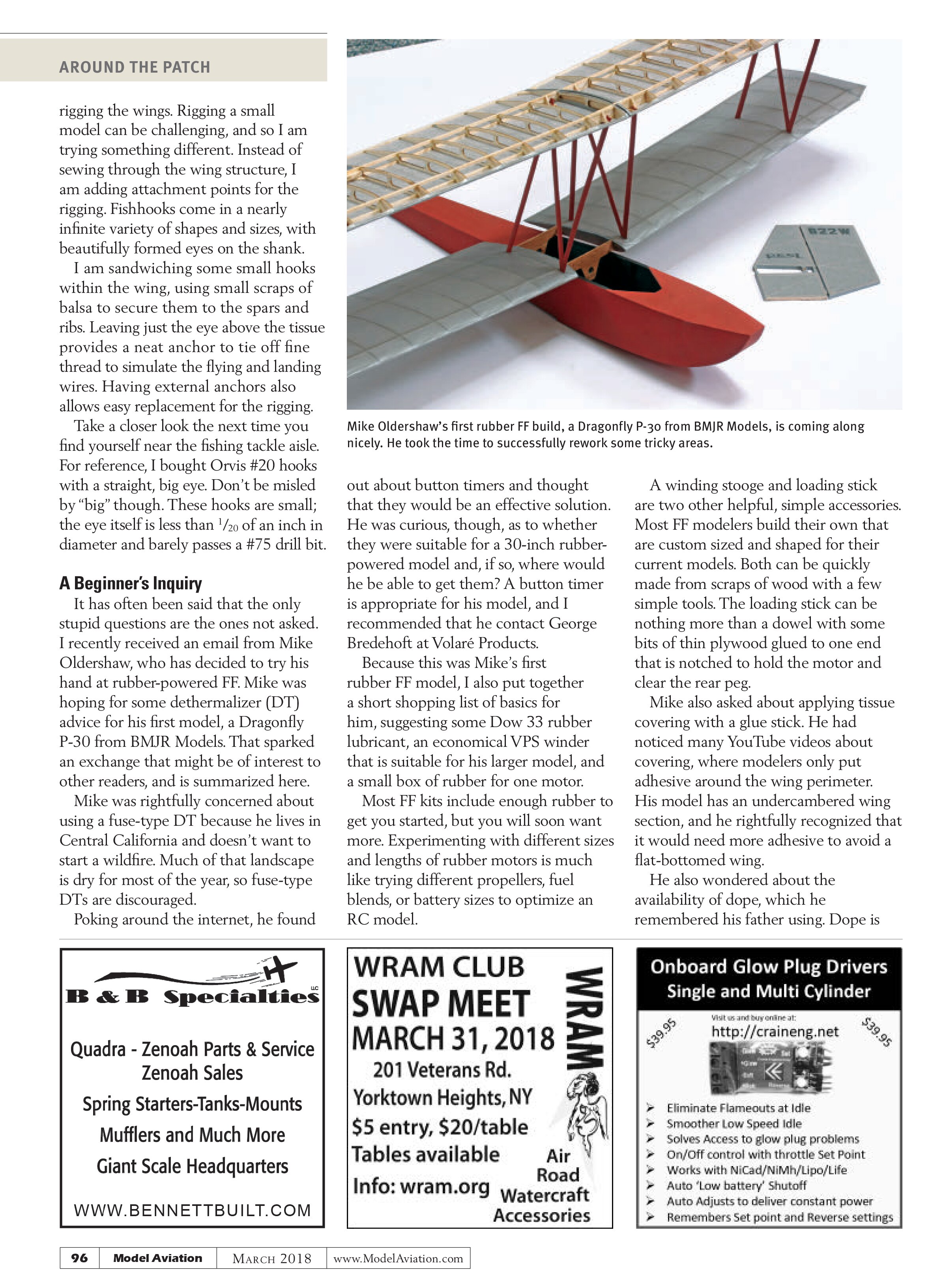
Covering has begun on the Peel Z-1 Glider Boat and will be completed after the rigging anchors are installed. The preshaped, streamlined, bamboo strut stock is available from the Flying Models website. The #20 fishing hooks will be anchored into the wings as rigging points. Be careful—they are invisible on the workshop floor!
Tip of the Day
Several readers have emailed me regarding my Peel Z-1 Glider Boat project. All of the struts are in place at this point, and I am starting on
rigging the wings. Rigging a small model can be challenging, and so I am trying something different. Instead of sewing through the wing structure, I am adding attachment points for the rigging. Fishhooks come in a nearly infinite variety of shapes and sizes, with beautifully formed eyes on the shank.
I am sandwiching some small hooks within the wing, using small scraps of balsa to secure them to the spars and ribs. Leaving just the eye above the tissue provides a neat anchor to tie off fine thread to simulate the flying and landing wires. Having external anchors also allows easy replacement for the rigging.
Take a closer look the next time you find yourself near the fishing tackle aisle. For reference, I bought Orvis #20 hooks with a straight, big eye. Don’t be misled by “big” though. These hooks are small; the eye itself is less than 1⁄20 of an inch in diameter and barely passes a #75 drill bit.
A Beginner’s Inquiry
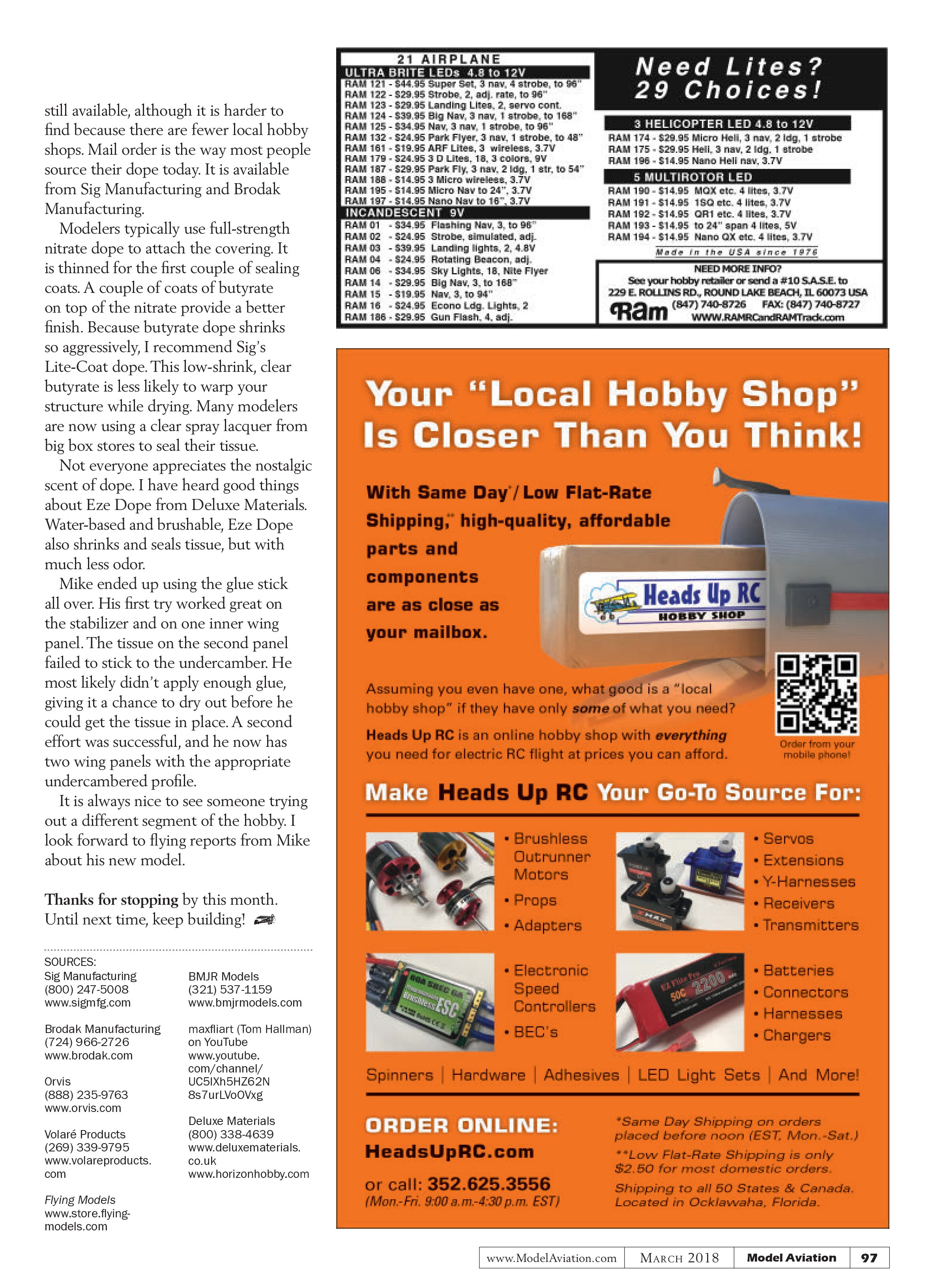
It has often been said that the only stupid questions are the ones not asked. I recently received an email from Mike Oldershaw, who has decided to try his hand at rubber-powered FF. Mike was hoping for some determinalizer (DT) advice for his first model, a Dragonfly P-30 from BMJR Models. That sparked an exchange that might be of interest to other readers, and is summarized here.
Mike was rightfully concerned about using a fuse-type DT because he lives in Central California and doesn’t want to start a wildfire. Much of that landscape is dry for most of the year, so fuse-type DTs are discouraged.
Poking around the internet, he found
out about button timers and thought that they would be an effective solution. He was curious, though, as to whether they were suitable for a 30-inch rubber-powered model and, if so, where would he be able to get them? A button timer is appropriate for his model, and I recommended that he contact George Bredehoft at Volaré Products.
Because this was Mike’s first rubber FF model, I also put together a short shopping list of basics for him, suggesting some Dow 33 rubber lubricant, an economical VPS winder that is suitable for his larger model, and a small box of rubber for one motor.
Most FF kits include enough rubber to get you started, but you will soon want more. Experimenting with different sizes and lengths of rubber motors is much like trying different propellers, fuel blends, or battery sizes to optimize an RC model.
A winding stooge and loading stick are two other helpful, simple accessories. Most FF modelers build their own that are custom sized and shaped for their current models. Both can be quickly made from scraps of wood with a few simple tools. The loading stick can be nothing more than a dowel with some bits of thin plywood glued to one end that is notched to hold the motor and clear the rear peg.
Mike also asked about applying tissue covering with a glue stick. He had noticed many YouTube videos about covering, where modelers only put adhesive around the wing perimeter. His model has an undercambered wing section, and he rightfully recognized that it would need more adhesive to avoid a flat-bottomed wing.
He also wondered about the availability of dope, which he remembered his father using. Dope is
still available, although it is harder to find because there are fewer local hobby shops. Mail order is the way most people source their dope today. It is available from Sig Manufacturing and Brodak Manufacturing.
Modelers typically use full-strength nitrate dope to attach the covering. It is thinned for the first couple of sealing coats. A couple of coats of butyrate on top of the nitrate provide a better finish. Because butyrate dope shrinks so aggressively, I recommend Sig’s Lite-Coat dope. This low-shrink, clear butyrate is less likely to warp your structure while drying. Many modelers are now using a clear spray lacquer from big box stores to seal their tissue.
Not everyone appreciates the nostalgic scent of dope. I have heard good things about Eze Dope from Deluxe Materials. Water-based and brushable, Eze Dope also shrinks and seals tissue, but with much less odor.
Mike ended up using the glue stick all over. His first try worked great on the stabilizer and on one inner wing panel. The tissue on the second panel failed to stick to the undercamber. He most likely didn’t apply enough glue, giving it a chance to dry out before he could get the tissue in place. A second effort was successful, and he now has two wing panels with the appropriate undercambered profile.
It is always nice to see someone trying out a different segment of the hobby. I look forward to flying reports from Mike about his new model.
Thanks for stopping by this month.
Until next time, keep building!
SOURCES:
Sig Manufacturing
(800) 247-5008
www.sig mfg.com
Brodak Manufacturing
(724) 966-2726
www.brodak.com
Orvis
(888) 235-9763
www.orvis.com
Volaré Products
(269) 339-9795
www.volareproducts.com
Flying Models
www.store.flying-models.com
BMJR Models
(321) 537-1159
www.bmj rmodels.com
maxfl iart (Tom Hallman)
on YouTube
www.youtube.com/channel/UC5IX5hHZ6ZN8s7urLVoOVxg
Deluxe Materials
(800) 338-4639
www.deluxematerials.co.uk
www.horizonhobby.com