APPLYING SILKSPAN
A FRESH LOOK AT DOPE-AND-TISSUE COVERING
BY BOB BENJAMIN | PHOTOS BY THE AUTHOR

Editor’s note: Bob’s article includes 18 photos with detailed captions covering the entire process. Because of space restrictions in the print edition, only the first eight photos are included with this article. The remaining photos and captions can be seen online at www.ModelAviation.com.
Since model airplane builders have been using aircraft dope to attach, seal, and finish tissue and other paper coverings, we have been looking for a better way to achieve the taut, light, neat appearance of doped tissue, silkspan, or real silk without having to deal with the smelly side effect of using either butyrate or nitrate aircraft dope! Most people who aren’t aeromodelers would refuse to
put up with it. Throughout the years, model builders have invested a lot of time and effort trying to discover or invent another process that would give comparable results without making most of us into social outcasts.
Dope products present another challenge beyond that of aromatic hydrocarbon solvents—they shrink as they dry. Traditionally, this characteristic has been put to good use. Shrinking dope reliably pulls paper or fabric covering smooth, taut, and wrinkle-free as it dries. The problem is that the more dope we add in pursuit of a well-sealed, glossy covering, the more it shrinks. Without special additives and great care, enough dope will warp and distort even the best-built aircraft structure.
We all know about iron-on products that have been around since the mid-1960s. Countless outstanding models have been finished that way, but plastic covering isn’t necessarily the best way to go. Many of us still feel that the results they produce can’t even come close to the finesse of the old methods.
If you’ve ever looked closely at a well-built, doped silk, or tissue-finished model airplane, I think you’ll agree with me that it has soul. I think you’ll also agree that it is worth some effort to try to keep the process going.
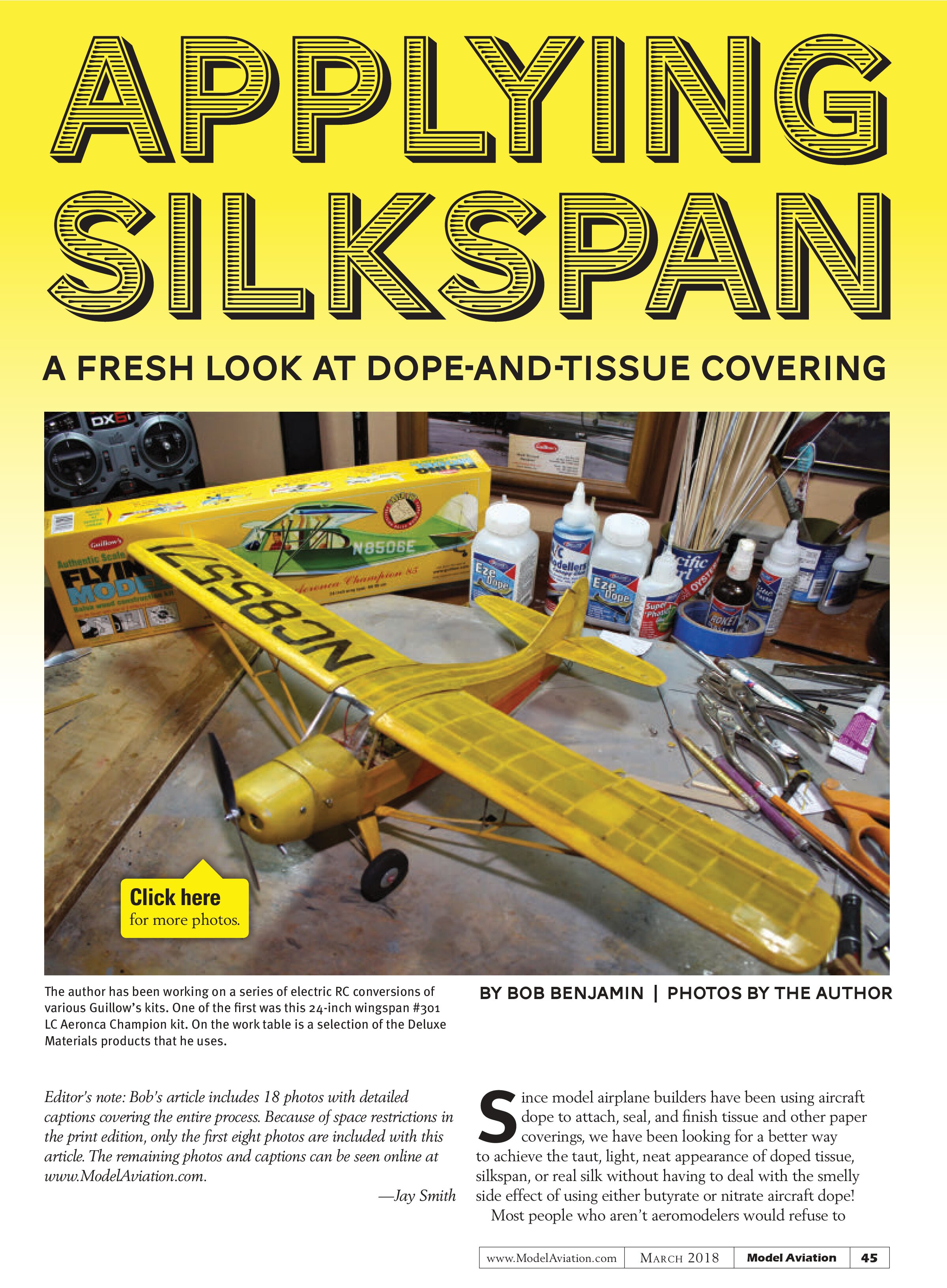
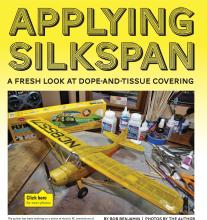
Deluxe Materials Eze Dope does the best job of dealing with the issues of smell and unwanted shrinkage of any similar product that I have used. Later in this article, I will demonstrate using Eze Dope and the Deluxe Materials companion product, Tissue Paste, to cover and finish a typical small balsa stick-and-tissue model airplane. The

airplane is a 24-inch wingspan Guillows’s 301 LC Aeronca Champion kit.
Before I get started covering the Champ, let’s discuss all of those Guillows’s models. There’s a lot going on with them that I want to share. Have you ever built one of the classic stick-and-tissue scale models with the great artwork on the outside of the box and many little balsa sticks and die-cut parts inside? There’s much more potential in those kits than you might think.
I’ve devoted a lot of time to working out practical electric-power RC conversions of several Guillows’s models, including several kit #403 Supermarine Spitfires and a kit #1005 F6F Hellcat, along with this Aeronca. I also have a kit #2001 P-38 RC conversion that is just beginning to go together, as well as a few others waiting at the back of the worktable.
I’ll share some details about the RC Champ conversion. As with my other Guillows’s kit conversions, my goal was to use as much as possible of the original kit material and change only the design features necessary to achieve good RC flight characteristics. On this model, that included adding working control surfaces and a motor mount, making provisions for radio/battery access, and reinforcing the landing gear.
I used the original wing and tail incidence angles and set the dihedral to match my full-scale airplane references. I replaced the Guillows’s covering tissue that came in the box with Guillows’s standard lightweight silkspan, which is easy to order from the company.
My only obvious aerodynamic change was to round off the wing airfoil’s

leading edge (LE). I made an effort to enhance the scale appearance and the model’s visual appeal.
Those of you who are familiar with my writing already know that, along with a thorough narrative, I like to use a series of photos with detailed captions to tell much of the story. Additional photos can be seen online at www.ModelAviation.com.
Let’s discuss that covering job. The lesson today is not about how to do tissue/silkspan covering, but how to use Deluxe Materials products to do it better. Silkspan is indeed a type of tissue that’s slightly heavier and tougher than the traditional Japanese variety. Because I am using lightweight silkspan on this model, I’ll refer to that material from here on.
Model builders have traditionally attached silkspan to balsa model airplane structures using either clear dope or thinned cellulose cement. Aside from the smell issue, dope has the advantage of drying and sticking in place quickly. After you learn how to properly handle it, you have the option of working fast, but the nitrate clear dope around the perimeter of a small wing panel might set up so quickly that you actually have to go back to re-wet spots that have dried or grabbed before you’ve finished getting them correctly lined up.
If you are using your silkspan dry (not yet wetted with water), you face the added task of controlling all of those edges and corners that want to wrinkle. Covering wet makes this slightly easier, but the covering is still going to fight being smoothed into place.
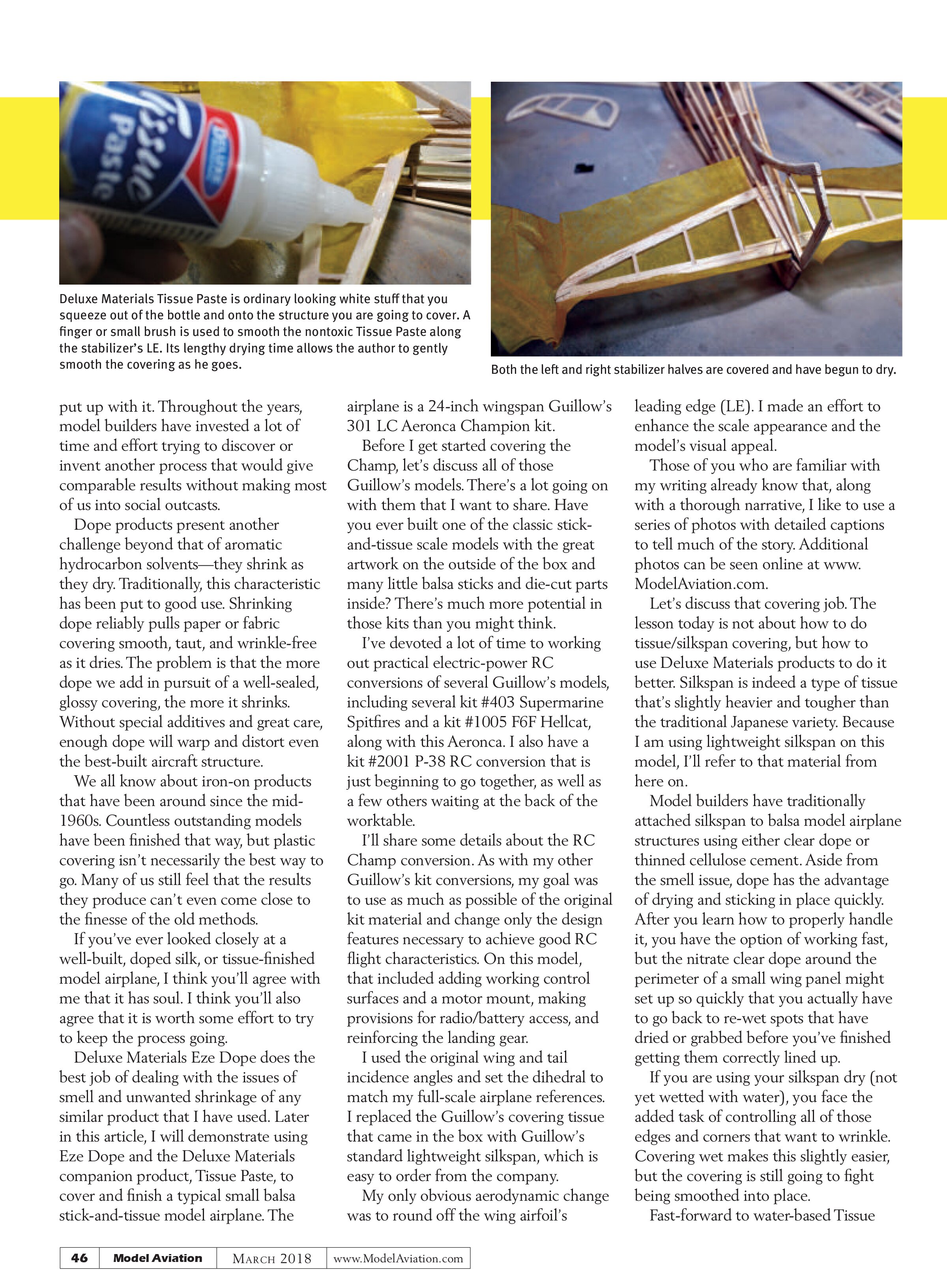
Fast-forward to water-based Tissue
Paste. This not only eliminates the smell, but also automatically wets the silkspan wherever it touches the Tissue Paste. As a result, it goes limp and stays exactly where you put it. It gets better. You won’t have to re-wet stubborn loose or wrinkled spots.
Tissue Paste dries slowly enough to give you plenty of time to work around all of the edges of the parts you are working on until they are right. In practice, this means that while covering a wing panel, for example, you might have to set it aside for 10 or 15 minutes after covering one side before it is dry enough for you to turn it over and finish the job. I consider this characteristic to be an asset because it encourages you to work more slowly and deliberately, which usually leads to making fewer mistakes.
Using Deluxe Materials covering products demands that you make good use of that slow-down-and-get-it-right requirement.
I mentioned that the Eze Dope that I will use to seal and finish this silkspan is not going to do any extra shrinking as it dries. Your covering job will remain exactly as smooth and gently taut as it is when it first dries.

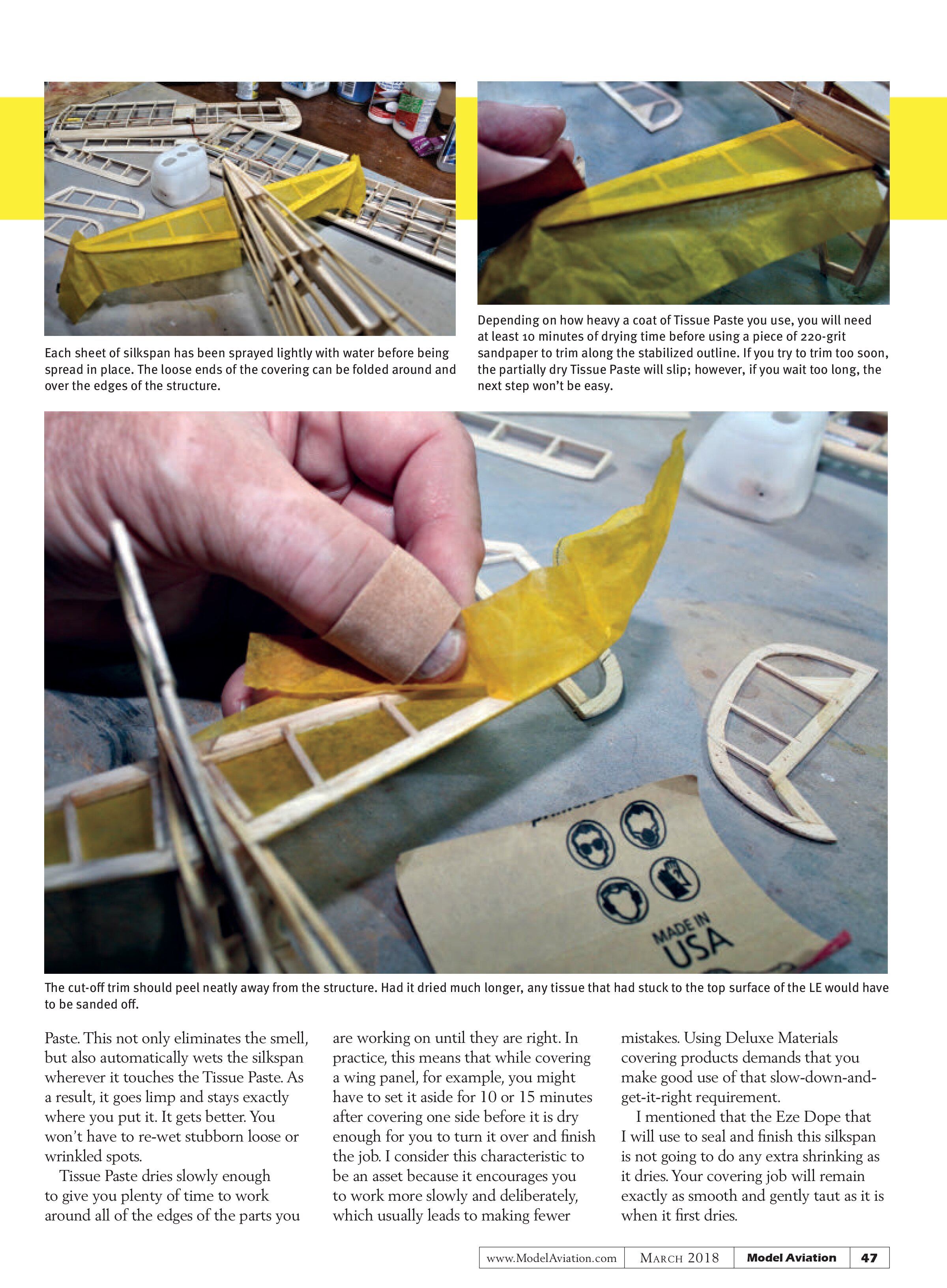
Each sheet of silkspan has been sprayed lightly with water before being spread in place. The loose ends of the covering can be folded around and over the edges of the structure.

Depending on how heavy a coat of Tissue Paste you use, you will need at least 10 minutes of drying time before using a piece of 220-grit sandpaper to trim along the stabilized outline. If you try to trim too soon, the partially dry Tissue Paste will slip; however, if you wait too long, the next step won’t be easy.


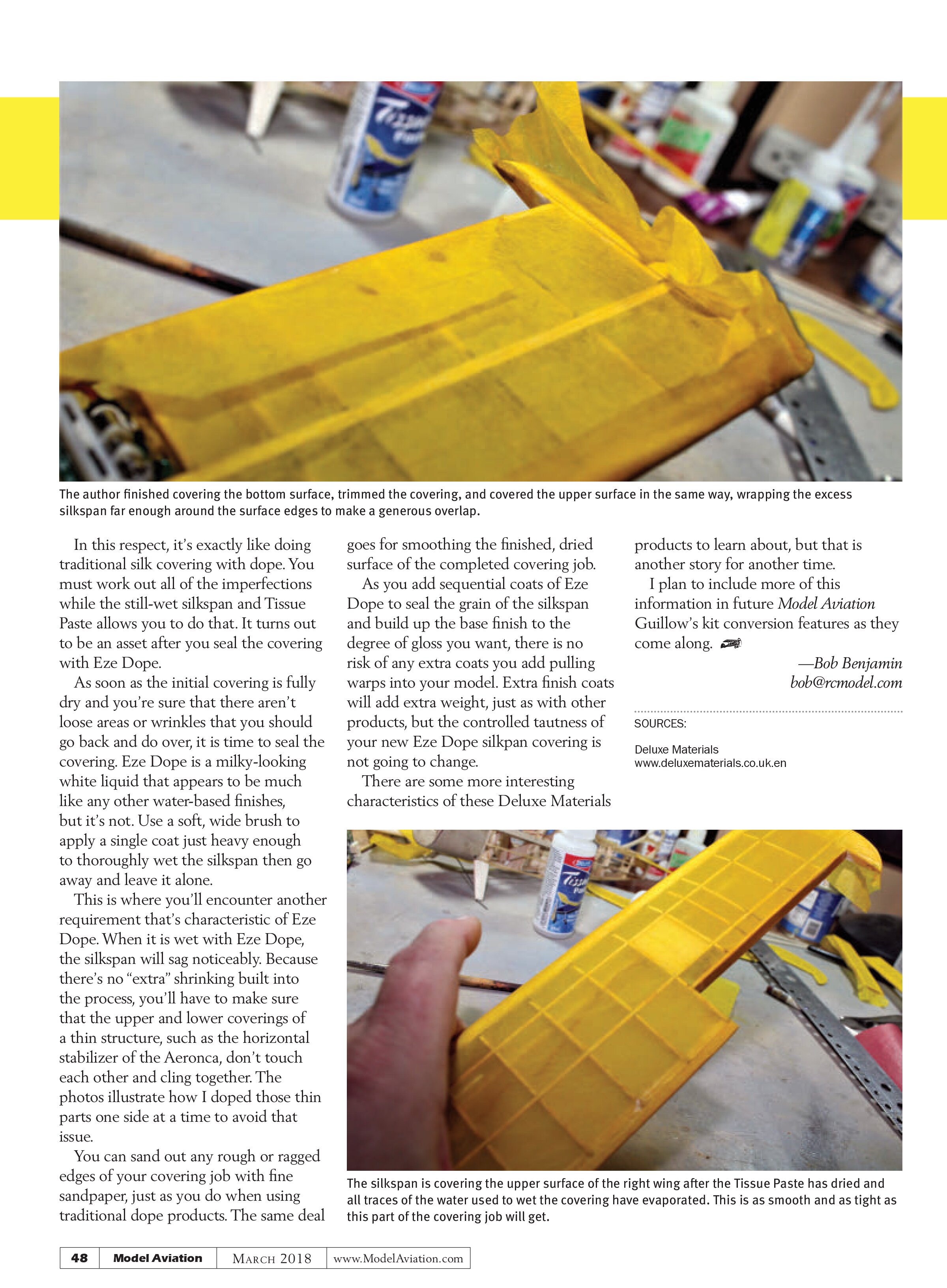
In this respect, it’s exactly like doing traditional silk covering with dope. You must work out all of the imperfections while the still-wet silkspan and Tissue Paste allows you to do that. It turns out to be an asset after you seal the covering with Eze Dope.
As soon as the initial covering is fully dry and you’re sure that there aren’t loose areas or wrinkles that you should go back and do over, it is time to seal the covering. Eze Dope is a milky-looking white liquid that appears to be much like any other water-based finishes, but it’s not. Use a soft, wide brush to apply a single coat just heavy enough to thoroughly wet the silkspan then go away and leave it alone.
This is where you’ll encounter another requirement that’s characteristic of Eze Dope. When it is wet with Eze Dope, the silkspan will sag noticeably. Because there’s no “extra” shrinking built into the process, you’ll have to make sure that the upper and lower coverings of a thin structure, such as the horizontal stabilizer of the Aeronca, don’t touch each other and cling together. The photos illustrate how I doped those thin parts one side at a time to avoid that issue.
You can sand out any rough or ragged edges of your covering job with fine sandpaper, just as you do when using traditional dope products. The same deal goes for smoothing the finished, dried surface of the completed covering job.
As you add sequential coats of Eze Dope to seal the grain of the silkspan and build up the base finish to the degree of gloss you want, there is no risk of any extra coats you add pulling warps into your model. Extra finish coats will add extra weight, just as with other products, but the controlled tautness of your new Eze Dope silkspan covering is not going to change.
There are some more interesting characteristics of these Deluxe Materials

products to learn about, but that is another story for another time.
I plan to include more of this information in future Model Aviation Guillows kit conversion features as they come along.
—Bob Benjamin
bob@rcmodel.com
SOURCES:
Deluxe Materials
www.deluxematerials.co.uk/en