Reflecting on 2017 as
we move into 2018
Last year, in the February issue of Model Aviation, I advised our members to “buckle up” because the year was going to be a bumpy ride. My forecast was right.
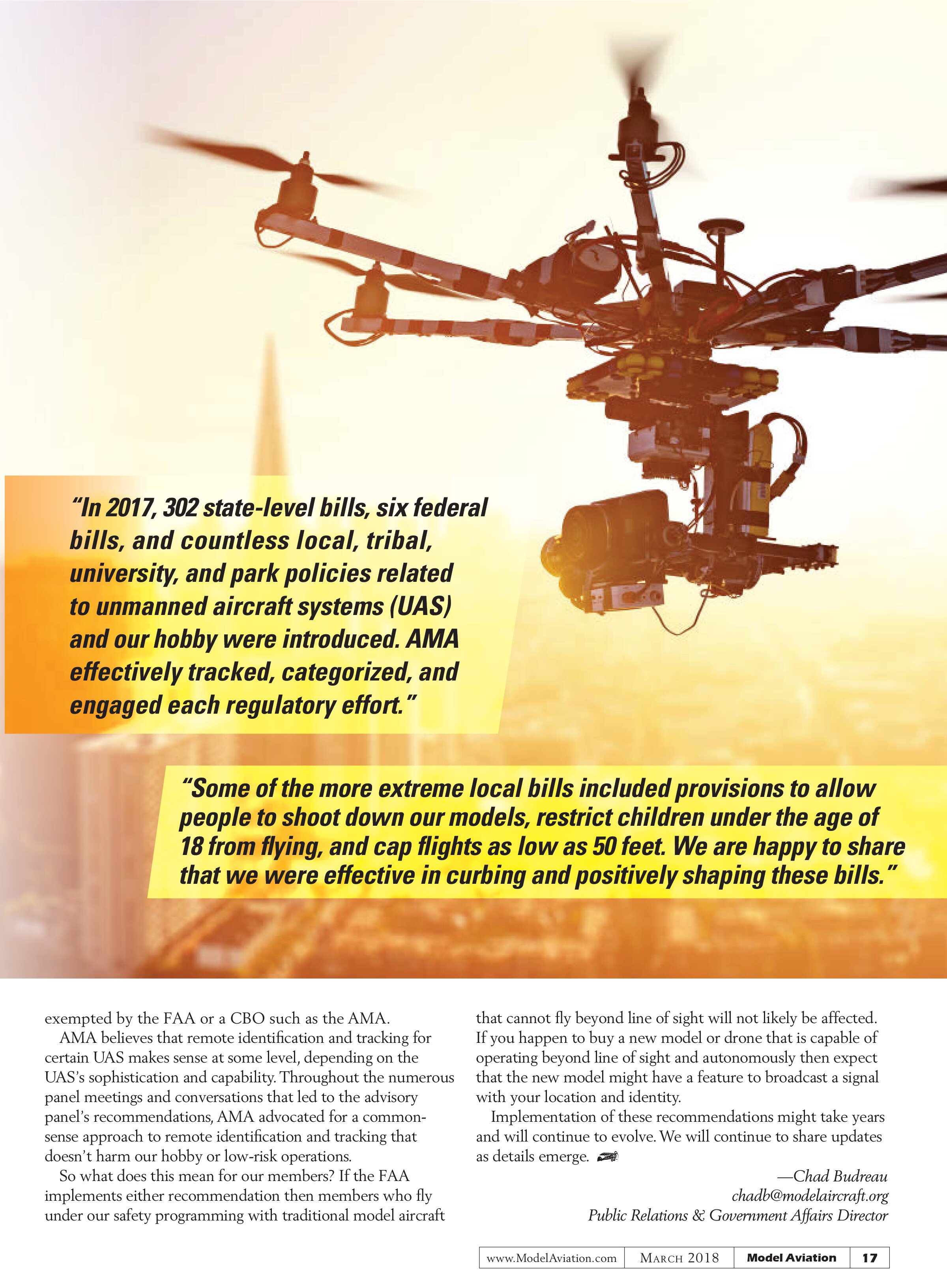
In 2017, 302 state-level bills, six federal bills, and countless local, tribal, university, and park policies related to unmanned aircraft systems (UAS) and our hobby were introduced. AMA effectively tracked, categorized, and engaged each regulatory effort.
Perhaps the most notable takeaway from 2017 is that Section 336, the Special Rule for Model Aircraft, remained in place. Despite mounting pressure against the Special Rule, AMA was able to refute misperceptions and keep it as a law. We were also successful in refining some of the language for a 2018 vote.
The House of Representatives now clarifies the definition and role of community-based organizations (CBOs) such as AMA, and the Senate bill includes provisions for flying FPV. We will continue to work with Congress on a few other issues, such as improving the airport notification process, as well as refining this updated language.
Why is Section 336 so important to our members? This carveout allows hobbyists to follow and operate within the programming of a CBO such as the AMA. According to current laws, recreational model aviation pilots must fly under the FAA’s Small UAS Rule, known as Part 107. The only exception is for a small group of hobbyists who fully satisfy Section 336 to fly under the programming of a CBO such as the AMA. Without this section, our members must exclusively comply with Part 107, which would ground many of our activities, including competitions, races, RC Soaring, large model aircraft, turbines, and more.
Many in Washington, D.C., as well as industry leaders, do not understand our hobby and have consequently mischaracterized Section 336. By no means is Section 336 intended to give hobbyists a free pass; rather Congress’ intent with the Special Rule was to allow for private/public partnerships to manage a community of model aviation hobbyists.
Please continue to remain engaged as we provide updates on the Special Rule, especially as opposition continues to increase against Section 336.
At the local level, AMA engaged with 1,030 government officials, stakeholders, and local legislators to shape or influence UAS regulations. Through these efforts, we were effective in protecting, preserving, and promoting our great hobby.
Some of the more extreme local bills included provisions to allow people to shoot down our models, restrict children under the age of 18 from flying, and cap flights as low as 50 feet. We are happy to share that we were effective in curbing and positively shaping these bills, allowing our members to continue flying safely and responsibly as they have for decades.
Perception is part of our strategy to influence positive legislation. Averaging nearly once a week, AMA was published, quoted, or interviewed by media including CNN, Popular Science, Bloomberg, NBC News, and USA Today. These efforts shared the importance of Section 336, the AMA, and hobby in general. AMA also featured our hobby and members at the local level in 20 regional newspapers. Online exposure alone exceeded 643,000 impressions.
If 2017 was a bumpy ride, 2018 will be more akin to a rough off-road trip. Instead of asking you to simply “buckle up,” you might want to make sure your roll bar is secure as we prepare to take off. At the end of 2018, I am optimistic that we will continue to celebrate and enjoy this hobby not only for this generation, but for generations to come.
What Does Remote ID and Tracking Mean for Our Members?
In 2017, the AMA participated in 13 federal-level committees and work groups. One of those committees was for the FAA’s Aviation Rulemaking Committee (ARC) on unmanned aircraft (model airplanes and drones) remote identification and tracking. This ARC was a four-month process comprising 74 members representing law enforcement, aviation, manufacturers, researchers, and the AMA. The committee was tasked to identify technologies to allow law enforcement, homeland defense, national security, and air traffic control communities to remotely track and identify UAS in the airspace.
One recommendation made by the panel requires that remote ID and tracking should only apply to aircraft that have the capability to fly autonomously, by navigating between more than one point without active control of the pilot, or flying beyond 400 feet using a real-time sensor or camera. This means that model aircraft that are incapable of autonomous or long-range operations do not have to comply with remote ID and tracking.
An alternative recommendation requires all UAS to comply with remote ID and tracking, with only a few exemptions. These exemptions include UAS for law enforcement or under air traffic control, models incapable of flying beyond 400 feet (such as toys), and models waived or exempted by the FAA or a CBO such as the AMA.

AMA believes that remote identification and tracking for certain UAS makes sense at some level, depending on the UAS’s sophistication and capability. Throughout the numerous panel meetings and conversations that led to the advisory panel’s recommendations, AMA advocated for a common-sense approach to remote identification and tracking that doesn’t harm our hobby or low-risk operations.
So what does this mean for our members? If the FAA implements either recommendation then members who fly under our safety programming with traditional model aircraft that cannot fly beyond line of sight will not likely be affected. If you happen to buy a new model or drone that is capable of operating beyond line of sight and autonomously then expect that the new model might have a feature to broadcast a signal with your location and identity.
Implementation of these recommendations might take years and will continue to evolve. We will continue to share updates as details emerge.
—Chad Budreau
chadb@modelaircraft.org
Public Relations & Government Affairs Director