Invasion of the selfie drones
Patrick Sherman
lucidity@roswellflighttestcrew.com

In the beginning, there was just one type of drone. Everyone, including DJI, tried to build the DJI Phantom: a midsize, stable, aerial camera platform that was capable of capturing smooth video and transmitting it to a ground station in real time. The Roswell Flight Test Crew’s answer was the RQCX-3 Raven, a homebuilt hexacopter that could fly for 5 minutes on a fully charged battery.
When we carried a thermal imaging camera aloft for the first time, giving firefighters an aerial perspective of a blaze they were battling, it was the Raven doing the lifting. When I competed in a timed obstacle course event at the (never repeated) First Annual Multirotor Challenge—a predecessor of FPV drone racing—the
Raven was the bird dodging the pylons. Like Henry Ford’s Model T, there was one basic template that all drones shared. This began to change in 2015 as FPV racing emerged. The aircraft became smaller, faster, and more nimble. If the Raven was the family station wagon—able to do nearly everything, but not especially well—then racing drones are Formula 1 cars that are highly specialized and built to perform one narrow task to the highest possible standard. By my reckoning, that was the first substantial branch in the drone family tree.
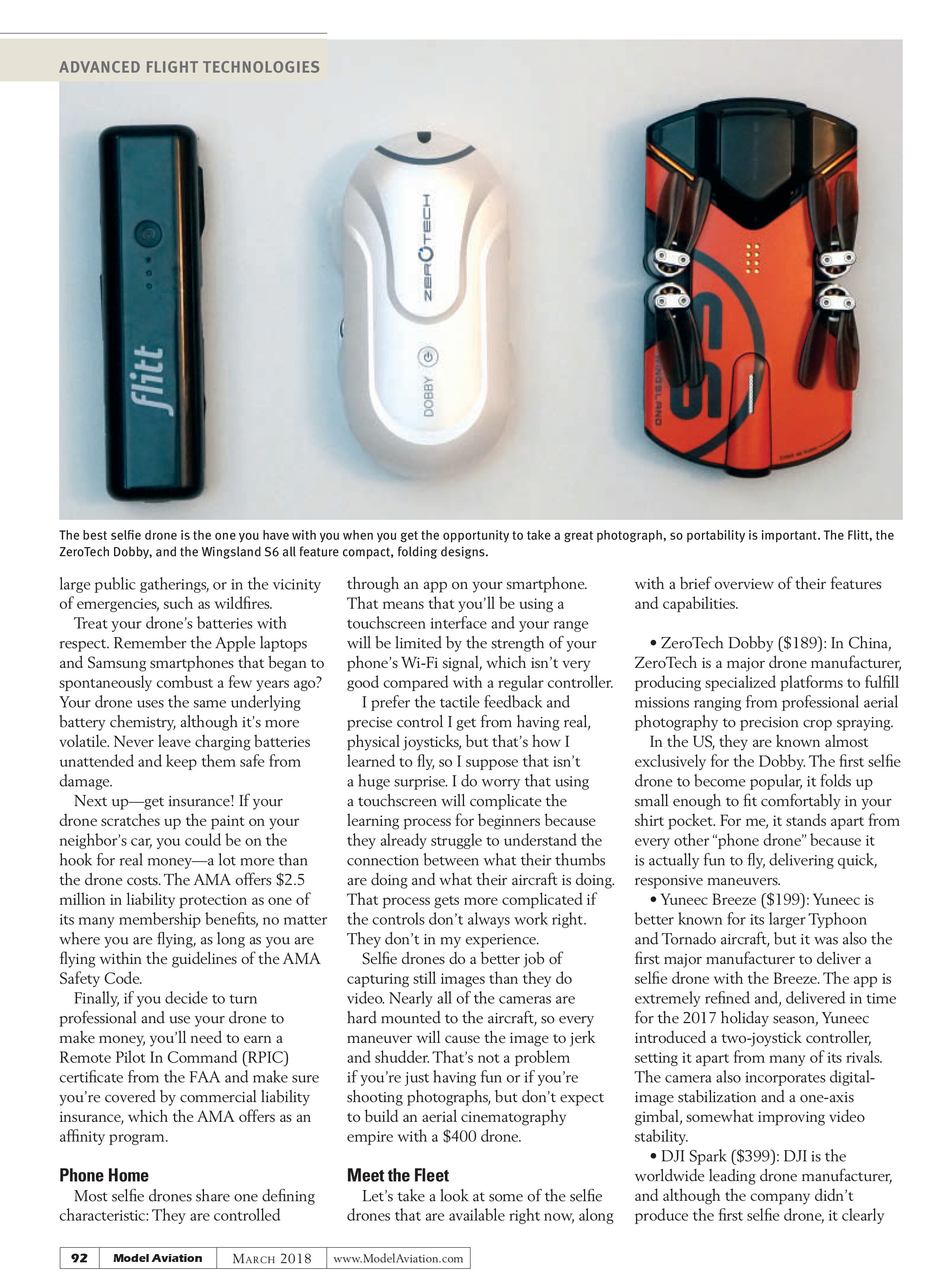
In 2017, we saw another branch, as the “selfie” drone emerged as its own category. If the DJI Phantom is the crossover SUV, and racing drones are open-wheel racers, then selfie drones are
Vespa scooters. They are not practical for work or running errands, but they are a lot of fun when you’re on vacation or hanging out with friends.
Fly Safely
Maybe you want a selfie drone to round out your existing fleet of camera-carrying aircraft, or you are looking for your first drone and you want something inexpensive and easy to fly. If you are new to drones (and especially if you’re new to RC flying), there are a few things you need to know.
First, your drone is an aircraft and you are an aviator. I know; it only cost $200 and you bought it at Walmart, but you are launching a machine into the most crowded and tightly regulated airspace in the world. Don’t fly near airports,
large public gatherings, or in the vicinity of emergencies, such as wildfires.
Treat your drone’s batteries with respect. Remember the Apple laptops and Samsung smartphones that began to spontaneously combust a few years ago? Your drone uses the same underlying battery chemistry, although it’s more volatile. Never leave charging batteries unattended and keep them safe from damage.
Next up—get insurance! If your drone scratches up the paint on your neighbor’s car, you could be on the hook for real money—a lot more than the drone costs. The AMA offers $2.5 million in liability protection as one of its many membership benefits, no matter where you are flying, as long as you are flying within the guidelines of the AMA Safety Code.
Finally, if you decide to turn professional and use your drone to make money, you’ll need to earn a Remote Pilot In Command (RPIC) certificate from the FAA and make sure you’re covered by commercial liability insurance, which the AMA offers as an affinity program.
Phone Home
Most selfie drones share one defining characteristic: They are controlled
through an app on your smartphone. That means that you’ll be using a touchscreen interface and your range will be limited by the strength of your phone’s Wi-Fi signal, which isn’t very good compared with a regular controller.
I prefer the tactile feedback and precise control I get from having real, physical joysticks, but that’s how I learned to fly, so I suppose that isn’t a huge surprise. I do worry that using a touchscreen will complicate the learning process for beginners because they already struggle to understand the connection between what their thumbs are doing and what their aircraft is doing. That process gets more complicated if the controls don’t always work right. They don’t in my experience.
Selfie drones do a better job of capturing still images than they do video. Nearly all of the cameras are hard mounted to the aircraft, so every maneuver will cause the image to jerk and shudder. That’s not a problem if you’re just having fun or if you’re shooting photographs, but don’t expect to build an aerial cinematography empire with a $400 drone.
Meet the Fleet
Let’s take a look at some of the selfie drones that are available right now, along
with a brief overview of their features and capabilities.
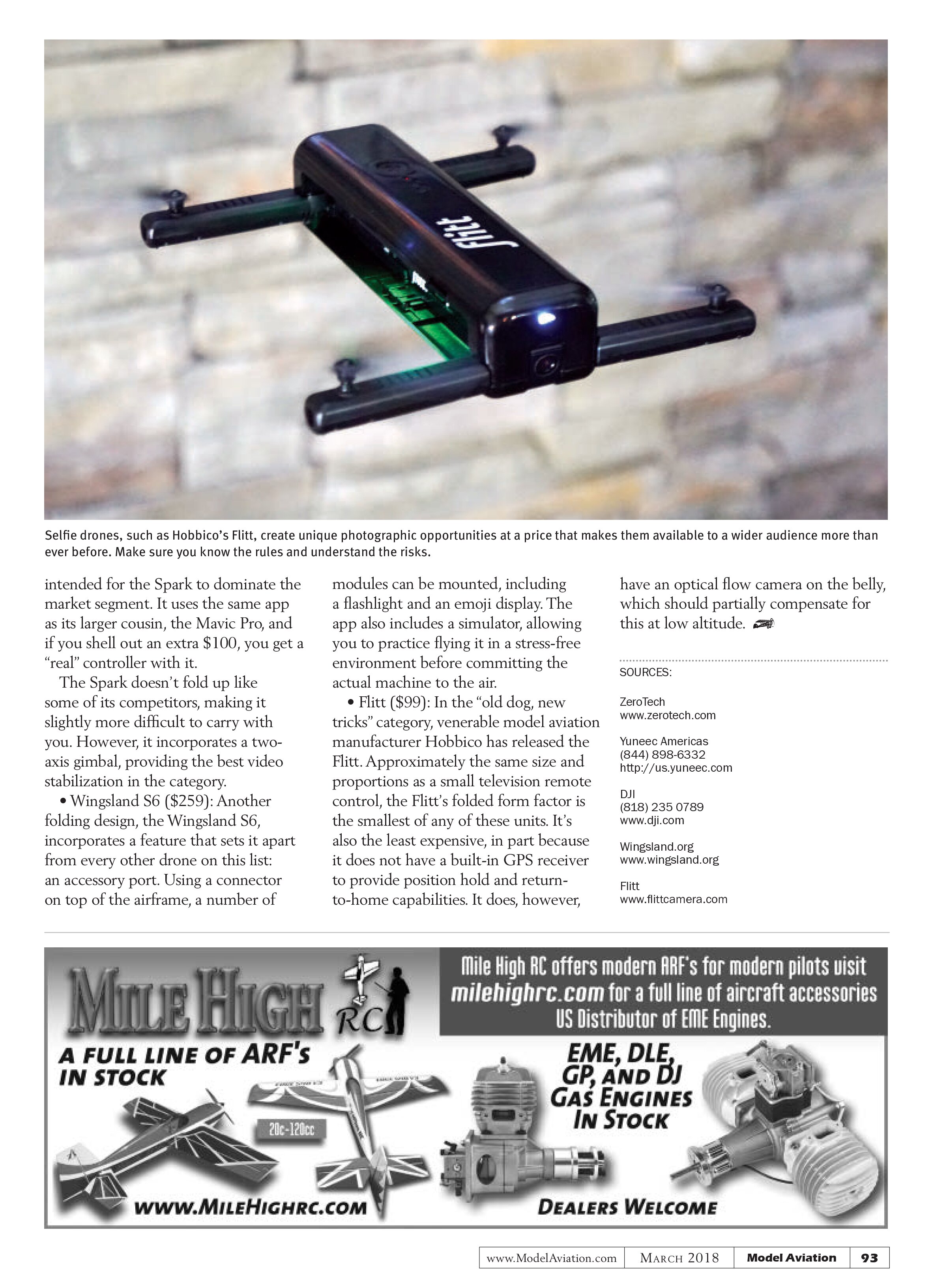
- ZeroTech Dobby ($189): In China, ZeroTech is a major drone manufacturer, producing specialized platforms to fulfill missions ranging from professional aerial photography to precision crop spraying.
- In the US, they are known almost exclusively for the Dobby. The first selfie drone to become popular, it folds up small enough to fit comfortably in your shirt pocket. For me, it stands apart from every other “phone drone” because it is actually fun to fly, delivering quick, responsive maneuvers.
- Yuneec Breeze ($199): Yuneec is better known for its larger Typhoon and Tornado aircraft, but it was also the first major manufacturer to deliver a selfie drone with the Breeze. The app is extremely refined and, delivered in time for the 2017 holiday season, Yuneec introduced a two-joystick controller, setting it apart from many of its rivals. The camera also incorporates digital-image stabilization and a one-axis gimbal, somewhat improving video stability.
- DJI Spark ($399): DJI is the worldwide leading drone manufacturer, and although the company didn’t produce the first selfie drone, it clearly intended for the Spark to dominate the market segment. It uses the same app as its larger cousin, the Mavic Pro, and if you shell out an extra $100, you get a “real” controller with it.
- The Spark doesn’t fold up like some of its competitors, making it slightly more difficult to carry with you. However, it incorporates a two-axis gimbal, providing the best video stabilization in the category.
- Wingsland S6 ($259): Another folding design, the Wingsland S6 incorporates a feature that sets it apart from every other drone on this list: an accessory port. Using a connector on top of the airframe, a number of modules can be mounted, including a flashlight and an emoji display. The app also includes a simulator, allowing you to practice flying it in a stress-free environment before committing the actual machine to the air.
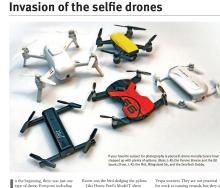
- Flitt ($99): In the “old dog, new tricks” category, venerable model aviation manufacturer Hobbico has released the Flitt. Approximately the same size and proportions as a small television remote control, the Flitt’s folded form factor is the smallest of any of these units. It’s also the least expensive, in part because it does not have a built-in GPS receiver to provide position hold and return-to-home capabilities. It does, however, have an optical flow camera on the belly, which should partially compensate for this at low altitude.
Selfie drones, such as Hobbico’s Flitt, create unique photographic opportunities at a price that makes them available to a wider audience more than ever before. Make sure you know the rules and understand the risks.
Sources:
ZeroTech
www.zerotech.com
Yuneec Americas
(844) 898-6332
http://us.yuneec.com
DJI
(818) 235 0789
www.dji.com
Wingsland.org
www.wingsland.org
Flitt
www.flittcamera.com