Stay outta my stuff
Dave Gee
safetycolumn@cs.com
I’ve met relatively few hermits who fly model aircraft. Most of us share our home with others, or at least have occasional visitors. These people are usually not modelers (despite seeing how much fun we have with our sport).
Have you given any thought to what might happen if an unsupervised nonmodeler came into contact with your hobby stuff? Some of us have rooms full of tools and equipment, but even a single airplane “fleet” includes a battery and a propeller.
Our aircraft are fascinating to many people, but those who are unfamiliar with models will often give the propeller a spin then pick the airplane up by the rudder. They have no idea about what is safe and not safe with an RC flying machine.
It’s worth an ounce of prevention to prepare your modeling gear for such exposure. Grab one of those handy electronic label printers and make it clear that this drawer is full of “sharp” or “flammable” things. Try to visualize your work area through the eyes of a fascinated, but untrained, visitor.
Unplug tools and equipment when not in use. I found my own hot-wire foam cutter sitting there, powered up and ready to burn someone or something with the touch of a button, and my inquisitive young nieces were on their way over. “Hey Uncle Dave, is this supposed to make smoke?”
Inline Skate Syndrome
I have a theory about the news media to explain the constant flow of breathless stories about drone misuse. They sometimes make it sound like drones (by which they mean FPV multirotors) threaten the very survival of humanity. Well, I think that it’s all because these machines are the latest fad gadget, and media interest is drawn to whatever is hot at the moment.
Some years back, for example, the news was full of stories about inline skating accidents, which were the current thing. The numbers were rising by the minute—a terrible crisis of broken bones and scraped knees. The funny thing is that there were no stories about a huge drop in injuries from discarded, out-of-style quad roller skates.
The same thing happened when razor scooters were hot and during the recent resurgence of skateboards. Did the total number of injuries rise, or did it just shift from obsolete to trendy wheeled toys?
I’ll bet that those same people will find themselves in the emergency room, regardless of what device is in style. Careless users will find a way to hurt themselves with anything new and cool, and cautious types will read the instructions and stay safe no matter what gadget they try.
So it is with model aircraft. Conscientious modelers take great care to operate their aircraft safely. A few trend followers will misuse whatever they get their hands on, but soon enough they’ll be drawn away to some other next big thing and we can get back to the fun of flight operations with our choice of new or old-fashioned models.
Get Down!
Mike Myers is an experienced modeler from Glendale, California. He recently participated in an online discussion about a tragic airline disaster from years ago. The flight crew knew there was trouble in the control system, but they didn’t immediately put the jet on the ground. Instead, the pilots continued to head for their destination as they tried to sort things out. The airliner flew past

several available landing fields before eventually crashing, with the loss of all onboard.
Mike wrote a comment that related the whole story to our hobby: “[This] refers to commercial aircraft. But getting the thing down safely is also imperative when you are flying an RC model and something isn’t right. CG [center of gravity] problems are the most common—rescuing a tail-heavy model aircraft is not easy.”
I’d paraphrase it as, “Don’t fool around—get it on the ground.” Many of us have seen pilots try to resolve a situation in flight when the wiser choice would have been to land and figure it out in the pit area. Losing control of a model means putting others at risk because you can no longer govern where it comes down. And it will come down!
Those “funny RC crash” DVD video companies would be out of business if
all pilots followed this advice. Over and over, they show airplanes struggling to remain airborne, or even being horsed off of the ground with problems that should have been investigated on a bench.
If you fly alone in the middle of a desert, far from civilization, then never mind. The rest of us need to be ready to act quickly when trouble appears, to protect bystanders. Land the darn thing and fix what ails it.
Turning Pro
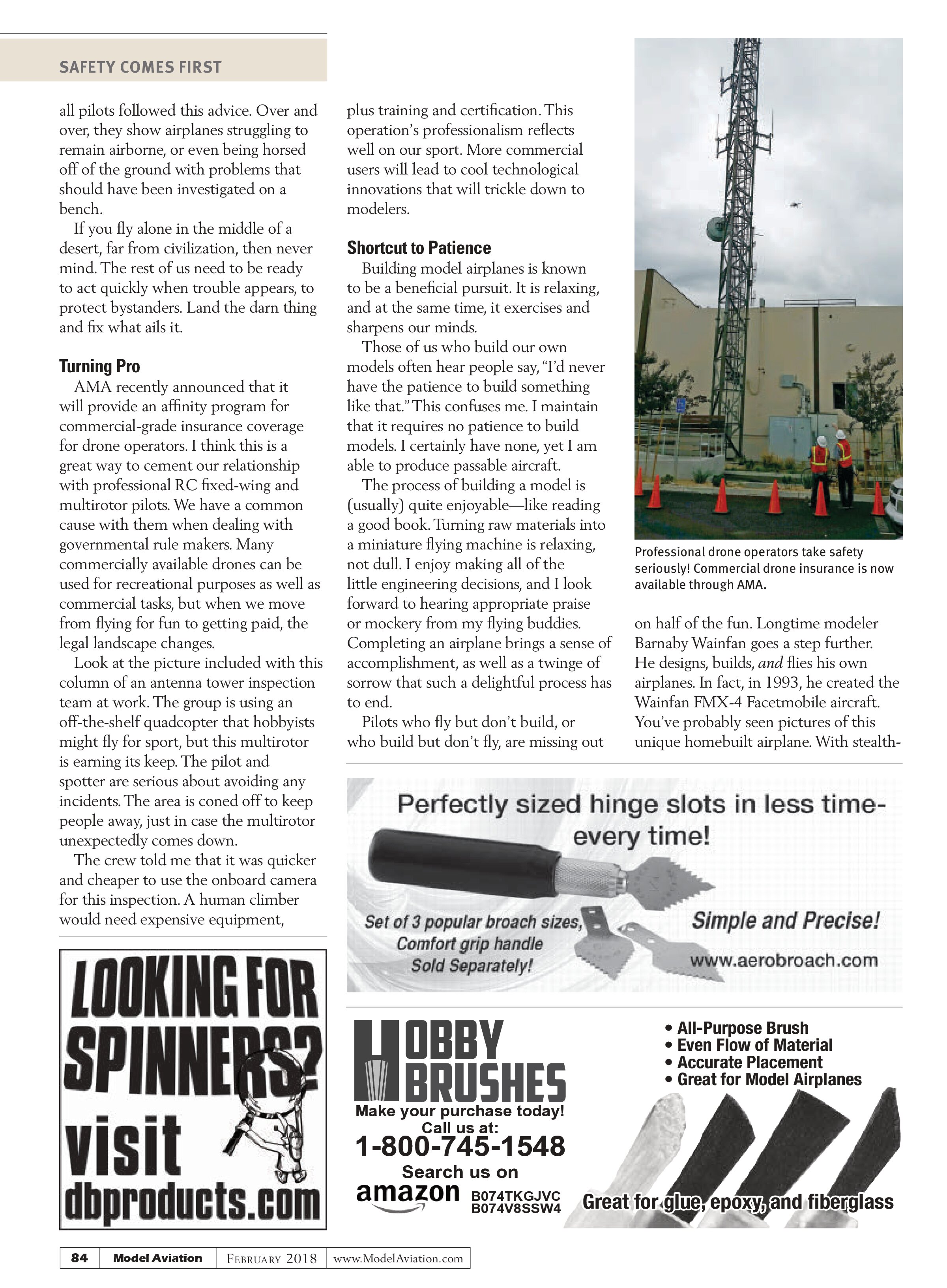
AMA recently announced that it will provide an affinity program for commercial-grade insurance coverage for drone operators. I think this is a great way to cement our relationship with professional RC fixed-wing and multirotor pilots. We have a common cause with them when dealing with governmental rule makers. Many commercially available drones can be used for recreational purposes as well as commercial tasks, but when we move from flying for fun to getting paid, the legal landscape changes.
Look at the picture included with this column of an antenna tower inspection team at work. The group is using an off-the-shelf quadcopter that hobbyists might fly for sport, but this multirotor is earning its keep. The pilot and spotter are serious about avoiding any incidents. The area is coned off to keep people away, just in case the multirotor unexpectedly comes down.
The crew told me that it was quicker and cheaper to use the onboard camera for this inspection. A human climber would need expensive equipment,

plus training and certification. This operation’s professionalism reflects well on our sport. More commercial users will lead to cool technological innovations that will trickle down to modelers.
Shortcut to Patience
Building model airplanes is known to be a beneficial pursuit. It is relaxing, and at the same time, it exercises and sharpens our minds.
Those of us who build our own models often hear people say, “I’d never have the patience to build something like that.” This confuses me. I maintain that it requires no patience to build models. I certainly have none, yet I am able to produce passable aircraft.
The process of building a model is (usually) quite enjoyable—like reading a good book. Turning raw materials into a miniature flying machine is relaxing, not dull. I enjoy making all of the little engineering decisions, and I look forward to hearing appropriate praise or mockery from my flying buddies. Completing an airplane brings a sense of accomplishment, as well as a twinge of sorrow that such a delightful process has to end.
Pilots who fly but don’t build, or who build but don’t fly, are missing out

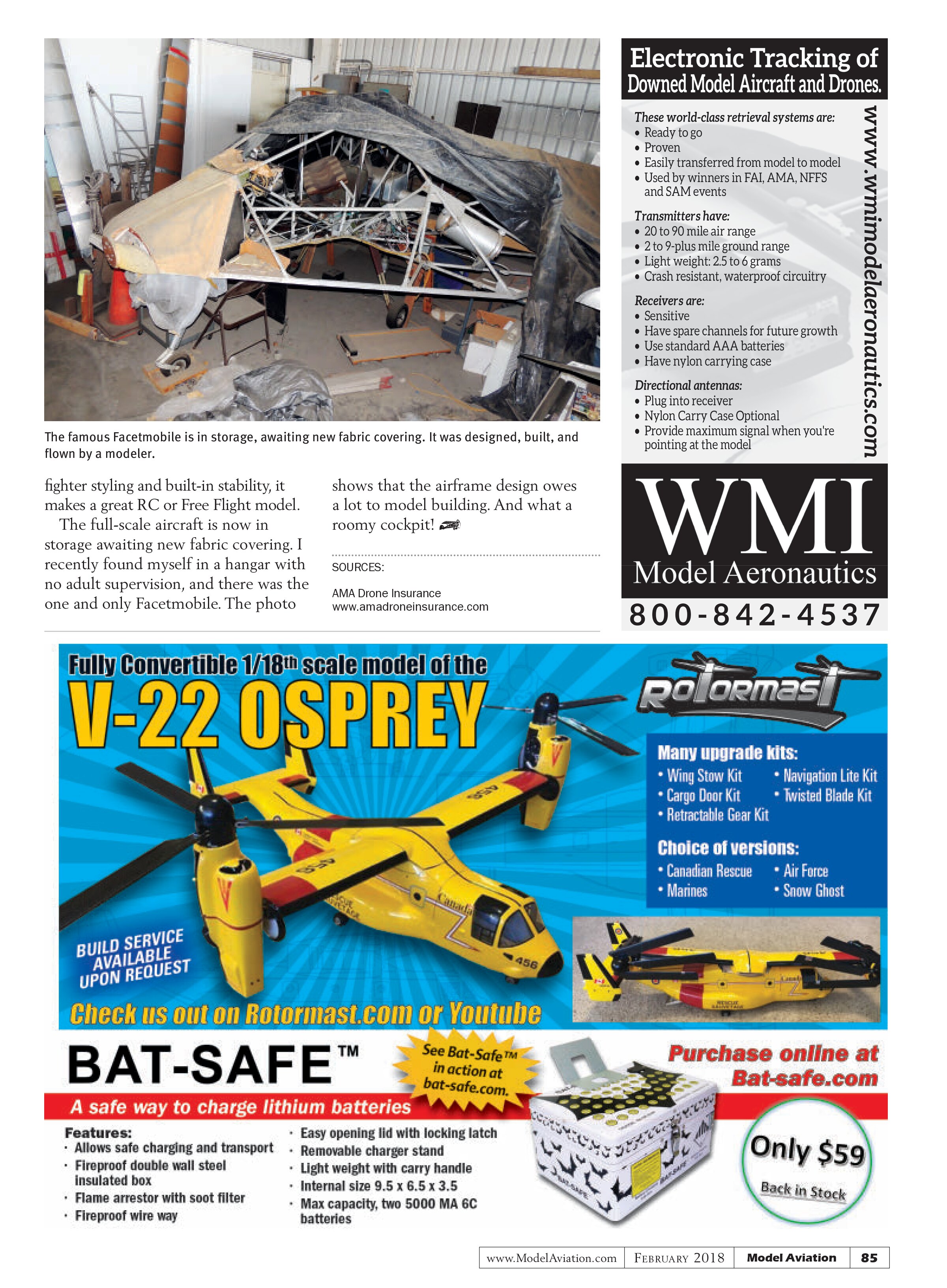
fighter styling and built-in stability, it makes a great RC or Free Flight model.
The full-scale aircraft is now in storage awaiting new fabric covering. I recently found myself in a hangar with no adult supervision, and there was the one and only Facetmobile. The photo shows that the airframe design owes a lot to model building. And what a roomy cockpit!
SOURCES:
AMA Drone Insurance
www.amadroneinsurance.com